We get commissions for bookings made through this post. Booking links, and any accommodation options shown on the page, are handled by a partner that adds commission tracking automatically. It never costs you more, and it never affects what we recommend. Affiliate disclosure
Why the Sagrada Familia Remains the World’s Most Extraordinary Basilica
No building on earth has captured the human imagination quite like the Sagrada Familia Barcelona landmark that has been under construction for more than 140 years. As the basilica approaches its long-awaited completion in 2026 with the crowning of the Tower of Jesus Christ, there has never been a more exciting moment to plan your visit. This sagrada familia guide covers everything you need to know, from securing sagrada familia tickets to understanding the profound symbolism woven into every stone.
Whether you are a first-time visitor or returning to witness the latest construction milestones, a sagrada familia visit is the single most unforgettable experience Barcelona offers. Read on for practical tips, historical context, and insider advice that will help you make the most of your time inside Antoni Gaudi’s masterpiece.
A Brief History of the Sagrada Familia: 1882 to the 2026 Milestone
The story of the sagrada familia barcelona begins not with Gaudi but with a devout bookseller named Josep Maria Bocabella, who founded the Association of Devotees of Saint Joseph and dreamed of building an expiatory temple. Construction started on March 19, 1882, under architect Francisco de Paula del Villar. When disagreements arose, the project was handed to a young, relatively unknown architect: Antoni Gaudi, who was just 31 years old.
Gaudi devoted the remaining 43 years of his life to the temple. Over the decades he radically transformed the original neo-Gothic plans into something the world had never seen: a building that fused organic geometry, Catholic symbolism, and an almost supernatural understanding of light. When Gaudi died in 1926 after being struck by a tram, only one facade, one tower, the apse, and the crypt had been completed.
Progress slowed dramatically during the Spanish Civil War, when anarchists destroyed many of Gaudi’s plaster models and drawings. Subsequent architects have painstakingly reconstructed his vision using surviving fragments, photographs, and the geometric rules Gaudi embedded into the design itself. Today, advanced 3D modelling and CNC stone-cutting technology have accelerated the pace dramatically.
The year 2026 marks a watershed. The Tower of Jesus Christ, rising to 172.5 metres and topped by a radiant cross, is set to become the tallest element of the basilica, making the sagrada familia barcelona the tallest religious structure in Europe. For the latest updates on the Sagrada Familia completion timeline, see our dedicated article.
Gaudi’s Vision: Nature as the Blueprint
To understand the sagrada familia barcelona, you must understand how Gaudi thought. He once said, “The straight line belongs to men, the curved one to God.” Every element of the basilica draws from the natural world. The interior columns branch like trees, splitting at calculated angles to distribute weight without the need for external flying buttresses. The result is a forest canopy of stone that floods the nave with filtered, coloured light.
Gaudi used catenary arches and hyperboloid surfaces, shapes he derived by hanging weighted strings upside down and studying the curves they formed. These parabolic and hyperbolic geometries are not merely aesthetic; they are structurally optimal, channelling forces directly downward and eliminating the need for the heavy buttressing that characterises Gothic cathedrals.
The symbolism is equally deliberate. The basilica has three grand facades representing the life of Christ: Birth (Nativity), Death (Passion), and Resurrection (Glory). Eighteen towers symbolise the Twelve Apostles, the Four Evangelists, the Virgin Mary, and Jesus Christ. Every number, every proportion, and every ornament carries theological meaning. If you want to explore more of Gaudi’s work across Barcelona, the basilica is the ideal starting point.
Architectural Deep-Dive: Columns, Arches, and Symbolism
Step inside the sagrada familia barcelona and the first thing you notice is the forest. Massive columns of basalt, granite, and porphyry rise from the floor and branch outward, their angles precisely calculated using Gaudi’s ruled-surface geometry. The columns are not round but polygonal: some have a star-shaped cross-section that gradually morphs as they ascend, rotating slightly with each transition. This creates a helical twisting effect that is both structurally efficient and visually mesmerising.
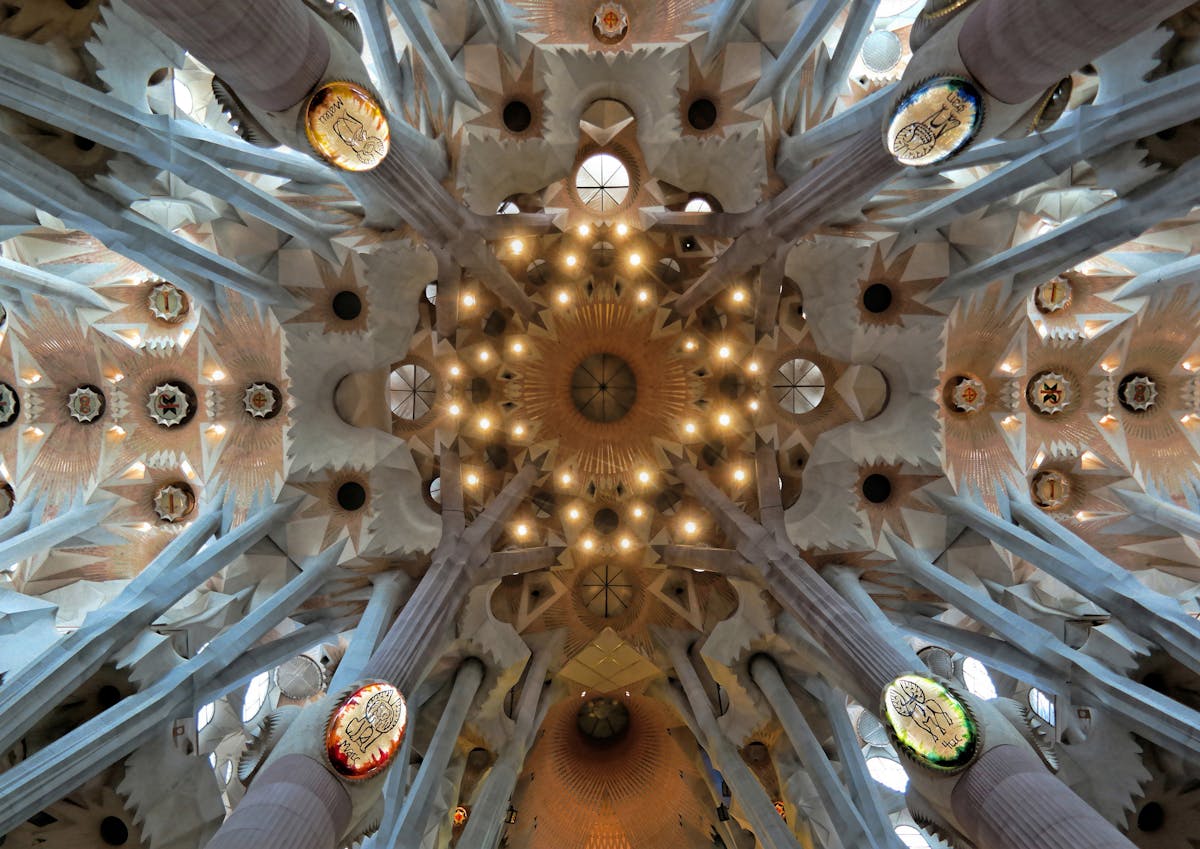
The ceiling vaults use hyperboloid and paraboloid surfaces that open into skylights, allowing natural illumination to penetrate deep into the nave. Gaudi designed these openings to function like the canopy gaps in a forest, letting shafts of light fall at specific angles depending on the time of day and season.
Look closely at the capitals and you will find carved leaves, fruits, and seeds from Mediterranean species. The floor plan itself is a Latin cross, 90 metres long and 60 metres wide, capable of seating around 9,000 worshippers. The central nave reaches a height of 45 metres, and the transept rises to 30 metres, dimensions Gaudi chose to maintain human-scale proportions despite the building’s enormous size.
For those interested in how these principles appear across Gaudi’s portfolio, our guide to Casa Batllo vs Casa Mila offers a fascinating comparison.
The Two Facades: Nativity and Passion Compared
The Nativity Facade
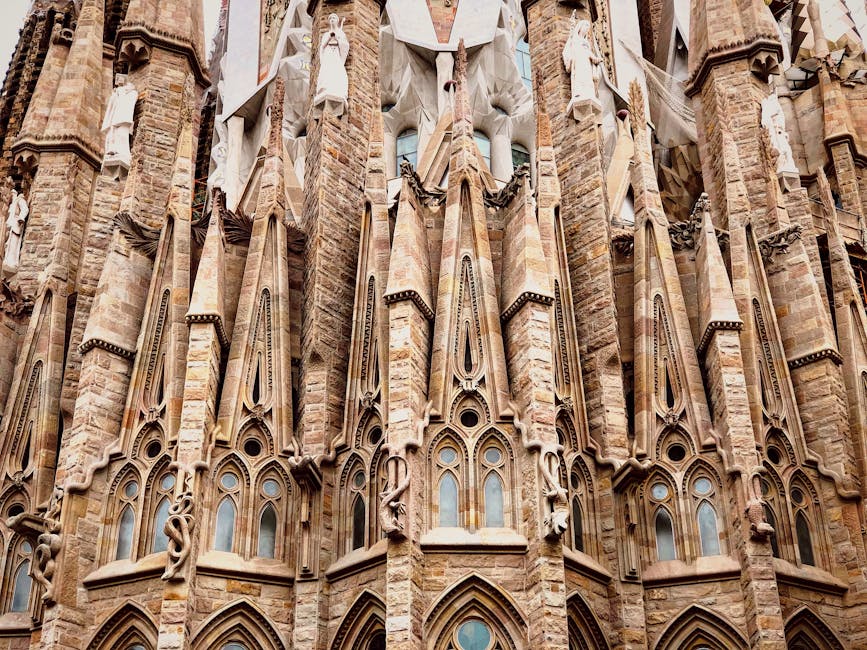
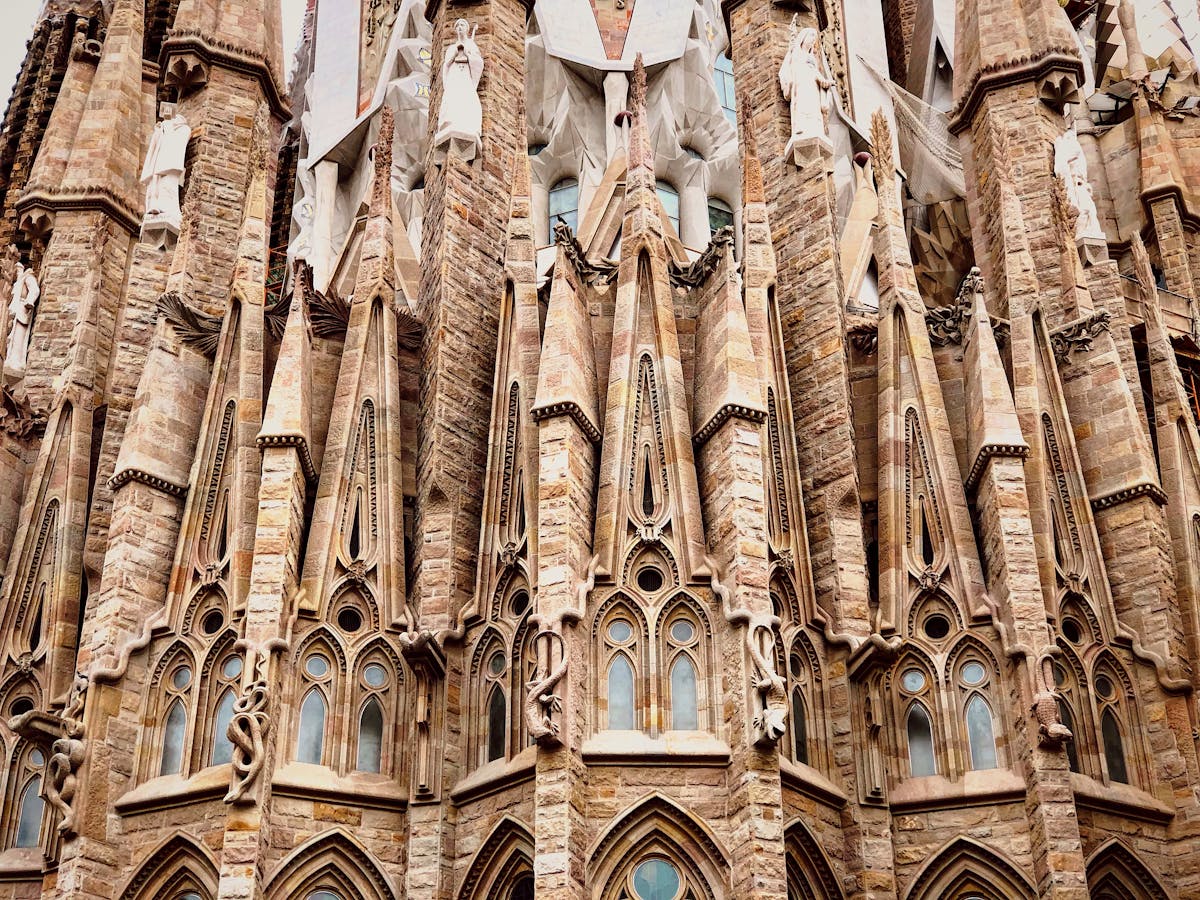
The Nativity Facade is the only one substantially completed during Gaudi’s lifetime, and it remains the most ornate surface on the entire building. Facing northeast to catch the morning sun, it celebrates the birth and early life of Jesus Christ. The facade is divided into three portals: Faith, Hope, and Charity, each teeming with sculptural detail.
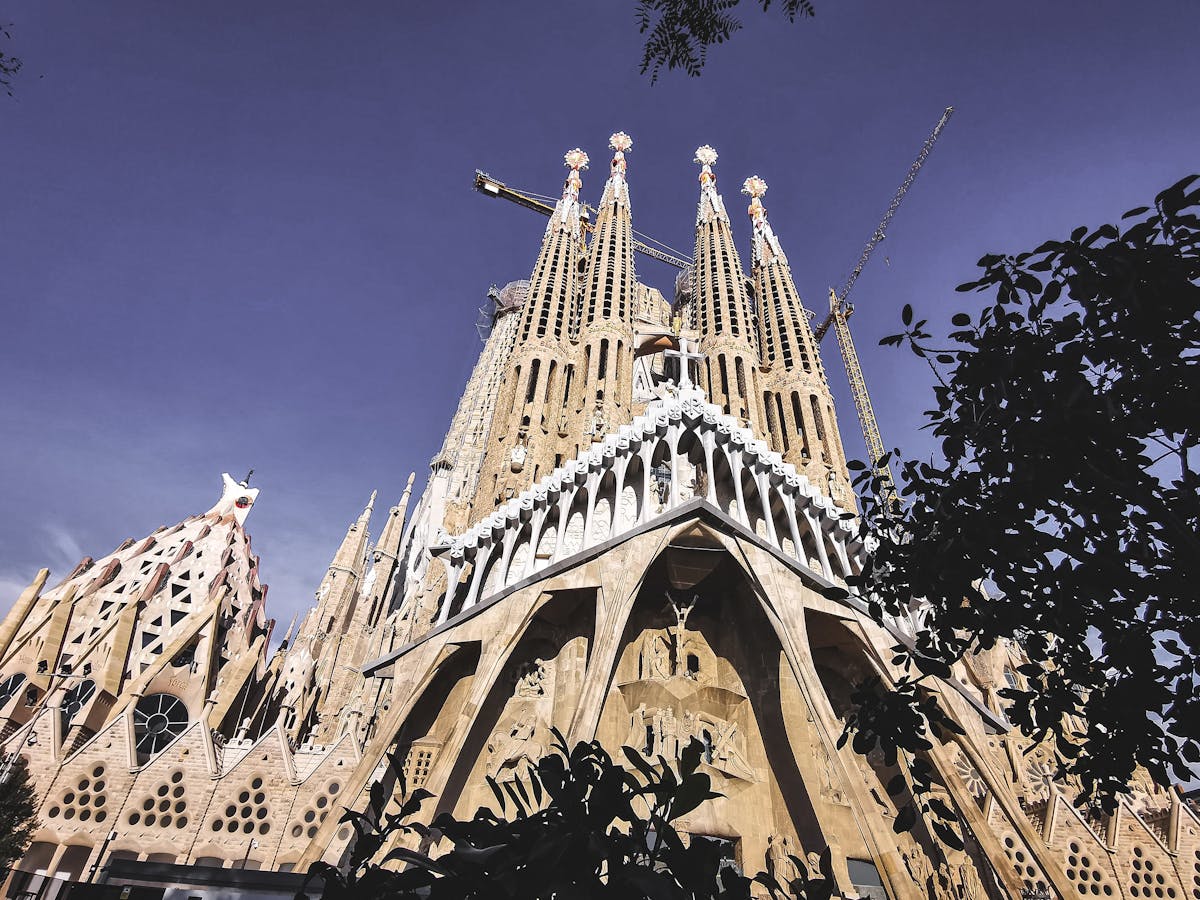
Gaudi made plaster casts from live models, real animals, and even stillborn infants to achieve anatomical accuracy. The result is an almost overwhelming abundance of life: turtles supporting columns, birds nesting among stone branches, musical angels, and the Holy Family surrounded by adoring shepherds. The Nativity Facade was designated a UNESCO World Heritage Site in 2005 as part of the “Works of Antoni Gaudi” inscription.
The Passion Facade
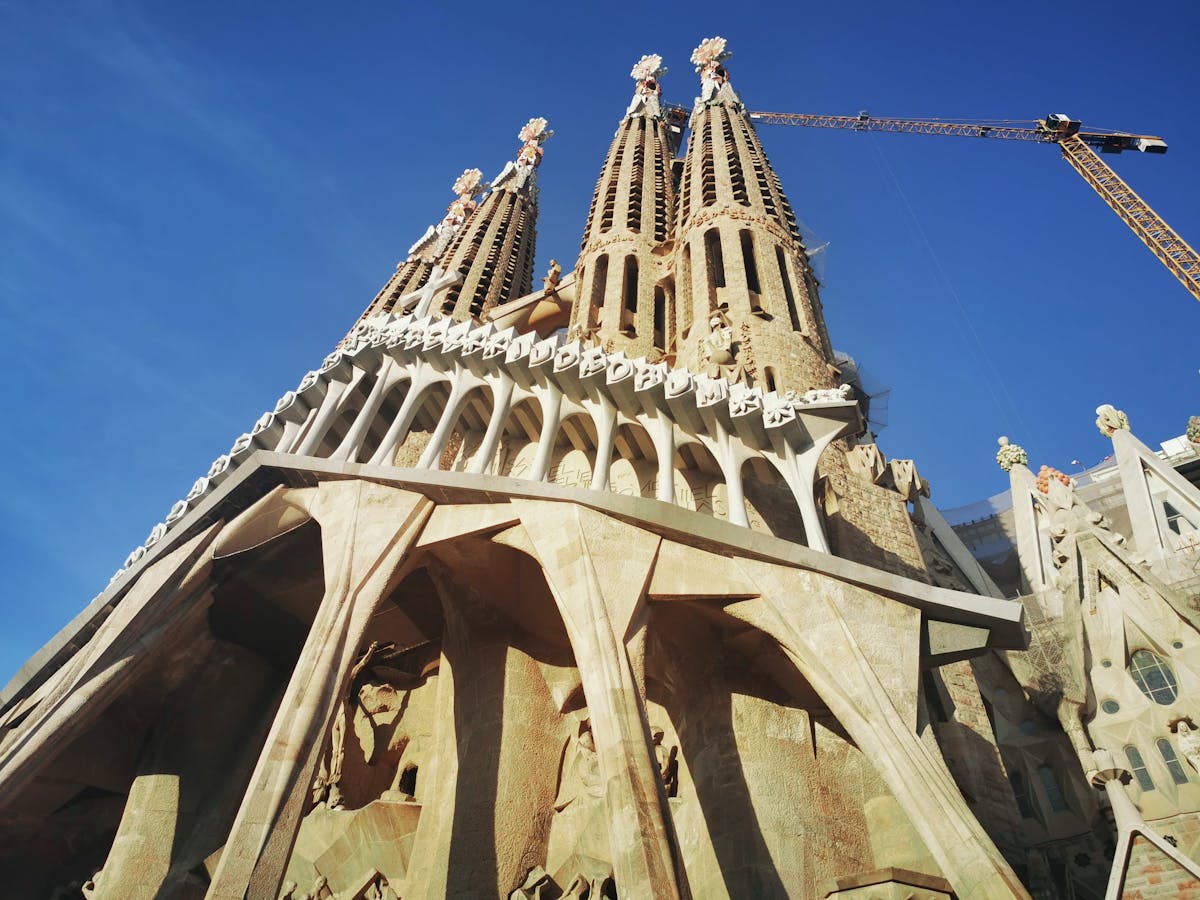
In stark contrast, the Passion Facade faces southwest and tells the story of Christ’s suffering and crucifixion. Gaudi deliberately intended this facade to be austere, angular, and stripped of ornament, meant to evoke fear and sacrifice. The sculptural work, executed by Josep Maria Subirachs beginning in 1987, uses harsh, geometric forms with flat planes and sharp edges.
The scenes read in an S-shaped sequence from bottom-left to top-right, beginning with the Last Supper and ending with the Burial. Notable details include a cryptogram (a four-by-four magic square that sums to 33, the age of Christ at crucifixion) and the soldiers whose helmets reference Gaudi’s chimney designs at Casa Mila. While the Passion Facade divides opinion, its emotional power is undeniable, and it provides the perfect counterpoint to the joyful exuberance of the Nativity side.
The Interior Light Experience: A Rainbow in Stone
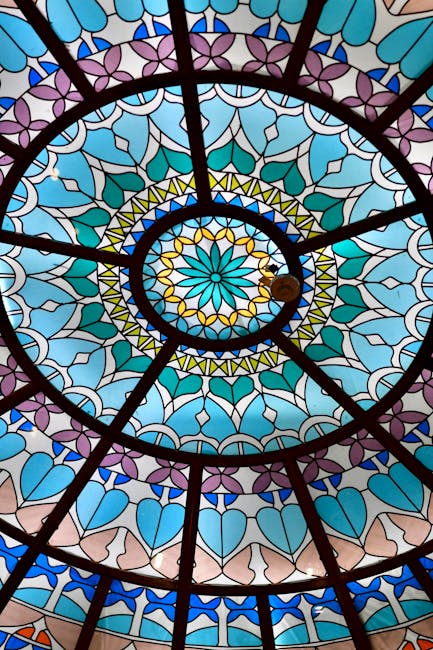
If the exterior of the sagrada familia barcelona astounds, the interior transcends. Gaudi designed the stained-glass windows to create a progression of colour from warm to cool as you move from the Nativity side (east) to the Passion side (west). Morning sunlight passes through deep reds, oranges, and golds on the eastern windows, casting a warm glow across the nave. By afternoon, the western windows pour in blues, greens, and violets.
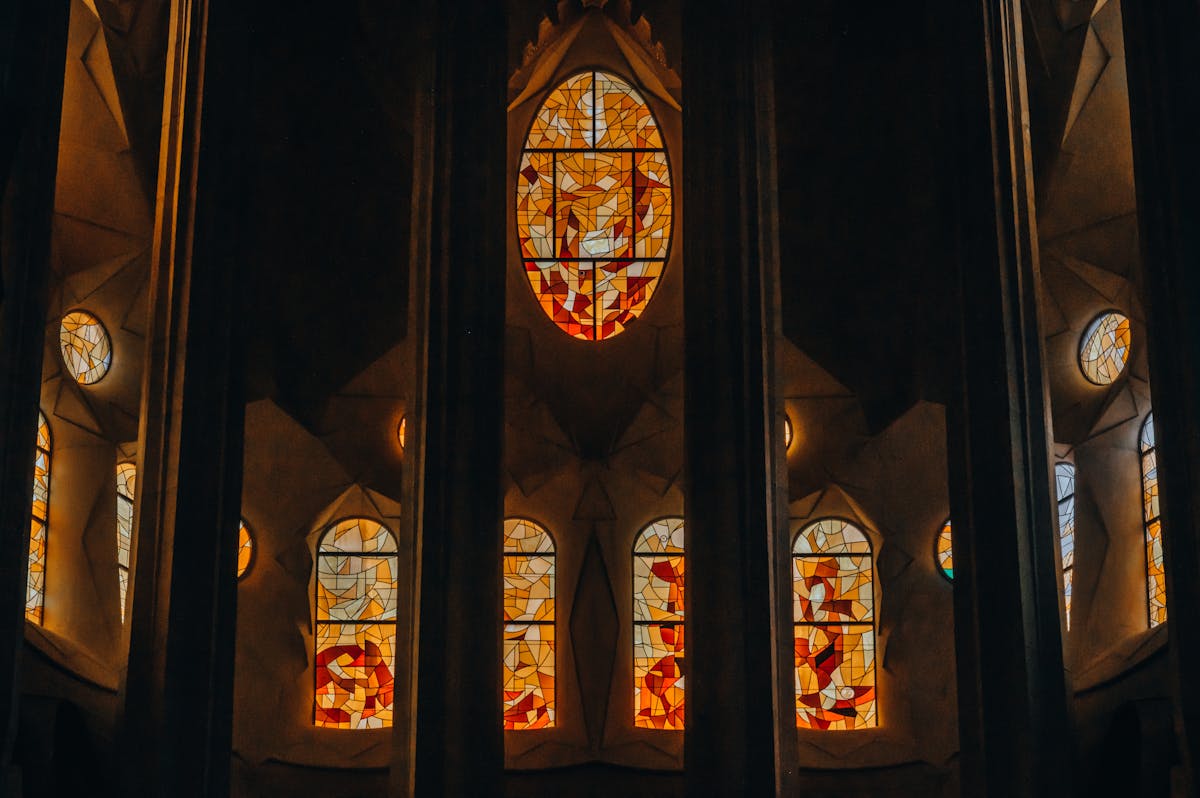
The effect is not accidental. Gaudi understood that light is as much a building material as stone or glass. On a clear day, the nave becomes a kaleidoscope: patches of emerald, ruby, and sapphire light drift across the white stone columns and floor, shifting slowly as the sun moves. Many visitors describe the experience as spiritual regardless of their beliefs, and it is one reason a sagrada familia visit is consistently rated among the top cultural experiences in the world.
For the most dramatic light show, visit between 9 and 10 in the morning or during the late afternoon when the sun is at a low angle. The interplay of light and geometry is the centrepiece of any proper sagrada familia guide.
Tower Access: Nativity Tower vs Passion Tower
Your sagrada familia tickets can include access to one of the two tower clusters. Each offers a different experience and different views, so choosing wisely matters.
Nativity Tower
The Nativity Tower faces the Eixample district and provides close-up views of the ornate carvings on the Nativity Facade. From the top, you can see across to the Mediterranean Sea, the Parc de la Ciutadella, and the grid of streets designed by Ildefons Cerda. The spiral staircase descent is narrow and steep, which is part of the thrill.
Passion Tower
The Passion Tower faces the city centre, offering views toward Montjuic, Tibidabo, and the sprawling rooftops of the Eixample. You get a different perspective on the construction work in progress and a close look at Subirachs’ angular sculptures. The descent is slightly easier than the Nativity Tower.
Both towers are accessed by lift and exited via a tight spiral staircase. People with claustrophobia, vertigo, or mobility limitations should consider carefully. Children under six are not permitted in the towers. Whichever you choose, the elevated vantage point transforms your understanding of the sagrada familia barcelona and its place within the city fabric.
Sagrada Familia Tickets: Types, Prices, and How to Book
Securing your sagrada familia tickets is the single most important logistical step. Here is what you need to know for 2026.
Ticket Types
- Basic Entry (Sagrada Familia Only): Grants access to the basilica interior and the museum in the crypt. Priced at approximately 26 EUR for adults.
- Sagrada Familia with Audioguide: Includes a multilingual audioguide (available in over 15 languages) that explains the history, symbolism, and architecture as you walk through. Around 36 EUR.
- Sagrada Familia with Tower Access: Adds entry to either the Nativity or Passion Tower. Approximately 40 EUR.
- Sagrada Familia with Guided Tour: A live expert guide leads a group through the basilica, providing in-depth commentary and answering questions. Around 50 EUR.
Children under 11 enter free. Students and seniors may qualify for reduced rates. All prices are subject to change, so always verify on the official Sagrada Familia website.
How to Book
Book exclusively through the official site at sagradafamilia.org. Third-party resellers frequently mark up prices or sell invalid tickets. During peak season (April through October), slots sell out two to eight weeks in advance, especially morning time slots and tower-access tickets. Book as early as possible, and if your preferred date is unavailable, check back regularly as cancellations do free up spots.
Your ticket includes a specific entry time. Arrive five to ten minutes early, as late arrivals may forfeit their slot. Bring a printed or digital copy of your ticket and a valid photo ID.
Best Time to Visit the Sagrada Familia
Timing can make or break your sagrada familia visit. Here are the key considerations.
- Time of Day: The first slot of the day (9:00 AM) is the least crowded and catches the spectacular eastern light through the stained glass. Late afternoon (after 4:00 PM) offers the western light effect and thinning crowds. Midday slots are the busiest.
- Day of the Week: Weekdays are generally less crowded than weekends. Tuesday and Wednesday tend to be the quietest.
- Season: November through February sees fewer tourists, though Barcelona’s mild winters still make for a pleasant visit. The Christmas and Easter weeks are exceptions.
Allow 90 to 120 minutes for a thorough visit. If you include tower access and spend time in the museum, budget closer to two hours. Rushing through the sagrada familia barcelona would mean missing the details that make it extraordinary.
What to Bring, Dress Code, and Practical Tips
A few practical details will ensure your sagrada familia visit goes smoothly.
Dress Code
The Sagrada Familia is an active Catholic basilica, and a modest dress code is enforced. Shoulders must be covered. Shorts and skirts should reach at least mid-thigh. Transparent clothing is not permitted. Security staff may deny entry to visitors who do not comply, so carry a light scarf or cardigan in warmer months.
What to Bring
- Comfortable shoes: The interior is vast, and if you are climbing a tower, you will descend several hundred steps on a tight spiral staircase.
- Camera or smartphone: Photography (without flash or tripods) is permitted inside the basilica. The light effects are highly photogenic.
- Water: Small water bottles are allowed. Stay hydrated, especially in summer.
- Sunscreen and hat: You will likely queue briefly outside, and the Barcelona sun is strong from May to September.
- Ticket and ID: Digital or printed ticket plus a valid photo identification document.
Audioguide and the Crypt Museum
The audioguide is worthwhile for first-time visitors. It lasts roughly 45 minutes and covers the major features, facades, and Gaudi’s design philosophy. For a deeper experience, consider a guided tour with a licensed expert, available through the official site or through reputable Barcelona architecture tour operators.
Do not skip the museum located in the crypt beneath the nave. It houses original plaster models, architectural drawings, and photographs documenting the construction process from the 1880s to the present day. You can also view Gaudi’s tomb through a small window; he is buried in the Chapel of Our Lady of Mount Carmel in the crypt. The museum is included with all ticket types and adds about 20 to 30 minutes to your visit.
Nearby Attractions: Making the Most of Your Day
The sagrada familia barcelona sits in the Eixample district, surrounded by excellent dining, shopping, and culture. After your visit, consider the following.
- Hospital de la Santa Creu i Sant Pau: A stunning Modernista complex by Lluis Domenech i Montaner, located just a 10-minute walk up Avinguda de Gaudi. The tree-lined avenue connecting the two landmarks is a lovely stroll.
- Park Guell: Another Gaudi masterpiece, about 25 minutes by bus or metro. Our Park Guell guide has everything you need to plan a seamless visit.
- Eixample District Exploration: The surrounding blocks are full of Modernista architecture, local tapas bars, and boutique shops. The Mercat de la Sagrada Familia, a neighbourhood food market, is just a few streets away.
If you are building a multi-day itinerary, our 3-day Barcelona itinerary integrates the sagrada familia barcelona with other essential sights for an efficient and memorable trip.
Frequently Asked Questions
Is the Sagrada Familia finished?
Not yet, but it is closer than ever. The Tower of Jesus Christ is the centrepiece of the 2026 completion milestone, though finishing touches on the Glory Facade and various decorative elements will continue beyond that date. Even in its current state, the basilica is fully open for worship and tourism, and many argue that witnessing the final stages of construction is part of the magic. For detailed projections, see our article on the Sagrada Familia completion timeline.
Can I attend Mass at the Sagrada Familia?
Yes. Mass is held on Sundays and certain holy days. It is open to the public and free of charge, but seating is limited and doors open early. Check the Sagrada Familia Wikipedia page or the official website for current schedules.
Are there lockers or bag storage?
Small bags and backpacks are permitted, but large luggage is not allowed inside. There are no lockers on-site, so plan accordingly. Leave large items at your hotel or use a luggage storage service nearby.
Is the Sagrada Familia accessible for wheelchair users?
The main basilica floor is fully accessible, including the museum. However, the towers are not wheelchair accessible due to the narrow spiral staircases. Wheelchair users and visitors with limited mobility can still enjoy the extraordinary interior and crypt without limitation.
Final Thoughts: A Building Like No Other
The sagrada familia barcelona is not merely a building or even a basilica. It is a living testament to one man’s belief that architecture could capture the divine, and to the generations of artisans, engineers, and believers who have carried that vision forward for nearly a century and a half. The 2026 milestone, with the Tower of Jesus Christ reaching its full height, brings Gaudi’s dream tantalisingly close to reality.
Whether you are drawn by faith, by art, by architecture, or simply by curiosity, a sagrada familia visit will leave a lasting impression. Use this sagrada familia guide to plan wisely: book your sagrada familia tickets early, arrive at the right time, and give yourself the full 90 to 120 minutes the experience deserves. There is nothing else like it anywhere in the world.