La Merce: The Festival That Is Barcelona’s Heart on Display
For five days every September, Barcelona stops being a city and becomes a stage. Streets fill with 50-metre human towers, fire-breathing devils chase crowds down the Via Laietana, papier-mache giants weighing more than a small car waltz across medieval squares, and the night sky over the Magic Fountain explodes in choreographed fireworks set to live music. This is la merce barcelona, the city’s patron-saint festival and one of Europe’s great cultural spectacles. It is free, it is loud, it is utterly Catalan, and missing it when you are in town in late September is one of those mistakes you regret for years.
This guide to the la merce festival covers everything you need to plan a visit: the dates and the overall arc of the programme, the must-see traditions, where exactly to stand for each event, the food and music programme, the smart logistical moves for getting around without losing your sanity, and the small etiquette rules that separate respectful visitors from accidental nuisances. Whether you are a first-timer or a returning visitor wanting to dig deeper into what was once the largest barcelona patron saint festival in the Catalan calendar, you will find a complete plan here.
A Brief History: 150 Years of Barcelona’s Biggest Party
Saint Mary of Mercy (Mare de Deu de la Merce) became Barcelona’s official patroness on 25 September 1687, after the city’s leaders credited her intercession with ending a plague of locusts. The first formal festivities were held the following year, but the modern la merce festival as we know it dates to 1871, when the city council combined the religious feast with civic celebrations. The festival was modernised again in 1902 and given a final overhaul in 1976, when post-Franco Barcelona embraced La Merce as a symbol of restored Catalan identity.
What you see today is a layered tradition: deeply Catholic in origin, profoundly Catalan in cultural expression, and increasingly cosmopolitan in its programming. Recent editions have added concerts by international musicians, large-scale street art, and partnerships with guest cities (a different “convidada” each year contributes its own street performance and gastronomy). The 2026 edition is particularly significant, coinciding with Barcelona’s designation as World Capital of Architecture and the centenary of Antoni Gaudi’s death.
When Is La Merce 2026?
La Merce 2026 runs from Friday 18 September to Thursday 24 September 2026, with the headline events concentrated between Saturday 19 and Wednesday 23 September. The day of the patron saint herself, 24 September, is a public holiday in Barcelona, so museums, banks, and many shops are closed. Plan accordingly: book restaurants ahead, expect public transport to run on Sunday schedules, and be ready for crowds.
The full schedule is published by the Barcelona City Council in early September each year on the official La Merce website. Major events have set traditional times (the Castellers happen on the Sunday morning, the Piromusical fires the closing salvo on Wednesday night), but smaller concerts and parades shift slightly from edition to edition.
The Six Signature Events You Must See
1. The Castellers (Human Towers)
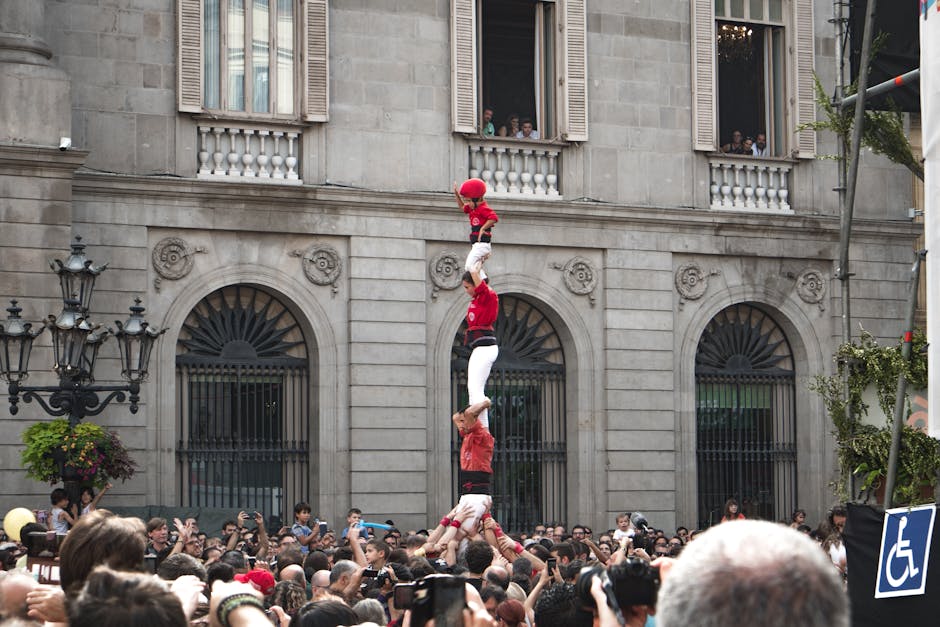
The castellers are the single most iconic image of La Merce. Sunday morning, the city’s top human-tower teams (collas) gather in Placa Sant Jaume in front of City Hall, dressed in their signature striped shirts and white trousers, and proceed to build trembling structures of nine, sometimes ten levels. Children no older than seven scramble up the swaying tower, the smallest one (the enxaneta) raising one hand to signal completion. The crowd holds its breath, then erupts.
The competition pits the city’s strongest collas (Castellers de Barcelona, Castellers de la Vila de Gracia, Castellers de Sants, Castellers del Poble Sec) against each other in formal rotation. Each tower is dismantled live in front of the audience, which is the most dangerous moment. Falls do happen, but injuries are surprisingly rare due to the dense base of supporting bodies (the pinya).
Where: Placa Sant Jaume, in front of the City Hall.
When: Sunday of the festival weekend, 11:00 AM to about 2:00 PM.
Tip: Arrive by 10:00 AM to find a spot with a sightline. Cafe terraces around the square are reserved or full by 9:30 AM. The first row of crowd packs in tight; the second and third rows are more comfortable but obstruct your view of the bottom of the tower.
2. The Correfoc (Fire Run)
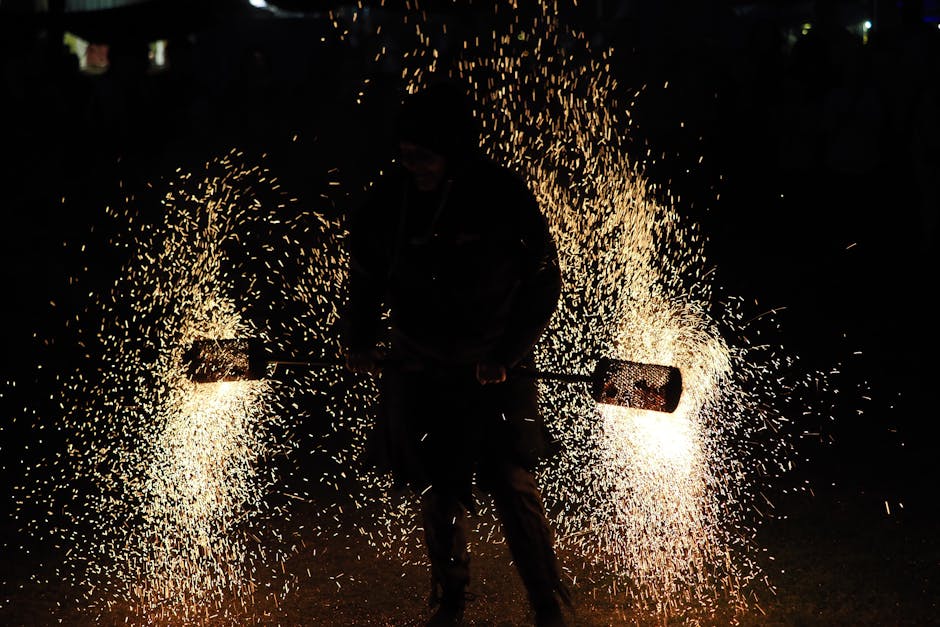
If you only watch one Catalan tradition in your life, make it the correfoc. Hundreds of devils dressed in horned costumes, brandishing pitchforks loaded with spinning fireworks, race through the streets while drumming groups (timbalers) thunder behind them. The whole spectacle is accompanied by the rhythmic, primal beat of the Catalan dragon dance, and the smell of gunpowder fills the air for blocks.
The route on the final night moves through the Old City, traditionally beginning at Placa Sant Jaume, snaking through the Gothic Quarter and El Born, and ending at the Parc de la Ciutadella. Spectators are encouraged to “dance” alongside (not in front of) the devils, dodging falling sparks while the rest of the crowd cheers. Some of the most experienced revellers come dressed in long-sleeved cotton clothing, hats, and even goggles to safely engage with the sparks at close range.
Where: Routes vary; the main correfoc usually starts in Placa Sant Jaume and ends at Parc de la Ciutadella.
When: Saturday or Sunday night, around 10:00 PM until midnight.
Tip: Wear cotton (synthetic fabrics melt), close-toed shoes, and a hat. Cover your hair, watch the path closely, and never block the route. If you want to hang back, position yourself at the start or end of the route where the procession is slower and less chaotic.
3. The Giants and Big Heads (Gegants i Capgrossos)
Centuries before Disney, Barcelona’s neighborhoods built their own folkloric celebrities: 4-metre-tall papier-mache giants and oversized comic heads worn by costumed dancers. The Gegants i Capgrossos parade winds through the city dressed in elaborate medieval royal costumes, dancing slowly to the tune of the gralla (a traditional Catalan double-reed instrument). Many of the giants represent specific historical figures or local legends; some are over 100 years old.
The giants gather in Placa Sant Jaume for the formal opening ceremony, then disperse in waves to neighbourhoods across the city. A full census of giants from across Catalonia and beyond joins the parade, sometimes 100 figures strong.
Where: Placa Sant Jaume opening; routes through the Gothic Quarter and Eixample.
When: Saturday and Sunday morning of the festival weekend.
Tip: The procession is family-friendly and the slower-paced of the festival’s main events. Children usually love it. Dress for warmth in case of an early-morning chill.
4. The Piromusical (Music and Fireworks Closing Show)
The festival closes with a half-hour fireworks-and-music show synchronised to the Magic Fountain of Montjuic. The Piromusical is a legitimate Barcelona spectacle: the National Art Museum (MNAC) glows in the background, the fountain dances in coloured water, and the sky above Avinguda Maria Cristina explodes in synchronised pyrotechnics. The music programme typically blends classical pieces with Catalan rumba, modern pop, and rock anthems, ending with a triumphant final salvo.
This is the festival’s emotional crescendo, the moment when locals stop joking and stand silently with tears in their eyes. Barcelona is famously a city that takes its civic identity seriously, and the Piromusical reminds you why.
Where: Plaza Espanya, looking up Avinguda Maria Cristina to the National Art Museum.
When: Wednesday 23 September 2026, around 10:00 PM.
Tip: Arrive by 8:30 PM to claim a spot. Bring a small folding cushion. The metro is your only realistic way in and out (L1 or L3 to Espanya).
5. The Tronada and Toc d’Inici (Opening Ceremony)
The festival officially opens with the Tronada, a thunderous gunpowder display in Placa Sant Jaume. A line of devils light a chain of firecrackers that runs along a low wire over the heads of the crowd, ending in a deafening blast that signals “the festival has begun”. This is followed by the Toc d’Inici, where the Mayor reads a proclamation from the City Hall balcony and ceremonial colours are raised.
The Tronada lasts only minutes but is an essential moment of festival ritual.
Where: Placa Sant Jaume.
When: Friday evening, around 8:00 PM.
6. The Mostra d’Associacions (Civic Associations Fair)
Slightly more low-key but lovely: the Mostra d’Associacions brings together hundreds of Barcelona civic associations (sports clubs, neighbourhood committees, advocacy groups, gastronomic societies) at booths in the Parc de la Ciutadella for two days. It is a free, open-air glimpse into the social fabric that holds Barcelona together. Children’s activities, food stalls, and live music run simultaneously.
Where: Parc de la Ciutadella.
When: Saturday and Sunday of the festival weekend, 11:00 AM to 9:00 PM.
Music Programming: BAM and Concerts Across the City
Music is central to La Merce. Two parallel programmes run alongside the traditional events: the Festival Internacional Asia, which brings Asian music and dance to Catalonia each year, and the celebrated BAM (Barcelona Accio Musical), an alternative music festival booked free in plazas across the city.
BAM features Catalan, Spanish, and international bands across genres: electronic, indie rock, hip-hop, world music, and Catalan folk fusion. Stages typically pop up in Placa Reial, Placa de Sant Pere, Pla del Palau, and Plaza Catalunya. All concerts are free.
The main music venues during La Merce are:
- Avinguda Maria Cristina: Headliner stage; large international acts and the Piromusical.
- Plaza Catalunya: Major free pop/rock concerts.
- Parc de la Ciutadella: Family-oriented programming and the Mostra d’Associacions.
- Placa Reial: Late-night club-style sets.
- Multiple smaller plazas: Folk, classical, and experimental sets.
If you are a music fan, plan one full evening to follow BAM from venue to venue with a notebook of your favourite acts. Catalan rumba bands like Pau Riba and electronic acts like John Talabot have been past headliners.
Special Events for La Merce 2026
The 2026 edition includes special programming tied to two anniversaries:
- World Capital of Architecture (UIA-UNESCO): Barcelona holds this title in 2026, and several La Merce events incorporate architectural illuminations, talks, and installations across the Eixample.
- Gaudi Centenary: 2026 marks 100 years since Antoni Gaudi’s death. Expect special light shows on Casa Batllo, Casa Mila, and the Sagrada Familia, plus a dedicated Gaudi route through the Eixample.
The Pyrotechnics Festival (Piromusical Internacional) and Fountain Show may also include extended runs leading up to the closing on 23 September.
Where to Stay During La Merce
Hotels book up fast, particularly in the Old City and Eixample. The best neighbourhoods to base yourself for La Merce access are:
- Gothic Quarter and El Born: Steps from Placa Sant Jaume, the heart of all major events. The lively trade-off is street noise late into the night.
- Eixample (Esquerra/Dreta): 15-minute walks to the Old City, plus easy metro access to Plaza Espanya for the Piromusical. Quieter at night.
- Poble Sec: Walking distance to the Magic Fountain and Avinguda Maria Cristina; an excellent food and tapas neighbourhood for late-night meals.
Book at least 4 to 6 weeks ahead for late September dates, and 8 to 12 weeks ahead if you have specific hotel preferences. Apartments via Vrbo or local agencies often have better value than hotels, particularly for groups.
Food and Drink: La Merce Beyond the Spectacle
Barcelona shows up at the table during La Merce. The city’s neighbourhood restaurants run festive menus, the markets stay extra busy, and a parallel “Vins de la Merce” wine fair runs in the Pati de la Caritat behind the Cathedral, with tastings and tapas from Catalan vineyards.
Festival-Themed Food
- Coca de Sant Joan: An iconic Catalan flatbread topped with candied fruit and pine nuts; though traditionally served at Sant Joan in June, bakeries make special La Merce versions.
- Cremat de la Merce: A blue-flamed rum drink shared at communal pots in some neighbourhood bars during the festival.
- Calçots: Out of season in September, but charcoal-grilled spring onions sometimes appear at street food stalls.
- Esmorzar de forquilla: The traditional working-man’s “fork breakfast” of stews and offal, served extra strong in Old City bars during festival mornings.
Where to Eat Smart During the Festival
- Reserve dinner well ahead in the Old City and Eixample. Walk-ins after 9:00 PM are nearly impossible.
- Lunch is easier; most kitchens serve from 1:00 to 4:00 PM and again from 8:00 PM.
- Try a more local neighbourhood like Sant Antoni, Poble Sec, or Sants for festive set menus at lower prices.
- The city’s best tapas bars run small variations on their menus during the festival; book ahead.
Getting Around During La Merce
The city’s metro and bus system shifts to extra-frequent service during festival nights, and special late metros run on Friday, Saturday, and the closing Wednesday until at least 2:00 AM. The Barcelona metro stays open 24 hours from Saturday morning through Sunday close as standard.
Taxis and ride-shares get expensive and slow. Avoid cars during major events; the Old City is closed to traffic, and main avenues like Via Laietana are blocked for processions.
The most useful metro stops during La Merce:
- L4 Jaume I: 2-minute walk to Placa Sant Jaume.
- L1/L3 Catalunya: Plaza Catalunya stage and a 5-minute walk to the Cathedral.
- L1/L3/L8 Espanya: Piromusical and Avinguda Maria Cristina concert stage.
- L4 Ciutadella Vila Olimpica: Parc de la Ciutadella for the Mostra d’Associacions.
- L4 Drassanes: Old Port and Las Ramblas processions.
For a complete transit overview, see our Barcelona metro guide.
Etiquette and Practical Tips
- Dress in cotton for the correfoc. Synthetic fabrics melt; long sleeves and trousers protect against sparks.
- Photograph respectfully. No flash during the castellers’ final climb. Avoid using a flash near sparking devils.
- Stay back from the cordons. Police barriers are real safety lines.
- Pickpockets work the festival hard. Crowded events on Las Ramblas and Placa Sant Jaume are favourite hunting grounds. Use zipped pockets and secure bags.
- Hydrate and pace yourself. Barcelona September is still warm; carry a water bottle.
- Bring small cash. Plenty of food vendors are cash-only.
- Catalan phrases help. “Bona Merce” (“Good Merce”) goes a long way at any street stall.
- Mind public-holiday closures. The 24th is a holiday; museums, banks, and many shops shut.
- Sit-down, then move. Watch one event in full, then walk to the next venue. Trying to chase three at once gets exhausting.
- Listen to the locals. If a local stops watching the correfoc and walks away, follow them; they may know about a falling beam, a windshift, or a dangerous corner ahead.
A Sample 4-Day La Merce Itinerary
Day 1 (Friday 18 September): Arrive and Open
- Late afternoon: arrive in Barcelona, check in, light dinner.
- 8:00 PM: Tronada (opening fireworks) at Placa Sant Jaume.
- 10:00 PM: Catch a free BAM concert at Plaza Reial or Plaza Catalunya.
Day 2 (Saturday 19 September): Giants and Music
- Morning: Gegants parade through the Gothic Quarter.
- Afternoon: Mostra d’Associacions in Parc de la Ciutadella.
- Evening: Major BAM concerts in multiple venues; one big stage near Avinguda Maria Cristina.
- Late night: Correfoc through the Old City to Parc de la Ciutadella.
Day 3 (Sunday 20 September): Castellers and Long Lunch
- 10:00 AM: Stake out a spot in Placa Sant Jaume.
- 11:00 AM to 2:00 PM: Castellers competition.
- 2:30 PM: Long lunch at a Catalan restaurant; recover.
- Evening: Family activities at Parc de la Ciutadella; smaller BAM stages.
Day 4 (Wednesday 23 September): Closing Piromusical
- Daytime: Visit a museum (the Sagrada Familia or Picasso Museum) or take a long lunch.
- Evening: Dinner near Plaza Espanya by 7:30 PM.
- 10:00 PM: Piromusical closing fireworks at the Magic Fountain.
- 11:00 PM: Late drinks back in Eixample or El Born.
Who Should Visit La Merce?
- Culture lovers: Yes, absolutely. There is no better window into authentic Catalan tradition.
- Music fans: Yes. BAM is one of Europe’s best free festivals.
- Families with older children: Yes. Giants and the Magic Fountain are kid-friendly. Skip the correfoc with under-10s.
- Families with young children: Be selective. The crowds during castellers and correfoc are overwhelming for under-6s.
- Anyone afraid of fireworks or close-pyrotechnic events: Skip the correfoc; enjoy the Piromusical from afar.
- Quiet-trip seekers: Visit Barcelona at another time. La Merce is loud, late, and crowded.
La Merce vs. Other Catalan Festivals
Barcelona has many festivals, but La Merce is the largest and the only one that involves the entire city. For comparison:
- Sant Jordi (23 April): Day of love and books; gentler and more poetic.
- Sant Joan (23-24 June): Midsummer night beach bonfires and fireworks across the city.
- Festa Major de Gracia (mid-August): Streets of the Gracia neighbourhood are decorated like fairy tales for one week. Smaller-scale and walkable.
- La Diada (11 September): National day of Catalonia; political marches and quieter civic ceremonies.
- La Merce (mid-late September): The biggest of them all.
For more detail on the calendar, see our Barcelona events and festivals pillar.
Frequently Asked Questions
Is La Merce free?
Yes. Almost every event is free and open to the public. The wine fair has tasting tickets (5 to 10 EUR per glass), and some smaller indoor concerts may have nominal cover charges, but the major events are free.
What dates is La Merce 2026?
Friday 18 September to Thursday 24 September 2026, with the headline events between Saturday 19 and Wednesday 23 September.
Is the correfoc safe?
Yes, if you wear cotton long sleeves, close-toed shoes, a hat, and follow the marshals’ instructions. Stay out of the cordoned route unless you are dressed appropriately and ready to dance with sparks.
Can children attend?
Yes for the giants parade, the Magic Fountain show, the Mostra d’Associacions, and many BAM concerts. The castellers are family-friendly though crowded. The correfoc is generally not recommended for under-10s due to noise, sparks, and density.
Where is the best place to watch the castellers?
Placa Sant Jaume, ideally on the Pla de la Generalitat side closest to the city hall balcony. Arrive by 10:00 AM to claim a spot.
Are the dates fixed every year?
The festival always runs over the days leading up to and on 24 September, the feast of La Merce. Specific opening and closing days vary slightly based on which days fall closest to the saint day.
Are restaurants open during the festival?
Yes, but reservations are essential, especially in the Old City. Plan dinner ahead. Lunchtime is more flexible.
Is La Merce better in odd or even years?
The basic programme stays consistent. Special-edition years (anniversaries, Olympic-style milestones, the 2026 architecture year) add larger international elements.
Can I visit during La Merce without joining the crowds?
Yes. Many museums, parks, and beaches stay open as usual. You can dip into one or two festival events and otherwise enjoy a normal Barcelona visit.
What should I avoid during the festival?
Avoid driving in the Old City. Avoid wearing synthetic fabrics during the correfoc. Avoid carrying valuables in unzipped pockets. Avoid trying to photograph the entire festival; pick events and watch them properly.
Final Thoughts: The Soul of Barcelona Visible
The la merce festival is the rare cultural event that lives up to its reputation in every way. The traditions are old enough to feel ancient, vivid enough to feel alive, and so embedded in the city’s identity that locals will travel from abroad to be home for the long weekend. If your trip falls in mid- to late September 2026, build the dates of the festival around your itinerary; if not, plan a future trip with La Merce in mind.
To dig into the rest of Barcelona’s calendar, see our complete events and festivals pillar, our Sant Jordi guide, and our Festa Major de Gracia article. To plan the rest of your visit, the Barcelona travel guide covers practical logistics and the 3-day itinerary can wrap around the festival weekend nicely.