Barcelona’s skyline belongs to one man—Antoni Gaudí—whose visionary designs transformed a thriving Catalan city into the world’s most distinctive architectural destination. When you wander through Barcelona’s streets, you’re not just seeing buildings; you’re witnessing the artistic revolution of a genius who rejected rigid geometry in favor of nature’s organic forms. From the soaring spires of the Sagrada Familia to the whimsical mosaic terraces of Park Güell, Gaudí’s Barcelona has earned seven UNESCO World Heritage designations—a testament to the city’s unparalleled modernist heritage.
This comprehensive guide explores every facet of Gaudí’s architectural legacy, from his most celebrated works to hidden masterpieces that reveal his creative evolution. Whether you’re an architecture enthusiast, a casual visitor, or someone planning a dedicated modernist pilgrimage, understanding Gaudi Barcelona requires context, detail, and insider knowledge. Let’s begin with the cultural movement that produced this visionary architect.
Understanding Catalan Modernisme: The Cultural Awakening Behind Gaudi Barcelona
Before Gaudi Barcelona became the world’s modernist capital, Catalonia experienced a profound cultural and economic transformation. The late 19th century brought the Renaixença—a Catalan cultural revival that celebrated the region’s distinct identity, language, and artistic traditions. Simultaneously, Barcelona’s industrial boom created unprecedented wealth among the merchant and manufacturing classes, who commissioned ambitious new buildings to showcase their status and taste.
This confluence of cultural nationalism and financial resources gave birth to Modernisme—Catalonia’s distinctive version of Art Nouveau. While Art Nouveau emphasized whimsical ornamentation and stylized nature motifs, Modernisme was more profound. It integrated Catalan identity, drew from medieval Gothic architecture, and pursued structural innovation alongside aesthetic beauty. Gaudi Barcelona represents the apex of this movement—buildings that are simultaneously deeply rooted in Catalan tradition and radically forward-thinking.
The distinction matters: Modernisme in Gaudi Barcelona wasn’t purely decorative. It embraced new materials like iron and ceramics, experimented with structural engineering, and viewed buildings as total artistic environments where every element—from tile work to ironwork to spatial design—carried meaning. This holistic approach fundamentally shaped how Gaudí approached each commission.
Sagrada Familia: Gaudí’s Unfinished Masterpiece
The Sagrada Familia stands as the world’s most famous unfinished building and the spiritual center of Gaudi Barcelona. When Gaudí took over the project in 1883, the Expiatory Church of the Holy Family was already under construction, but he transformed it into something far more ambitious—a structure that defies easy categorization. Is it Gothic? Is it modernist? The answer is both and neither. It’s purely Gaudi Barcelona.
Gaudí spent the last twelve years of his life almost exclusively on the Sagrada Familia, moving into the project workshop and dedicating himself entirely to its realization. His design integrated Gothic principles—soaring vertical lines, pointed arches, ribbed vaults—with modernist sensibilities and his own organic, nature-based geometry. The structure employs parabolic arches that distribute weight more efficiently than traditional Gothic forms, centuries ahead of its time in structural thinking.
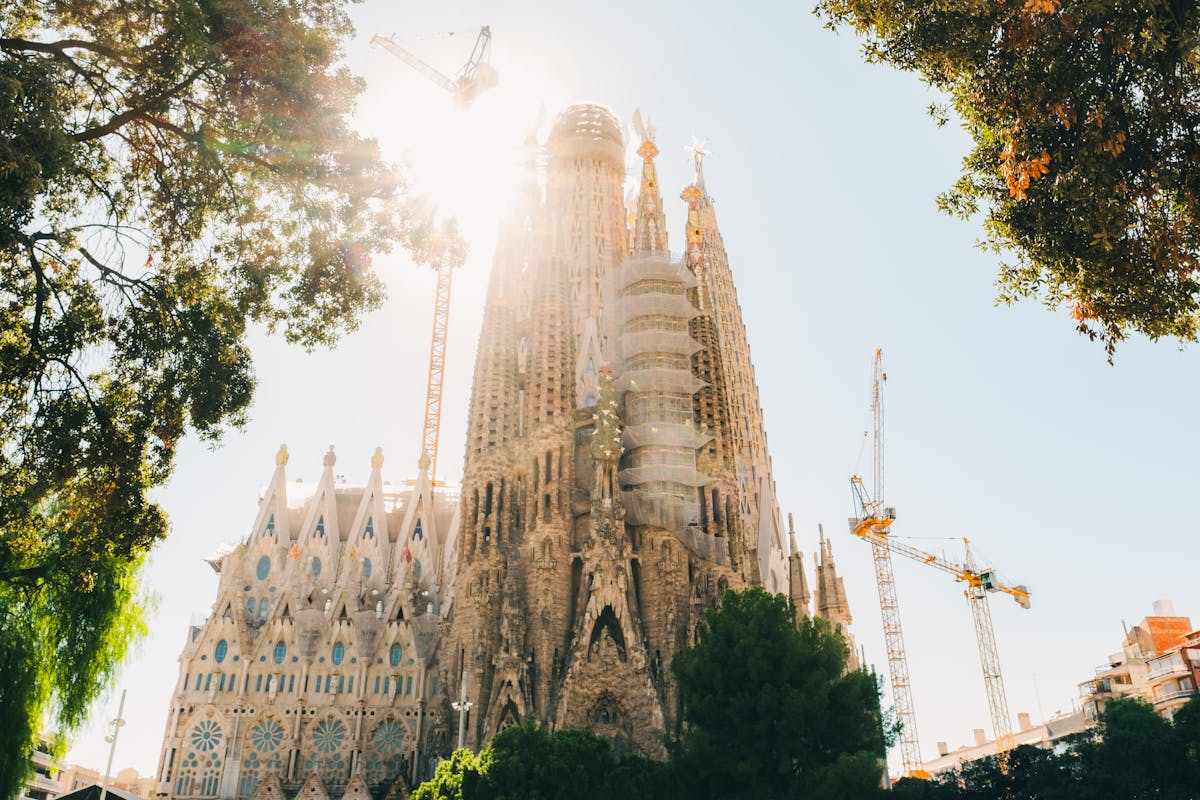
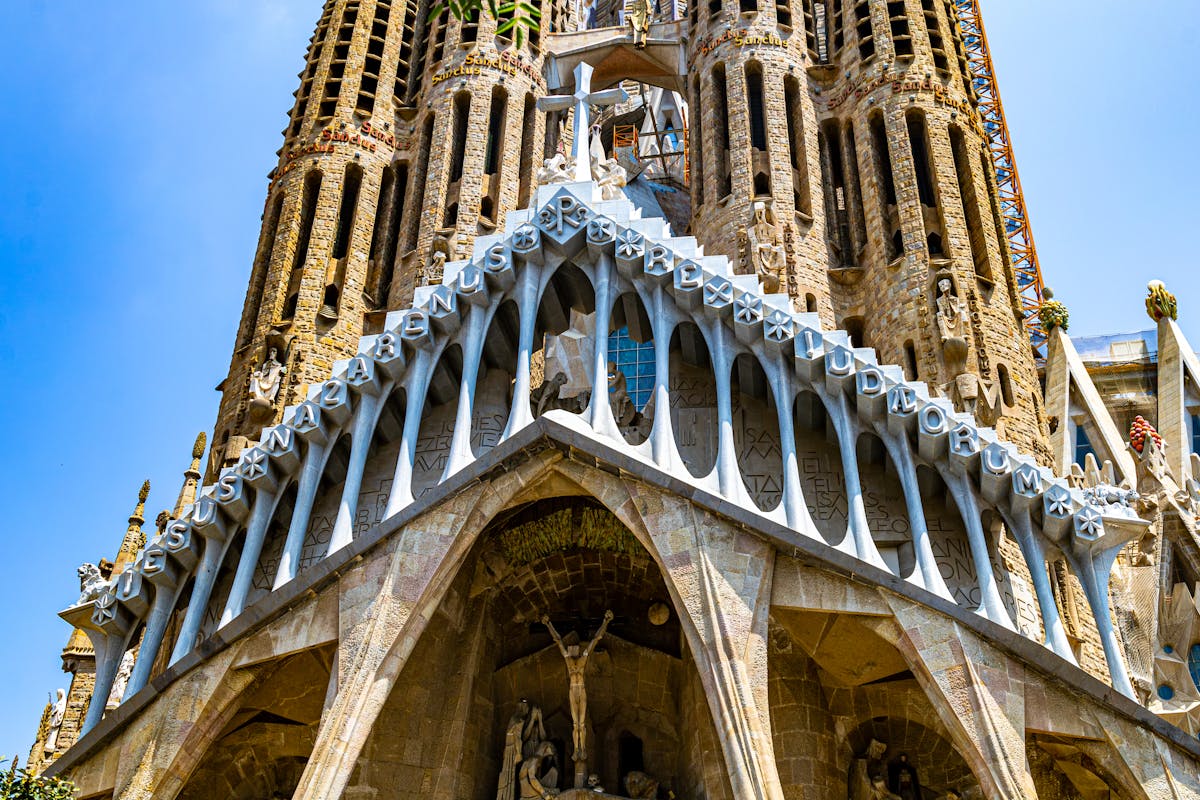
The basilica’s three main facades represent birth, passion, and glory—each with distinct sculptural programs that tell spiritual narratives. The Nativity Facade, largely completed under Gaudí’s direction, brims with naturalistic detail: fruit, animals, plants intertwined with religious symbolism. The Passion Facade employs stark, angular forms—an intentional contrast emphasizing suffering and sacrifice. The yet-to-be-completed Glory Facade will contain the main entrance and rise to extraordinary heights.
What makes Gaudi Barcelona’s Sagrada Familia eternally compelling is its structural audacity. The interior columns branch upward like stone trees, their branching patterns calculated to distribute loads naturally, just as a forest distributes structural stress. Skylights, positioned to create changing light throughout the day, are supposed to cast illumination that’s meant to evoke spiritual transcendence. This isn’t merely beautiful building; it’s architecture as theology.
Completion has been a contested issue, but current projections suggest the Sagrada Familia will be substantially complete by 2026, over a century after Gaudí’s death in 1926. For the latest updates on the Sagrada Familia’s progress, see our detailed completion timeline.
Visiting the Sagrada Familia requires advance booking. Expect 2-3 hours minimum for a meaningful visit. Early morning or late evening visits offer fewer crowds and spectacular lighting. For comprehensive planning, consult our dedicated Sagrada Familia guide.
Park Güell: Where Nature Becomes Architecture
While the Sagrada Familia represents Gaudi Barcelona’s spiritual aspirations, Park Güell embodies his most playful, nature-inspired vision. Commissioned by industrialist Eusebi Güell as an exclusive residential community (though the residential vision never fully materialized), the park sprawls across a hillside overlooking Barcelona with what seems like impossible harmony between constructed elements and natural landscape.
Gaudi Barcelona’s approach to Park Güell was revolutionary: rather than imposing geometry onto nature, he studied the terrain, understood existing vegetation, and integrated architecture as an extension of the natural environment. Pathways follow natural contours. Structures nestle into hillsides. And everywhere—everywhere—there’s ceramic mosaic tilework that seems to capture the essence of color itself.
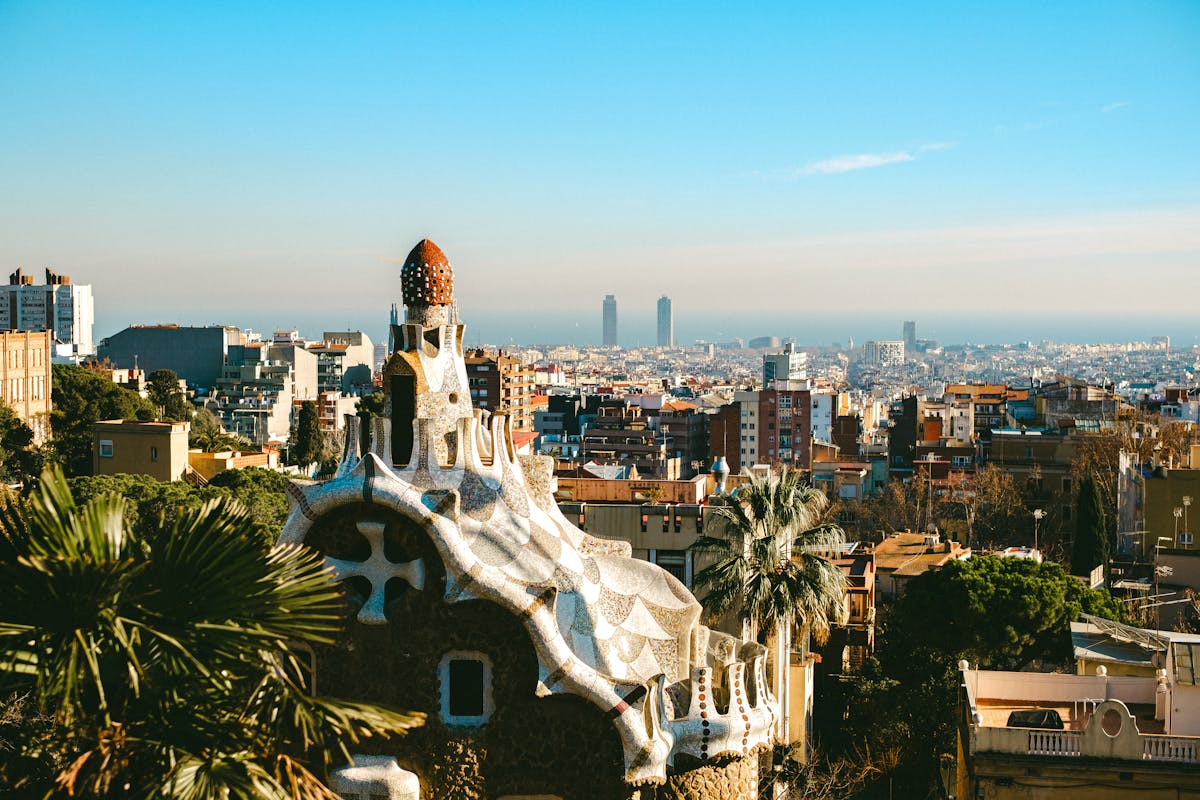
The central terrace, with its undulating bench decorated in trencadís (broken ceramic tile mosaic), might be Gaudi Barcelona’s most photographed creation. That bench isn’t merely functional seating—it’s biomimetic sculpture. Its curves follow human body contours while its integrated backing supports natural spine positioning. The mosaic patterns, created from leftover ceramic fragments, possess visual dynamism while celebrating resourcefulness and beauty found in discarded materials.
The park’s gatehouses flank the entrance like fairy-tale structures—mushroom-shaped buildings with conical roofs that Gaudi Barcelona designed using catenary curves, the natural shape a hanging chain assumes under gravity. Structurally sophisticated yet appearing whimsical, these gatehouses perfectly distill Gaudi Barcelona’s philosophy: engineering excellence disguised as artistic fantasy.
The Hypostyle Hall beneath the terrace contains 86 Doric columns supporting the plaza above—a structure that references classical architecture while its columns bear decorative tilework that feels entirely modern. Walking through this underground forest of columns, surrounded by filtered light and color, visitors immediately grasp why Gaudi Barcelona has captured the world’s architectural imagination.
Park Güell now requires advance ticketing to manage crowds. Visit early morning (opening) or late afternoon (near closing) for the most peaceful experience. The park’s elevation provides spectacular views of Barcelona and the Mediterranean, particularly beautiful during golden hour.
Casa Batlló: The House of Bones and Dragon Legend
Walking down Passeig de Gràcia, Barcelona’s most prestigious avenue, you’ll recognize Casa Batlló immediately—it’s the building that looks alive. Where neighboring structures embrace symmetry and right angles, Casa Batlló Barcelona appears organic, almost sculptural, as if Gaudi Barcelona shaped it from clay rather than constructed it from materials.
Commissioned as a renovation of an existing building, Gaudi Barcelona essentially created a new structure within the old framework, pushing his modernist philosophy to maximalist extremes. The facade undulates in graceful curves. Windows are asymmetrical and irregular, framed in wrought iron that resembles skeletal bone structure—hence “the house of bones.” The roof’s arched, tiled surface has sparked centuries of interpretation: some see dragon scales, others see a reclining beast, still others see abstract modernist poetry.
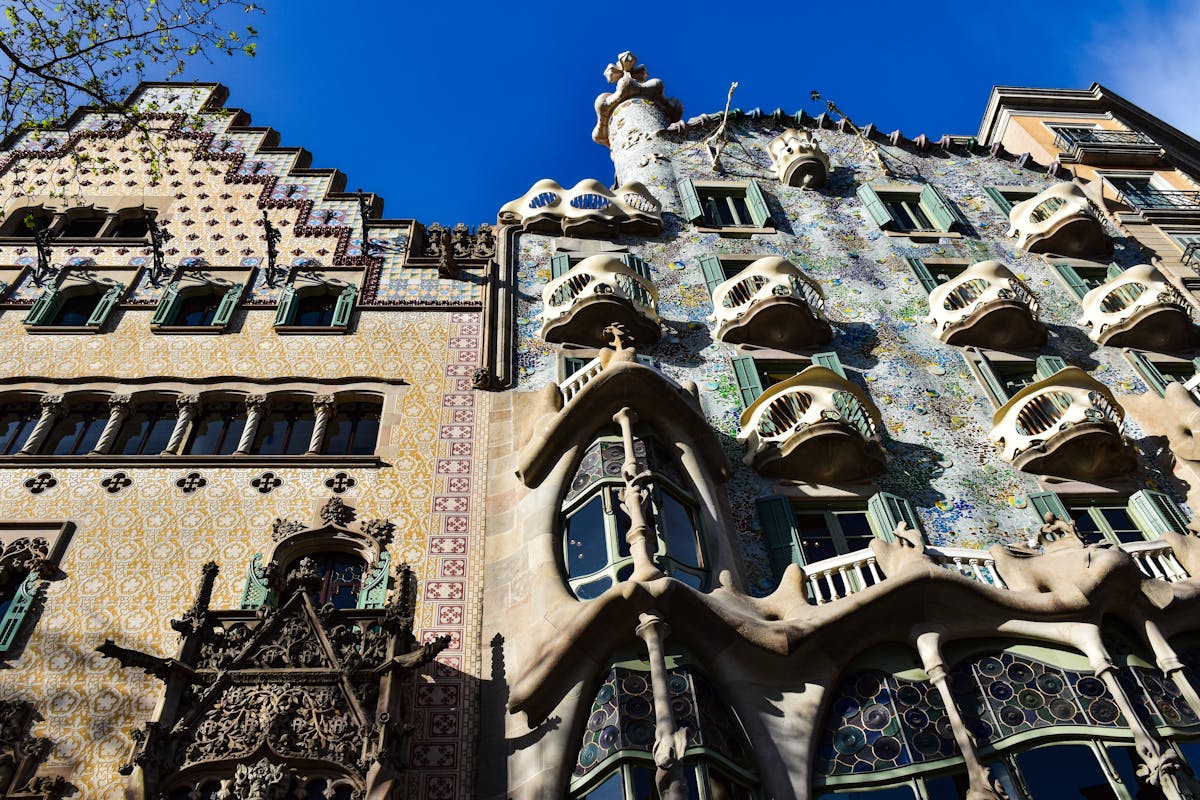
The dragon legend, whether Gaudi Barcelona deliberately cultivated it or not, adds mystical resonance to this already extraordinary building. Medieval Catalonia venerated Saint George, who slayed a dragon, and Casa Batlló sits on the avenue’s prestigious section where Catalan bourgeoisie displayed their cultural identity through architectural commission. Some scholars interpret the dragon roof as Gaudi Barcelona’s subtle nod to Catalan tradition, a modernist reimagining of medieval mythology.
The interior spaces are equally revelatory. Gaudi Barcelona eliminated load-bearing interior walls where structurally possible, creating flowing spaces that feel organic and sculptural. Doorways have rounded frames. Ceilings undulate. Light enters through windows positioned to create optimal illumination in each room. The chimney spaces, visible from exterior, rise like fantastic sculptures—organic forms that serve functional purposes while becoming visual art.
Casa Batlló Barcelona’s color palette shifted dramatically from its original monochromatic stone and ceramic base—modern restoration has reintroduced vibrant blues, greens, and earth tones that contemporary photographs suggest were Gaudi Barcelona’s intention. Walking past Casa Batlló today, you see the building as Gaudi Barcelona likely envisioned it: a living, breathing creature of color and form rather than austere modernist statement.
Interior visits reveal Gaudi Barcelona’s attention to minute detail. Light wells spiral through the building’s center, bringing daylight to every level. Plumbing and ventilation systems incorporate beauty into engineering—cast-iron pipes are sculptural elements. The noble floor (piano nobile), where the property owner lived, features Gaudí Barcelona’s most elaborate ornamentation.
Advance tickets are essential for Casa Batlló Barcelona. Evening visits, when interior lighting emphasizes the building’s sculptural qualities, are particularly magical. Compare Casa Batlló with Casa Milà to understand how Gaudí Barcelona’s style evolved across different residential commissions.
Casa Milà (La Pedrera): The Stone Quarry and Modernist Innovation
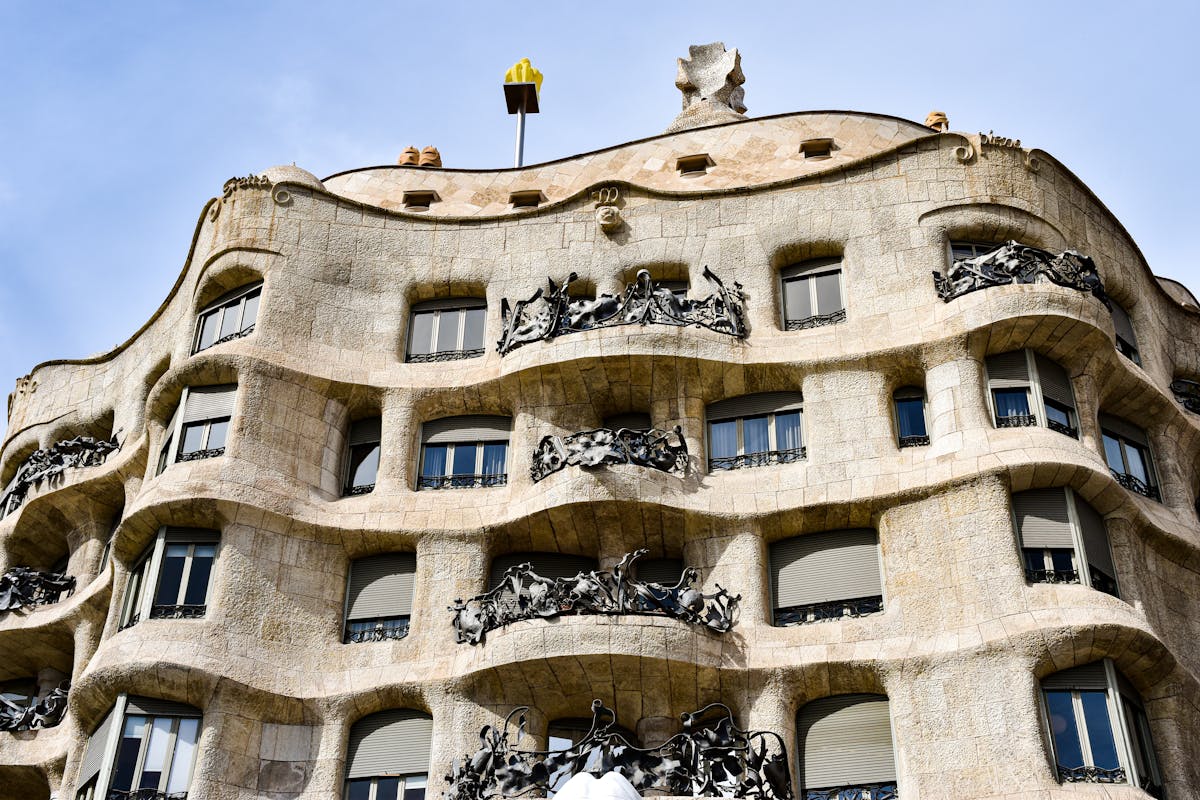
Two blocks from Casa Batlló stands Casa Milà—known colloquially as La Pedrera (The Stone Quarry) for its remarkable quarry-like stone facade. If Casa Batlló Barcelona is Gaudí’s most sculptural residential project, Casa Milà Barcelona represents his most architecturally daring: an apartment building where curving facade walls have virtually no flat surfaces.
Completed in 1912, Casa Milà Barcelona abandoned traditional structural frameworks in favor of iron columns and beams that allowed Gaudí Barcelona to create an almost completely curved exterior. The undulating stone facade, intended to recall quarried stone, appears to ripple and flow. Window openings are integrated irregularly into this fabric—no two identical, each sized and positioned to optimize interior light while creating visual dynamism across the facade.
The wrought-iron balconies of Gaudí Barcelona’s Casa Milà are sculptural masterpieces—organic forms crafted by ironworker Josep Jujol that resemble seaweed, waves, and abstract organic structures. Each balcony is unique, yet all harmonize aesthetically. Modern viewers often describe them as “algae” or “seaweed,” capturing how completely Gaudí Barcelona absorbed natural forms into architectural vocabulary.
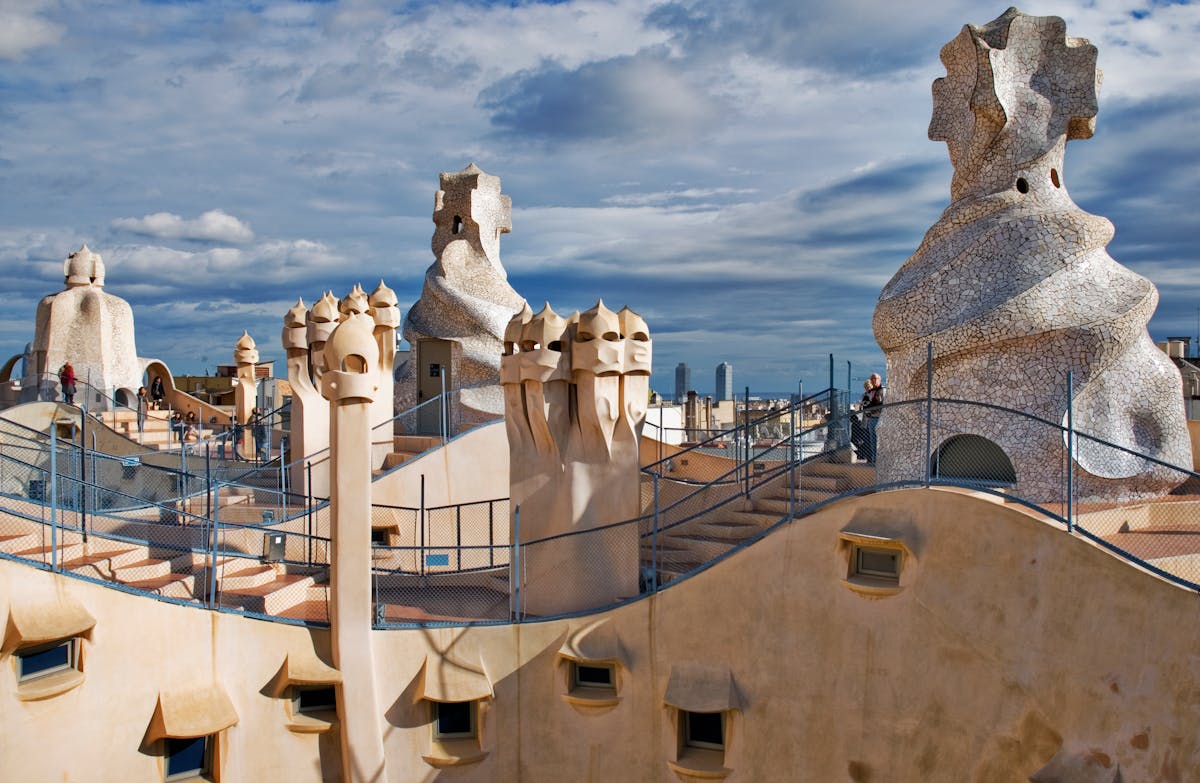
Casa Milà Barcelona’s rooftop features iconic chimney stacks that dominate Barcelona’s skyline. These aren’t mere functional chimneys—they’re sculptural “warriors” or “sentinels,” ceramic and stone structures that resemble abstract humanoid forms standing watch over the city. Visitors touring the rooftop (often included in admission) discover these whimsical sentinels immediately capture the Gaudí Barcelona philosophy: every architectural element, no matter how utilitarian, becomes art.
The building’s courtyards—two large wells bringing light and air to interior apartments—feature curved walls that create spatial drama. Gaudí Barcelona designed these as experiential spaces, understanding that occupants would perceive architecture as three-dimensional experience rather than mere facade viewing.
Evening illumination of Casa Milà Barcelona’s facade is spectacular, with strategic lighting emphasizing the undulating stone curves. Many visitors prefer evening visits for photography, though daytime permits superior interior photography. Access includes the piano nobile (apartment) and the rooftop exhibition. Our detailed comparison guide helps determine which building better suits your interests.
Lesser-Known Gaudí Works: Hidden Masterpieces Across Barcelona
Most Gaudí Barcelona visitors focus on the Big Three—Sagrada Familia, Park Güell, and the Passeig de Gràcia residences. Yet Gaudí Barcelona’s portfolio contains several remarkable works that deserve serious attention from architecture enthusiasts.
Casa Vicens: Gaudí Barcelona’s First Masterpiece
Casa Vicens, completed in 1888, represents Gaudí Barcelona’s residential debut for a Barcelona textile manufacturer. The building announced his distinctive style with authority: ceramic tile decoration (particularly striking green and white Moorish-influenced patterns), wrought-iron railings with organic curves, and spatial innovation within the constrained urban lot.
Casa Vicens Barcelona sits in the Gràcia neighborhood, a less-touristed district that retains bohemian character. The facade’s ceramic tilework is among Gaudí Barcelona’s most exuberant—where later works achieved increasingly sophisticated integration of decoration and structure, Casa Vicens Barcelona appears more decorative, more playful. This makes it historically significant for understanding Gaudí Barcelona’s evolution toward abstraction and organic form.
Palau Güell: Gaudí Barcelona’s Dark Palace
The Palau Güell, a 1890 commission for Eusebi Güell (the same patron who would later commission Park Güell), represents Gaudí Barcelona’s most exotic interior space. From the street, the limestone facade appears relatively restrained—notable primarily for two dramatic parabolic arches framing the entrance. But interior spaces reveal Gaudí Barcelona at his most theatrical.
The Palau Güell Barcelona rises seven stories (including two subterranean levels) with a central hall reaching from cellar to attic, flooding with light from a glazed cupola. Gaudí Barcelona created interior spaces of breathtaking ornament—marquetry woodwork, sculptural plasterwork, ornamental ironwork. The style feels Gothic meets modernist excess. The hall’s proportions, the intimate rooms radiating from it, the chapel occupying the top floor—every element creates spatial drama.
The Palau Güell Barcelona’s stables, occupying the lower levels, feature parabolic arches that distribute horse weight safely while creating visual harmony between utilitarian space and artistic vision. This is quintessentially Gaudí Barcelona: solving practical problems through forms inspired by nature and geometry.
Colònia Güell Crypt: Industrial Spirituality
Beyond Barcelona proper, in Santa Coloma de Cervelló, Gaudí Barcelona created a chapel for a textile colony—a worker housing and manufacturing complex. The Crypt of Colònia Güell Barcelona, built 1898-1914, represents Gaudí Barcelona’s most experimental structural work. Here, he pioneered the inverted catenary arch model—hanging chains weighted to show how forces flow through structures—then inverted the form to create vaults and walls.
The crypt’s interior is a forest of organic columns and vaults, combining stone and brick in ways that appear almost sculptural. Stained glass windows filter colored light across undulating surfaces. This space, more than any other Gaudí Barcelona work, reveals the spiritual dimension of his architecture—the aspiration toward transcendence through built form.
Bellesguard: Medieval Romance Reinterpreted
Bellesguard, a residential commission completed in 1909, represents Gaudí Barcelona’s exploration of medieval architecture reinterpreted through modernist sensibility. The castle-like facade, with crenellations and defensive appearance, drew inspiration from the medieval castle that previously occupied the site. Yet Gaudí Barcelona synthesized this historical reference with modernist principles—the windows’ shapes, the decorative tilework, the iron railings reflect his characteristic organic approach.
The Quadrat d’Or: Barcelona’s Golden Square of Architecture
The intersection of Passeig de Gràcia and Carrer de Còrsega marks the beginning of Barcelona’s Quadrat d’Or—the “Golden Square”—a concentrated neighborhood of perhaps 150 buildings representing the finest Modernisme architecture. While Gaudí Barcelona dominates attention (Casa Batlló and Casa Milà anchor the district), understanding the broader Modernisme context enriches appreciation for Gaudí Barcelona’s work.
The Quadrat d’Or Barcelona developed rapidly (1890-1910) as newly wealthy industrialists and merchants commissioned prestigious residences. The district’s architecture tells Barcelona’s modernist story in architectural detail. Walking the Quadrat d’Or Barcelona, you encounter Gaudí’s vision filtered through dozens of interpretations by other architects, all responding to similar cultural and economic impulses.
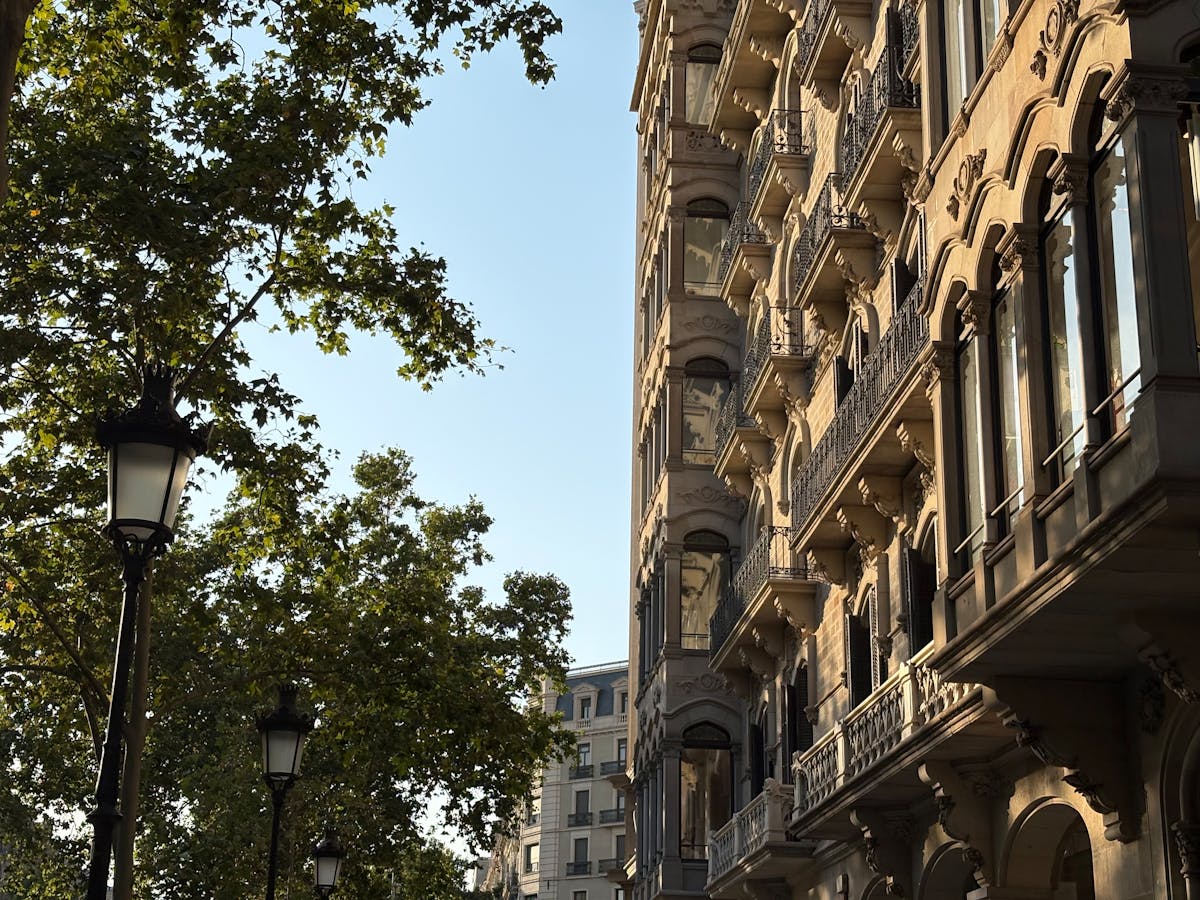
The Quadrat d’Or Barcelona walking route begins naturally at Casa Batlló and Casa Milà, then expands to include the remarkable Hospital de Sant Pau (with gorgeous interior courtyards), Casa de les Punxes (a striking pointed-tower building), the elaborate Casa Amatller and Casa Lleó Morera (flanking Casa Batlló), and numerous other gems. A self-guided walking tour of the Quadrat d’Or Barcelona takes 2-3 hours and costs nothing beyond street access.
Many Quadrat d’Or Barcelona buildings now house offices, museums, or shops, meaning you can experience modernist interiors without specialized museum entry. The district rewards slow walking and careful observation—carved stonework, decorative tilework, wrought-iron railings reveal themselves continuously.
Beyond Gaudí: Other Modernist Masters Who Shaped Barcelona
While Gaudí Barcelona captures international imagination, Catalonia produced other architects of profound sophistication who deserve recognition. Understanding these contemporaries enriches your appreciation for what made Gaudí Barcelona distinctive—and confirms that Modernisme represented a genuine cultural movement rather than a single genius’s vision.
Lluís Domènech i Montaner: Lyrical Ornament
Lluís Domènech i Montaner (1850-1923) represents an alternative Modernisme approach—where Gaudí Barcelona pursued abstraction and organic form, Domènech i Montaner embraced ornament as expressive language. His Palau de la Música Catalana, completed 1908, is one of Barcelona’s most astonishing interiors—a concert hall where every surface celebrates music through sculptural, ceramic, and glass embellishment.
The Palau de la Música Barcelona’s auditorium features a stained-glass ceiling that appears to float above the space, creating the illusion of open sky. Mosaic-encrusted columns, ornate plasterwork, and decorative elements create an environment where the building itself becomes musical. Where Gaudí Barcelona pursued structural innovation, Domènech i Montaner pursued ornamental poetry.
Other Domènech i Montaner works—the Hospital de Sant Pau, the Recinte Modernista de Sant Pau—demonstrate consistent commitment to ornamentation as functional design element. In his hands, decoration never feels superficial; instead, ornament communicates meaning while serving spatial and functional purposes.
Josep Puig i Cadafalch: Historical Synthesis
Josep Puig i Cadafalch (1867-1956) occupied a middle ground between Gaudí Barcelona’s organic innovation and Domènech i Montaner’s ornamental expressionism. His works synthesized historical references (particularly medieval Catalan architecture) with modernist sensibilities. Casa de les Punxes, with its dramatic pointed towers, demonstrates Puig i Cadafalch’s approach: recognizable historical vocabulary reinterpreted through contemporary sensibility.
Puig i Cadafalch’s prolific career extended through multiple stylistic phases, but his best Modernisme works (1898-1911) reveal an architect equally comfortable with structural experimentation and decorative richness. His approach feels less revolutionary than Gaudí Barcelona’s yet arguably more accessible—historical resonance combined with contemporary forms created buildings that spoke to Catalan identity while embracing modernity.
Planning Your Complete Gaudí Barcelona Architecture Tour
Successfully experiencing Gaudí Barcelona requires strategic planning. The city receives millions of visitors annually, and major sites regularly reach capacity well before closing time. This section provides practical guidance for maximizing your Gaudí Barcelona experience.
Grouping Buildings by Neighborhood
Barcelona’s Gaudí Barcelona sites cluster geographically, allowing efficient itinerary planning:
Passeig de Gràcia Corridor: Casa Vicens (Gràcia neighborhood), Casa Batlló, and Casa Milà occupy roughly 2km along Barcelona’s most prestigious avenue. A single day can accommodate all three with advance tickets. Early morning visits to one building, mid-morning to another, and afternoon/evening to the third avoids peak crowds.
Northern Hills: Park Güell requires its own dedicated visit (minimum 2 hours). The distance from central Barcelona necessitates either metro (L3 line) or taxi/bus. Combining Park Güell with other nearby sites requires careful planning due to elevation changes and transit time.
Sagrada Familia & Surroundings: The Sagrada Familia dominates the central district, easily accessible via metro (L2/L5 lines). Nearby Gaudí Barcelona sites are fewer, but the neighborhood contains other compelling modernist architecture worth exploring.
Extended Barcelona: Palau Güell (Gothic Quarter, near Las Ramblas), Casa Vicens (Gràcia neighborhood), and Colònia Güell (30km outside Barcelona) require individual trips or carefully planned multi-day itineraries.
Booking Strategies and Admission Costs
Major Gaudí Barcelona sites now require advance online booking to manage crowds. Typical admission costs (2026):
Sagrada Familia: €30-35 (basic entry), €39+ (with audio guide or tower access). Park Güell: €14-16. Casa Batlló: €24-29. Casa Milà: €24-29. Palau de la Música: €18-25 (guided tours). Most sites offer discounts for children and seniors.
Combination tickets sometimes offer modest savings. The Barcelona Turisme office sells tourist packages that may include Gaudí Barcelona site access, though these often cost more than individual advance booking.
Best Times to Visit
Gaudí Barcelona sites see highest crowds April-October, particularly June-September. November-February offers significantly fewer visitors, though some days close earlier. Easter week and Christmas weeks generate holiday crowds.
Within each day, patterns are predictable: opening hours (first 30-60 minutes) have minimal crowds. Mid-morning (10am-noon) brings peak crowds. Afternoon lulls occur 2-4pm before dinner-time upticks. Evening hours (last 2-3 hours before closing) attract fewer visitors and offer excellent lighting conditions for photography.
Suggested Multi-Day Itineraries
3-Day Gaudí Barcelona Focus: Day 1: Sagrada Familia (early morning arrival, 2-3 hours), lunch in Eixample, Casa Batlló (afternoon), Casa Milà (evening). Day 2: Park Güell (morning), lunch in Gràcia neighborhood, Casa Vicens afternoon. Day 3: Palau de la Música (morning tour), Gothic Quarter walking (afternoon), Palau Güell (late afternoon).
5-Day Comprehensive Modernisme Tour: Extend 3-day itinerary with Day 4 dedicated to Quadrat d’Or walking tour and architectural exploration, plus Hospital de Sant Pau and Casa de les Punxes. Day 5: extended Gaudí buildings list exploration, Colònia Güell Crypt day trip, or deep-dive into a single building (Casa Batlló or Sagrada Familia) with audio guide or specialist tour.
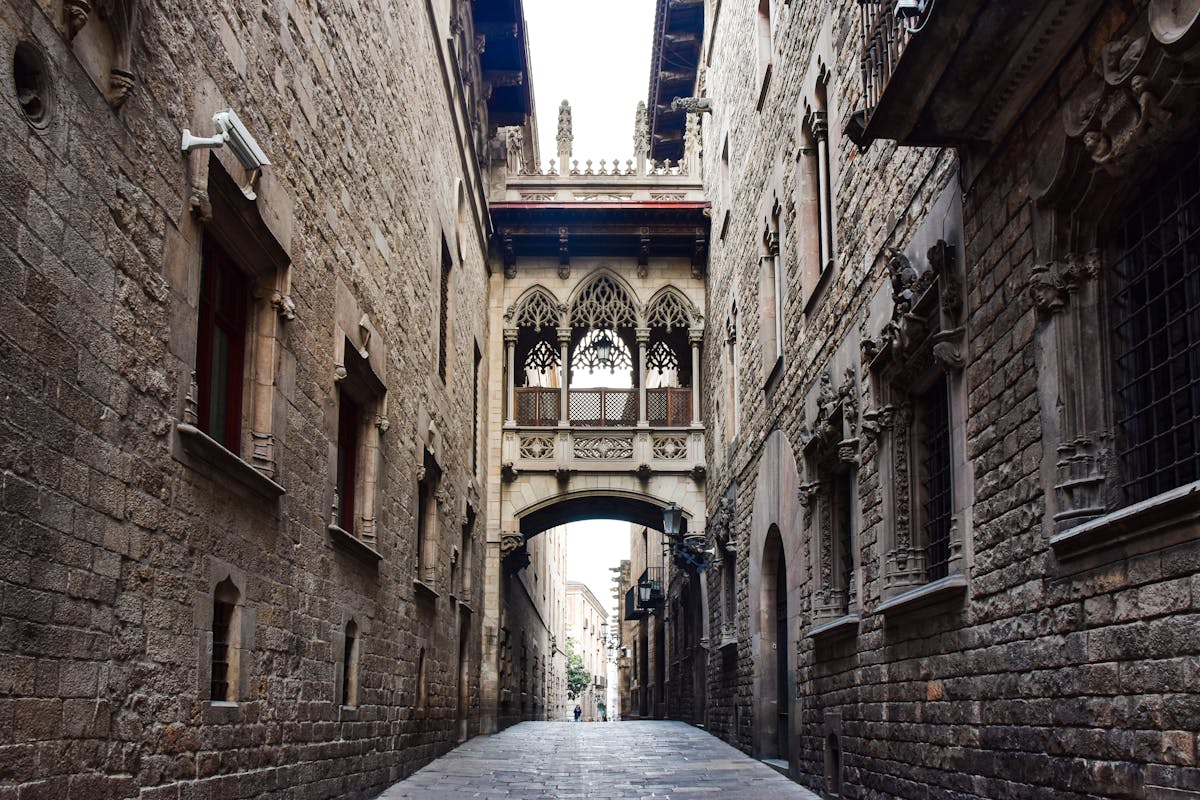
Architecture-Focused Tour: Combine Gaudí Barcelona sites with Gothic architecture in Barcelona (Cathedral, Santa Maria del Pi, Santa Maria del Mar) to understand historical influences on Modernisme. This contextual approach deepens appreciation for how Gaudí Barcelona synthesized medieval architectural principles with contemporary innovation.
Specialist Tours and Guides
Self-guided visits are entirely feasible with advance research. However, specialist architecture tours (available through barcelonatourism.org and private operators) provide deeper contextual understanding. Tours typically focus either on Gaudí Barcelona comprehensively or on specific buildings with expert analysis of structural systems, design philosophy, and historical context.
Barcelona neighborhoods guide contextualizes where Gaudí Barcelona sites sit within broader city geography. Things to do in Barcelona positions Gaudí Barcelona architecture within broader visit planning.
Gaudí Barcelona: Legacy and Contemporary Understanding
Antoni Gaudí died in 1926, struck by a tram while crossing the street—a tragic, mundane end for a visionary genius. Yet his architectural legacy has only grown more significant with time. What seemed eccentric or overly decorative to early 20th-century modernists is now recognized as revolutionary structural thinking disguised in organic forms.
Contemporary architects, structural engineers, and theorists recognize Gaudí Barcelona as a precursor to digital design and parametric architecture. His catenary arch experiments prefigured computer-generated optimal structural forms by a century. His understanding of load distribution, material properties, and organic form optimization anticipated principles that 21st-century architects pursue through computational design.
Yet Gaudí Barcelona’s relevance extends beyond technical innovation. In an age of global architectural homogenization, Gaudí Barcelona’s fierce commitment to regional identity, cultural specificity, and integration of fine art with functional building offers a counter-model. His buildings don’t merely function efficiently; they celebrate their location, engage with Catalan tradition, and pursue beauty as integral to purpose.
Every year, millions visit Gaudí Barcelona sites—drawn by UNESCO designations, Instagram aesthetics, or genuine architectural pilgrimage. Whether you approach Gaudí Barcelona as a casual tourist, serious architecture student, or spiritual seeker, these buildings reward deep engagement. Their forms reveal new dimensions with repeated observation. Their spaces create unexpected emotional responses. Their integration of function and beauty offers lessons that transcend architectural discipline.
Barcelona without Gaudí Barcelona would be substantially different—a successful Mediterranean city lacking the architectural magnetism that draws visitors from every continent. With Gaudí Barcelona, it becomes a destination for anyone who cares about human creativity, cultural identity, and the possibility that buildings can be simultaneously functional, beautiful, innovative, and spiritually significant.
Your exploration of Gaudí Barcelona awaits. Whether standing before the Sagrada Familia’s soaring spires, walking Park Güell’s mosaic terraces, or discovering hidden architectural gems in Barcelona’s neighborhoods, you’re witnessing the work of an architect who transformed a city into a manifesto for beauty, innovation, and distinctively Catalan modernity.
Plan Your Barcelona Visit: For comprehensive Barcelona travel planning beyond Gaudí Barcelona architecture, explore our Barcelona Travel Guide. For architectural tours specifically, explore Barcelona architecture tours and learn about Gaudí’s life and legacy. For comparison of specific buildings, discover modernist architecture beyond Gaudí.