Why Park Guell Is Gaudi at His Most Joyful
Antoni Gaudi designed the Sagrada Familia for God and Casa Batllo for the wealthy, but he designed Park Guell for play. The hilltop wonderland on the slopes of Mount Carmel was conceived in 1900 as a residential garden city; only two of its planned 60 houses ever sold, and the project failed commercially. What it left behind is one of the most photographed and most magical places on earth: an undulating mosaic bench winding around a vast plaza, a tiled dragon guarding a carriage entrance, gingerbread-house gatehouses, and serpentine columns rising from a forest of stone palms. This park guell barcelona guide covers everything you need: when to come, which park guell tickets to choose, what to see inside the Monumental Zone, the park guell free area that most visitors miss, the hidden corners locals love, and the small set of practical moves that turn a good visit into a great one.
By the end of this article you will know how to plan, what to skip, where to stand for the best photos, and how to combine the visit with the rest of your Barcelona trip. Whether you are visiting for the first time or returning after a previous trip, our park guell guide is built to be both readable in advance and consultable on the day.
A Brief History: From Failed Real-Estate Project to UNESCO Site
Eusebi Guell, a wealthy Catalan industrialist and Gaudi’s most important patron, bought a large hilltop site in 1900 and asked the architect to design a 60-villa garden community modelled on the English garden cities of the period (the comma in “Park Guell” is a deliberate Anglicism). Construction began the same year. Gaudi imagined a community where each villa stood on its own terraced plot, with shared gardens, market halls, and a chapel.
The plan was ahead of its time, geographically and commercially. The hill was steep, the location remote, and the buyers never came. By 1914 only two houses had been built (one of which Gaudi himself eventually moved into and lived in for the last 20 years of his life). Construction stopped, and the site sat half-finished.
The City of Barcelona acquired the land in 1922 and converted it into a public park. UNESCO inscribed it as a World Heritage Site in 1984 as part of the “Works of Antoni Gaudi”. In 2013, due to overcrowding, the most architecturally significant section (the Monumental Zone, where the famous dragon, mosaic bench, and Hypostyle Hall are located) became ticketed. The wider park, including the Three Crosses Hill, the Austria Gardens, and the wooded slopes, remains free.
Park Guell Tickets and Prices for 2026
Tickets are timed-entry, capped at 1,400 visitors per hour, released in 30-minute slots. Booking online at least 7 to 14 days in advance is essential during peak season (April to October); even in winter, weekends and holidays sell out 2 to 5 days ahead.
Ticket Types and 2026 Prices
- General Entry (Monumental Zone): 18 EUR for adults, 13 EUR for children 7 to 12, free for under-7s.
- General Entry + Audioguide: 25 EUR adults; the audio adds historical context and is recommended for first-time visitors.
- Guided Tour (Monumental Zone): 27 to 35 EUR depending on group size; the small group format gives you 60 to 75 minutes with a licensed expert.
- Combined Park Guell + Sagrada Familia: Various third-party tour operators sell same-day combined tickets at around 75 to 95 EUR. Useful if you want both attractions packaged.
- First Sunday of the Month Free: A small batch of free Monumental Zone tickets is released on the first Sunday of each month at the on-site box office. Queue by 8:30 AM for any chance.
Where to Buy Tickets
Always book through the official site at parkguell.barcelona. Third-party resellers add markups and sometimes sell invalid tickets. Mobile tickets work; print is unnecessary.
What Your Ticket Includes
- Access to the Monumental Zone for one entry within your 30-minute slot.
- Once inside, you can stay as long as you like before park closing.
- You may not re-enter once you leave.
- The free outer park (Austria Gardens, Carmel Hill, Three Crosses) is always open without a ticket.
Best Time to Visit Park Guell
Timing changes everything. Park Guell is at its best in two windows.
- First slot of the day (9:30 AM): Empty plazas, soft golden light, cool air, no queues. Photographers should aim here.
- Last 90 minutes (about 6:00 PM in summer, 4:00 PM in winter): Crowds thin, light turns warm, and the city below glows. Sunset from the Three Crosses Hill is the best free panorama in Barcelona.
Avoid:
- Midday between noon and 3:00 PM in summer. The mosaic surfaces reflect heat aggressively, and the Nature Square has almost no shade.
- Saturday and Sunday afternoons in spring and autumn. The crowds peak.
- Holidays and school breaks; visitor numbers double.
The seasonal rhythm:
- Spring (April-May): Wildflowers across the slopes, perfect 18 to 22 degree afternoons.
- Summer (June-August): Beautiful but hot. Visit at 9:30 AM or after 6:00 PM.
- Autumn (September-October): Often the best season. Mild weather and lighter crowds after the first weeks of September.
- Winter (November-March): Quietest, with lower light angles that flatter photos. Cool but rarely cold.
Hours
- Late March through late October: 9:30 AM to 7:30 PM daily.
- Late October through late March: 9:30 AM to 5:30 PM daily.
What to See: A Walk Through the Monumental Zone
Main Entrance and the Gatehouses
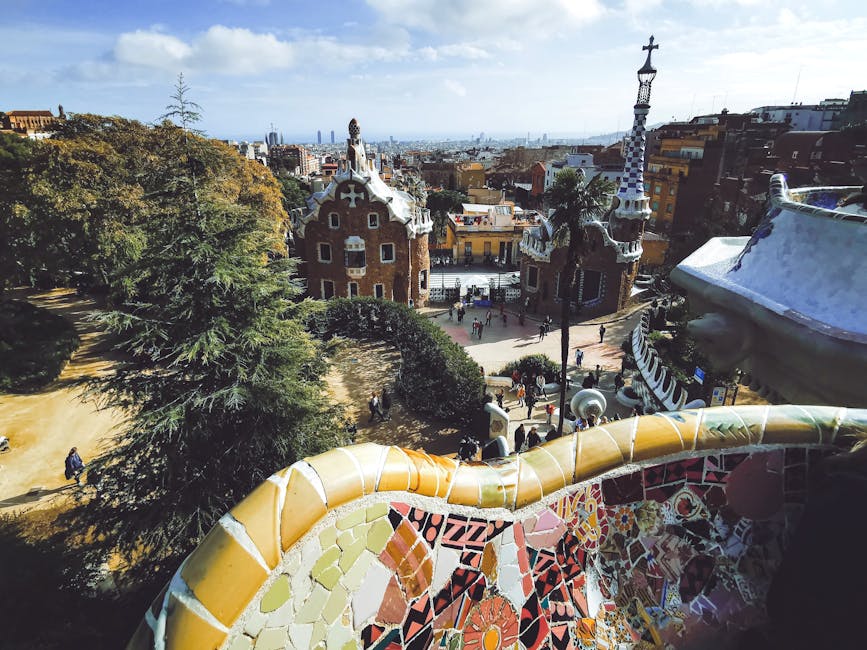
You enter Park Guell through the main gates on Carrer d’Olot. The two gingerbread-house gatehouses (the Casa del Guarda on the left and the Casa de l’Administracio on the right) are the most fairytale buildings in Barcelona. Their undulating roofs of broken-tile mosaic, their fly-trap chimneys, and their fanciful turrets show Gaudi at his most playful. The Casa del Guarda houses a small interpretive exhibition (included in the Monumental Zone ticket).
The Dragon Stairway and Salamander
The grand staircase leading up to the Hypostyle Hall is dominated by the famous Drac (dragon, though many visitors call it a salamander). The colourful tiled creature has become the symbol of Park Guell and the most photographed sculpture in Barcelona. Drink fountains on either side of the dragon were practical features for the planned residents; today they double as photo backdrops. Be patient; the queue for the dragon photo can be 20 minutes during peak hours.
The Hypostyle Hall (Sala Hipostila)
Above the dragon staircase, you enter the Hypostyle Hall, originally designed as a covered marketplace for the planned community. Eighty-six Doric columns support a serpentine ceiling decorated with circular medallions of broken tile, glass, and ceramic. Look up; the medallions feature original work by Gaudi’s collaborator Josep Maria Jujol. Each one is unique, and several incorporate broken champagne bottles, dolls’ heads, and broken plates. Gaudi pioneered the technique of trencadis (broken-tile mosaic) here.
The Nature Square (Plaça de la Natura) and Mosaic Bench
Above the Hypostyle Hall opens the wide Nature Square, a sprawling terrace originally designed for community markets and outdoor performances. Around its perimeter winds the famous serpentine mosaic bench, designed by Jujol under Gaudi’s direction. The bench follows a continuous, flowing curve that mimics the human body’s contours, making it one of the most ergonomic outdoor benches ever built. The view from the square stretches over Barcelona to the Mediterranean. Best photo spot: stand on the eastern side at sunset.
The Bird Nests and Viaduct Walkways
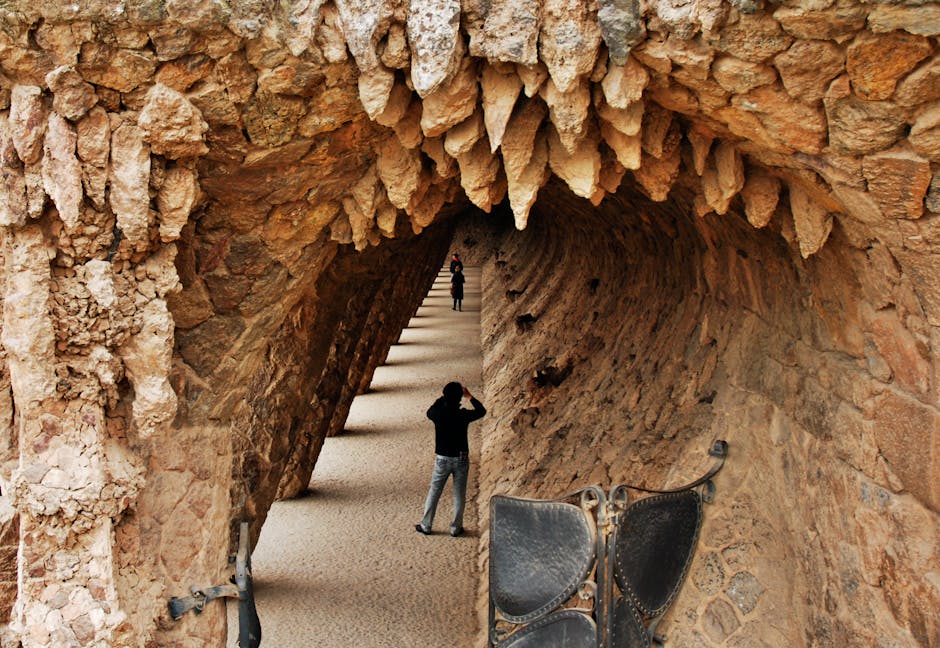
Below the Nature Square, Gaudi’s stone viaducts wind through the park, supported by leaning columns that mimic the trunks of olive trees and the legs of running animals. The Bird Nests (Nius d’Ocells) are stone niches set into the walls, designed as habitat for native birds. Many visitors miss the viaducts entirely; walk down the western path to see them up close.
The Casa Museu Gaudi (Optional Add-On)
The pink Casa Museu Gaudi sits inside the park near the eastern boundary. This was Gaudi’s home from 1906 to 1925, and the museum displays his original furniture, drawings, and personal effects. It is a separate ticket (8 EUR) but worth the visit if you are a Gaudi devotee. Combined Casa Museu plus Monumental Zone tickets are available.
The Park Guell Free Area: What Most Visitors Miss
The Monumental Zone gets all the attention, but the free outer park covers about 12 hectares and contains some of the most magical corners. You can walk these without any ticket.
1. Turo de les Tres Creus (Three Crosses Hill)
The highest point in the park at 182 metres. The 10-minute uphill walk from the Carretera del Carmel entrance takes you to a stone altar topped with three iron crosses. The 360-degree view stretches from the Mediterranean to Tibidabo to the Sagrada Familia in the Eixample grid below. This is the single best free panorama in Barcelona, and most Monumental Zone ticket holders never make it up here.
2. The Austria Gardens (Jardins d’Austria)
Added in 1977 as a Viennese gift to Barcelona, these quiet, shaded gardens sit on the eastern slope. Olive trees, cypress, and a Roman-inspired fountain make this one of the most peaceful spots in the entire park. Almost no tourists; bring a book.
3. The Pinewoods
The wooded slopes north and west of the Monumental Zone are crisscrossed by paths that locals use for morning runs. The forest floor is soft with pine needles, and the views through the trees are gorgeous. You can connect from the free area to the Bunkers del Carmel (a separate hilltop) on a 20-minute walk if you want to extend the day.
4. The Stone Colonnades
The colonnades on the western flank were designed as a covered carriageway for residents. The leaning columns, made of local stone, look like they are about to fall but have stood for over a century. They are not in the Monumental Zone, so anyone can walk through.
5. The Carrer del Carmel Entrance
Most visitors use the main Carrer d’Olot gate. The Carrer del Carmel entrance on the eastern side is much quieter and gives you a different first impression. It also drops you closer to the Three Crosses path.
How to Get to Park Guell
Park Guell is on a hill, and getting there involves either a steep walk or a transfer.
- Metro L3 to Lesseps + 15-minute uphill walk: The most common route. Climb steadily up Travessera de Dalt, then turn into Avinguda de l’Hospital Militar.
- Metro L3 to Vallcarca + 12-minute walk including escalators: The Vallcarca metro has free escalators that climb most of the hill, leaving you with a 5-minute walk on flat ground.
- Bus 24 from Plaza Catalunya: Drops you at the Carretera del Carmel entrance. About 30 minutes; a comfortable option for those who want to skip the climb.
- Bus 116 (the dedicated Park Guell circular): A small minibus that connects Lesseps metro with the main entrance. Useful for families and those with mobility issues.
- Taxi or Uber: 8 to 12 EUR from the city centre; the most convenient option if you have time pressure.
Returning is similar; the downhill walk to Lesseps takes about 15 minutes. If you are tired, take bus 24 or a taxi.
Practical Tips for the Visit
- Wear comfortable shoes. Steep cobbles, uneven paths, and lots of stairs.
- Carry water. No drinking fountains in the Monumental Zone; the few in the free area are seasonal.
- Sun protection. Hat, sunglasses, sunscreen. The Nature Square has no shade.
- Allow 90 minutes for the Monumental Zone. Add another 60 minutes if you want the Three Crosses Hill or Austria Gardens.
- Book tickets at least 7 to 14 days ahead. Earlier in summer and on weekends.
- Arrive 5 minutes before your slot. Late arrivals lose their entry.
- Bring a small daypack. Large bags are not allowed in the Monumental Zone.
- Strollers welcome. The main pathways are accessible, though some stairs require lifting.
- Photography is allowed. Tripods are not.
- Toilets are limited. Use them at your hotel or a cafe before you climb.
- Stay on the marked paths. Off-path access is restricted in many areas.
- Pickpockets work the entrances. Keep your phone and wallet secure.
Photography Guide: Best Spots and Times
- Mosaic bench from the eastern side at golden hour: The Sagrada Familia is in the background, the bench glows.
- Dragon staircase at 9:30 AM: Empty steps, soft light.
- Hypostyle Hall ceiling, looking up: Wide-angle lens reveals the medallions.
- Casa del Guarda gingerbread roof from below the dragon: Frame the gatehouse against the sky.
- Three Crosses Hill at sunset: Free, panoramic, magical.
- Stone columns of the Hypostyle Hall: Symmetrical shots from the entrance.
- Bird Nests: Detail shots; locals’ favourite Instagram spot.
Park Guell vs. Other Gaudi Sites: Should You Visit Them All?
Park Guell is one of seven Gaudi sites in Barcelona inscribed by UNESCO. Here is how it compares.
- Sagrada Familia: Indispensable. Different experience entirely; book both.
- Casa Batllo: Smaller, intimate, more interior-focused. Combines well with Park Guell on a 2-day Gaudi plan.
- Casa Mila (La Pedrera): Rooftop with chimney sculptures rivals Park Guell for visual interest. Highly recommended.
- Palau Guell: Earlier Gaudi work in the Raval. Worth a visit for serious Gaudi fans.
- Casa Vicens: Gaudi’s first major commission, in upper Gracia. Less visited; combine with Park Guell.
- Colonia Guell Crypt: Gaudi’s experimental basilica outside the city. A half-day excursion.
For a full Gaudi tour, see our Gaudi Barcelona pillar, the Sagrada Familia guide, and the Casa Batllo vs Casa Mila comparison.
Combining Park Guell with Other Sights
A Half-Day Park Guell Plan
- 9:00 AM: Coffee at a Gracia cafe near Lesseps metro.
- 9:30 AM: Monumental Zone with audioguide.
- 11:00 AM: Three Crosses Hill walk.
- 12:00 noon: Austria Gardens stroll.
- 12:30 PM: Walk down to Gracia for lunch.
A Full-Day Park Guell + Gracia + Bunkers del Carmel Plan
- 9:30 AM: Park Guell Monumental Zone.
- 11:30 AM: Walk to Bunkers del Carmel via the wooded paths (free, 25 minutes).
- 12:30 PM: Picnic at the Bunkers viewpoint.
- 2:00 PM: Walk down to Gracia.
- 2:30 PM: Long lunch in Plaça del Sol or Plaça de la Vila de Gracia.
- 4:30 PM: Casa Vicens visit.
- 6:30 PM: Drinks in Gracia.
Pairing with the Sagrada Familia
Many visitors do both in one day, with Sagrada Familia in the morning and Park Guell at sunset. The metro connection takes 25 minutes (L5 from Sagrada Familia to Vall d’Hebron, transfer to L3 to Vallcarca). Allow plenty of time between the two timed entries.
Etiquette and Things Not to Do
- Don’t sit on the dragon. The mosaic is fragile and you can damage it.
- Don’t bring food into the Monumental Zone. Eat in the free outer area.
- Don’t fly drones. Strictly forbidden.
- Don’t touch the mosaic surfaces. Body oils degrade the trencadis.
- Don’t shout in the Hypostyle Hall. The acoustics are extraordinary; the original idea was for it to host markets and music. Keep voices low to share the space.
- Don’t smoke in the park. No-smoking rules apply throughout.
- Don’t try to enter without a ticket. Security is strict at the Monumental Zone.
- Don’t be late. Late arrivals routinely lose their slot.
Park Guell with Children
Park Guell is one of the most child-friendly Gaudi sites. Kids respond viscerally to the dragon, the gingerbread houses, and the fairy-tale colours. A few tips:
- Book the first slot of the day (9:30 AM) when energy is high and crowds are low.
- Bring a small picnic for the free area.
- Allow them to lead the pace; the park rewards wandering.
- Carry a baby carrier rather than a stroller for the steepest paths.
- Casa Museu Gaudi can be skipped with under-7s.
For more, see our family activities Barcelona guide.
Park Guell Accessibility
The Monumental Zone has accessible paths to the main features (Hypostyle Hall, Nature Square, dragon staircase via the elevator route). Some sections (the upper terraces, Three Crosses Hill) are not wheelchair accessible due to steep gradients. Check the official accessibility map at parkguell.barcelona for current routes. Wheelchair users receive a discounted entry price; companions enter free.
Weather Considerations
- Hot summer days: Visit at 9:30 AM or after 6:00 PM. Carry water and a hat.
- Rainy days: The park is open in light rain. The Hypostyle Hall provides shelter. Heavy rain makes the cobbles slippery.
- Cold winter mornings: Layer up. The wind on the Three Crosses Hill can be sharp.
- Lightning storms: The high points are exposed. Wait it out at a covered cafe.
Frequently Asked Questions
Is Park Guell worth visiting?
Yes, absolutely. It is one of the most photographed and most enjoyable architectural experiences in Europe. Skip it only if you have less than 1 day in Barcelona.
How much do Park Guell tickets cost in 2026?
18 EUR for adults, 13 EUR for children 7 to 12, free for under-7s. Audioguide adds 7 EUR.
How long should I spend at Park Guell?
90 minutes minimum for the Monumental Zone. Add 60 to 90 minutes if you want the free outer park (Three Crosses Hill, Austria Gardens).
Can I visit Park Guell for free?
Yes, the outer park (Austria Gardens, Three Crosses Hill, pinewoods) is always free. The Monumental Zone (with the dragon, mosaic bench, Hypostyle Hall) requires a ticket. The first Sunday of each month, a small batch of free Monumental Zone tickets is released at the on-site box office; queue early.
What time does Park Guell open?
9:30 AM daily. Closes 7:30 PM in summer and 5:30 PM in winter.
Should I book Park Guell tickets in advance?
Yes. Tickets routinely sell out 7 to 14 days ahead during peak season. Book online through the official site.
Is Park Guell included in the Barcelona Card?
The Barcelona Card includes some Park Guell discounts but not free entry. Buy your timed-entry ticket separately.
Can I bring a stroller?
Yes, on most main paths. Some stairs require lifting. The Carrer del Carmel entrance is more stroller-friendly than the main entrance.
What should I wear?
Comfortable walking shoes, layers (cool in winter, hot in summer), hat and sunscreen in summer.
Where is the best photo spot?
The eastern end of the mosaic bench at sunset, with the Sagrada Familia visible in the distance.
Can I visit Park Guell at night?
The park is closed at night, but the surrounding streets and the Bunkers del Carmel viewpoint are accessible at any hour.
Is there a cafe inside the park?
Yes, a small cafe near the entrance serves coffee, snacks, and lunch. Prices are tourist-area; consider walking down to Gracia for better food.
Final Thoughts: The Most Photographed Hill in Europe
Park Guell is the closest Gaudi gets to inviting you into a children’s storybook. The dragon, the gingerbread houses, the serpentine bench, and the colonnades are all designed to delight. Plan smart (book ahead, arrive early or late, bring water), give yourself 90 to 180 minutes, and remember to walk up to the free Three Crosses Hill before you leave. You will leave with a phone full of photos and a small piece of why Barcelona is unlike anywhere else.
For more, see our Gaudi Barcelona pillar, the Sagrada Familia guide, the Casa Batllo vs Casa Mila comparison, and our 3-day Barcelona itinerary for how to fit Park Guell into a complete trip.