We get commissions for bookings made through this post. Booking links, and any accommodation options shown on the page, are handled by a partner that adds commission tracking automatically. It never costs you more, and it never affects what we recommend. Affiliate disclosure
On the evening of 5 January, three kings step off a boat at the bottom of La Rambla, and for the next three hours the streets of Barcelona belong to children throwing their arms up for sweets. The following morning the city stays in its pyjamas. Then, the day after that, it goes shopping, because the sales have started. Barcelona in January is the quietest, cheapest and, for a certain kind of visitor, the most rewarding month of the year: short queues at the Sagrada Família, restaurant tables without a reservation, clear winter light and a calendar of local festivities that most tourists never see.
This guide covers January’s weather honestly (it is colder than you think, indoors especially), the dated events for January 2027, what the month is good and bad for, and how to plan around the short days. For the whole year at a glance, see our Barcelona month-by-month guide; for the bigger question of whether to come in winter at all, our best time to visit guide weighs the seasons against each other. Prices and details were checked in September 2026.
January at a glance
| January in Barcelona | |
|---|---|
| Average high / low | 14 °C / 5.5 °C |
| Rain | About 40 mm, falling on around four days |
| Sunshine | About five hours a day |
| Daylight | Sunrise around 08:15; sunset from about 17:30 at the start of the month to 18:05 at the end |
| Sea temperature | About 13 °C: for walking beside, not swimming in |
| Crowds | The lowest of the year, after the first week |
| Prices | Hotel rates at or near their lowest of the year |
| Public holidays | 1 January and 6 January |
| Big events | The Three Kings parade (5 January), the winter sales (from 7 January), the Tres Tombs, the start of calçot season |
| Verdict | Excellent for architecture, museums and food. Not a beach month in any sense |
The weather, honestly
January is Barcelona’s coldest month, and the averages flatter it slightly. A typical day reaches about 14 °C in the early afternoon and drops to around 5 or 6 °C before dawn. On a still, sunny day in a sheltered square at lunchtime you can sit outside in a jumper and feel smug about the weather back home. On a grey day with a wind off the sea, 12 °C feels colder than the number suggests.
The good news is that the sun shines a lot. January averages about five hours of sunshine a day and only four or so days of rain, and a clear, cold, blue-sky morning is the most typical January weather of all. Snow in the city itself is rare enough to make the news when it happens.
The thing that catches visitors out is the cold indoors. Barcelona’s buildings are designed to shed heat, not keep it: stone floors, high ceilings, thin windows and, in older flats, heating that ranges from modest to theoretical. Hotels are heated, but a traditional bar or a converted palace museum can feel colder than the street. Dress in layers you can take off and put on again, rather than one heavy coat.
What to pack
- A warm coat that can handle 5 °C in the evening, and a scarf.
- Layers: a jumper or fleece for museums and churches, a lighter layer for sunny afternoons.
- A compact umbrella or waterproof. The rain is infrequent but can be heavy when it comes.
- Comfortable shoes with grip. Polished stone pavements are slippery in the rain.
- Sunglasses. The low winter sun is bright, and you will be squinting into it along the east–west streets.
Our Barcelona packing list covers the rest.
January 2027: the dates that matter
| Date | What happens | What it means for you |
|---|---|---|
| Friday 1 January | New Year’s Day, public holiday | A slow, hungover city; many shops and some sights closed, including the Picasso Museum |
| Sunday 3 January | First Sunday of the month | Free entry at several museums, some by advance reservation only |
| Tuesday 5 January | The Cavalcada de Reis, the Three Kings parade | The biggest night of the month; see below |
| Wednesday 6 January | Epiphany (Reis), public holiday | Most shops closed; restaurants full at lunch with family gatherings |
| Thursday 7 January | The winter sales (rebaixes) traditionally begin | Big discounts that run into late February or early March |
| Mid-January | Sant Antoni’s feast day (17 January) and the neighbourhood festival | Street events in the Sant Antoni district |
| A Saturday in the second half of the month | The Tres Tombs horse parade in Sant Antoni | Hundreds of horses and carriages; date announced in early January |
| Sunday 31 January | The Gran Festa de la Calçotada in Valls, traditionally the last Sunday of January | The best-known calçot festival in Catalonia, a day trip away |
Dates for fixed holidays are certain. Event dates beyond those are based on the usual pattern and on 2026’s timings; check the organisers’ announcements, which usually appear in December.
The Three Kings: 5 and 6 January
In Catalonia, as in the rest of Spain, the main present-giving happens not on Christmas Day but on the morning of 6 January, when the Three Kings (els Reis Mags) are said to have arrived in the night. The evening before, Barcelona welcomes them with the Cavalcada de Reis, one of the great spectacles of the city’s year and one that almost no tourists plan around.
How the evening works
In 2026 the Kings arrived by sea at the Moll de la Fusta, at the bottom of La Rambla, at about 16:30, in front of a waterfront crowd. The parade itself set off at 18:00 from near the Parc de la Ciutadella and took roughly three hours to wind across the city, via the Avinguda del Marquès de l’Argentera, Passeig d’Isabel II and Passeig de Colom, along the Avinguda del Paral·lel, Ronda de Sant Pau, Carrer d’Urgell and Carrer de Sepúlveda, before finishing at the Magic Fountain on Montjuïc. Expect a similar pattern in 2027; the city publishes the exact route and timings in late December.
The floats are elaborate, the music is loud, and the Kings and their pages throw sweets into the crowd by the handful. Children bring bags, adults bring umbrellas turned upside down, and nobody is above catching a caramel.
Tips for the Cavalcada
- Pick a spot away from the start and the end. The arrival at the port and the first stretch are the most crowded. The long section on the Paral·lel and in Sant Antoni is easier, especially for families.
- Arrive early. The parade takes time to reach the later stretches of the route, but the pavements fill up well before it does.
- Dress warmly. You will be standing still on a January evening for a couple of hours.
- Expect closures. Streets along the route close to traffic and bus routes are diverted. The metro is the way to get around that evening.
- Mind your pockets. A dense, distracted crowd is a pickpocket’s favourite setting.
6 January: the quiet day
Epiphany is a public holiday and a family day. Most shops are shut, the streets are quiet in the morning while children open presents, and restaurants are packed at lunchtime with three-generation tables. This is the day for the tortell de Reis, a ring-shaped pastry filled with marzipan or cream and topped with candied fruit. Hidden inside are a small figure of a king and a dried bean: whoever finds the king wears the paper crown, and whoever finds the bean pays for the cake. Buy one from any bakery on the 5th or 6th, and do not break a tooth on the bean.
Naughty children, incidentally, get coal. These days it is carbó dolç, a black sugar sweet that looks alarmingly like the real thing and is sold in every sweet shop in the city in early January.
The winter sales
Barcelona’s regulated winter sales, the rebaixes, traditionally begin on 7 January, straight after the Three Kings, and run into late February or early March, with the deepest discounts in the later weeks. The main shopping streets, Passeig de Gràcia, Portal de l’Àngel, Rambla de Catalunya and the streets of the Eixample, are busy for the first weekend and settle down afterwards.
Three things worth knowing:
- Shops are closed on Sundays in January. Sunday opening in the tourist zones is only permitted between mid-May and mid-September, so in January, Sunday is for museums, not shopping. Plan your shopping for Monday to Saturday.
- Tax-free shopping has no minimum spend for visitors from outside the EU. The paperwork is digital and validated at kiosks at the airport before check-in, and the refund after the operator’s commission is typically around 12–16% of the price.
- The outlet village runs sales too. La Roca Village, about 40 minutes from the city, discounts its already-discounted stock in January. Our La Roca Village guide covers the trip.
Our Barcelona shopping guide covers the districts, the opening hours and what is actually worth buying.
The Tres Tombs: horses in Sant Antoni
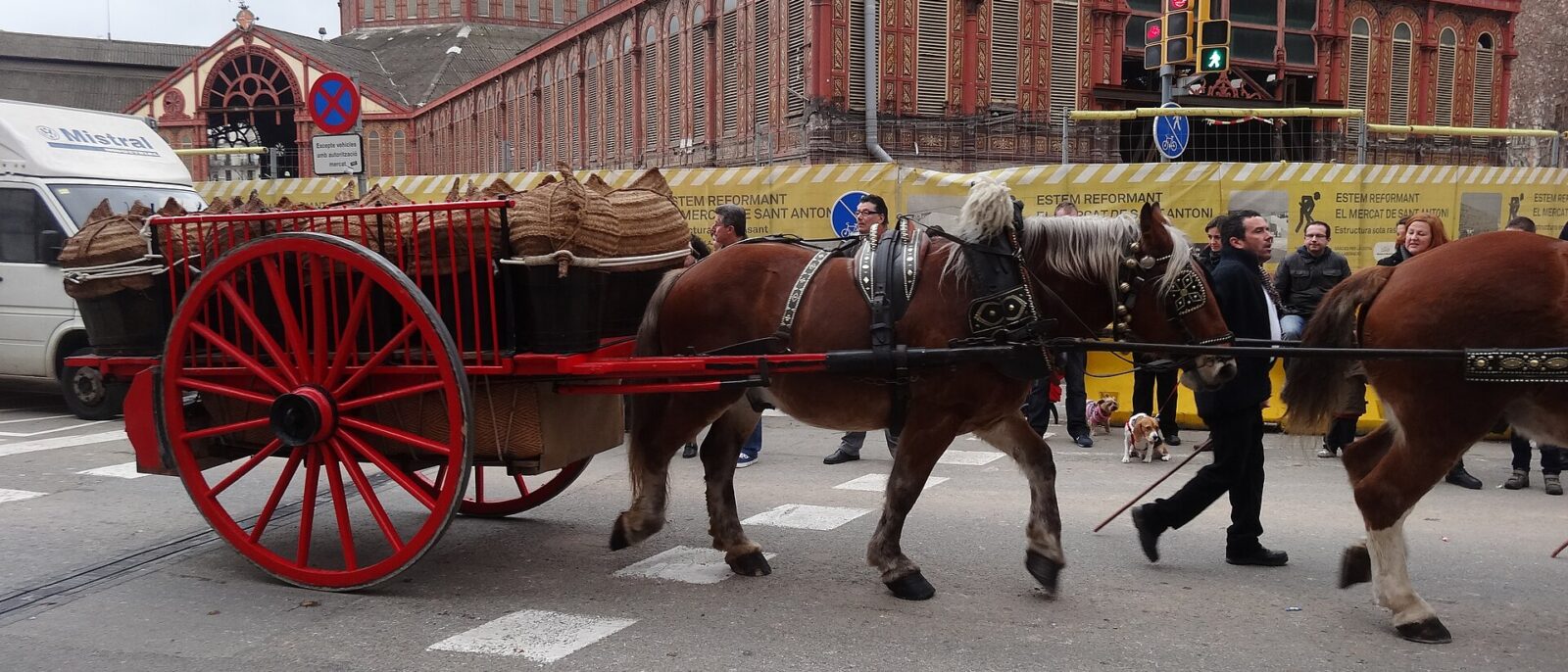
Sant Antoni Abat, whose feast falls on 17 January, is the patron saint of animals, and the neighbourhood that bears his name celebrates with one of the oldest traditions in the city: the Cavalcada dels Tres Tombs. Hundreds of horses, donkeys and mules, many pulling carts and carriages, parade through the streets of Sant Antoni, the riders in traditional dress, the harnesses polished and hung with bells and plumes. The name means “three turns”: the procession traditionally circled the neighbourhood three times.
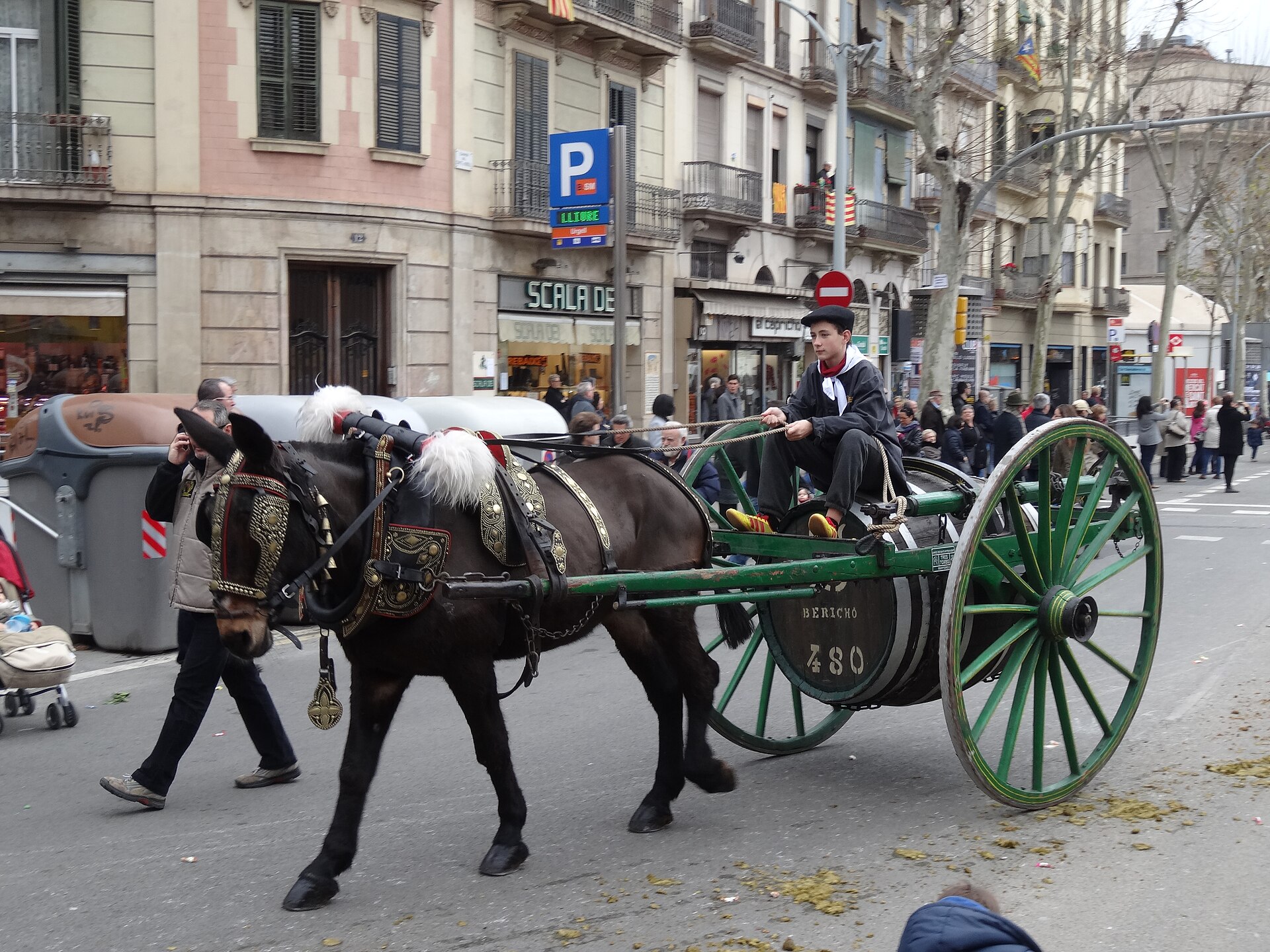
The parade is held on a Saturday in the second half of January, with the opening proclamation in the morning outside the Escola Pia de Sant Antoni. The 2026 edition, the 201st, was set for 24 January; it was rained off and held in May instead, a useful reminder that January dates depend on the weather. The route loops through the neighbourhood’s streets, along the Rondes and the Paral·lel. It is free, local and delightful, and a very good morning to combine with breakfast in the Mercat de Sant Antoni.
Our Sant Antoni neighbourhood guide has the rest of the area.
Calçot season begins
January is when Catalonia’s favourite winter food ritual gets going. Calçots are long, mild spring onions, grown by earthing up the stems so that they stay white and sweet. They are grilled over a fierce fire of vine cuttings until the outsides are black, wrapped in newspaper to steam, and then eaten by hand: you strip off the charred outer layer, dip the soft white centre in salvitxada or romesco sauce, a red sauce of roasted peppers, tomatoes, nuts and garlic, tip your head back and lower it in. Bibs are provided, and needed. A proper calçotada continues with grilled lamb and sausage, and wine from a porró.
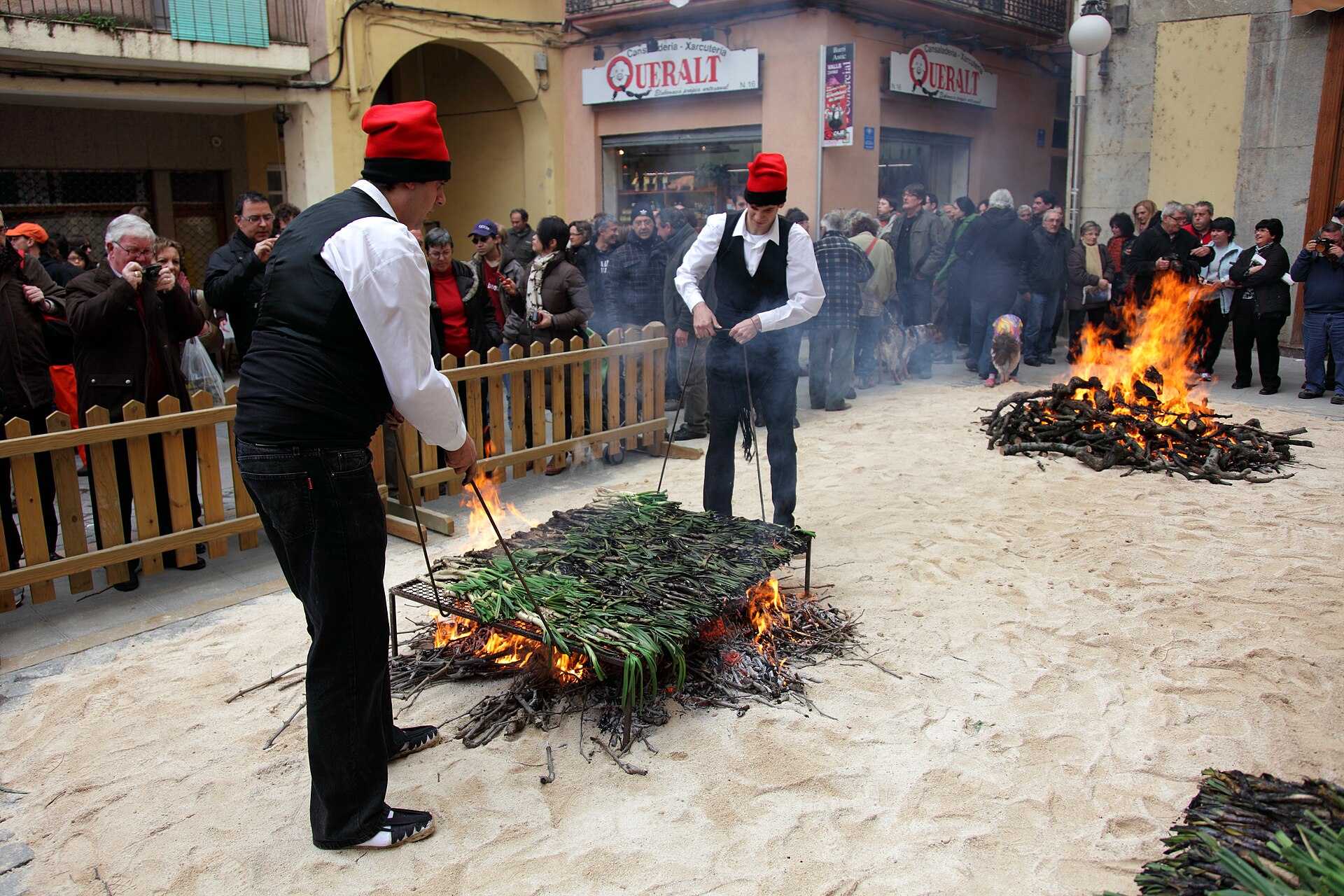
The calçot comes from Valls, in the province of Tarragona, and its Gran Festa de la Calçotada is traditionally held on the last Sunday of January, which in 2027 means Sunday 31 January. There are grilling contests, eating contests and a great deal of smoke. It is a long day trip from Barcelona, so check transport before you commit. Closer to home, many Catalan restaurants in the city serve calçots through the season, and a weekend calçotada at a country restaurant in the hills outside the city is a classic local outing. Our Catalan cuisine guide covers the rest of the winter table.
What January is good for
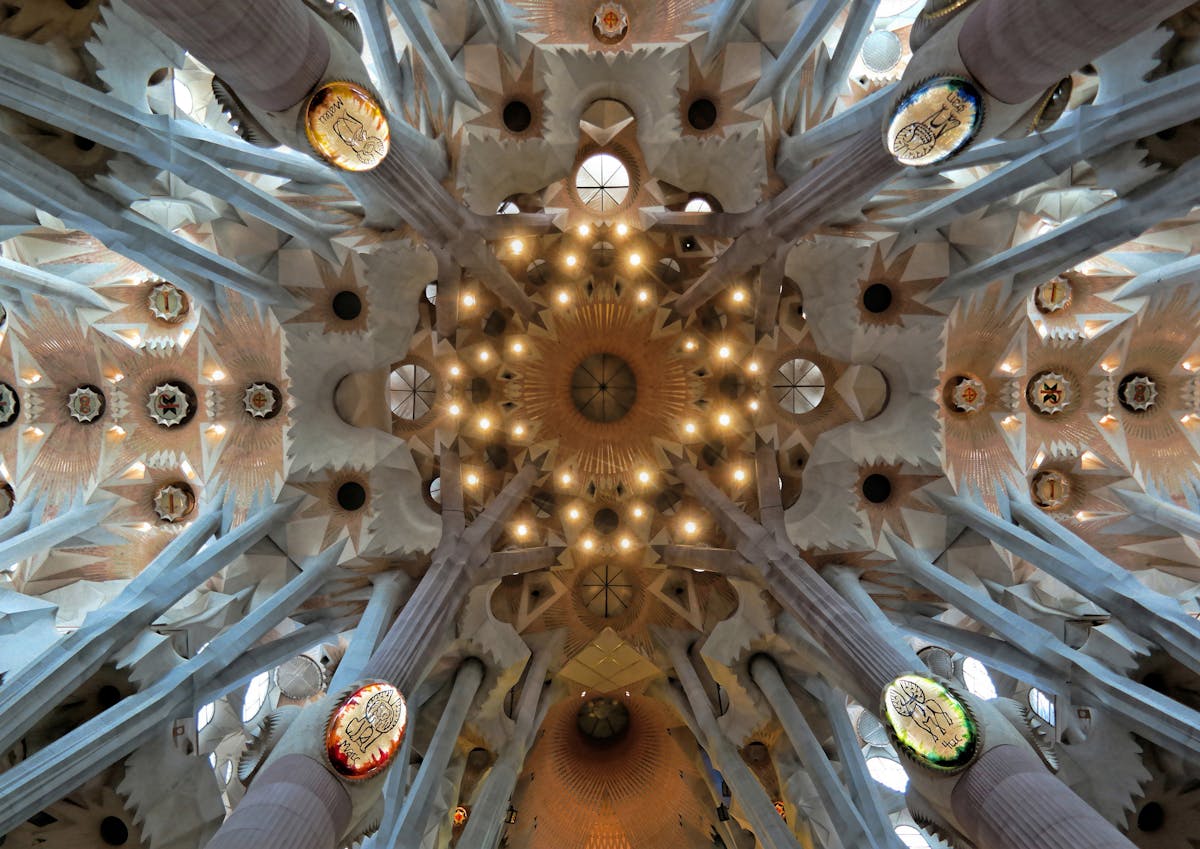
- The Sagrada Família. Queues are the shortest of the year after the first week, and the low winter sun does beautiful things to the stained glass: cool blues and greens on the east side in the morning, and deep reds and oranges pouring through the western windows in the afternoon. Book an afternoon slot. Our Sagrada Família guide has the tickets.
- Museums. January is museum season. The Picasso Museum, the MNAC, the Miró and the rest are at their quietest, and a first-Sunday visit on 3 January gets you in free at several of them. Our museums guide and Picasso Museum guide have the details.
- The Gaudí houses and Park Güell. Casa Batlló, La Pedrera and the Park Güell terrace are all far more enjoyable without the summer crowds, and you can often book the day before.
- Eating. Tables at good restaurants appear without weeks of notice, the winter menus are at their heartiest, and calçots are coming into season.
- Football. The league season is in full swing. Our guide to seeing FC Barcelona play covers tickets.
- Walking. Cool, clear days are perfect for covering long distances on foot, from the Gothic Quarter to the Eixample to Gràcia, and for the hills of Collserola and Montjuïc.
- Day trips inland. Montserrat on a clear January day is spectacular, if cold at the top; Girona is lovely and quiet. Our day trips guide covers both. Serious snow is about three hours away in the Pyrenees, where La Molina is reachable by train.
What January is bad for
- The beach. The sea is about 13 °C. A walk along the promenade on a sunny day is lovely; a swim is for the brave and the local winter-swimming clubs.
- Long evenings outdoors. It is dark by about 17:30 to 18:00 and cold soon after. Terraces have heaters, but this is indoor dining season.
- The Magic Fountain. The fountain has traditionally paused for maintenance early in the year. Check before you go; our Magic Fountain guide has the current pattern.
- Sunsets from the Bunkers. The Bunkers del Carmel close at 17:30 in winter, and in January the sun sets just after. Go for the clear morning views instead; our Bunkers del Carmel guide explains the rules.
- The Costa Brava. The coastal towns are beautiful in winter but many hotels, restaurants and beach bars close for the season.
- Sunday shopping. See above: shops close on Sundays in January.
Crowds and prices
The first few days of January are busy: New Year visitors, Spanish families on their Christmas break and the Three Kings all overlap. From about 7 January, when Spanish schools go back, the city empties out, and the rest of the month is the quietest of the year. Only a handful of big trade fairs change the picture, and the largest of them, the Mobile World Congress, falls in late February or early March, not January.
That makes January one of the best-value months to visit. Hotel rates are at or near their annual low, flights are cheap outside the New Year and Reis weekends, and you will rarely need to book restaurants more than a day ahead. One cost does not fall: Barcelona’s tourist tax, which since April 2026 runs from €6 per person per night in a hostel to €12 in a five-star hotel, plus VAT, for the first seven nights of a stay. Our tourist tax guide has the full table, and our Barcelona hotels guide covers where to stay.
Four days in January: a sample plan
The short days shape a January trip. Plan to be indoors from about 17:30, save museums for the late afternoon and use the bright middle of the day for walking.
- Day one: the old city. The Gothic Quarter and El Born in the morning, lunch at a market counter, the Picasso Museum in the afternoon, and Santa Maria del Mar as the light fades. Dinner in El Born.
- Day two: Gaudí. Park Güell in the morning, then down through Gràcia for lunch, and the Sagrada Família on an afternoon slot for the western light through the glass. Evening on Passeig de Gràcia with the Christmas lights, if they are still up, or Casa Batlló by night.
- Day three: Montjuïc. The MNAC in the morning, the Fundació Joan Miró after lunch, and the view from the castle before dark. Dinner in Poble-sec.
- Day four: out of town, or into the markets. A day trip to Montserrat or Girona, or a slow Saturday of the Sant Antoni market, the Tres Tombs if it falls that day, and the sales.
Our rainy day guide has the backup plan if the weather turns.
Is January a good time to visit Barcelona?
Yes, if you come for the city rather than the climate. January gives you the Sagrada Família, the Gaudí houses and the great museums without the crowds that make them hard work for most of the year, at the lowest prices of the year, with clear light and a calendar of genuinely local events. The Three Kings parade alone is worth planning a trip around if you have children.
No, if what you want is Mediterranean sunshine, long evenings on terraces and the beach. For that, come from late May onwards, and see our month-by-month guide to pick the right month.
And if you can only come in the first week, embrace it: the Kings, the tortell, the lights and the first day of the sales make early January a festival in its own right.
Frequently asked questions
Is Barcelona warm in January?
Mild by northern European standards, cool by Mediterranean ones. Daytime highs average about 14 °C and nights drop to around 5 or 6 °C. Sunny days are common and can feel pleasantly warm at lunchtime, but evenings are cold and buildings can feel chilly inside.
Can you swim in Barcelona in January?
Only if you are very hardy. The sea is about 13 °C. Local winter-swimming clubs do it, and a few visitors join them for the story, but January is a month for walking along the beach rather than going in.
Does it rain a lot in Barcelona in January?
No. January averages about 40 mm of rain spread over roughly four days, and around five hours of sunshine a day. Rain, when it comes, can be heavy, so carry a small umbrella.
Is Barcelona busy in January?
The first week is busy with New Year and Three Kings visitors. After about 7 January the city is at its quietest of the whole year, with the shortest queues at the major sights.
Is January the cheapest time to visit Barcelona?
It is one of the cheapest, with hotel rates at or near their annual low and cheap flights outside the holiday weekends. The tourist tax still applies at the same rates all year.
What happens in Barcelona on 5 and 6 January?
On the evening of 5 January the Three Kings arrive by sea and parade through the city, throwing sweets to the crowds, in the Cavalcada de Reis. 6 January, Epiphany, is a public holiday when children open their presents; most shops close and families gather for lunch and a tortell de Reis cake.
When do the January sales start in Barcelona?
The winter sales traditionally begin on 7 January, the day after the Three Kings, and run until late February or early March. Shops are closed on Sundays at this time of year.
Are shops open on Sundays in Barcelona in January?
Generally no. Sunday opening in the city’s tourist zones is only allowed between mid-May and mid-September. In January most shops close on Sundays, as they also do on the 1 and 6 January holidays.
What should I pack for Barcelona in January?
A warm coat, layers you can take off indoors, a scarf, a compact umbrella, comfortable shoes with some grip and sunglasses for the bright, low winter sun.
Is the Magic Fountain running in January?
The fountain has traditionally paused for its annual maintenance early in the year, so it may not be running in January. Check the city’s official schedule before planning an evening around it.
What is the Tres Tombs?
A traditional horse and carriage parade in the Sant Antoni neighbourhood, held on a Saturday in the second half of January in honour of Sant Antoni Abat, the patron saint of animals. It is free to watch and has been held for more than two hundred years.
For the month before, see Barcelona in December: the Christmas fairs by the cathedral and the Sagrada Família, the lights, the Catalan Christmas traditions from the caganer to the Tió, and the quiet, good-value weeks before the holidays.
Related Barcelona Guides
- Barcelona month by month — the whole year at a glance.
- The best time to visit Barcelona — how to choose your season.
- Christmas in Barcelona — the run-up to the Three Kings.
- New Year’s Eve in Barcelona — how the year starts.
- Barcelona shopping — where to spend the sales.
- Sant Antoni — the neighbourhood of the Tres Tombs.
- Barcelona’s best museums — for the short winter afternoons.
- Day trips from Barcelona — Montserrat, Girona and beyond.
Photo Credits
Horses at the Tres Tombs by the Mercat de Sant Antoni: Tres Tombs in Sant Antoni, 2014 Barcelona 08 by Jordiferrer, CC BY-SA 3.0, via Wikimedia Commons.
Barrel cart at the Tres Tombs: Tres Tombs in Sant Antoni, 2014 Barcelona 01 by Jordiferrer, CC BY-SA 3.0, via Wikimedia Commons.
Calçotada in Valls: Calçotada a Valls (Catalonia) by flydime, CC BY-SA 2.0, via Wikimedia Commons.