We get commissions for bookings made through this post. Booking links, and any accommodation options shown on the page, are handled by a partner that adds commission tracking automatically. It never costs you more, and it never affects what we recommend. Affiliate disclosure
Barcelona has more hotel beds per resident than almost any comparable European city, and it is still the most expensive place in Spain to sleep. The average room went for €195 a night across the first half of 2026, ahead of Madrid, ahead of Seville, ahead of anywhere else in the country. Finding the best hotels in barcelona is therefore less about spotting a hidden gem than about understanding what each price band actually buys you here — because the gap between a good €160 four-star and a bad one is enormous, and both of them will look identical on a booking site. This page is about which property to book. If you have not yet settled on a district, start with our guide to where to stay in Barcelona, which compares the neighbourhoods themselves; come back here once you know roughly which part of town you want to wake up in.
What follows covers every accommodation type the city offers — five-star landmarks, the enormous four-star middle, boutique and design hotels, aparthotels, hostels, and what is left of the tourist-flat market after the licence phase-out. It also covers the tourist tax, which rose sharply in April 2026 and now adds a meaningful amount to every bill. Prices were checked in September 2026 and move constantly with season and demand; treat them as the right order of magnitude rather than a quote.
What a Barcelona hotel actually costs
These are realistic all-in nightly rates for a double room, before breakfast, in shoulder season. Add 25–60% for July, August and the big trade-fair weeks; subtract 20–30% for January and February.
| Category | Typical rate | Tourist tax per person per night | What you actually get |
|---|---|---|---|
| Hostel dorm bed | €28–55 | €6.00 | A bed, a locker, a shared bathroom, a social scene |
| Budget hotel / pensió | €75–120 | €7.00 | Small, clean, often no lift, frequently no air-conditioning |
| Three-star | €110–180 | €7.00 | Reliable, compact rooms, decent location, air-conditioning |
| Four-star | €150–280 | €8.40 | The city’s default; rooftop pool is common at the upper end |
| Five-star | €300–700+ | €12.00 | Real service, real space, a genuine sense of place |
| Aparthotel (2 people) | €130–250 | €7.00 | A kitchen, a washing machine, more room, less service |
| Licensed tourist flat | €140–300 | €9.50 | Space and independence, but a shrinking and legally fraught market |
Note what the tax column does to a family holiday. Two adults in a four-star for five nights pay €84 in tax on top of the room rate, and 10% VAT is charged on the tax itself. Our Barcelona tourist tax guide has the full band table and the exemptions — under-16s do not pay, and the tax applies only to the first seven nights of any stay.
Understanding the Barcelona market before you book
Why prices are what they are
Barcelona ran at 74% occupancy through the first half of 2026 and 78% across 2025. That is high enough that hotels have very little reason to discount, and it explains why last-minute bargains here are rare in a way they are not in, say, Lisbon or Valencia. The city also stopped issuing new hotel licences in the central districts years ago, so supply is essentially fixed while demand keeps growing.
The practical consequence: book early and the price is the price. Waiting rarely helps. The exception is the deep off-season, when a genuinely quiet mid-January Tuesday can produce a 40% discount on a four-star that would be €260 in June.
The seasons that matter
- Peak (June–September, plus Easter): everything is full and everything is expensive. August is slightly softer than July because the city itself empties, but the beach districts stay busy.
- Shoulder (April–May, October–early November): the sweet spot. Good weather, sane prices, and the museums are bearable. Our best time to visit guide makes the case in more detail.
- Low (mid-November–March, excluding Christmas and New Year): the cheapest rooms of the year, and a perfectly good time to visit if you are here for architecture and food rather than beaches.
- Congress weeks: the wildcard. Mobile World Congress in late February, the Smart City Expo, ISE and the big medical congresses can triple rates across the whole city for four days. Check the Fira Barcelona calendar before you fix dates — this catches out more visitors than anything else on this page.
The tourist flat phase-out, and why it matters to hotel prices
Barcelona is dismantling its short-term rental sector. All 10,101 remaining licences expire in November 2028 and none will be renewed; no new licences have been issued for years; several thousand flats have already returned to the residential market. Platforms must remove listings without a valid national registration number within 48 hours of an order, and the fines for operating unlicensed run to €600,000.
For visitors this has two consequences. First, the flat you book must show a licence number — an HUT code — or you are risking a cancellation you cannot appeal. Second, as that supply disappears, hotel prices have only one direction to go. Our guide to the Barcelona Airbnb ban explains what is legal, what is not, and the one workaround that remains: stays of 32 nights or more fall outside the tourist-accommodation rules entirely and are still perfectly legal.
The property types, honestly assessed
Five-star and grand luxe
Barcelona’s top end is unusually good, because a lot of it is housed in buildings that were remarkable before they were hotels. This is the one city where paying for a five-star buys you something you cannot get in a four-star: a Domènech i Montaner staircase, a Frank Gehry fish on the roof of the block, a rooftop pool with the whole Eixample laid out below it.
Names worth knowing, roughly in order of character rather than price:
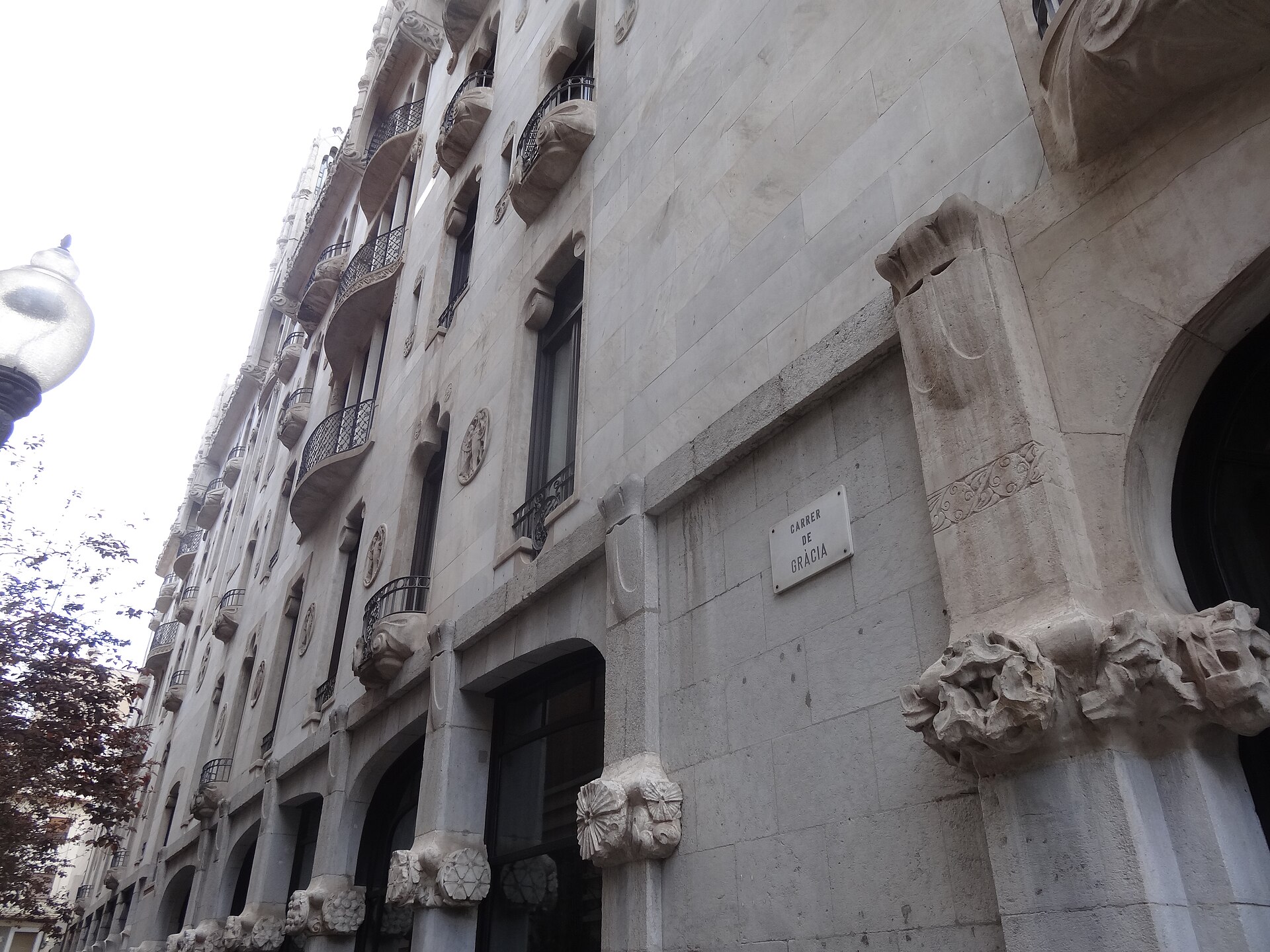
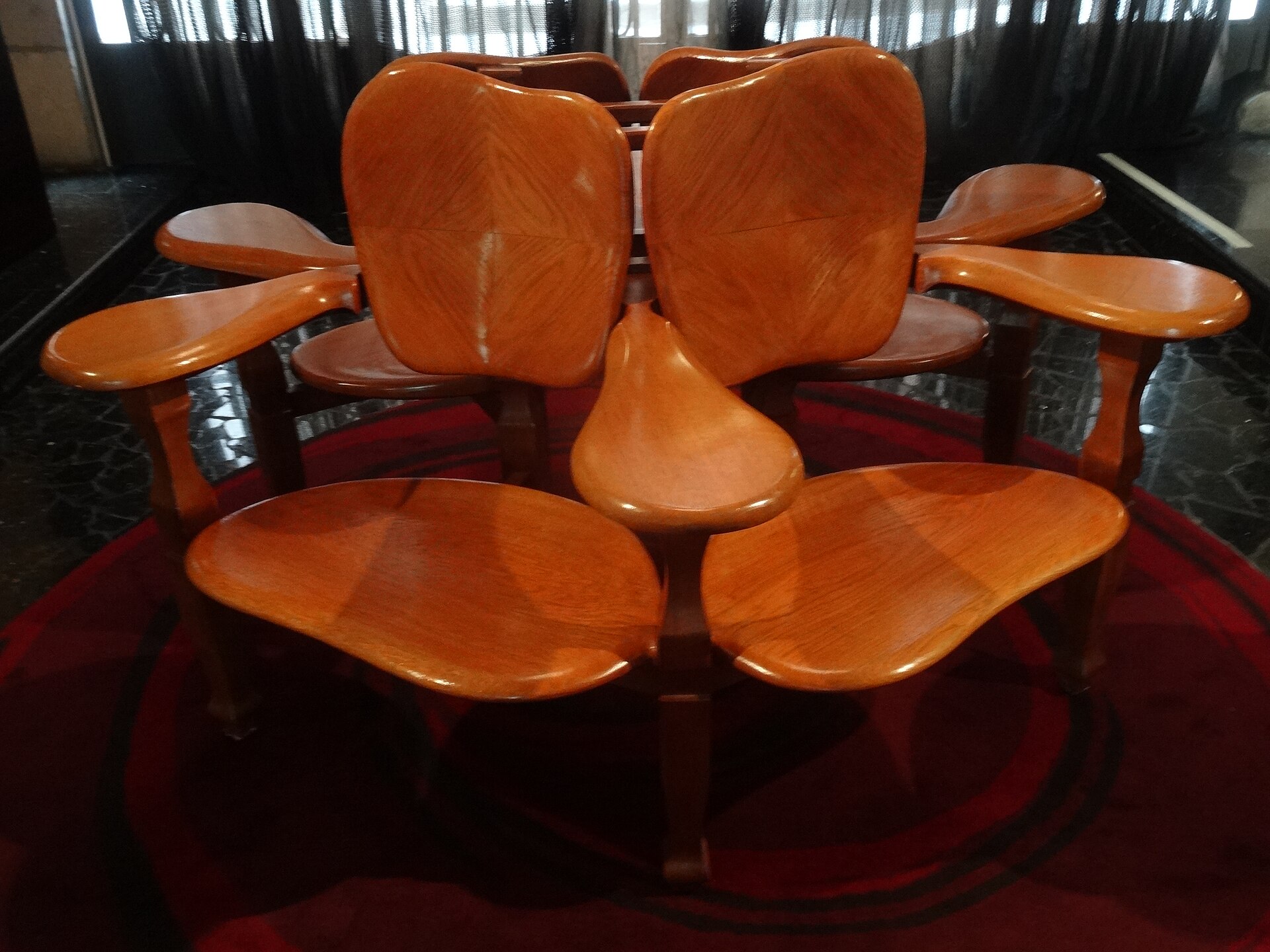
- Casa Fuster (top of Passeig de Gràcia) — a 1908 Domènech i Montaner mansion with a jazz café in the old ballroom. Rooms are smaller than the price suggests; the building is the point.
- El Palace (Gran Via) — the old Ritz, opened 1919, formal in a way almost nothing else in the city is. Roman-style baths in some suites.
- Mandarin Oriental (Passeig de Gràcia) — the most polished service in Barcelona, in a converted bank. Excellent if you want international five-star standards rather than local character.
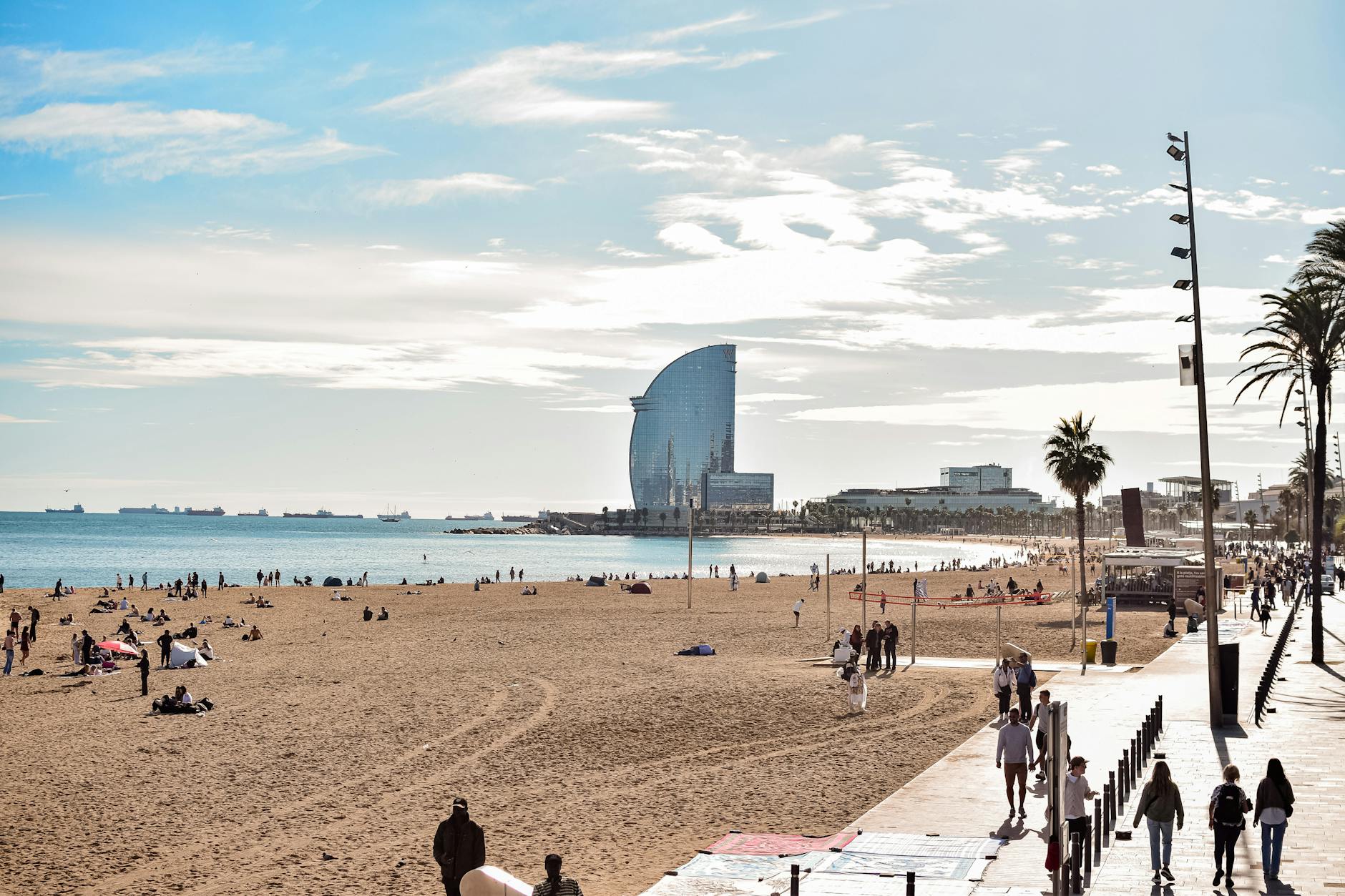
- Hotel Arts and W Barcelona (waterfront) — both landmark towers, both with the best pools in the city, both a long way from the medieval centre. Choose these if the beach matters more than the Gothic Quarter.
- The Serras (Port Vell) — small, discreet, with a rooftop that looks straight down the harbour. Better value than its neighbours.
- Cotton House (Gran Via) — the former cotton-makers’ guild, and one of the loveliest interiors in the city.
The honest note: Barcelona five-star rooms are frequently smaller than five-star rooms elsewhere, because the buildings are old and protected. If floor area matters to you more than provenance, a modern four-star will give you more of it for half the money.
Four-star: the Barcelona default
Something like half the city’s rooms are four-star, and this is where most visitors should be looking. At €150–280 you get air-conditioning, a lift, a proper bathroom, a reasonable breakfast and — increasingly — a small rooftop pool, which in July is not a luxury but a survival tool.
The variation within the band is enormous. A four-star on Gran Via in a converted 1920s block and a four-star in a 2018 build near Glòries carry the same star rating and offer completely different experiences. Things that reliably separate the good from the mediocre:
- Room orientation. Eixample blocks have an inner courtyard. Interior rooms are dark and silent; exterior rooms are bright and, on a main street, loud. Neither is better — but you should choose deliberately rather than be assigned.
- The rooftop. A “rooftop pool” in Barcelona ranges from a genuine 15-metre lap pool to a plunge tub that fits four people. Look at the photographs properly.
- Breakfast. Barcelona hotel breakfast is usually €18–28 and usually not worth it, because the city’s cafés do better for €5. Book room-only and go out.
- The lift. Older buildings have tiny, slow lifts, occasionally one that only reaches the floor below yours. If you have mobility needs or heavy cases, ask before booking — our accessible Barcelona guide covers this properly.
Three-star and the small independents
Barcelona’s three-star band is better than the number implies, and it is where the value is. €110–180 buys you a compact, clean, air-conditioned room in a central location, often in a family-run property that has been there for decades. What you lose is space, a bar, room service and any kind of concierge.
The design-led small chains are worth knowing here: the Praktik group put well-designed small hotels into old Eixample flats — one built around a bakery, one around a wine bar — at three-star prices. Yurbban does something similar with rooftops and a strong sustainability line. Casa Bonay, on Gran Via, is the design-hotel benchmark for the city and prices just above the band.
Aparthotels and serviced apartments
An underrated category, and often the right answer for families and stays of four nights or more. You get a kitchen, usually a washing machine, considerably more floor area than a hotel room, and daily or near-daily cleaning — with the legal certainty that a tourist flat no longer offers. Rates run €130–250 for two, and the marginal cost of a third and fourth person is far lower than booking two hotel rooms.
The trade-off is service. Reception hours may be limited, there is rarely a restaurant, and nobody will find you a taxi at 6am. For a family with young children who need a fridge, a kettle and somewhere to put the buggy, that is a good trade. Our family hotels guide goes into the specifics.
Hostels
Barcelona has one of Europe’s strongest hostel scenes, and the modern ones are a long way from the stereotype: pod beds with curtains and individual lights, decent kitchens, rooftop terraces, and private twin rooms at three-star prices minus the three-star rate. A dorm bed runs €28–55 depending on season and how many people are in the room, and the tourist tax on a hostel is the lowest band at €6 per person per night.
The key distinction is party versus quiet. Some hostels are explicitly social — pub crawls, bar, communal dinners — and some are explicitly not, and booking the wrong one is the single most common hostel mistake. Look for the words “party” or “social” in the description, and read the reviews for the word “sleep”.
Tourist flats: what is left, and the rules
Licensed holiday flats still exist and will until November 2028. If you book one, three checks are non-negotiable:
- The listing must display an HUT licence number. No number, no booking — the platform is legally required to remove it, and it can vanish between your reservation and your arrival.
- The building must permit it. Some residents’ associations have banned tourist lets outright, and arriving to a hostile neighbour who calls the police is not a good start to a holiday.
- The tax applies. Holiday flats pay €9.50 per person per night, more than a four-star hotel, and hosts do not always mention this at booking.
For a stay of 32 nights or longer, none of this applies — long-term lets are ordinary residential tenancies and are entirely legal. If you are coming to Barcelona for a month or more, that is the route.
Choosing by traveller type
First-time visitors, three or four nights
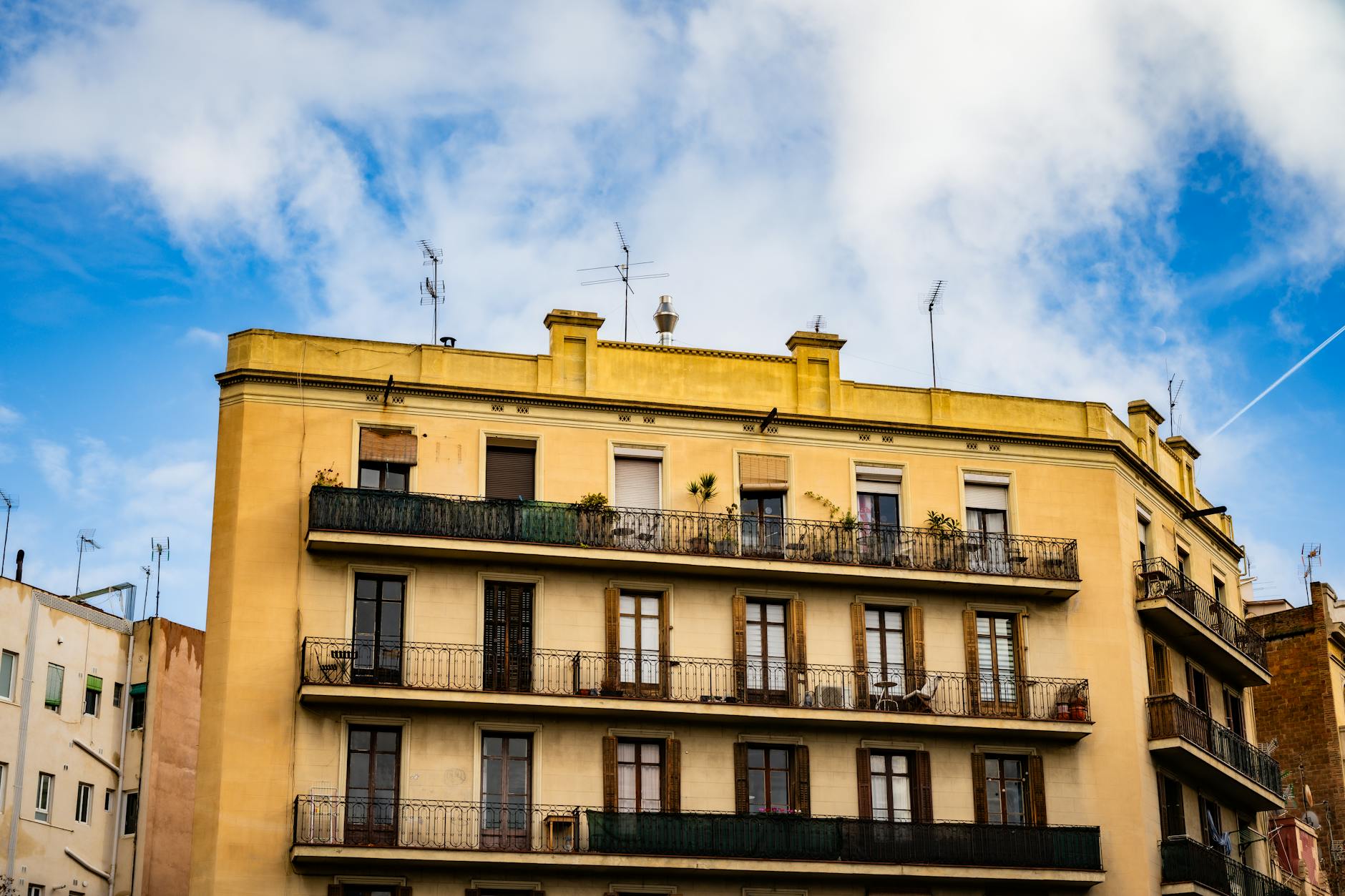
Book a four-star in the Eixample, ideally within a few streets of Passeig de Gràcia or Rambla de Catalunya. It is central without being in the tourist crush, it is safe at night, it is well connected on the metro, and it puts you within walking distance of both the Gothic Quarter and the Sagrada Família. Anything in the €160–220 band here will be perfectly good.
Couples
The small design hotels in El Born and the upper Eixample are the strongest category — enough character to feel like a treat, small enough not to feel like a conference. A rooftop is worth paying for. See our romantic Barcelona guide for the rest of the evening.
Families
Aparthotel, or a four-star with connecting rooms — and check the pool is open in your month, because a surprising number close from October. Avoid the Gothic Quarter with a pushchair; the streets are cobbled, narrow and crowded. Barceloneta and the Vila Olímpica work well if the beach is part of the plan.
Solo travellers
A hostel with private rooms gives you the social option without the dorm, and Barcelona has several. Failing that, the three-star band is where solo rates are least punishing — many four-stars charge nearly the double rate for single occupancy. Our solo travel guide covers the rest.
Business and congress visitors
If you are here for the Fira, stay near it rather than in the old town: the Gran Via venue is at L’Hospitalet, twenty minutes out on L9 Sud, and the hotels around Plaça d’Espanya and Sants halve your commute. Book the moment your dates are confirmed — congress weeks sell out months ahead and rates triple.
Longer stays
Over a month, take a residential let rather than anything tourist-licensed. It is legal, it is dramatically cheaper per night, and you avoid the tourist tax entirely after the seventh night in any case. Gràcia, Sant Antoni and Poble-sec all work well for this — see Gràcia, Sant Antoni and Poble-sec.

How to book well
When to book
- Peak summer and Easter: three to five months ahead. The good four-stars in the good streets go first.
- Shoulder season: six to eight weeks is usually enough, and you will occasionally do better closer in.
- Congress weeks: as soon as you know. There is no late strategy that works.
- Deep winter: two to three weeks, and watch for genuine last-minute discounting, which does exist in January.
Direct versus the booking sites
Use the aggregators to find the property and to read the reviews, then check the hotel’s own site before you book. Independent Barcelona hotels frequently match or beat the platform rate and add something — free breakfast, a late checkout, a room on a higher floor — because they save 15–18% in commission. Chains almost always have a best-rate guarantee. It takes one extra browser tab.
The refundable-rate question
Non-refundable rates typically save 10–15%. In a city that runs at 75% occupancy, that is a genuine saving and the risk is real. Our view: take the non-refundable rate only if your flights are also non-refundable and your dates are certain. Otherwise the flexible rate is worth the premium, particularly given how often Barcelona trips get reshaped around a football fixture or a festival announcement.
Reading the reviews properly
Ignore the score and read the one-star and three-star reviews from the last six months. In Barcelona specifically, look for these words:
- “Noise” — the single biggest complaint in this city. Balconies over Gran Via, Aribau or Rambla de Catalunya are loud until 2am, and Spanish street life does not observe northern European bedtimes.
- “Air conditioning” — some older hotels run centrally controlled systems that switch off in October regardless of the weather, and Barcelona can hit 28°C in early November.
- “Interior room” — reviewers complaining about a dark, windowless-feeling room are describing an Eixample courtyard room, which is a real thing and worth knowing about before arrival.
- “Renovation” — half this city is permanently under scaffolding. Recent reviews will tell you if your hotel is.
Things worth asking before you arrive
- Is there a lift, and does it reach every floor?
- Is the rooftop pool open in my month, and is it hotel-guests-only or a public bar?
- Is early check-in or late checkout possible, and at what cost? Barcelona flights land at awkward hours.
- Is luggage storage available before check-in and after checkout? Almost always yes, and it saves a wasted half-day.
- Does the room rate include the tourist tax? It almost never does. Budget for it separately.
Where the hotels are, in one paragraph each
This is the short version; the full comparison lives in where to stay in Barcelona.
- Eixample — the biggest concentration of four- and five-stars, grid streets, wide pavements, excellent metro. The default recommendation and rightly so.
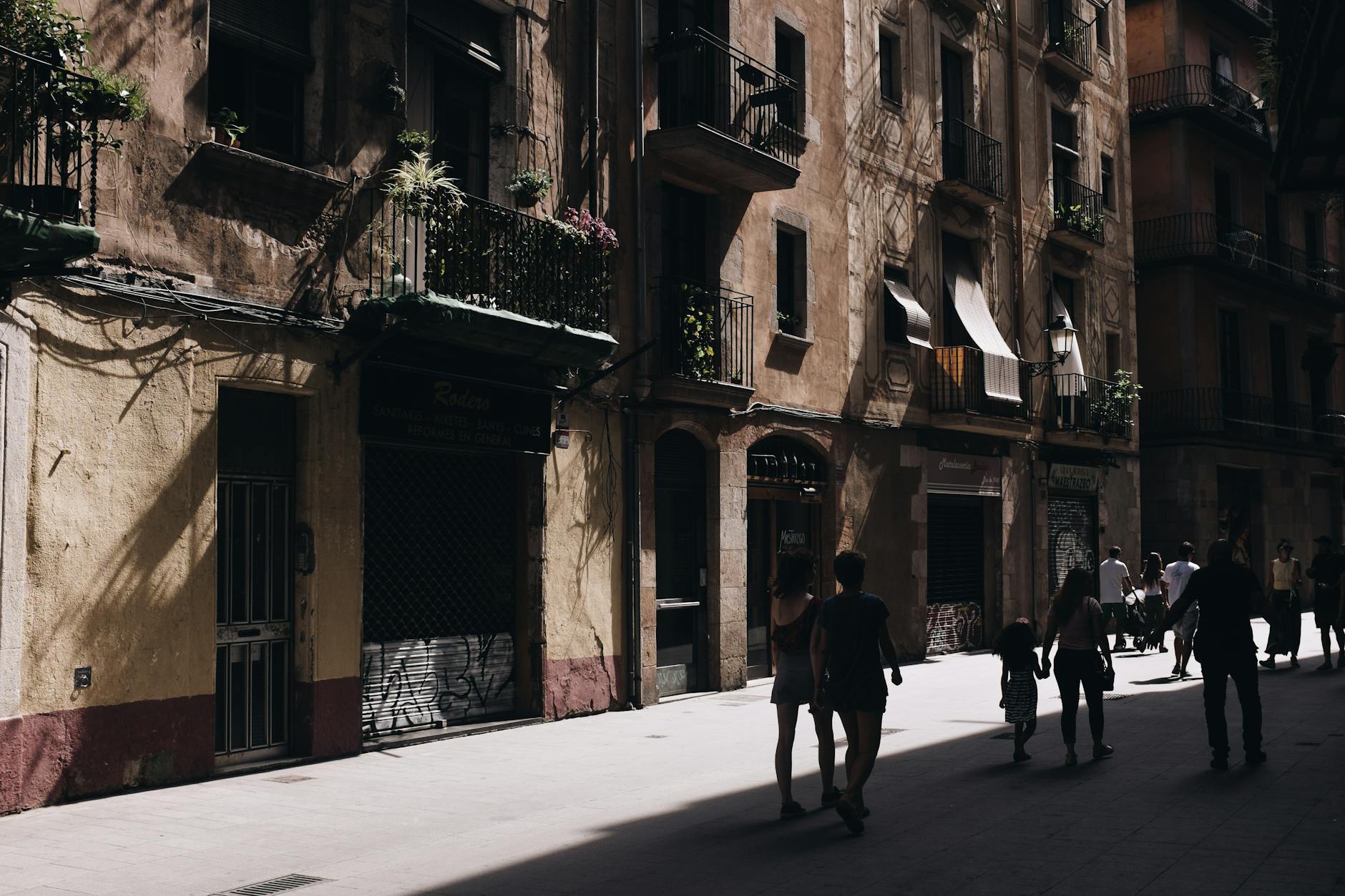
- Gothic Quarter — atmospheric, central, and noisy. Small hotels in old buildings, frequently without lifts. Wonderful for a couple, awkward with luggage or children.
- El Born — the best food and the best small hotels, slightly quieter than the Gothic Quarter, a short walk from everything.
- El Raval — the cheapest central rooms, a genuinely interesting neighbourhood, and the part of the old city where you should pay attention at night.
- Barceloneta and the Vila Olímpica — beach access, the two landmark towers, and a twenty-minute walk or short metro ride from the historic centre.
- Gràcia — village squares, independent shops, very few large hotels but plenty of small ones and aparthotels. Great for a second visit.
- Sants and Plaça d’Espanya — functional rather than charming, but well priced and unbeatable for the Fira and for onward trains, including the high-speed line to Madrid.
Things Barcelona hotels do differently
- Check-in is 15:00 and checkout is 11:00 or 12:00, and both are enforced more firmly than in northern Europe. Store your bags and go out.
- Passport registration is mandatory. Spanish law requires hotels to record and report guest identity documents. Have passports out at check-in; it is not optional and not negotiable.
- The tourist tax is usually collected at checkout, in cash or on the card, and it will not have appeared on your booking confirmation.
- Twin beds mean two single mattresses pushed together more often than not. If you want a genuine king, specify it.
- Air-conditioning may be seasonal. Central systems in older buildings switch between heating and cooling on a calendar, not a thermostat.
- Tipping is not expected in hotels beyond a euro or two for a porter. Our money and payments guide covers the norms.
The honest verdicts
A few things this site will say that hotel-comparison pages generally will not.
Hotel breakfast is usually a waste of money. €22 for a buffet in a city where a proper café breakfast — coffee, orange juice, pa amb tomàquet — costs €5 is poor value. Book room-only unless the breakfast is genuinely famous.
A Las Ramblas address is not a good address. It sounds central and it is, but it is also the noisiest, most pickpocketed and most touristed strip in the city. Two streets in either direction gets you a better hotel for less money. Our safety guide explains why the specific geography matters.
“Sea view” often means a sliver. Outside the two waterfront towers and a handful of Barceloneta properties, a sea view in Barcelona is frequently a diagonal glimpse between buildings. Look at the photographs from the room, not the ones from the roof.
Five-star is not automatically better here. The city’s four-star band is unusually strong, and a well-chosen €200 room will beat a poorly chosen €400 one comfortably. Spend the difference on dinner.
Location beats amenities on a short trip. On three nights, a fifteen-minute walk saved each way is worth more than a spa you will never use. On ten nights, the reverse starts to apply.

What the star ratings actually mean here
Spanish hotel classification is regional, and in Catalonia it is a regulated scheme based on facilities rather than on service quality. That distinction matters more than most visitors realise. A star rating tells you whether there is a lift, whether rooms have a private bathroom of a given size, whether there is 24-hour reception and whether room service exists. It tells you almost nothing about whether the staff are any good, whether the beds are comfortable or whether the place has been decorated this decade.
So a tired four-star in a 1970s block and a beautifully run four-star in a converted modernista flat carry the same badge. The categories also include a “superior” tier at four stars, and a gran luxe designation above five, which the tourist tax treats as its own band. Meanwhile pensions, hostals and fondes are separate legal categories entirely — usually small, family-run and considerably cheaper, and in Barcelona’s old town frequently very good. Do not skip a place because it calls itself a pensió; some of the best-value rooms in the Gothic Quarter are in exactly those.
A note on where the hotels came from
Barcelona had barely a hundred hotels before 1992. The Olympic Games rebuilt the waterfront, put up the two towers at Port Olímpic and roughly doubled the city’s capacity in five years, and the twenty years afterwards did it again. By the mid-2010s the growth had become politically contentious, and the city adopted a special urban plan — the PEUAT — that froze new tourist accommodation in the central districts entirely.
That freeze is why the market looks the way it does now: no new central supply, high occupancy, high rates, and a slow drift of new building towards the outer districts and L’Hospitalet. It is also why so many of the interesting properties are conversions. When a developer cannot build a new hotel in the Eixample, the only way in is to buy an old building and change its use — which is how the city ended up with hotels in a cotton exchange, a bank, a bakery and a modernista mansion.
Roughly what you will pay, by district
Indicative four-star double-room rates in shoulder season. These are the numbers to sanity-check a booking site against — if a four-star in the Eixample is showing at €95, something is wrong with it, and if one in El Raval is showing at €280, you are paying for a brand rather than a location.
| District | Typical four-star rate | Walk to Plaça de Catalunya | Trade-off |
|---|---|---|---|
| Eixample (Dreta, near Passeig de Gràcia) | €180–260 | 5–15 min | Best all-rounder; street noise on the main axes |
| Eixample (Esquerra, near Sant Antoni) | €150–210 | 15–20 min | Better value, more local, fewer landmark buildings |
| Gothic Quarter and El Born | €170–250 | 5–10 min | Atmosphere and noise in equal measure |
| El Raval | €120–180 | 10 min | Cheapest central rooms; be street-aware at night |
| Barceloneta and Vila Olímpica | €180–300 | 20–30 min | Beach on the doorstep, old city a metro ride away |
| Gràcia | €140–200 | 25–30 min | Quiet, residential, very few large hotels |
| Sants and Plaça d’Espanya | €120–180 | 20 min by metro | Functional; unbeatable for the Fira and the trains |
| Poblenou and Glòries | €110–170 | 15 min by metro | Newest buildings, biggest rooms, least character |
Hotels for specific requirements
- Adults-only. A growing category in the Eixample and along the beach, usually marketed as “adults recommended” from 16 or 18. Worth seeking out if you want a quiet rooftop; worth avoiding entirely if you are travelling as a family, since the policy is enforced.
- Pet-friendly. More common than in most Spanish cities, particularly in the mid-range chains, but almost always with a size limit and a nightly charge. Confirm in writing before arrival rather than at the desk.
- Spa and wellness. Real spas — as opposed to a sauna in a basement — are concentrated in the five-star band and the two waterfront towers. Several sell day passes to non-guests, which is often better value than paying for the room.
- Accessible rooms. Newer buildings are genuinely good; converted Eixample blocks vary enormously, and “accessible” sometimes means a wide door and nothing else. Ask specifically about the lift, the bathroom threshold and the width of the entrance from the street. Our accessible Barcelona guide covers the details.
- LGBTQ+ travellers. The Gaixample — the western Eixample around Carrer del Consell de Cent — has a cluster of gay-owned and gay-friendly hotels, and the city as a whole is among the most welcoming in Europe. See our LGBTQ+ Barcelona guide.
- Long-stay and remote work. Aparthotels with proper desks and reliable wifi are a better bet than hotels, and monthly rates are often negotiable directly with the property in low season.
If something goes wrong
Two Barcelona-specific things worth knowing. First, every registered accommodation must hold official complaint forms — fulls de reclamació — and must give you one on request. Asking for one is a recognised escalation and it tends to resolve disputes quickly, because the form goes to the Catalan consumer authority.
Second, if a booking platform cancels a tourist flat on you at short notice because of a licensing problem, you are entitled to a refund but not to a replacement, and finding a last-minute room in this city in season is genuinely difficult. That asymmetry is the strongest practical argument for booking a licensed hotel or aparthotel rather than a flat, quite apart from the legal position. A modest amount of travel insurance covers the gap.
Frequently asked questions
How much does a hotel in Barcelona cost per night?
The citywide average was €195 across the first half of 2026. In practice: €110–180 for a three-star, €150–280 for a four-star and €300–700 for a five-star in shoulder season, with July, August and congress weeks running considerably higher and January and February considerably lower.
What is the best area to stay in Barcelona?
The Eixample for most first-time visitors — central, safe, well connected and full of good four-stars. El Born and the Gothic Quarter for atmosphere, Barceloneta for the beach, Gràcia for a quieter second visit. Our where to stay guide compares them properly.
How much is the tourist tax in Barcelona?
Per person per night since April 2026: €12 in a five-star, €8.40 in a four-star, €7 in most other hotels, €6 in a youth hostel and €9.50 in a licensed tourist flat, plus 10% VAT on the tax. It applies to the first seven nights only, and under-16s are exempt.
Can I still book an Airbnb in Barcelona?
Licensed tourist flats remain legal until their licences expire in November 2028, and any legitimate listing will display an HUT licence number. Unlicensed short lets are being removed from the platforms and carry fines up to €600,000 for the operator. Stays of 32 nights or more fall outside the rules and are unaffected.
When should I book a hotel in Barcelona?
Three to five months ahead for peak summer and Easter, six to eight weeks for shoulder season, and immediately for any date that coincides with a Fira congress. Barcelona runs at around 75% occupancy year-round, so waiting for a discount rarely works outside deep winter.
Is it cheaper to book hotels direct or through a booking site?
Frequently direct, once you account for the extras. Independent hotels save 15–18% in commission and often pass some of it back as free breakfast, a better room or a late checkout. Use the platforms to find and vet the property, then check the hotel’s own site before you confirm.
Do Barcelona hotels have air conditioning?
Almost all three-star and above, yes. Budget hotels and older pensions sometimes do not, and some central systems switch to heating on a calendar date regardless of the actual weather — worth checking if you are visiting in October or May.
Are hostels in Barcelona any good?
Very. The modern ones offer curtained pod beds, rooftop terraces, decent kitchens and private twin rooms, at €28–55 for a dorm bed. The one thing to get right is whether the hostel is a party hostel or a quiet one, because the two experiences have almost nothing in common.
What is an aparthotel, and is it worth it?
A licensed hotel where the units have kitchens and more floor space, sold at roughly four-star prices. For families and for stays of four nights or more it is often the best value in the city, and it carries none of the legal uncertainty of a tourist flat. The trade-off is limited reception hours and no restaurant.
Do I need to show my passport at a Barcelona hotel?
Yes. Spanish law requires accommodation providers to register guest identity documents, and this applies to every guest including children. Have passports accessible at check-in.
Is breakfast worth adding to a Barcelona hotel booking?
Usually not. Hotel breakfast runs €18–28 while a café breakfast a few doors away runs about €5. The exception is a hotel with a genuinely notable breakfast, or a family who would rather not negotiate a café with small children at 8am.
Which Barcelona hotels have rooftop pools?
Many four- and five-stars in the Eixample and the old town, and both waterfront towers. The variable is size and season: some are proper swimming pools open from May to October, others are small plunge pools, and a number close entirely in winter. Confirm both before you book on the strength of a photograph.
Hostels get a section above, but they deserve more than a paragraph — the category has changed enormously here, and the choice between a party hostel and a quiet one matters more than the price does. Our dedicated guide to Barcelona’s hostels segments them by traveller type, with real dorm prices, the security realities and a costed three-night trip.
Related Barcelona Guides
- Where to stay in Barcelona — the neighbourhood-by-neighbourhood comparison that pairs with this page.
- The Barcelona tourist tax — the 2026 bands, the exemptions and how it is collected.
- Barcelona’s Airbnb phase-out — what is legal now, and what happens in 2028.
- Family hotels in Barcelona — connecting rooms, pools and the aparthotel case.
- Barcelona’s neighbourhoods — the character of each district, beyond the hotel question.
- Barcelona on a budget — where the savings actually are.
- The complete Barcelona travel guide — the hub for everything else on this site.
Photo Credits
Hotel Casa Fuster facade: BCN Hotel Casa Fuster 03 by Jordiferrer, CC BY-SA 4.0, via Wikimedia Commons.
Modernist armchairs in the Casa Fuster lobby: BCN Hotel Casa Fuster 05 by Jordiferrer, CC BY-SA 4.0, via Wikimedia Commons.