We get commissions for bookings made through this post. Booking links, and any accommodation options shown on the page, are handled by a partner that adds commission tracking automatically. It never costs you more, and it never affects what we recommend. Affiliate disclosure
The queue for the Picasso Museum forms on one of the narrowest streets in Barcelona, and it is worth knowing before you join it that a good share of the people in it are expecting a different museum. There is no Guernica here, very little Cubism, and nothing resembling a greatest-hits tour of the twentieth century. What the Picasso Museum Barcelona has instead is stranger and, for the right visitor, a great deal better: the most complete record anywhere of how a gifted teenager became Picasso, hung in five medieval palaces a few streets from where most of it was painted.
This guide covers what a ticket costs, how the free slots actually work (every one of them has to be booked, and the booking window is short), the opening hours for both halves of the year, and the part most guides skip, which is which rooms deserve your time and which you can walk through. Prices and hours come from the museum’s own website and were checked in September 2026. Treat them as the right order of magnitude rather than a promise, because Barcelona’s museums adjust both with little notice.
Tickets, hours and free entry at a glance
| Ticket | Price | Who it is for | The catch |
|---|---|---|---|
| General (collection and temporary exhibitions) | €14 online, €15 at the ticket office | Most adult visitors | Timed entry, and capacity is capped |
| Reduced | €7.50 | 18–25s, university students, over-65s, unemployed visitors, Barcelona library card holders | Bring the ID or card that proves it |
| Free by category | €0 | Under-18s, professional tourist guides, holders of a disability card and their companion, accredited teachers and journalists | Book a slot with the rest of your party anyway |
| Free slots | €0 | Anyone | Every one needs an online reservation, released four days ahead |
| Articket BCN | €38 | Anyone visiting three or more of the city’s six big art museums | Only pays back if you actually go to the others |
| Season | Days | Hours | Free window |
|---|---|---|---|
| Winter (29 September 2026 to late March) | Tuesday–Sunday | 10:00–19:00 | Thursday 16:00–19:00 |
| Summer (late March to late September) | Tuesday, Wednesday, Sunday | 09:00–20:00 | — |
| Summer (late March to late September) | Thursday, Friday, Saturday | 09:00–21:00 | 19:00–21:00 |
| All year | First Sunday of the month | Normal hours | All day |
The museum is closed every Monday, and on 1 January, 1 May, 24 June and 25 December. On 24 and 31 December it opens from 10:00 to 14:00 only. The ticket office stops selling half an hour before closing, which on a winter evening means 18:30, and there is no point arriving at 18:45 with a plan.
How the free slots actually work
Free entry to the Picasso Museum is genuinely free, but it is not walk-up. Every free slot must be reserved online, and the reservations open four days before the visit, at 10:00 Barcelona time. Do not count on a walk-up place during a free window: the slots are allocated in advance, and the building’s capacity is capped.
There are four kinds of free window:
- The first Sunday of every month, all day.
- Thursday afternoons in winter, 16:00 to 19:00, from late September to late March.
- Thursday, Friday and Saturday evenings in summer, 19:00 to 21:00, from late March to late September.
- Three open-door days: 12 February, for the Santa Eulàlia winter festival; International Museum Day in May (17 May in 2026); and 24 September, the day of La Mercè.
Four days is not much warning, and the arithmetic catches people out, so here is what it looks like in practice:
| The free slot you want | When the tickets are released |
|---|---|
| Any winter Thursday, 16:00–19:00 | The Sunday before, from 10:00 |
| Sunday 4 October 2026 | Wednesday 30 September, from 10:00 |
| Sunday 1 November 2026 | Wednesday 28 October, from 10:00 |
| Sunday 6 December 2026 | Wednesday 2 December, from 10:00 |
| A summer Friday evening | The Monday before, from 10:00 |
| A summer Saturday evening | The Tuesday before, from 10:00 |
Getting one
Be online at 10:00 on release day. Barcelona runs on Central European Time, which means 09:00 if you are booking from the UK and, for most of the year, 04:00 in New York, which is exactly as appealing as it sounds. Leaving it until the evening of release day is how most people end up with nothing.
Book only through the museum’s own ticketing site, which you reach from the official website. The free slots are not sold anywhere else, and a third-party site offering “free entry” to the Picasso Museum for a fee is selling you a guided tour, a booking service or a misunderstanding. Book every member of your party, including children who would be free in any case, because entry is by time slot and the building has a hard capacity limit.
Is the free slot worth the effort?
If €14 is what stands between you and the museum, yes, without hesitation. The collection is the same at 16:00 on a Thursday as it is at 10:00 on a Tuesday.
The experience is not. The free windows are the busiest hours of the museum’s week, and the rooms that matter most, the Blue Period and Las Meninas, are exactly the ones where crowds pool. A paid ticket for the first slot on a Tuesday or Wednesday morning gets you those rooms at a fraction of the density. If you are between 18 and 25, or a student, the €7.50 reduced ticket makes the scramble for a free slot hard to justify at all.
One more thing worth knowing: plenty of older guides, some of them ranking very well, still promise free entry every Sunday afternoon. That rule has gone. Outside the first Sunday of the month, a Sunday visit costs full price, and people find this out at the ticket desk.
What the collection is, and what it is not
The museum exists because of a friendship. Jaume Sabartés met Picasso in Barcelona in 1899, in the bohemian café circle around Els Quatre Gats, and spent much of the rest of his life as the painter’s secretary, gatekeeper and archivist. It was Sabartés who proposed a Picasso museum in Barcelona and Sabartés who gave it its founding collection, some 574 works he had accumulated over six decades.
It opened in March 1963 in the Palau Aguilar on Carrer de Montcada, and it opened quietly. Franco’s government was not going to throw a party for the painter of Guernica, and the project was pushed through at city level, with the support of the mayor, Josep Maria de Porcioles, rather than celebrated from Madrid. Picasso never saw it. He had left Spain long before, refused to return while Franco lived, and died in France in April 1973, two and a half years before the dictator.
He gave generously all the same. When Sabartés died in 1968, Picasso donated the complete Las Meninas series in his memory. In 1970 he handed over the early work his family had kept in Barcelona for decades: well over 900 paintings, drawings, sketchbooks and schoolboy exercises. His widow, Jacqueline Roque, added 41 ceramics in the early 1980s. The collection now runs to more than 4,200 works.
That history explains the shape of the museum. It is enormously strong on Picasso from about 1890 to 1905, strong on a short stay in Barcelona in 1917, superb on one project from 1957, and thin on almost everything in between. Some things you will not find here:
- Guernica is in Madrid, at the Museo Reina Sofía.
- Les Demoiselles d’Avignon is at MoMA in New York, which is a shame, because its title comes from a street ten minutes’ walk from this building. More on that below.
- The great Cubist canvases are scattered across Paris, New York and a dozen other collections.
- For the full arc of his career in one building, the Musée Picasso in Paris and the Museo Picasso Málaga do that job better.
None of which is a criticism. It is simply a different museum from the one many visitors picture, and knowing that in advance is the difference between an hour of mild disappointment and one of the best things you do in Barcelona.
The rooms worth your time
The permanent collection is hung broadly in chronological order, which means you start with a child and finish with an old man, and the energy you bring to the first rooms is the energy you will not have for the last ones. Pace yourself accordingly.
The boy (1890s)
The early rooms are full of things no museum would hang if the artist had not gone on to be Picasso: charcoal studies of plaster casts, careful drawings of hands and feet, portraits of his parents and his sister Lola, small seascapes from his childhood years in A Coruña, caricatures in the margins of schoolbooks. Do not try to look at everything. Look at the speed. The family moved to Barcelona in 1895, when his father took a teaching post at La Llotja, the city’s school of fine arts, and within a couple of years the boy was producing academic work that most adult painters of the day would have been pleased to sign.
Two big canvases anchor this section, and they are the ones to stop for:
- The First Communion (1896), painted at 14 and shown at a major Barcelona exhibition that year. It is a conventional religious scene done with complete, slightly chilling competence.
- Science and Charity (1897), painted at 15: a sick woman in bed, a doctor taking her pulse, a nun holding a child and offering a cup. His father posed for the doctor. It won an honourable mention at the national fine arts exhibition in Madrid and a gold medal in Málaga, which is to say that at 15 Picasso had already reached the summit of the career his father had planned for him.
What makes these rooms work is what came next. Within a few years he had abandoned exactly this kind of painting and never went back to it. Standing in front of Science and Charity, you are looking at the road not taken, and at the moment the boy realised it was a road he could walk down with his eyes shut.
Els Quatre Gats and the turn of the century
The middle rooms follow him into Barcelona’s bohemia around 1899 and 1900, when the café Els Quatre Gats on Carrer de Montsió was the place the city’s modernista painters, poets and hangers-on argued into the night. Picasso had his first solo exhibition there in February 1900, a wall of portrait drawings of his friends, and the museum’s holdings from these years are a who’s who of that circle, Sabartés among them. The style swings about wildly as he tries on Toulouse-Lautrec, Steinlen and the Catalan painters he knew personally. It is the least resolved part of the collection and, if you like watching someone work things out, one of the most absorbing.
The Blue Period
In February 1901 Picasso’s closest friend, Carles Casagemas, shot himself in a Paris café. Within months Picasso’s palette had turned blue and his subjects had turned to the poor, the blind, the old and the abandoned. The Barcelona collection is not as rich in major Blue Period canvases as the legend might suggest, but what it has is choice:
- The Madman (1904), a gaunt figure drawn with the elongated hands that became a signature of the period.
- Desamparados (1903), a mother and child, stripped of everything except grief.
- Rooftops of Barcelona (1903), a view over the old city’s flat roofs, blue even in daylight. It is worth finding because you will spend the rest of your trip looking at the same roofs.
Nearby are a few works from just before and just after the blue years: the brash, colourful The Waiting (Margot) of 1901, painted in his Lautrec phase, and the Portrait of Senyora Canals of 1905, from the Rose Period, calmer and warmer, and a good place to see how quickly the mood lifted once he had settled in Paris.
1917: a Barcelona interlude
Picasso came back to Barcelona in 1917 with Diaghilev’s Ballets Russes, for whom he had been designing sets and costumes, and with Olga Khokhlova, the dancer he married the following year. The handful of paintings from that stay are some of the most enjoyable in the building. Harlequin, a melancholy figure in a diamond suit, was his own gift to the city, and is the painting that local schoolchildren tend to know. The Passeig de Colom looks down from a window towards the Columbus monument at the bottom of La Rambla, half Cubist and half postcard, and you can be standing on that same waterfront twenty minutes after you leave.
Las Meninas (1957)
This is the reason to go, and the rooms most visitors reach already tired.
Between August and December 1957, in the top-floor studio of his villa, La Californie, above Cannes, Picasso painted 58 canvases in response to Velázquez’s Las Meninas, the 1656 masterpiece in the Prado that Spanish painters had been measuring themselves against for three centuries. Most of the series is a sustained argument with that painting. The rest is the sound of him taking a breather: a run of pigeons on the balcony outside his studio window, a few landscapes, and a portrait of Jacqueline.
How to look at it:
- Start with the big one. The first canvas is huge and almost entirely grey. Picasso has turned Velázquez’s upright composition on its side into a wide landscape format, and the painter at his easel on the left has grown into a looming, blocky giant who seems to take up half the room.
- Find the dog. Velázquez painted a large, sleepy mastiff in the foreground. Picasso replaced it with his own dachshund, Lump, who turns up throughout the series as a few cheerful squiggles.
- Follow the Infanta. The little princess at the centre of Velázquez’s painting gets pulled out and painted on her own again and again, in different colours and in increasingly abstracted forms. By the end she is almost a sign rather than a person, and you can see every step of how she got there.
- Do not skip the pigeons. After weeks of wrestling with the most analysed painting in Spanish art, he opened the window and painted the birds. They are bright, quick and joyful, and they tell you more about how he worked than any wall text.
Give this sequence at least half an hour. It is the only place in the world where the whole series hangs together, and it is one of the best demonstrations anywhere of what the word variation means in painting.
Ceramics, prints and the temporary shows
The later rooms hold ceramics from Jacqueline Roque’s gift and a substantial collection of prints. They are pleasant rather than essential, and if your feet are going, this is where to save time. The temporary exhibitions are included in the standard ticket and are usually serious, often built around a single theme or a pairing, such as the Miró and Picasso show the museum mounted with the Fundació Joan Miró in 2023–24. Check what is on before you go; some are worth planning around.
If you only have ninety minutes
Most visitors spend between an hour and a half and two hours here. If you have ninety minutes and want the best of it, this is roughly how we would spend them:
- Ten minutes in the earliest rooms, looking at the drawings for speed rather than detail.
- Fifteen minutes with The First Communion and Science and Charity.
- Ten minutes in the Quatre Gats years, if you are curious, or five if you are not.
- Twenty minutes in the Blue Period rooms and the 1917 paintings.
- Thirty minutes with Las Meninas, starting with the first grey canvas and ending with the pigeons.
- The last five on the ceramics, or in the courtyards, which are free to linger in and much quieter than the galleries.
Most people do this the other way round: forty minutes in the first rooms reading every label, then a guilty trot through the rest. They arrive at the best room in the building already checking their phones.
Five medieval palaces on Carrer de Montcada
The building is half the visit, and nobody tells you that.
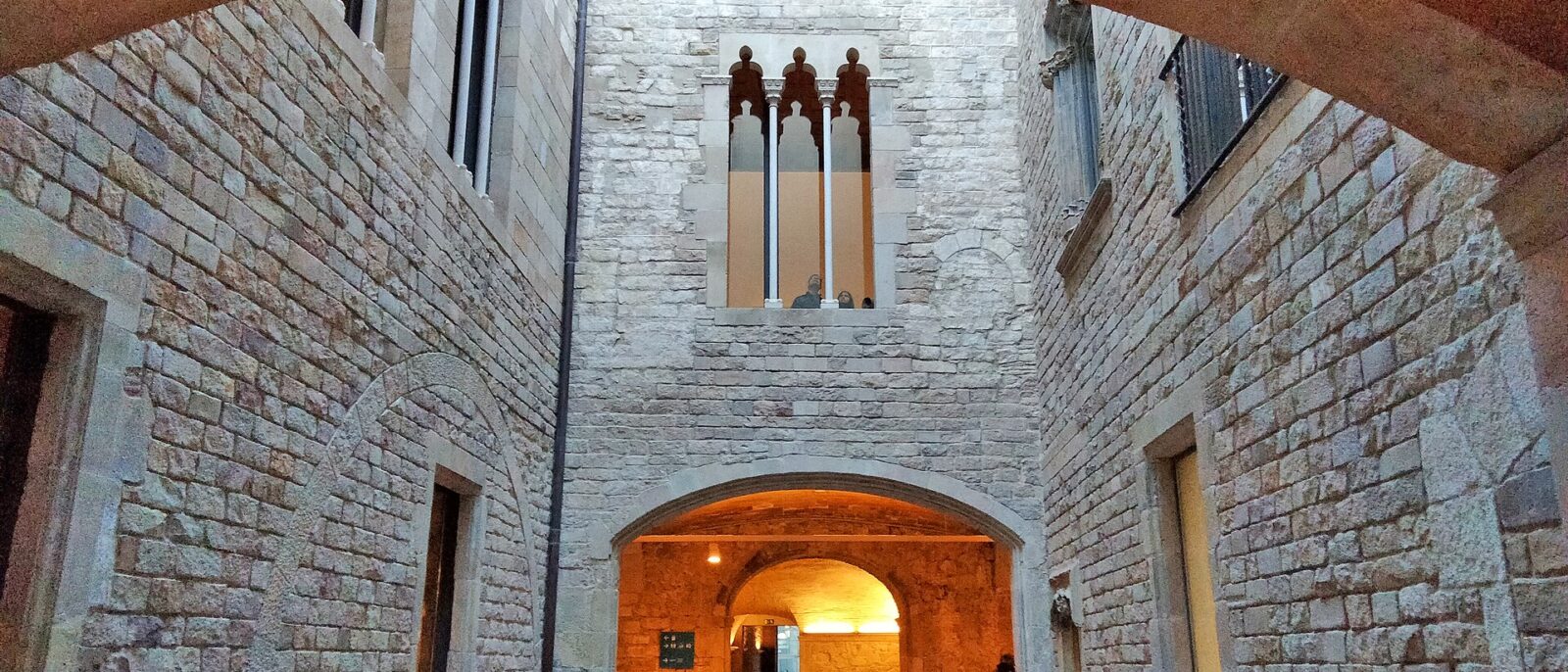
Carrer de Montcada was laid out in the twelfth century and became the address of choice for the merchant families who made medieval Barcelona rich on Mediterranean trade. Their houses were built around open courtyards with stone staircases climbing the walls outside, pointed arches at ground level and slender-columned windows above, a pattern that turns up across Catalan Gothic civil architecture and nowhere more completely than here. The museum occupies five of them, side by side from number 15 to number 23: the Palau Aguilar, the Palau del Baró de Castellet, the Palau Meca, Casa Mauri and the Palau Finestres, the last of which is used mainly for the temporary exhibitions.
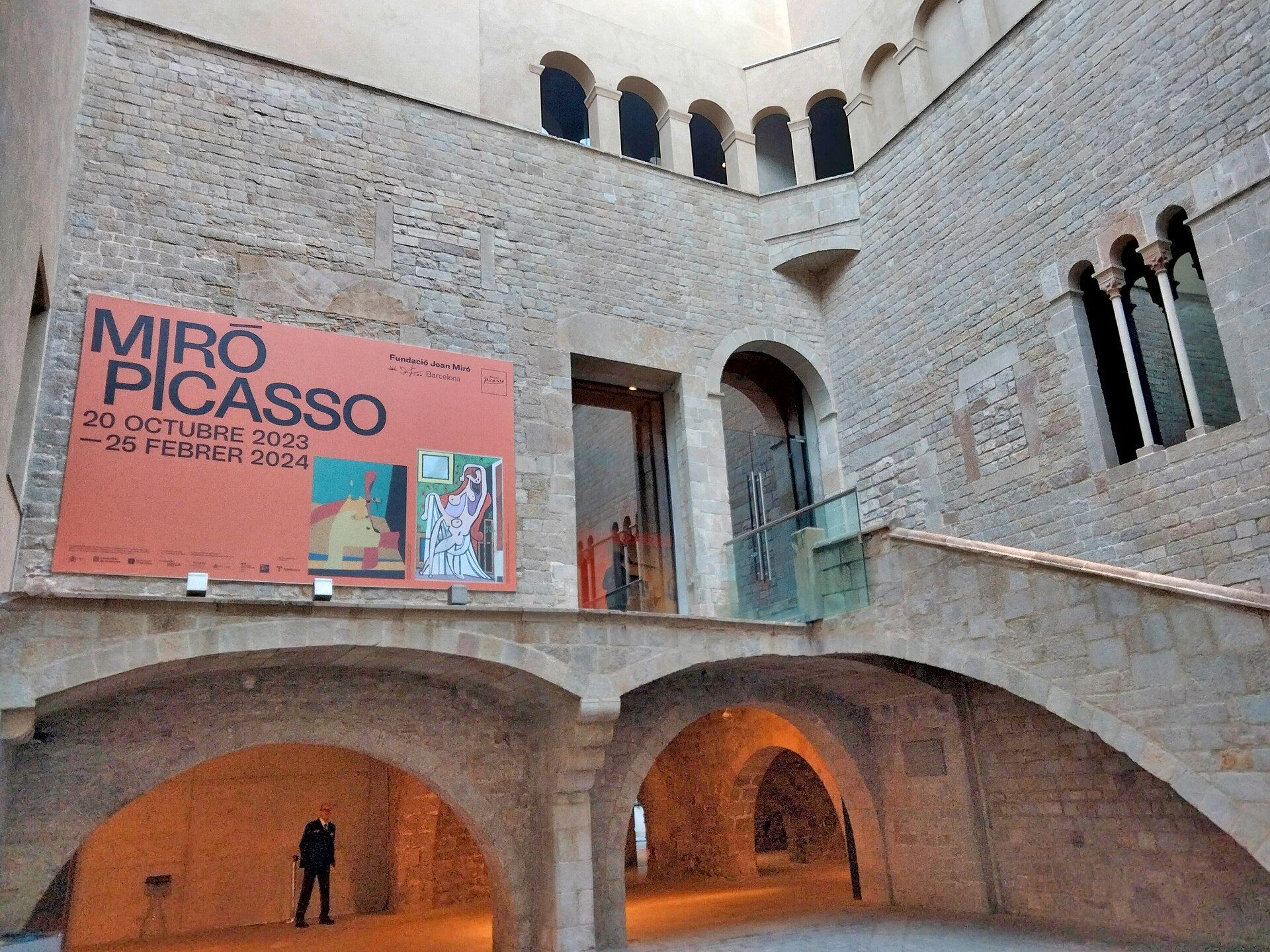
Walk through the courtyards slowly. The museum’s conversion stitched the five houses together with walkways and glass, but the bones are intact, and in the quieter corners you can stand in a merchant’s courtyard of the fourteenth century that has been in continuous use for most of seven hundred years. One detail for anyone heading on to Montjuïc: when the Palau Aguilar was being restored for the museum’s opening, workers uncovered thirteenth-century wall paintings of the Catalan conquest of Mallorca. They were removed and are now in the MNAC, where they are among the most striking pieces of secular medieval painting in the collection.
Our guide to Barcelona’s Gothic architecture covers the style properly, and the rest of Carrer de Montcada is worth a slow walk in its own right. There are more palaces further down, some with galleries you can wander into, and the street ends a few steps from Santa Maria del Mar.
Picasso’s Barcelona: a short walk after the museum
The collection is about a boy growing up in this city, and most of the places he grew up in are within fifteen minutes of the museum door. The walk below is about two kilometres and takes an hour with stops. It is free from start to finish.
- Santa Maria del Mar. Nothing to do with Picasso, and it would be perverse to walk past. Walk to the bottom of Carrer de Montcada and step inside the finest church in the city.
- La Llotja de Mar, on Passeig d’Isabel II, five minutes south. The old maritime exchange housed the city’s art school on its upper floor, and this is where Picasso’s father taught and where the boy was admitted in 1895. The story goes that he completed in days an entrance exam that other candidates were given a month for. It has probably been polished in the retelling, but not by much. The building still houses the Catalan Royal Academy of Fine Arts and is only occasionally open, so look at the neoclassical façade and move on.
- Carrer de la Plata, a narrow lane a couple of minutes away. His father rented him his first studio here in 1896, and this is where Science and Charity was painted. There is not much to see. That is somehow the point.
- Carrer d’Avinyó, a few more minutes north. In the early 1900s the street had brothels, and it was a brothel on this street that gave Les Demoiselles d’Avignon its title. The Avignon is Avinyó, not the city in Provence. Picasso did not choose the name and never much liked it. Today the street is lined with cafés and small shops, and nobody would guess.
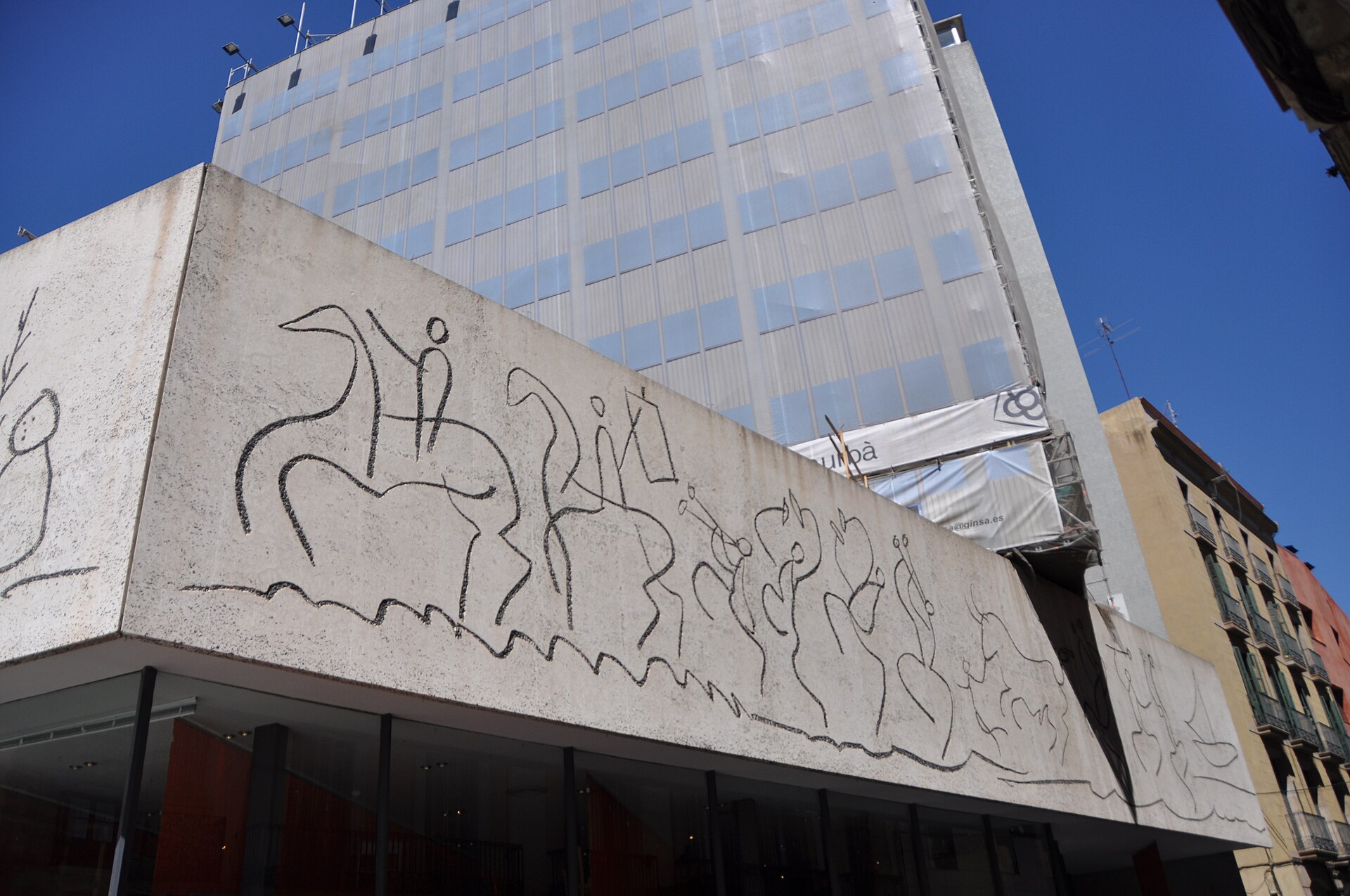
- Plaça Nova, facing the cathedral. The Col·legi d’Arquitectes de Catalunya building carries three friezes designed by Picasso and cut into the concrete by the Norwegian artist Carl Nesjar in 1962, a procession of figures, horses and musicians drawn from the city’s festivals. They are the best Picasso in the city that costs nothing to see, and, like the museum, he never saw them in place.
- Els Quatre Gats, at Carrer de Montsió 3, five minutes north of the cathedral. The café occupied the ground floor of Josep Puig i Cadafalch’s Casa Martí, one of the early landmarks of modernista architecture, and ran only from 1897 to 1903. It was here that Picasso showed his work publicly on his own for the first time. The present restaurant trades heavily on the history and is priced like it. A coffee at the bar gets you the room for a few euros.
If you have ten more minutes at the start, go the other way first. On Passeig de Picasso, beside the Parc de la Ciutadella, Antoni Tàpies’s Homage to Picasso of 1983 is a glass cube filled with old furniture and running water. It divides opinion, and it takes about three minutes to decide which side you are on.
Getting there and getting in
- Address: Carrer de Montcada 15–23, in El Born. The entrance is on Montcada itself, a narrow pedestrian street running between Carrer de la Princesa and the Passeig del Born.
- Metro: L4 (yellow) to Jaume I is the closest, about five minutes on foot. L1 (red) to Arc de Triomf and L4 to Barceloneta are both around ten minutes away. Our metro guide covers the tickets.
- By taxi: ask for Carrer de la Princesa and walk the last two minutes. Cars cannot reach the door.
- On foot: about ten minutes from the cathedral and fifteen from Plaça de Catalunya.
- Arrive a few minutes before your slot, not at the start of it. Entry is timed, and the street is too narrow for a relaxed queue.
- Travel light. The museum is a warren of stairs and passages between five buildings, and a large rucksack is a nuisance to you and everyone around you.
- Photography: the rules have long been stricter in the permanent galleries than in the courtyards. Follow the signs in each room rather than assuming, and never use flash.
- Accessibility: the palaces have been adapted with lifts and ramps, but a medieval building is never entirely level. The museum publishes an accessibility page, and it is worth contacting them in advance if you need step-free routes throughout. Our accessible Barcelona guide has wider advice.
When to go
The best hour of the week is the first slot on a Tuesday or Wednesday: 10:00 in winter, 09:00 in summer. The building is at its emptiest, and you can stand in front of the first Meninas canvas without anyone’s elbow in your ribs.
The worst times are the free windows, the first Sunday of any month, late mornings when tour groups come through, and any day it rains. The Picasso Museum is on every rainy-day list in the city, this one included, so a wet Saturday brings everyone indoors at once.
Mondays are closed, as are most of Barcelona’s municipal museums, which makes Monday a good day for the sights that open seven days a week: the Sagrada Família, Park Güell and the Gaudí houses on Passeig de Gràcia.
Summer evenings are worth knowing about if you are paying anyway. On Thursdays, Fridays and Saturdays the museum stays open until 21:00, which lets you fit it in after a day on the beach. From 19:00 the free visitors arrive, and it fills up.
Articket, city passes and the arithmetic
Articket BCN costs €38 and covers one visit to each of six museums within twelve months: the Picasso Museum, the Fundació Joan Miró, the MNAC, MACBA, the Fundació Antoni Tàpies and the CCCB. The sums are simple. Picasso at €14, the MNAC at €14 and the Miró at €18 come to €46 on their own, so if those three are already on your list, the card pays for itself and the other three are a bonus. If you are only doing Picasso and one other, it does not.
Two caveats. You may still need to reserve a time at the busier museums even with the card in hand, so check how the booking works when you buy it. And none of the six is a Gaudí building, so it does nothing for the most expensive part of most Barcelona trips.
The Barcelona Card is a transport pass with a list of museum discounts attached. It is worth checking the current discount on the Picasso Museum, but it should not be the reason you buy the card. Our city passes guide does the full arithmetic across Articket, the Barcelona Card, Go City and the transport-only options.
Picasso Museum, Fundació Miró or the MNAC?
Plenty of visitors have time for one serious art museum, not three. This is how the big three compare:
| Picasso Museum | Fundació Joan Miró | MNAC | |
|---|---|---|---|
| Adult ticket | €14 online | €18 | €14, valid two days |
| Free entry | Booked slots only (see above) | Check the foundation’s own site | Saturdays from 15:00 and the first Sunday of the month |
| Where | El Born, in the old town | Montjuïc, in parkland | Montjuïc, in the Palau Nacional |
| Time needed | 1h30–2h | 1h30–2h | 2–3h, and you still will not see it all |
| What it does best | How Picasso became Picasso; Las Meninas | A whole career, joyfully hung, with roof terraces of sculpture | Romanesque church frescoes nobody expects to love |
| The weakness | Little of the famous mature work | A climb or a bus up Montjuïc | Its size; it is exhausting |
Our view: if you already love Picasso, or want to understand him, go to the Picasso Museum. If you want one art museum that leaves you in a better mood than you arrived in, go to the Miró. Josep Lluís Sert’s building is a joy in itself, and our Montjuïc guide explains how to combine it with the MNAC and the views. If you are staying long enough for two, do Picasso on a weekday morning and the MNAC on a Saturday afternoon, when it is free.
Is the Picasso Museum worth it?
Yes, with one condition: go for the museum it actually is. If you want to see how genius forms, in real time, in the city where it happened, nothing else in the world does this as well. The progression from the plaster-cast drawings to Science and Charity to the Blue Period is one of the great museum sequences in Europe, and the Meninas rooms would justify the ticket on their own.
It is not the right choice if you want the famous Picasso of the posters, the fractured faces and the big Cubist statements. You will find some of that language in the late Meninas canvases, but not the paintings everyone knows. It is also not where to spend your only morning if you have a single day in Barcelona. The Sagrada Família and a slow walk through the Gothic Quarter come first.
For families, it is better than you might expect. Under-18s are free, the building itself is a medieval puzzle to explore, and the idea that a 14-year-old painted some of the pictures on the walls tends to land well with actual 14-year-olds. The museum runs family activities, and the programme is on its website. Small children will manage about forty minutes.
Around the museum: El Born before and after
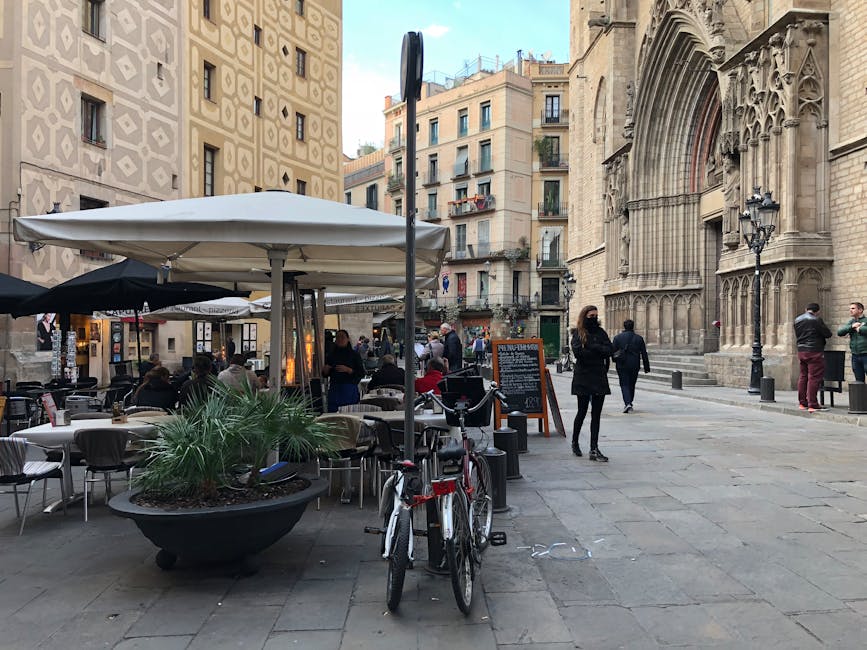
The museum sits in the middle of the most enjoyable district in the old city, and it would be a waste to go straight back to the metro afterwards. A few things within five minutes’ walk:
- El Xampanyet, almost opposite the museum on Carrer de Montcada, is a tiled cava bar that has been pouring its house fizz since the 1920s. It is standing room only from early evening, and it is supposed to be.
- The Mercat de Santa Caterina, five minutes north, under its famous wave of a roof, is a better place for a cheap, good lunch than anywhere on the museum’s doorstep. Our markets guide has the stalls worth knowing.
- The El Born Centre de Cultura i Memòria, in the old iron market hall at the end of the Passeig del Born, lets you look down on the excavated streets of the neighbourhood that was demolished after the siege of 1714.
- The Passeig del Born itself, the long rectangular square where medieval Barcelona held its jousts, is lined with bars that are pleasant for an early-evening drink before the dinner crowd arrives.
Our El Born neighbourhood guide goes much further, and the best tapas guide covers where to eat across the old city once the museum has closed.
Frequently asked questions
How much does the Picasso Museum in Barcelona cost?
€14 online or €15 at the ticket office, for the permanent collection and the temporary exhibitions together. The reduced ticket is €7.50, for 18–25s, university students, over-65s and a few other groups. Under-18s go free. Prices were checked on the museum’s website in September 2026.
When is the Picasso Museum free?
On the first Sunday of every month, on Thursday afternoons from 16:00 to 19:00 in winter, on Thursday, Friday and Saturday evenings from 19:00 to 21:00 in summer, and on three open days a year: 12 February, International Museum Day in May and 24 September. Every free visit has to be booked online in advance.
How do I book a free slot?
Through the museum’s own ticketing site, which releases free tickets four days before each date at 10:00 Barcelona time. For a winter Thursday that means booking on the Sunday before; for a first-Sunday visit, the Wednesday before. The popular slots go quickly, so book as soon as they open.
Is the Picasso Museum free on Sunday afternoons?
Not any more. That rule appears in many older guides, but the museum’s current free times are only the first Sunday of the month, the Thursday or summer-evening windows and the three open days. Other Sundays are full price.
How long do you need at the Picasso Museum?
An hour and a half to two hours for the permanent collection at a sensible pace, plus thirty to forty-five minutes if the temporary exhibition interests you. Ninety minutes is enough if you move briskly through the early rooms and save your attention for the Blue Period and Las Meninas.
What are the Picasso Museum’s opening hours?
From late September to late March, Tuesday to Sunday, 10:00 to 19:00. From late March to late September, 09:00 to 20:00 on Tuesdays, Wednesdays and Sundays, and 09:00 to 21:00 on Thursdays, Fridays and Saturdays. The museum is closed every Monday, and the ticket office shuts thirty minutes before closing.
Is Guernica in the Picasso Museum in Barcelona?
No. Guernica hangs in the Museo Reina Sofía in Madrid. Barcelona’s Picasso Museum concentrates on his early years, a 1917 stay in the city and the 1957 Las Meninas series.
What are the most famous works in the Picasso Museum?
Science and Charity (1897), painted when he was 15; The First Communion (1896); Blue Period works including The Madman and Desamparados; Harlequin (1917); and the 58-canvas Las Meninas series of 1957, which hangs together only here.
Is the Picasso Museum worth visiting?
Yes, for anyone curious about how Picasso became Picasso. It is the finest collection of his formative work anywhere, and the Meninas series is superb. It is less rewarding if you are hoping for the famous Cubist and later paintings, which are elsewhere.
Is the Picasso Museum included in Articket or the Barcelona Card?
It is one of the six museums on Articket BCN (€38, valid twelve months), which pays for itself if you also visit the MNAC and the Fundació Joan Miró. The Barcelona Card offers museum discounts rather than a free pass here, so check its current list before relying on it.
Is the Picasso Museum open on Mondays?
No, it is closed every Monday of the year, as well as on 1 January, 1 May, 24 June and 25 December.
What is the nearest metro to the Picasso Museum?
Jaume I on line L4, about five minutes’ walk. Arc de Triomf on L1 and Barceloneta on L4 are both around ten minutes away.
Related Barcelona Guides
- Barcelona attractions and tickets — what to book, what to skip and what to pay across the whole city.
- The best museums in Barcelona — the Picasso Museum in context, alongside the other eleven that matter.
- El Born — the neighbourhood around the museum, and where to eat and drink in it.
- An art and culture itinerary — five days built around the museums, galleries and architecture.
- Barcelona city passes — whether Articket, the Barcelona Card or Go City pays back on your trip.
- Free things to do in Barcelona — including the other museums with free hours.
- The Gothic Quarter — the other half of Picasso’s Barcelona, across Via Laietana.
- Montjuïc — for the Fundació Miró and the MNAC.
Photo Credits
Palau del Baró de Castellet courtyard, Picasso Museum: 436 Museu Picasso, Palau del Baró de Castellet, c. Montcada 17 (Barcelona), pati by Enric, CC BY-SA 4.0, via Wikimedia Commons.
Palau Finestres courtyard, Picasso Museum: 431 Museu Picasso, Palau Finestres, c. Montcada 23 (Barcelona), pati by Enric, CC BY-SA 4.0, via Wikimedia Commons.
Picasso friezes on the Col·legi d’Arquitectes, Plaça Nova: Barcelona (Plaça Nova) College of Architects building, friezes by Pablo Picasso and Carl Nesjar by Josep Bracons from Barcelona, Catalonia, CC BY-SA 2.0, via Wikimedia Commons.