We get commissions for bookings made through this post. Booking links, and any accommodation options shown on the page, are handled by a partner that adds commission tracking automatically. It never costs you more, and it never affects what we recommend. Affiliate disclosure
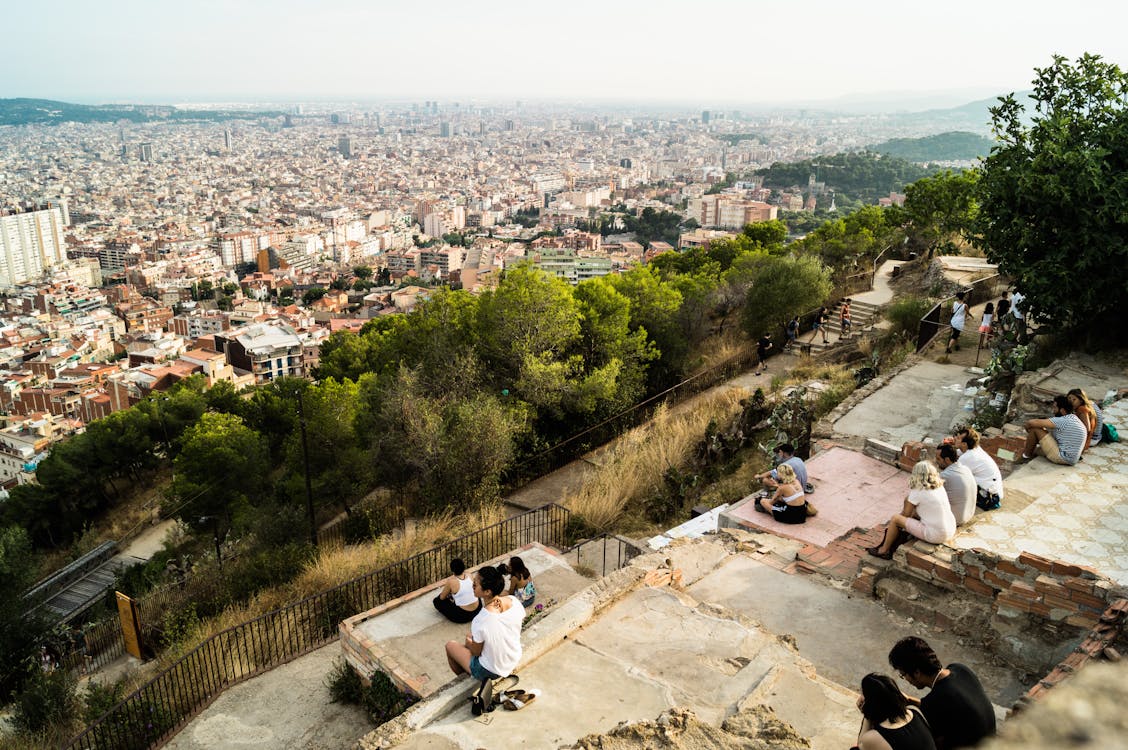
For about a decade the top of the Turó de la Rovira was the best free party in Barcelona. Every summer evening a few hundred people climbed the hill with cans, speakers and cameras, sat on the concrete rings of an old gun battery and watched the sun go down over the city, and then a good many of them stayed until two in the morning. The people who live on the streets below eventually had enough. Today the Bunkers del Carmel close in the early evening, the gates are locked at night, and most of the guides still ranking for the name are telling you to arrive for a sunset you are, for most of the year, no longer allowed to see.
The view is still there, and it is still the best free panorama in the city. This page covers the rules as they stand, the best time to go now that sunset is mostly off the table, how to get up the hill, what you are actually standing on (not bunkers, as it happens), and where to go for the sunset instead. Hours and rules were checked in September 2026 against the city’s own announcements. The site is being actively regulated, so check before you go.
The Bunkers del Carmel at a glance
| The short version | |
|---|---|
| Cost | Free. The city has ruled out charging for entry |
| Summer hours | 09:00–19:30 |
| Winter hours | 09:00–17:30 |
| At night | Closed, since May 2023 |
| Museum spaces | The history museum’s small interpretation spaces open Saturday and Sunday, 10:00–15:00 |
| Height | 262 metres, with a 360-degree view |
| Getting there | Metro L4 to Alfons X or L5 to El Carmel, then 15–30 minutes uphill; or a bus into El Carmel |
| Time needed | An hour at the top, plus the climb |
| Sunset? | Not for most of the year. See below |
| Rules | No alcohol, no amplified music, no access outside opening hours |
| Facilities | None at the top: no café, no kiosk. Bring water |
What changed, and why
Until 2023 the hilltop was open around the clock, and that is how it got its reputation. As word spread through social media, the evening crowd grew from a scattering of locals into a nightly crush of visitors on warm weekends, and the neighbourhood of El Carmel, which is residential, steep and not built for tourism, paid for it in noise, litter and late-night parties on its doorsteps.
In May 2023 the city closed the site at night and set opening hours for the first time: 09:00 to 19:30 in summer and 09:00 to 17:30 in winter. The gates are locked outside those hours.
That did not settle it. In May 2026 the city council approved a motion to introduce an access-regulation system for the batteries, managed by the Barcelona History Museum (MUHBA), with the stated aim of limiting tourist access and reducing overcrowding. The same measure commits the city to enforcing the opening hours with physical controls and a stronger Guàrdia Urbana presence, and to stop promoting the hill as a leisure spot in its own tourism channels. A monitoring group bringing together neighbourhood associations, the district, the museum and the tourism consortium now oversees the site. What the council has not done is introduce a fee; charging for entry was considered and rejected.
What that means for you: the Bunkers are open, free and worth the climb, but they are a heritage site in a residential neighbourhood that is actively trying to manage its visitors. Further changes, including capacity limits at busy times, would not be a surprise. Check the current position on the city’s or the museum’s website before you go, and treat the place accordingly.
So can you still see the sunset?
Mostly, no. Here is how Barcelona’s sunset lines up against the closing times through the year. The times are approximate and vary by a few minutes within each month:
| Month | Sunset, roughly | Site closes | Sunset from the hill? |
|---|---|---|---|
| January | 17:35 rising to 18:05 | 17:30 | No, it sets just after closing |
| February–March | 18:05–19:10 | 17:30 | No |
| April–August | 20:10–21:30 | 19:30 | No, by one to two hours |
| September | 20:20 falling to 19:35 | 19:30 | No, though it gets close by the end of the month |
| October | 19:30 falling to about 19:00, then about 17:55 once the clocks go back | Depends on which timetable is in force | Possibly, while summer hours still apply; check |
| November | 17:45 falling to 17:25 | 17:30 | From about the middle of the month, just |
| December | 17:20–17:30 | 17:30 | Yes, with minutes to spare, until about Christmas |
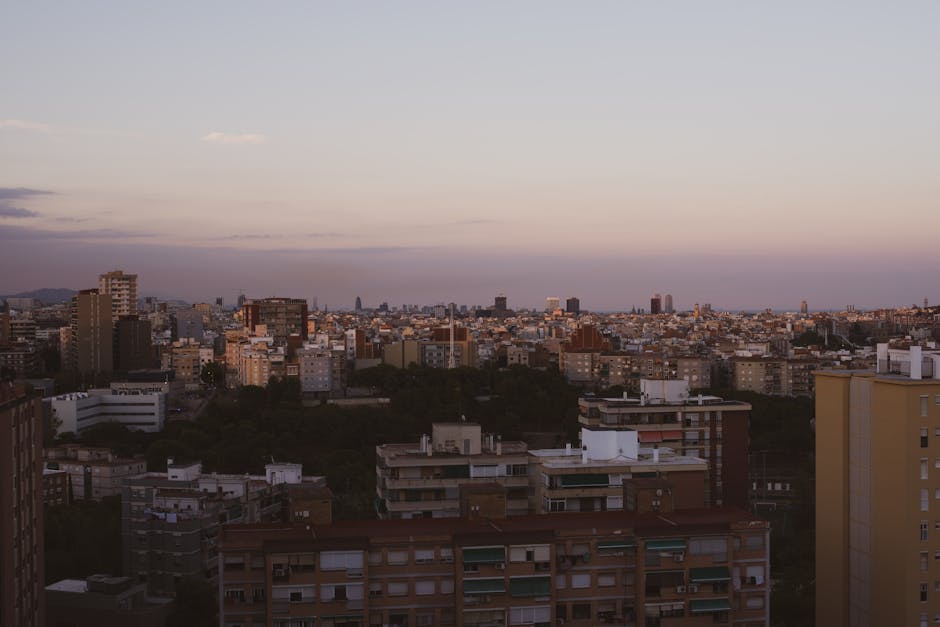
In practice, the sunset visit that made the Bunkers famous is now only realistic for a few weeks around midwinter, from about mid-November to Christmas, when the sun drops at about 17:25 and you walk down the hill in the dusk as the gates close. For the rest of the year, plan for the golden hour, the last hour or so before closing, when the low light turns the city gold and pink, rather than the sunset itself. And if a sunset is the point of the evening, go somewhere else. There is a list below.
The best time to go now
First thing in the morning is the new best time. Be at the top soon after 09:00 and you get the clearest air of the day and the hill mostly to yourself. The sun will still be low over the sea, so the classic view towards the Sagrada Família is backlit and silvery rather than warm, but the views west to Montjuïc and north to the mountains are at their sharpest. Morning visibility is what gives you the Pyrenees to the north and the jagged outline of Montserrat to the north-west on a good day. After midday, haze usually softens the far distance.
The day after rain is better still. Barcelona’s air is at its sharpest when a front has just passed through, and from the Turó de la Rovira that can mean seeing snow on the Pyrenees in winter.
Late afternoon gives you the warm light, with the sun behind you in the west lighting the city all the way to the water, and in summer that means going up at about 18:00 and leaving at closing time. It is also when the crowds are heaviest.
Weekend afternoons are the busiest time of the week, and on a fine Saturday or Sunday the concrete platforms can be crowded well before the light gets interesting. The weekend is, on the other hand, the only time the museum’s interpretation spaces are open.
Winter weekdays are the sweet spot for anyone who wants the view with space around it: cool enough for the climb, clear more often than not, and quiet.
What you are looking at
The Turó de la Rovira stands 262 metres above sea level on the ridge between El Carmel and the Guinardó, and nothing around it is tall enough to get in the way. The concrete gun platforms are laid out in a rough ring on the summit, which means you can turn through the full circle. Going round clockwise from the sea:
- The Sagrada Família, almost straight ahead as you look towards the water, its towers rising out of the Eixample grid. From here you can see exactly how much taller the basilica is than everything around it.
- The Mediterranean, with the Torre Glòries, the bullet-shaped tower formerly known as the Torre Agbar, off to the left; the twin towers of the Olympic Port; and the sail-shaped W Hotel at the far end of Barceloneta.
- Montjuïc to the right, with the port and its cranes beyond it, and on a clear day the planes turning in over the sea towards El Prat.
- Tibidabo and the Collserola ridge behind you, with the church of the Sagrat Cor and the amusement park on the summit.
- Montserrat, the serrated mountain some 50 kilometres to the north-west, visible on clear mornings.
- The Pyrenees to the north on the very best days, usually in winter, sometimes with snow on them.
The Eixample grid is the other thing to look at. From this height Ildefons Cerdà’s nineteenth-century plan, with its chamfered corners and square blocks marching towards the sea, reads like a diagram, cut most obviously by the long slash of the Avinguda Diagonal. Our guide to Barcelona’s best views compares this panorama with the city’s other viewpoints.
Not bunkers: what the hill actually is
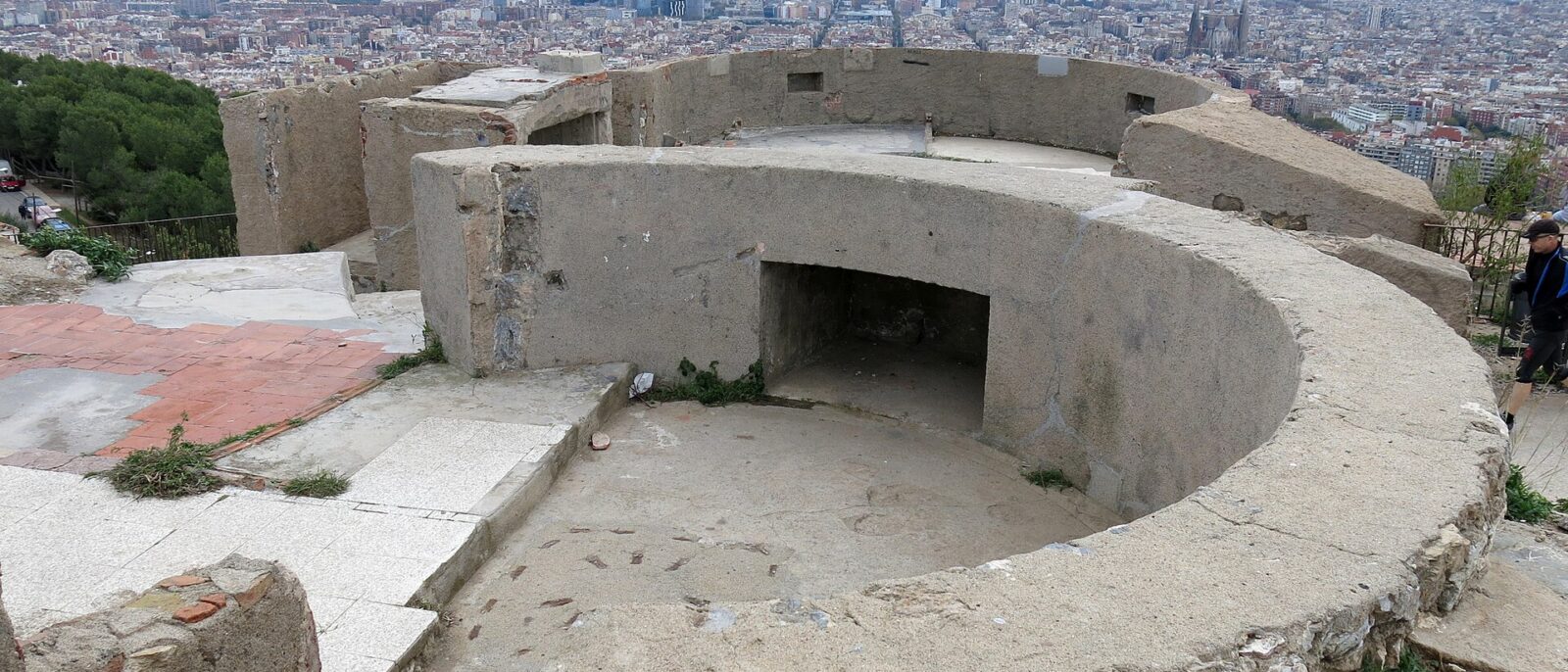
The structures on the summit are not bunkers. They are the remains of an anti-aircraft battery built by the Republican army during the Spanish Civil War, in 1937 and 1938, to defend Barcelona against bombing raids. The city was bombed repeatedly by Italian aircraft flying from Mallorca and by Nationalist planes, and the worst raids, over three days in March 1938, killed close to a thousand people. The concrete circles you sit on were the gun emplacements. The rooms behind them were stores, shelters and quarters for the crews who manned the guns.
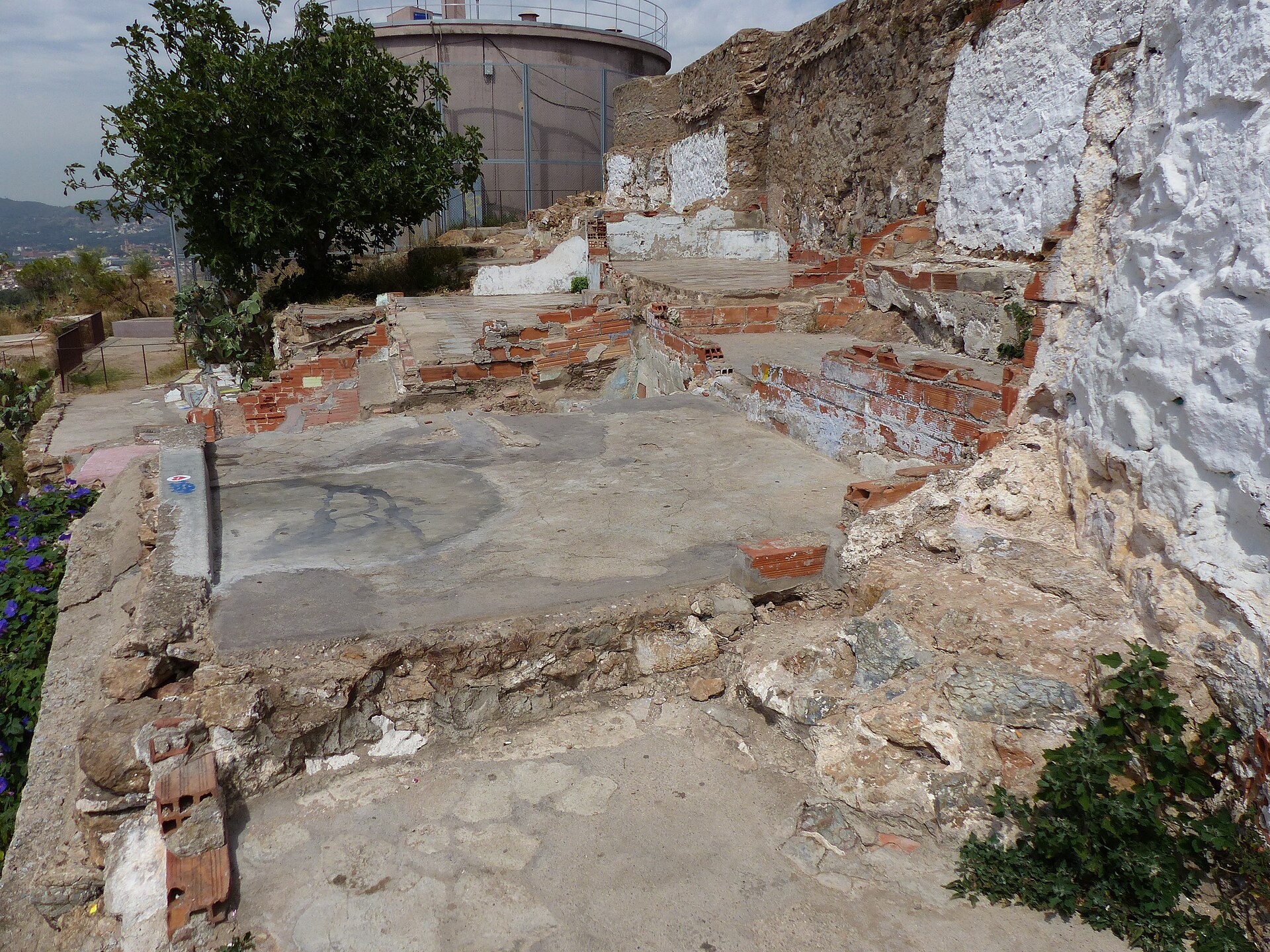
After the war the battery was abandoned, and then the hill found a second life that the “bunkers” name completely erases. From the 1940s, families arriving in Barcelona from poorer parts of Spain, with nowhere else to live, built shacks among and on top of the gun emplacements. The Turó de la Rovira became one of the city’s many barraques, shanty settlements, with hundreds of residents, no proper water supply for many years, and a view that the rest of Barcelona would one day queue for. The last of the shacks were not cleared until 1990, as the city tidied itself up for the Olympic Games.
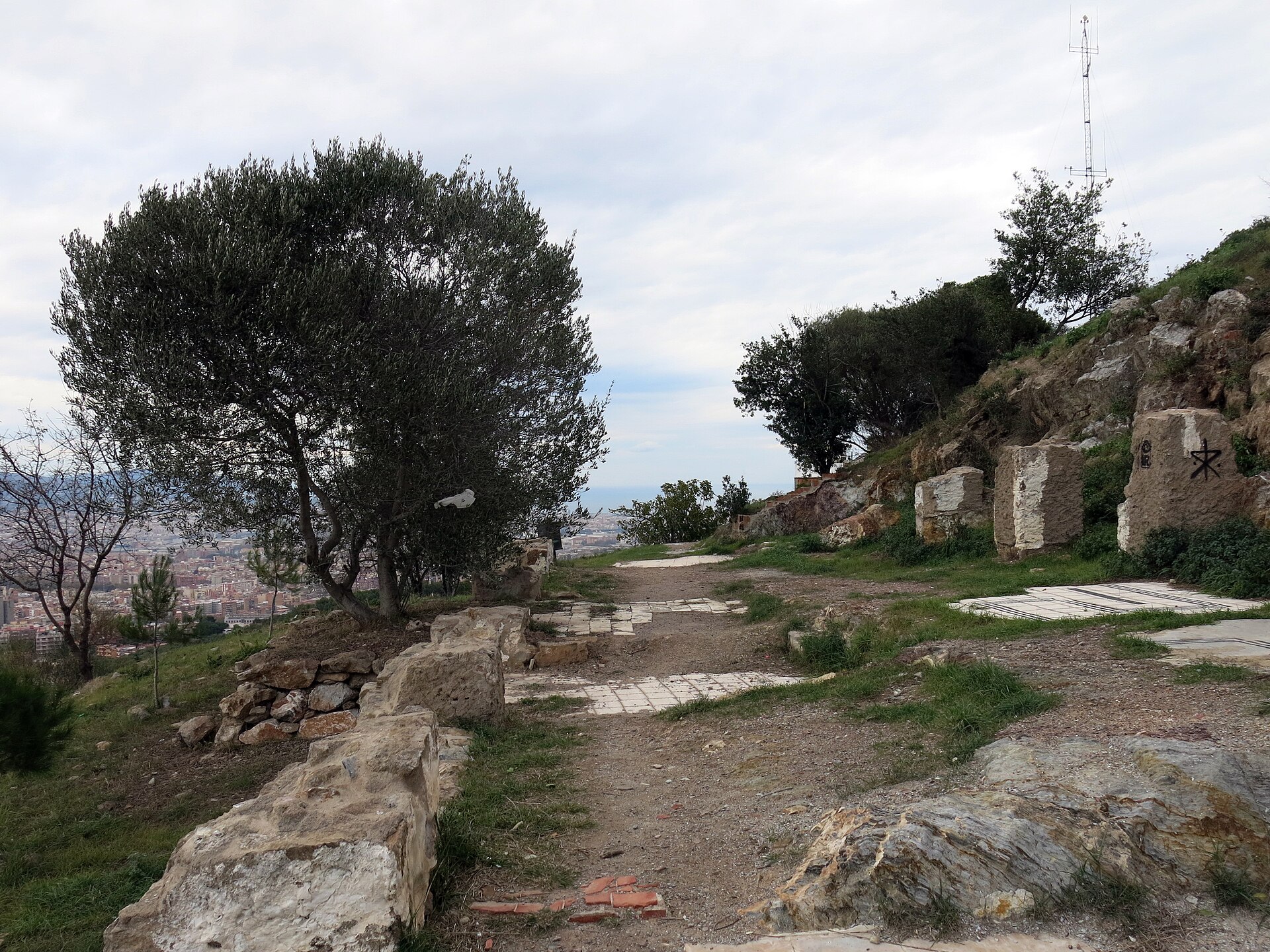
Look down as you walk around the summit and you can still see them: patches of floor tiles in the dirt, the outlines of rooms, fragments of whitewashed walls. The Barcelona History Museum restored the site from 2011 and treats it as both halves of that story, the war and the shanty town. The small interpretation spaces, open at weekends, explain both, and they are the best ten minutes you can spend here after the view.
If the Civil War side of the story interests you, the museum also runs Refugi 307, a restored air-raid shelter tunnelled into the hillside in Poble-sec, which it visits on guided tours. The shelter and the battery were two halves of the same defence of the city, one passive and one active, and seeing both makes sense of each. Our Poble-sec guide covers the neighbourhood around the shelter.
Getting there
The Bunkers are on a steep hill in a residential part of the city, and there is no way to reach the top without some climbing. Wear shoes with grip. The last part of the path is rough and uneven.
By metro
- L4 (yellow) to Alfons X, then about 20 to 30 minutes on foot, all of it uphill, through the Guinardó.
- L5 (blue) to El Carmel, then about 15 to 20 minutes of steep streets and steps.
Our metro guide covers tickets and passes.
By bus
Several TMB buses climb into El Carmel and save most of the walk. The V17 and the 24 run up from the centre, and the small 119 neighbourhood bus gets closest to the top. Routes and stops change, so put “Turó de la Rovira” into the TMB app or a maps app before you set off and take whichever is quickest from where you are.
On foot from Park Güell
The two sit on neighbouring hills, and plenty of people combine them. It is about half an hour’s walk from the upper side of Park Güell to the Bunkers, through the streets of El Carmel, with a fair amount of climbing. Doing Park Güell first and the Bunkers afterwards works well. Our Park Güell guide has the tickets and time slots for the park.
By taxi
A taxi can take you up the neighbourhood’s roads to within a few minutes’ walk of the summit, which is the sensible option for anyone who finds hills hard. There is no parking at the top to speak of, and driving up yourself is not worth the trouble.
What to bring
- Water. There is nothing to buy at the top, and the climb is steeper than it looks on a map.
- Sun protection in summer. The summit is almost entirely exposed, with a couple of trees and no real shade on the platforms.
- A layer in winter. The hill catches the wind, and a mild day in the streets below can feel several degrees colder at the top.
- Proper shoes. The final path is loose and uneven, and the concrete platforms are worn smooth in places.
- Binoculars, if you have them. Picking out the Pyrenees, the ships in the port or individual towers of the Sagrada Família is half the fun.
Photographing the view
The Bunkers are one of the few places in Barcelona where you can photograph the whole city in a single frame, and a little planning makes a big difference:
- The classic shot lines up the Sagrada Família with the sea behind it. It is best in the afternoon, when the sun is behind you and the stone of the basilica catches the light. In the morning the same view is shot into the sun.
- A moderate telephoto does more here than a wide-angle. The city is far enough below that a wide shot turns it into texture; a longer lens compresses the Sagrada Família, the Torre Glòries and the sea into one layered image.
- Panoramas work well from the highest platform. Shoot the full circle and you get Montjuïc, the port, the Olympic Port towers, the Besòs and Collserola in one sweep.
- Use the concrete. The curved walls of the gun emplacements make strong foreground lines, and they are what makes a photo from here recognisably the Bunkers rather than just an aerial view.
- Clear air beats golden light. A crisp winter morning after rain will give you a sharper, more detailed photograph than a hazy summer evening, however warm the colours.
El Carmel, the neighbourhood below
Most visitors pass through El Carmel on the way up without noticing it, which is a shame, because it is one of the most characterful working-class districts in the city. It grew in the middle of the twentieth century as families from the rest of Spain settled on the steep slopes below the hill, many of them in self-built houses, and it kept a strong identity of its own. Juan Marsé set his 1966 novel Últimas tardes con Teresa here, and its streets still have the feel of a village clinging to a hillside: steep stairways, small bars, washing on the balconies and views at the end of every street.
It is also the reason the rules on the hill exist. The streets are narrow and residential, the people who live on them have been through a great deal of change, and the hill above them is part of their neighbourhood before it is anyone’s viewpoint. A coffee or a vermouth in one of the neighbourhood bars on the way down is a small way of putting something back.
Rules, and how to be a good visitor
The rules are short and they are enforced:
- No access outside opening hours. The gates are locked, and the city has committed to preventing access at night.
- No alcohol. The drinking was a large part of what went wrong here.
- No amplified music. Headphones only.
And a few things that are not written on a sign but matter just as much:
- Keep your voice down on the way up and down. You are walking past people’s bedroom windows, and the noise of visitors on these streets is exactly why the hill is regulated.
- Take your rubbish away with you. There are no facilities at the top.
- Do not climb on the walls of the gun emplacements. They are eighty years old, the drops are real, and this is a protected heritage site.
- Remember what it is. This was a military position during a war in which the city below was bombed, and then a place where people lived in poverty for fifty years. It is fine to enjoy the view. It is worth knowing whose view it was.
Where to watch the sunset instead
If the sunset is what you are after, Barcelona has plenty of places where you are still welcome to stay for it:
| Viewpoint | Cost | Why go |
|---|---|---|
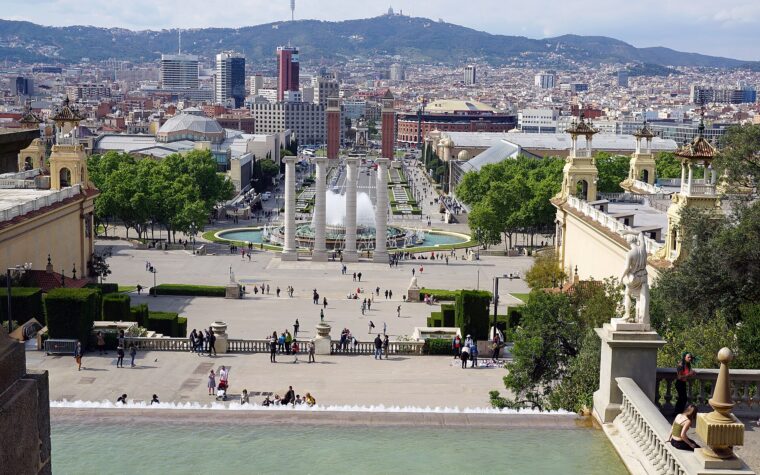
| Montjuïc: the steps and terrace of the Palau Nacional | Free | The classic evening view over Plaça d’Espanya and the city, and a short walk from the Magic Fountain on the evenings it runs |
| Carretera de les Aigües | Free | A flat track along the Collserola hillside high above the city, with the whole of Barcelona below and very few people |
| Tibidabo | Transport, plus the funfair if you want it | The highest viewpoint of all, looking down on the Bunkers themselves |
| A rooftop bar | The price of a drink | Sunset with a glass in your hand, which is what many people were really after on the hill |
Our guides to Montjuïc, Tibidabo and Barcelona’s rooftop bars cover each in detail, and the hiking guide has the Carretera de les Aigües.
Building it into a day
The Bunkers sit in the north of the city, a long way from the old town, so it makes sense to pair them with the other things up here rather than make a special trip:
- Park Güell and the Bunkers. A morning slot at Park Güell, then the walk across El Carmel to the Bunkers before the afternoon crowd. Lunch afterwards in Gràcia, 20 minutes downhill.
- The Bunkers and Sant Pau. Walk down from the hill through the Guinardó to the Recinte Modernista de Sant Pau, the vast modernista hospital complex, in about 25 minutes. Entry is €18 (€17 after 14:00), and our modernista architecture guide explains why it is one of the great buildings of the period.
- A Civil War morning. The Bunkers on a weekend morning, when the museum spaces are open, and Refugi 307 in Poble-sec on a guided visit, for the other side of the same story.
- The Bunkers and Gràcia. The hill in the late afternoon until closing time, then down to Gràcia for an evening in its squares, which is where the drinking now properly belongs.
Is it worth it?
Yes, without hesitation, and it costs nothing. The 360-degree view from the Turó de la Rovira is better than the one from the Sagrada Família’s towers, better than Park Güell’s terrace, and at least as good as Tibidabo’s, and the only price of admission is a steep walk.
But go for the view, not for the sunset party, which no longer exists and was the reason the hill had to be regulated in the first place. Go in the morning for clarity or late afternoon for light, allow an hour at the top, look down at the floor tiles as well as out at the city, and keep your voice down on the walk home.
And if you want a sunset with a drink, do that somewhere the neighbours will not mind. For more on how Barcelona is dealing with its visitor numbers more generally, our piece on whether Barcelona is still worth visiting covers the wider picture.
Frequently asked questions
Are the Bunkers del Carmel open at night?
No. The site has been closed at night since May 2023, and the city committed in 2026 to enforcing the opening hours with physical controls and police presence. It opens at 09:00 and closes at 19:30 in summer and 17:30 in winter.
Can you watch the sunset from the Bunkers del Carmel?
For most of the year, no, because the site closes before the sun goes down. The exceptions are the weeks from about mid-November to Christmas, when sunset in Barcelona falls at about 17:20 to 17:30, just before the winter closing time, and possibly part of October, depending on which timetable is in force.
Do the Bunkers del Carmel cost anything?
No, entry is free. The city council considered charging for access in 2026 and decided against it.
Do I need to book to visit the Bunkers del Carmel?
Not at the time of writing. In May 2026 the city approved an access-regulation system for the site, aimed at limiting tourist numbers, so check the city’s or the Barcelona History Museum’s website for the latest arrangements before you go.
How do I get to the Bunkers del Carmel?
Take metro L4 to Alfons X or L5 to El Carmel and walk uphill for 15 to 30 minutes, or take one of the TMB buses that climb into El Carmel, such as the V17, the 24 or the small 119, which gets closest to the top. It is also about half an hour’s walk from Park Güell.
Can you drink alcohol at the Bunkers del Carmel?
No. Alcohol and amplified music are not allowed, and drinking in public spaces can get you fined anywhere in Barcelona.
Are the Bunkers del Carmel really bunkers?
No. They are the remains of a Spanish Civil War anti-aircraft battery built in 1937 and 1938 to defend Barcelona from bombing raids. After the war the site became a shanty settlement, which lasted until 1990.
What can you see from the Bunkers del Carmel?
A full 360-degree panorama: the Sagrada Família and the Eixample grid, the Mediterranean and the Olympic Port towers, Montjuïc and the port, Tibidabo and the Collserola hills, and on clear days Montserrat and the Pyrenees.
What is the best time to visit the Bunkers del Carmel?
Early morning, soon after the 09:00 opening, for the clearest air and fewest people, especially the day after rain. Late afternoon gives better light but bigger crowds, particularly at weekends.
Are the Bunkers del Carmel suitable for children or wheelchair users?
Children enjoy it, but the gun platforms have drops and not every edge is railed, so keep them close. The climb is steep and the summit is rough and uneven, so it is not suitable for wheelchairs or pushchairs.
Related Barcelona Guides
- Barcelona’s best views — every viewpoint in the city, ranked.
- Park Güell — the neighbouring hill, and the obvious pairing.
- Montjuïc — where to go for the sunset instead.
- Tibidabo — the highest view in the city.
- Free things to do in Barcelona — the rest of the best things that cost nothing.
- Barcelona’s hidden gems — more places most visitors never find.
- Barcelona attractions and tickets — what to book, what to skip and what to pay.
Photo Credits
Gun emplacement on the Turó de la Rovira: 049 Turó de la Rovira, antiga bateria antiaèria by Enric, CC BY-SA 4.0, via Wikimedia Commons.
Tiled floors of former shacks on the summit: 013 Turó de la Rovira, restes de barraques by Enric, CC BY-SA 4.0, via Wikimedia Commons.
Shack remains built into the battery: Anti-aircraft batteries at Turó de la Rovira, 2016 01 by Benjamín Núñez González, CC BY-SA 4.0, via Wikimedia Commons.