We get commissions for bookings made through this post. Booking links, and any accommodation options shown on the page, are handled by a partner that adds commission tracking automatically. It never costs you more, and it never affects what we recommend. Affiliate disclosure
On most Monday evenings in summer there is a small crowd at the foot of Montjuïc looking at a dark, silent basin of water. They have walked up the avenue from Plaça d’Espanya, phones in hand, having searched for magic fountain barcelona and found a timetable that was out of date, a blog post from before the drought, or simply the wrong night. The Magic Fountain does not run every evening, it has not run at all for long stretches of the last few years, and the nights and times change with the seasons. Get those right and it is one of the best free hours in the city.
This guide gives the 2026 show times month by month, explains why the timetable keeps moving, and then gets to the question most guides skip: where to stand, because the difference between a good spot and a bad one is the difference between a spectacle and the backs of a thousand heads. Show times come from the city’s own published schedule and were checked in September 2026. They can change at short notice, so check on the day before you set off.
The Magic Fountain at a glance
| The short version | |
|---|---|
| What it is | A giant musical fountain of water, light and colour at the foot of Montjuïc, built for the 1929 International Exposition |
| Cost | Free |
| Summer (June–September) | Wednesday to Sunday, 21:30–22:30 |
| October | Thursday to Saturday, 21:00–22:00 |
| November–December | Thursday and Saturday, 21:00–22:00 |
| January–March | Check first: the fountain has often paused for winter maintenance |
| Where | Plaça de Carles Buïgas, on the Avinguda de la Reina Maria Cristina, below the Palau Nacional |
| Metro | L1 or L3 to Espanya, then about 10 minutes’ walk up the avenue |
| Best spot | Front and centre for the music; the Palau Nacional steps for the view and the photographs |
| Worth it? | Yes on a summer night, especially after sunset on the steps above. Not worth crossing the city for on a cold winter Thursday |
Show times in 2026, month by month
The shows run in the evening, after dark, and each one lasts about an hour. The nights and start times follow the seasons: more nights and a later start in summer, fewer nights and an earlier start in the colder months.
| Month | Nights | Show times | Notes |
|---|---|---|---|
| January–March | Check the official schedule | — | Traditionally the season for the fountain’s annual maintenance break; do not plan an evening around it without checking |
| April | Thursday, Friday, Saturday | 21:00–22:00 | The season restarts |
| May | Check the official schedule | — | Bridges the spring and summer timetables |
| June–September | Wednesday to Sunday | 21:30–22:30 | Five nights a week; the best time to go |
| October | Thursday, Friday, Saturday | 21:00–22:00 | Three nights a week |
| November–December | Thursday and Saturday | 21:00–22:00 | Two nights a week, and cold by the end of the year |
There are no regular shows on Mondays and Tuesdays at any time of year. Outside the summer, Sundays and Wednesdays are dark too. If your only free evening is a Monday, the fountain is not an option, and no amount of optimism on the walk up the avenue will change that.
How to check before you go
- Look at the city’s official page for the Font Màgica, or the listings of betevé, the city’s public broadcaster, on the day. Both publish the current schedule and note cancellations.
- Be suspicious of any timetable without a year on it. Plenty of pages ranking for the fountain still carry the pre-drought schedule, and some still say it is switched off.
- Check again if the weather is wild. Shows can be cancelled at short notice for technical problems, and strong winds send the spray over the crowd.
- Watch for special events. Big city occasions on the avenue, above all La Mercè in September and New Year’s Eve, replace the normal show with something bigger.
Why the timetable keeps changing
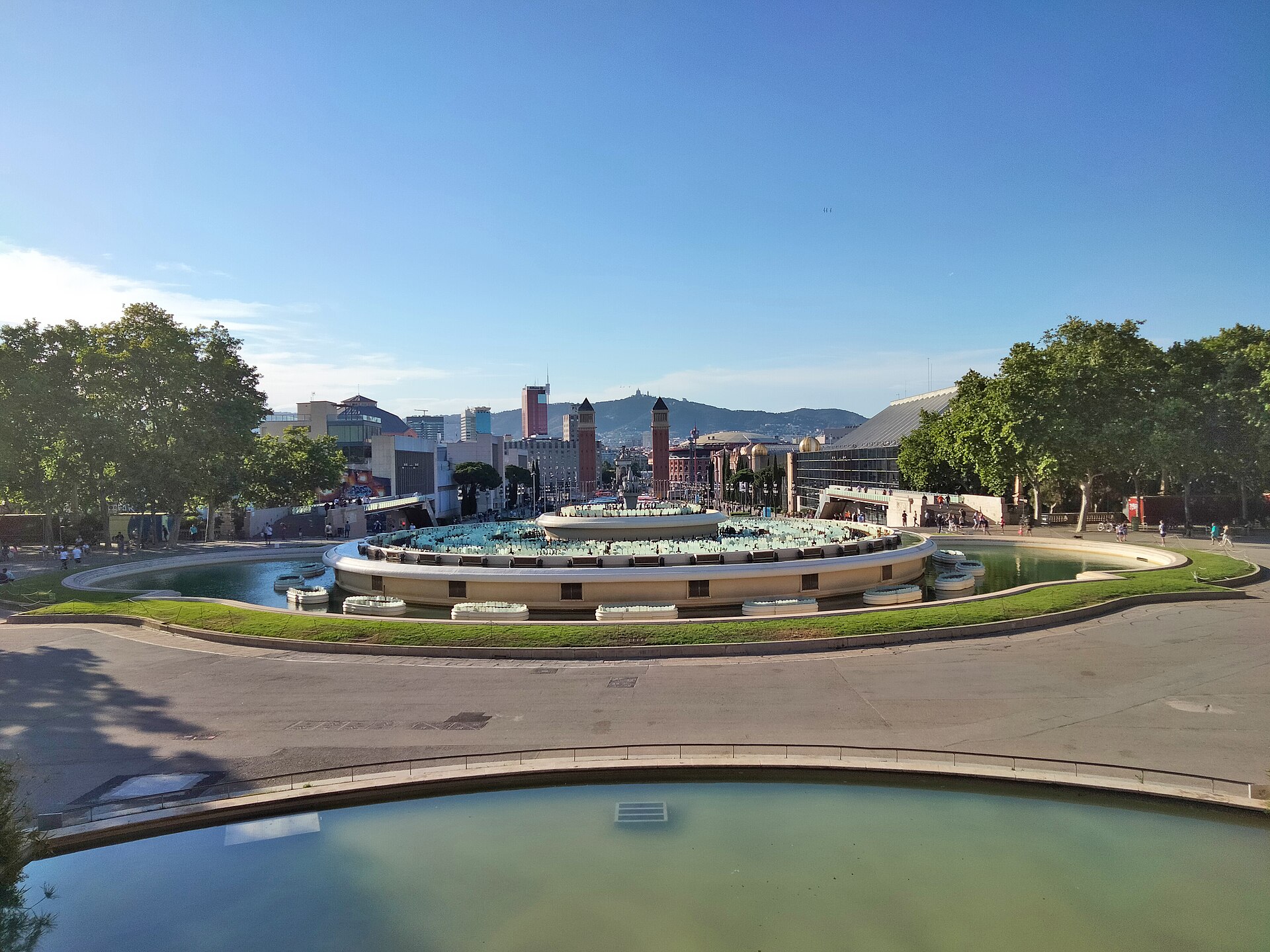
If the fountain’s schedule seems unusually unreliable, that is because it has been. Catalonia’s severe drought kept the shows switched off for long stretches between 2023 and 2025, as the city cut back on ornamental water use, and normal programming only returned in September 2025. That gap is why so much of what you find online is wrong: a lot of pages were written either before the drought, with a schedule that no longer applies, or during it, saying the fountain was closed.
Add the annual winter maintenance, the seasonal changes of night and start time, and the occasional takeover for a festival, and it is easy to see why people turn up on the wrong evening. The fix is simple: check on the day.
Where to stand
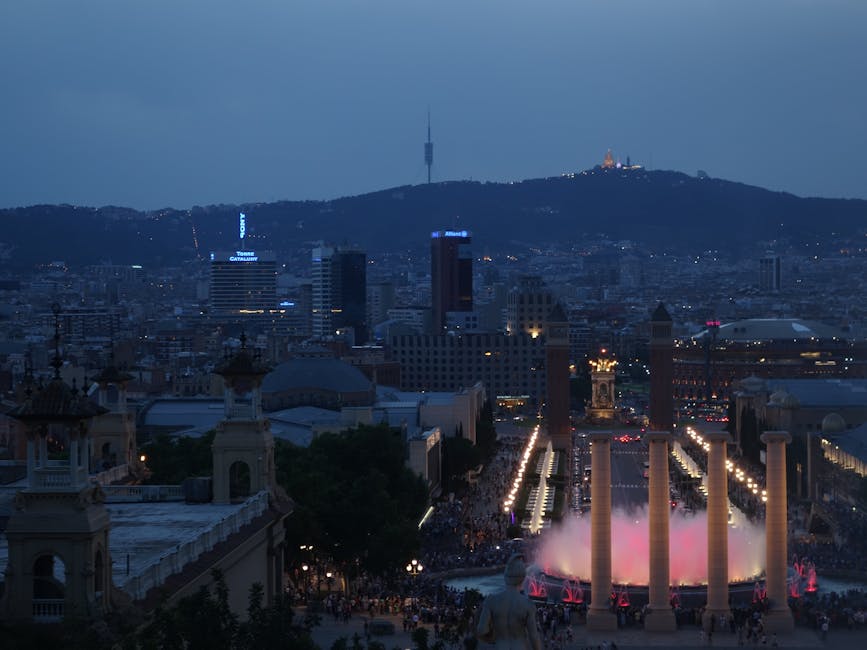
This is the part that makes or breaks the evening. On a busy summer night several thousand people come to watch, and the fountain looks and sounds very different depending on where you are.
Front and centre: for the music
The music comes from speakers around the fountain, so the area directly in front of the basin, facing up the hill towards the Palau Nacional, is where the show makes most sense: the jets rise and fall with the music, the colours change on the beat, and you get the Palau Nacional lit up behind it all. It is also where the crowd is deepest. In summer, arrive 20 to 30 minutes before the start to get anywhere near the front. The low walls around the square fill first, and they are the best seats in the house if you can get one.
The Palau Nacional steps: for the view and the photographs
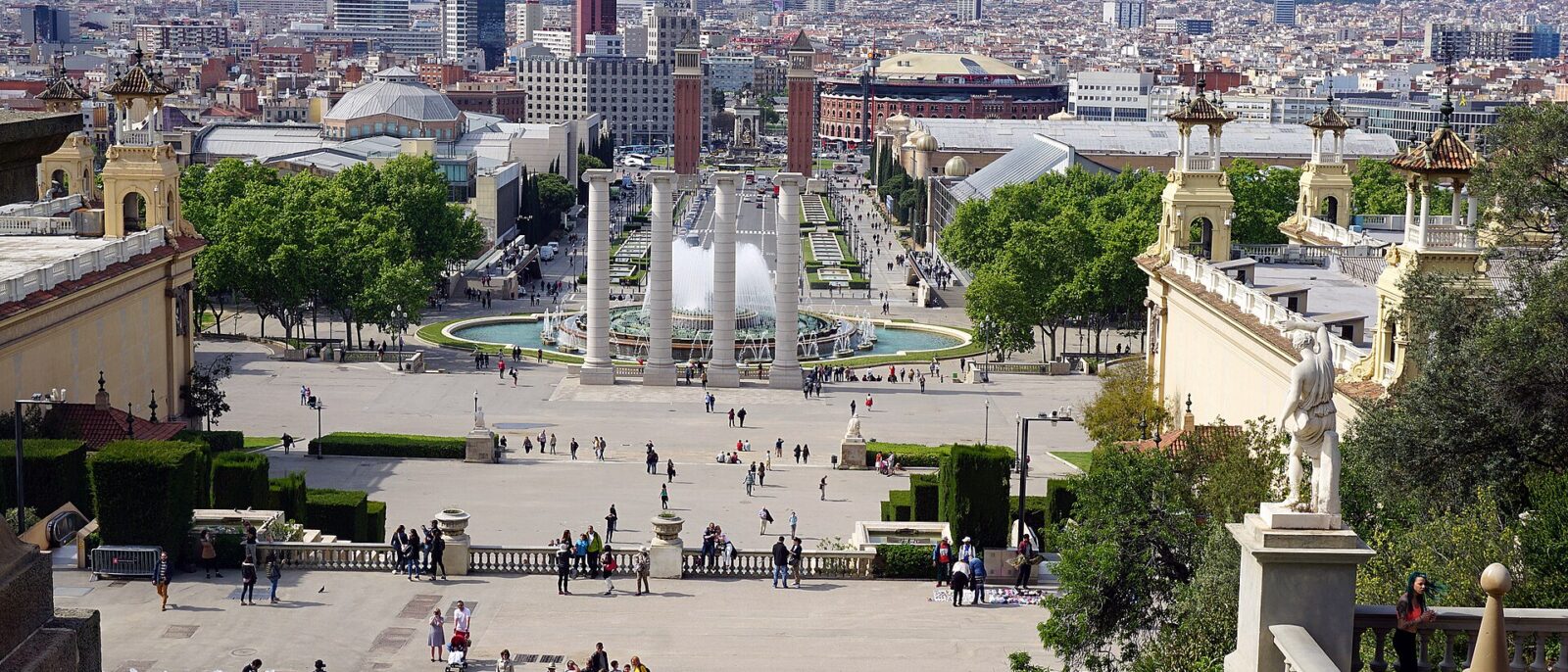
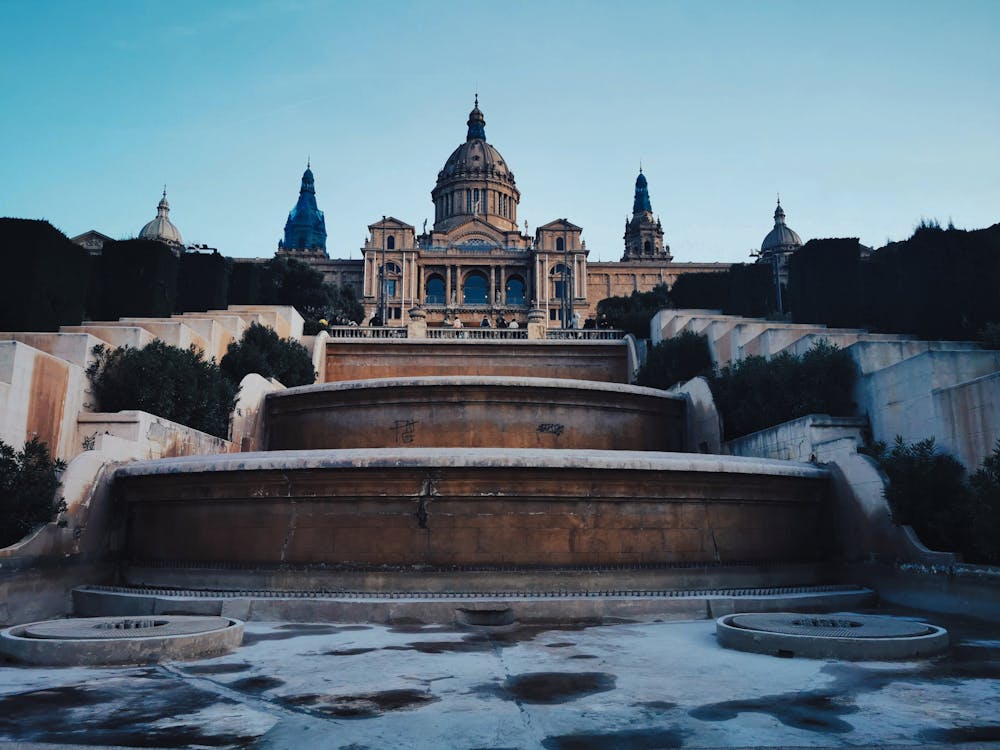
Climb the steps, or take the outdoor escalators, towards the Palau Nacional, home of the MNAC, and turn round. From the terraces halfway up and from the top you see the whole composition at once: the fountain, the four Ionic columns in front of it, the long avenue of lit jets running down to the two Venetian towers of Plaça d’Espanya, and the city beyond. The music is fainter up here, but the view is better, the crowd thinner, and this is where almost every good photograph of the fountain is taken from.
The avenue below: for the postcard
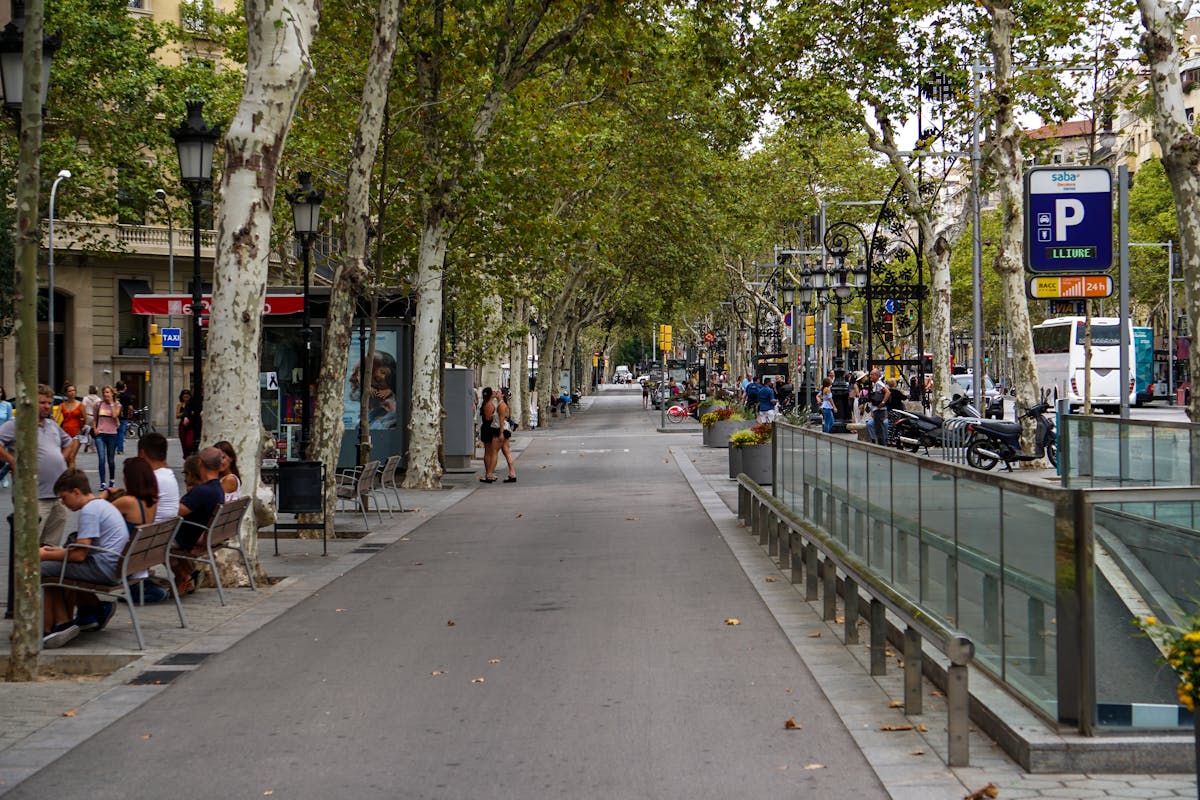
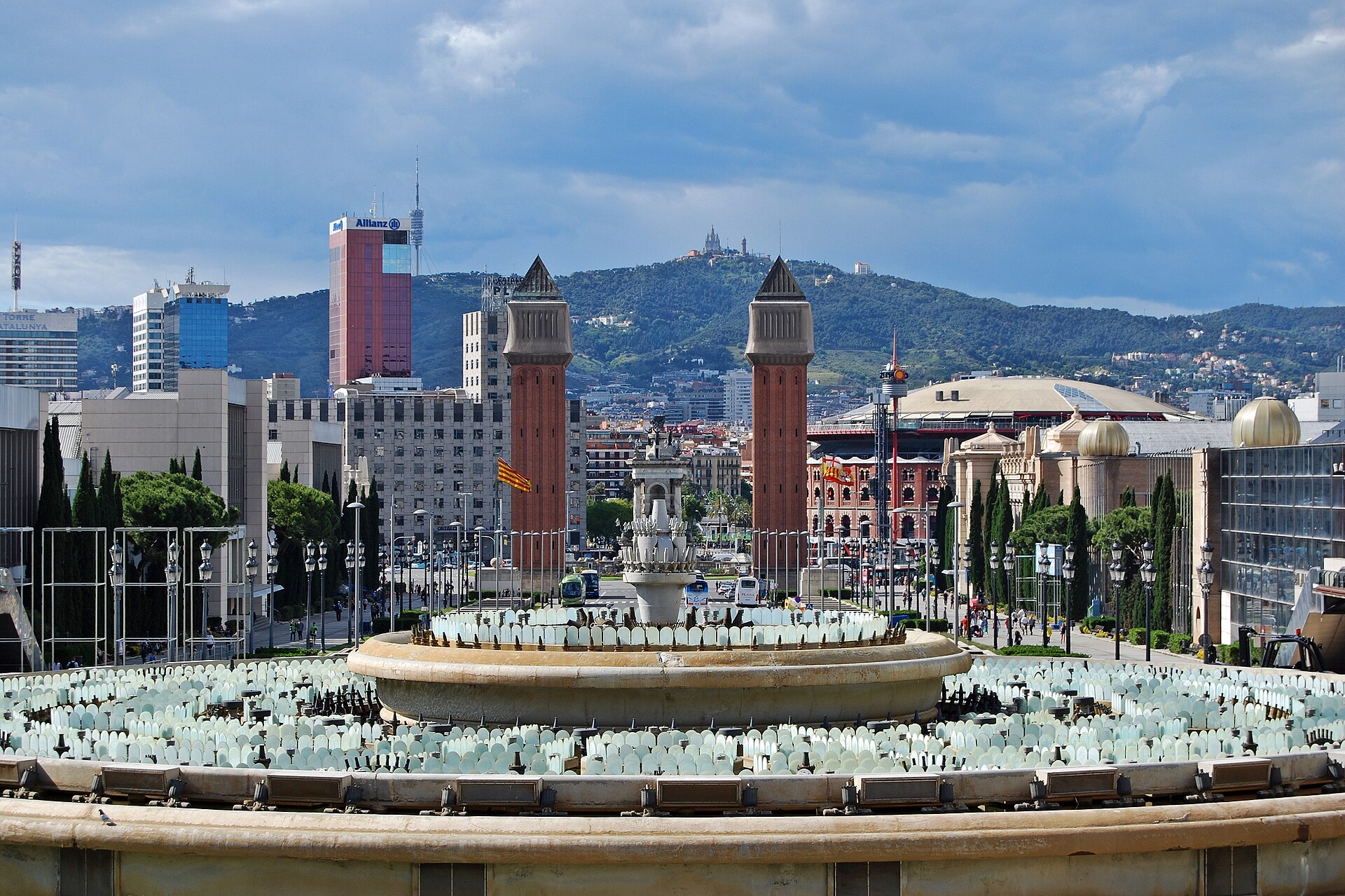
Walk a little way down the Avinguda de la Reina Maria Cristina towards Plaça d’Espanya and look back up the hill, and you get the classic postcard: the fountain in the foreground and the floodlit Palau Nacional behind it, with the cascades on the hillside between them. It is less crowded, good for families who want to stand at the edge rather than in the middle, and easy to leave from when the children flag.
Mind the wind
The tallest jets throw a fine spray, and it goes wherever the wind takes it. Before you settle, check which way the breeze is blowing and stand on the other side of the basin. The people in the front row downwind are the ones who go home damp.
What you are watching
The fountain was designed by the engineer Carles Buïgas for the 1929 International Exposition, which transformed Montjuïc from a largely empty hillside into the complex of palaces, pavilions and avenues that still covers it. It was built in less than a year by several thousand workers and switched on for the Exposition’s opening in May 1929. The square in front of it is named after Buïgas.
The music came later, in the 1980s, and the fountain was restored again ahead of the 1992 Olympics, when Montjuïc was the Games’ main stage. By one count its combination of water jets and lights allows some seven billion possible configurations. The show itself works through a series of musical sequences, from classical pieces to film scores and pop, so you can arrive at any point in the hour and still catch a full piece.
Three other things in view are worth knowing about:
- The four columns in front of the fountain were designed by the modernista architect Josep Puig i Cadafalch in 1919 to represent the four stripes of the Catalan flag. The dictatorship of Primo de Rivera had them demolished in 1928, just before the Exposition. They were rebuilt in 2010.
- The Venetian towers at the far end of the avenue, modelled on the campanile of St Mark’s in Venice, mark the Exposition’s grand entrance on Plaça d’Espanya.
- The old bullring on the far side of the square, Las Arenas, is now a shopping centre with a rooftop terrace that looks back up at Montjuïc.
Getting there
- Metro: L1 (red) or L3 (green) to Espanya. Come up on Plaça d’Espanya, pass between the Venetian towers and walk up the Avinguda de la Reina Maria Cristina for about 10 minutes. The FGC suburban trains also stop at Espanya. Our metro guide covers tickets.
- From the airport: the Aerobús stops at Plaça d’Espanya, which makes the fountain an easy first evening if you land in the afternoon and are staying nearby. Our airport transfer guide has the fares.
- On foot from Poble-sec: about 10 to 15 minutes from Carrer de Blai and the streets around it, which is where you should eat.
- Leaving: everyone leaves at once when the show ends, and Espanya station gets very busy. Either leave five minutes early or linger for a quarter of an hour and let the crowd clear.
The avenue is flat and step-free as far as the fountain. Beyond it, the outdoor escalators up to the Palau Nacional help with the climb, though they are not always running.
Make an evening of it
The fountain is best treated as the end of an evening on Montjuïc rather than a destination in itself. A few ways to build around it:
In summer: sunset on the steps, then the show
In June and July the sun sets in Barcelona between about 21:10 and 21:30, and the summer shows start at 21:30. That is almost perfect timing. Be on the terrace of the Palau Nacional for the sunset, with the whole city turning gold below you, then walk down to the fountain as the first jets go up. The MNAC terrace is one of the best free sunset spots in the city, and our best views guide has more. By late August and September the sun goes down closer to 20:30 and then 20:00, which leaves time for a drink in Poble-sec between the two.
If the MNAC itself is on your list, go on a Saturday: it is free from 15:00, and it closes in the early evening, leaving just enough time for dinner before the show.
Around the fountain
- The Barcelona Pavilion, Mies van der Rohe’s German pavilion for the 1929 Exposition, reconstructed in the 1980s, is just to one side of the fountain. It is one of the most influential buildings of the twentieth century and takes about half an hour.
- CaixaForum, across the avenue, is an arts centre in a modernista textile factory by Puig i Cadafalch, with serious exhibitions.
- The Poble Espanyol, a village of reproduction buildings from all over Spain, also built for the 1929 Exposition, is five minutes up the hill.
- The rooftop of Las Arenas, the bullring turned shopping centre on Plaça d’Espanya, has a circular terrace with a good view back towards Montjuïc.
Dinner
Eat in Poble-sec, not on the avenue. Carrer de Blai, a 10- to 15-minute walk away, is lined with pintxo bars where you pay by the stick, and the neighbourhood’s restaurants are cheaper and better than anything near the fountain. In summer, eat at about 20:00, walk up for the sunset and the show, and you will be keeping Barcelona hours without trying. Our Poble-sec guide has the details.
The big nights: La Mercè and New Year’s Eve
Twice a year the fountain becomes the centre of the city’s biggest party.
- La Mercè’s Piromusical, the fireworks, music and fountain show that closes the city’s festival, has traditionally been held on the Avinguda de la Reina Maria Cristina, where people stake out spots hours ahead. In 2026, with works under way at the Fira de Barcelona’s Montjuïc site, it moved to the beach at Bogatell on the festival’s last night; check where it is held in future years. Our La Mercè guide covers the whole festival.
- New Year’s Eve: the city’s official countdown was staged on the same avenue until 2025, with the fountain, fireworks and projections on the Palau Nacional. Because of the Fira works, the city has announced that from New Year’s Eve 2026 the countdown moves to the Anella Olímpica, higher up on Montjuïc. Our New Year’s Eve guide has the details and the alternatives.
On both nights the normal show is replaced by the event, the metro is packed, and the area is controlled. Plan accordingly, and arrive very early or not at all.
Tips for a better show
- Arrive early in summer. Twenty to thirty minutes before the start for a good spot at the front; the full hour is not necessary, and neither is standing through all of it.
- Bring a layer. Even in summer the evening breeze on Montjuïc can surprise you, and from October the late shows get properly cold.
- Watch your bag. A dense, distracted crowd looking upwards is exactly what pickpockets look for. Bags in front, phones in front pockets. Our safety guide covers the rest.
- Ignore the can sellers. The men walking through the crowd with six-packs are selling illegally, and drinking in the street can get you fined.
- With children, come for the first half-hour and leave before the crush. The summer shows start at 21:30, which is late for small children, but most of them are wide awake for the first jets. It is one of the best free things to do with kids in the city; see our family activities guide.
- For photographs, use the steps of the Palau Nacional, brace the camera against the balustrade, and shoot a sequence: the colours change every few seconds, and the best frame is rarely the first one.
Five mistakes people make
- Going on a Monday or Tuesday. There are no regular shows on either night, all year round. This single mistake accounts for most of the disappointed faces on the avenue.
- Trusting an old timetable. The schedule changed with the drought and changes with every season. A timetable without a year on it is a guess.
- Standing right at the basin’s edge downwind. The spray from the big jets drifts a long way. The front row on the wrong side gets soaked, and so does their camera.
- Leaving with everyone else. When the hour ends, thousands of people head for Espanya station at the same moment. Leave a little early, or sit on the steps for a quarter of an hour and let it drain away.
- Paying for anything. The show is free and there are no reserved places. Tours that include “the Magic Fountain” are selling you a walk to a public square.
Photographing the show
The fountain is harder to photograph well than it looks, because the light is moving, the colours shift every few seconds and the crowd is always in the way. A few things help:
- Go high. The terraces of the Palau Nacional put the crowd below the frame and give you the whole axis down to Plaça d’Espanya. The balustrades make a steady rest for a phone or camera.
- Arrive for blue hour. In summer the show starts close to sunset, and the first twenty minutes, while there is still some colour in the sky, give far better pictures than full darkness, when the Palau Nacional and the fountain become bright shapes on a black background.
- On a phone, turn off night mode for the jets. Night mode’s long exposures blur the water into a ghostly haze. Standard mode, braced against something solid, freezes the jets and keeps the colour.
- On a camera, shoot a burst. Shutter speeds of around 1/60 second keep the water sharp; slower speeds of half a second or more turn it into silk. Try both, because each colour sequence changes the look.
- Tripods are awkward in the crowd. Bring a small one only if you plan to stay up on the terraces, where there is room.
- Take video, not just stills. The fountain is choreographed to music, and a short clip with the sound catches what a photograph cannot.
Is the Magic Fountain worth it?
On a summer evening, yes, without hesitation. Sunset on the Palau Nacional terrace followed by an hour of the fountain is one of the best free evenings in Barcelona, and it costs nothing more than the metro fare.
It is not a laser show or a Las Vegas extravaganza, and people who arrive expecting one are sometimes underwhelmed. It is a 1929 fountain doing, with modern lights, what it was designed to do nearly a century ago: turning water into a public spectacle. The charm is in the setting, the crowd and the scale of the whole Montjuïc axis lit up at night.
In winter, only go if you are nearby. A cold November Thursday with two shows a week, a bitter breeze and half the jets hidden by spray is not worth crossing the city for. In summer, it is worth crossing the city for.
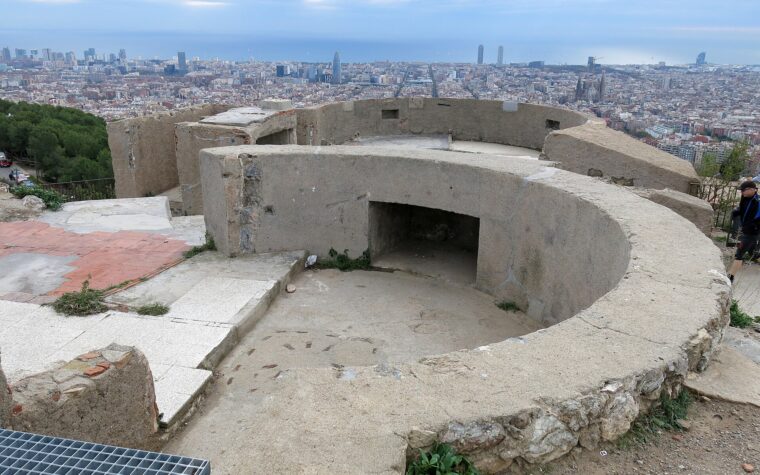
If you want a view to go with your evening in the colder months, note that the city’s other famous free viewpoint, the Bunkers del Carmel, now closes before dark. Montjuïc, with the fountain below it, is where the evening views are now.
Frequently asked questions
What time is the Magic Fountain show in Barcelona?
From June to September, 21:30 to 22:30 from Wednesday to Sunday. In October, 21:00 to 22:00 from Thursday to Saturday. In November and December, 21:00 to 22:00 on Thursdays and Saturdays. In April, 21:00 to 22:00 from Thursday to Saturday. Check the official schedule for January to March and for May, and on the day for cancellations.
Is the Magic Fountain running in 2026?
Yes. After being switched off for long periods during Catalonia’s drought between 2023 and 2025, the shows returned to a normal programme in September 2025 and have continued through 2026.
Is the Magic Fountain free?
Yes. There is no ticket and no charge; you simply turn up on a show night and stand anywhere around the fountain or on the steps above.
Is the Magic Fountain on every night?
No. There are no regular shows on Mondays or Tuesdays at any time of year, and outside the summer there are only two or three show nights a week. Always check which nights apply in the month you are visiting.
How long does the Magic Fountain show last?
Each show runs for about an hour and is made up of several musical sequences, so you can arrive part-way through and still see complete pieces. Most people watch for 30 to 45 minutes.
Where is the best place to watch the Magic Fountain?
Directly in front of the fountain, facing the Palau Nacional, for the full effect of the music; the steps and terraces of the Palau Nacional for the view of the whole axis and the best photographs; or a little way down the avenue for the classic postcard view with less crowd.
How do I get to the Magic Fountain?
Take metro L1 or L3 to Espanya and walk about 10 minutes up the Avinguda de la Reina Maria Cristina, between the Venetian towers. The Aerobús from the airport and the FGC trains also stop at Plaça d’Espanya.
What time should I arrive for the Magic Fountain?
In summer, 20 to 30 minutes before the show starts if you want a place near the front. Outside the summer and on weeknights you can usually arrive at the start and still find a decent spot.
Is the Magic Fountain good for children?
Very. It is free, outdoors, easy to leave early, and the colours and music hold children’s attention well. The summer shows start at 21:30, so for small children the first half-hour is usually plenty.
Does the Magic Fountain run during La Mercè and on New Year’s Eve?
On those nights the normal show is replaced by bigger events on the same avenue: La Mercè’s closing Piromusical and the city’s official New Year’s Eve countdown, both of which the city is moving elsewhere while the works at the Fira de Barcelona’s Montjuïc site are under way.
Related Barcelona Guides
- Montjuïc — everything else on the hill above the fountain.
- Poble-sec — where to eat before the show.
- Barcelona’s best views — including the Palau Nacional terrace at sunset.
- La Mercè — the festival that ends with the Piromusical at the fountain.
- Summer events in Barcelona — what else is on when the fountain runs five nights a week.
- Free things to do in Barcelona — the fountain and the rest of the best of the free list.
- Barcelona month by month — weather, events and crowds for every month of the year.
- Barcelona attractions and tickets — what to book, what to skip and what to pay.
Photo Credits
The Magic Fountain from the steps of the Palau Nacional: Font Magica de Montjuic BCN 04 2016 7242 by Mariordo (Mario Roberto Durán Ortiz), CC BY-SA 4.0, via Wikimedia Commons.
The Magic Fountain switched off: 067 Font Màgica de Montjuïc, apagada, pl. Carles Buïgas (Barcelona) by Enric, CC BY-SA 4.0, via Wikimedia Commons.
The fountain’s nozzles with the Venetian towers beyond: Avinguda de la Reina Maria Cristina 2013 by Felix König, CC BY 3.0, via Wikimedia Commons.