We get commissions for bookings made through this post. Booking links, and any accommodation options shown on the page, are handled by a partner that adds commission tracking automatically. It never costs you more, and it never affects what we recommend. Affiliate disclosure
Walk through Gràcia in the first week of August and you will see the same handwritten notice taped to door after door: tancat per vacances, closed for the holidays, back in September. The bakery, the shoe mender, the bar where the same four men play dominoes every evening, the little restaurant you saved on your phone months ago: all shut, their owners at the coast or up in the Pyrenees. A week later those same streets vanish under ceilings of painted cardboard, plastic bottles and fabric, and the neighbourhood throws the biggest street party of the Barcelona summer. Barcelona in August is like that. It is the hottest month, the warmest sea and the peak of the visitor year, and also, oddly, the month with the fewest locals: a city that half-closes and then celebrates in the streets it has just emptied.
This guide covers what August is really like: the weather, including the storms the brochures leave out, the dates to expect in August 2027, the Festa Major de Gràcia and its quieter cousin in Sants, what closes and what does not, the beaches, the crowds, the prices, and an honest verdict on whether August is your month. For the whole year side by side, see our Barcelona month-by-month guide; if you are still choosing a season, start with our best time to visit guide. Facts and prices were checked in October 2026; treat them as the right order of magnitude rather than a quote.
August at a glance
| August in Barcelona | |
|---|---|
| Average high / low | 29 °C / 21 °C: the warmest month of the year, just |
| Rain | About 65 mm on around five days, mostly in short, heavy storms |
| Sunshine | About nine hours a day |
| Daylight | Sunset from about 21:10 at the start of the month to about 20:30 at the end |
| Sea temperature | About 25 °C: the warmest of the year |
| Crowds | Peak for visitors; many residents are away |
| Prices | Peak |
| Big events | Festa Major de Gràcia (expected 15–21 August 2027), Festa Major de Sants (last week of August), the 15 August holiday, the end of the summer sales |
| Verdict | Superb for the sea and the street festivals, hard going for sightseeing, and a gamble for anyone with a list of neighbourhood restaurants |
The weather, honestly
August is the warmest month of the Barcelona year, though only by a whisker: the average high is about 29 °C, a fraction above July, and the average low about 21 °C. On paper that does not sound extreme. On the street it feels several degrees hotter, because the air coming off the sea is humid and the stone of the Eixample soaks up heat all day and gives it back all night. The nights are what visitors from cooler countries end up talking about. Barcelona now regularly strings together long runs of what Catalans call nits tropicals, tropical nights on which the temperature never drops below 20 °C, and heatwaves that push the afternoon into the mid-30s have become a normal part of recent summers rather than a freak.
The averages also hide the rain. July is the driest month of the year; August gets roughly three times as much, around 65 mm, but on only five days or so, and it tends to arrive all at once. A typical August storm builds over the Collserola hills behind the city in the afternoon, breaks with lightning and fat, warm drops, turns the steeper streets of Gràcia and Sant Gervasi into streams for an hour and has blown through by dinner. Storms are more likely in the second half of the month, as the season starts to turn towards the wet autumn. One is rarely a reason to cancel anything, but it is a good reason to know where the nearest museum is.
The sea, meanwhile, is at its best: about 25 °C, the temperature of a slightly cool bath, which makes August the finest month of the year for swimming. Warm water has a downside, and it is jellyfish. The mauve stinger is the most common visitor along this coast, numbers swing wildly from one summer to the next, and lifeguards hoist a jellyfish warning flag when they are about. A sting hurts more than it harms; the first-aid posts on the main beaches deal with them all day.
What to pack for August
- The lightest clothes you own, in linen or cotton, plus one layer that covers your shoulders and knees for churches, including the Sagrada Família.
- A hat, sunglasses and high-factor sun cream. The midday sun is fierce, and the reflection off the sand doubles it on the beach.
- A small umbrella or a packable rain jacket. Not for drizzle, which barely exists here in summer, but for the half-hour cloudburst that catches you between metro stations.
- Insect repellent. The tiger mosquito is established in Barcelona and, unlike the native kind, bites in daylight, especially in parks and leafy courtyards.
- A refillable water bottle. The city’s public drinking fountains are safe and easy to find.
- Swimming things and sandals you can actually walk in. You will end up on the beach more often than you planned.
Our Barcelona packing list covers the rest.
The month the city goes on holiday
The phrase every August visitor learns is tancat per vacances. Spain takes its summer holiday in August more thoroughly than almost anywhere else in Europe, and Barcelona is no exception. From the end of July a large share of residents leave for the coast, the mountains or the family village, and many of the small businesses that serve them close for two, three or even four weeks. The low point is the middle of the month, around the 15 August holiday, when whole stretches of residential streets have their shutters down.
What that means for a visitor depends on what kind of trip you are planning:
- Neighbourhood restaurants and bars are the most likely to be shut. The places in Gràcia, Sant Antoni, Poblenou and the upper Eixample that food writers love are run by people who want August off like everyone else. Some of the city’s best-known kitchens close for part of the month too.
- Independent shops follow the same pattern. The ceramicist, the vintage shop and the bookshop you read about may well be closed, while the chains and department stores carry on as normal.
- Neighbourhood markets slow down. Many stalls take a week or two off in rotation, and some markets shorten their hours in summer. La Boqueria keeps its usual Monday-to-Saturday timetable, though even there a few stalls go dark.
- Everything built for visitors stays open. The sights, the museums, the department stores, the beach bars and the restaurants in the old town run flat out, because August is their busiest month of the year.
The practical advice is simple. If a particular restaurant, bar or shop is the reason you are heading somewhere, check that it is open that week, on its own website or social media rather than on a map listing, which often lags behind. Then keep a second choice in your back pocket.
There is an upside, and residents who stay behind quietly enjoy it. Traffic thins out, rush hour on the metro is noticeably lighter, and outside the tourist centre the city takes on a slow, half-asleep feel that it has at no other time of year. In the last days of the month, as families come back for the start of school, it starts to fill up again.
August 2027: the dates that matter
| Date | What happens | What it means for you |
|---|---|---|
| Sunday 1 August | First Sunday of the month | Free entry at several museums, including the MNAC and the Picasso Museum; the Picasso’s free slots must be reserved online |
| Early August | The last nights of the Sala Montjuïc open-air cinema | In 2026 the season ran from 10 July to 5 August, in a moat of Montjuïc Castle |
| Wednesdays to Sundays | The Magic Fountain’s summer shows | 21:30–22:30, free, never on Mondays or Tuesdays |
| Thursdays to Saturdays | Picasso Museum summer evenings | Open until 21:00, with free entry from 19:00 for anyone who reserves |
| Mid-August | FC Barcelona’s season begins | Barça traditionally plays the pre-season Joan Gamper Trophy in August; in 2026 the La Liga home season opened at Spotify Camp Nou on 16 August |
| Sunday 15 August | The Assumption, a national public holiday | Falls on a Sunday in 2027, so the effect on opening hours is small |
| 15–21 August (expected) | The Festa Major de Gràcia | Decorated streets, free concerts and a week of street parties; in 2026 it ran 15–21 August |
| Around 16 August | The Festa de Sant Roc in the Plaça Nova | A small, very old festival by the cathedral, with giants and traditional music |
| Last week of August | The Festa Major de Sants | Built around Sant Bartomeu (Tuesday 24 August); in 2026 it began on Saturday 22 August |
| End of August | The summer sales (rebaixes) finish | The deepest discounts of the season, on what is left |
| All month, until 15 September | Sunday shopping in the central tourist zone | Shops in Ciutat Vella and much of the Eixample may open on Sundays, 12:00–20:00 |
The 2027 dates follow the pattern the festivals have kept for years and the 2026 programmes; the detailed programmes are usually published in July. Check them before you book a trip around a particular night.
The Festa Major de Gràcia
If you are in Barcelona in the middle of August, this is the thing to see. For a week from 15 August, the old village of Gràcia, swallowed by the city in the nineteenth century but still fiercely its own place, holds a festival that is part art competition, part neighbourhood party and part endurance test. In 2026 it ran from 15 to 21 August, with more than 900 activities and a long list of free concerts; expect the same week in 2027.
The decorated streets
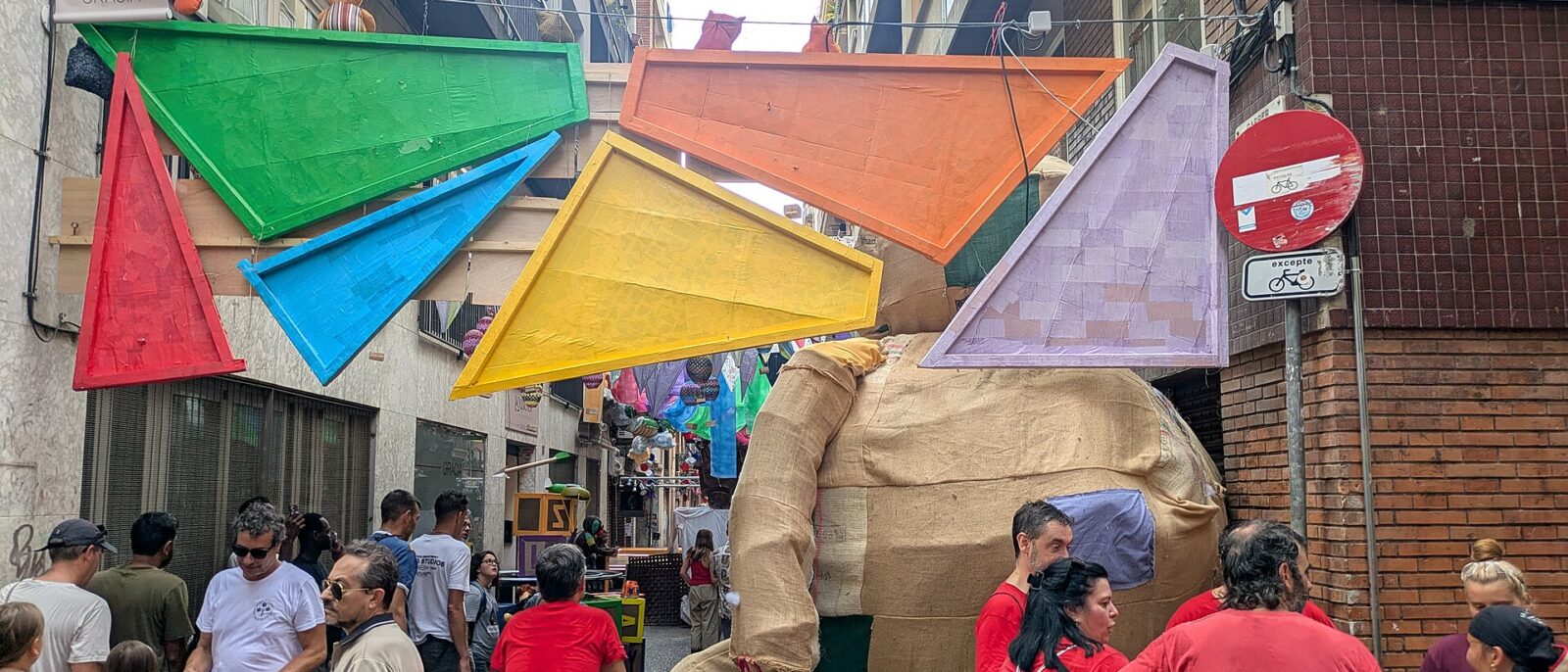
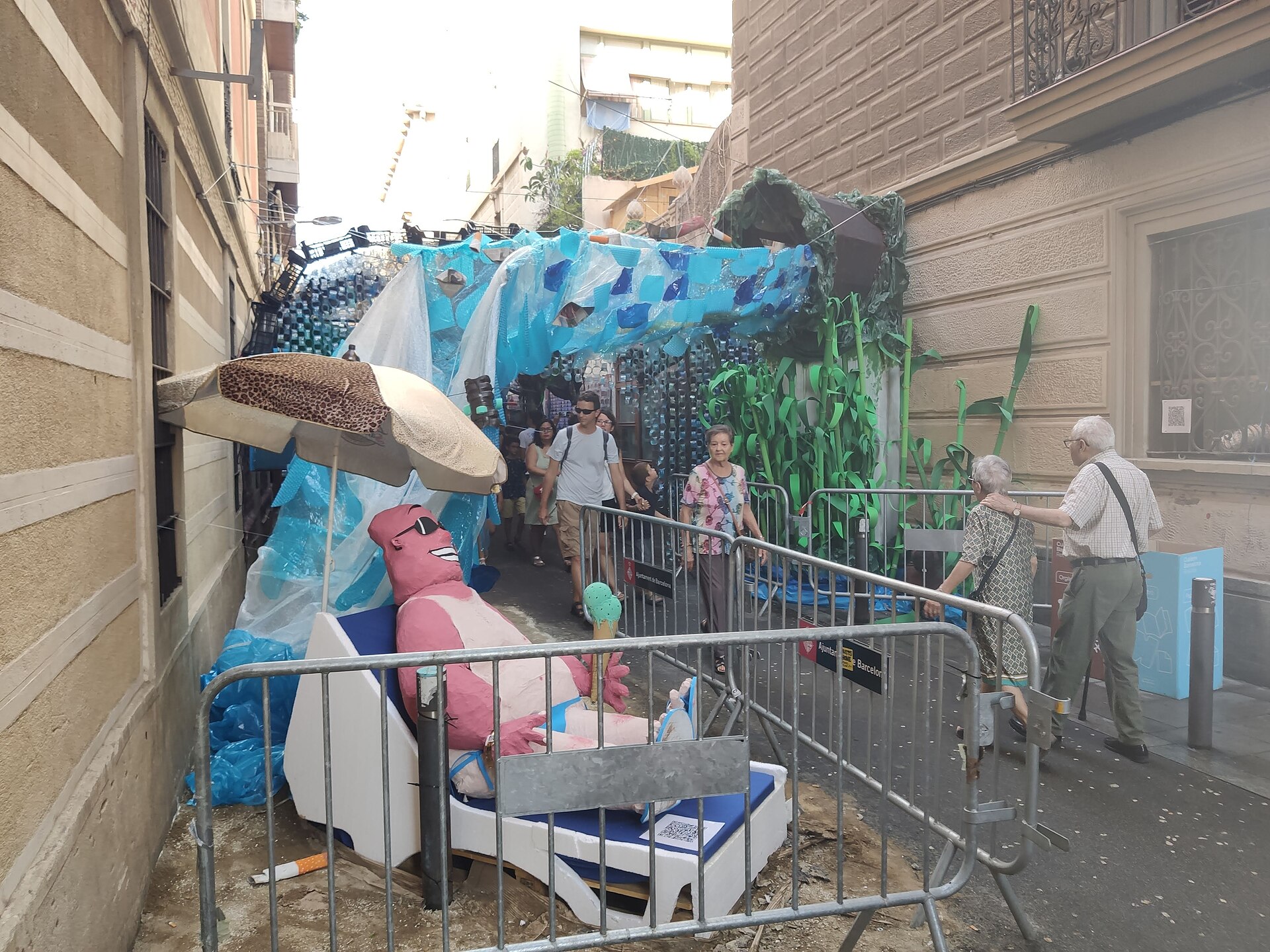
The heart of it is the carrers guarnits, the decorated streets. Each takes part through a committee of residents who choose a theme months in advance and then build it by hand, mostly out of recycled materials: plastic bottles become a coral reef, egg boxes become a dragon’s scales, old fabric becomes a sky. The finished decorations cover the whole street, overhead and at ground level, and the effect when you turn a corner into one is genuinely startling. Twenty-three streets and squares took part in 2026.
The decorations are judged, and the result matters a great deal to the people who made them. The 2026 prize went to the Plaça Rovira i Trias for “Batiscaforoviruskas”, a tribute to Batiscafo Katiuskas, the 2006 album by the Mallorcan band Antònia Font, which also marked twenty years of the square decorating without a break. It was the committee’s first win. Second place went to Carrer de Mozart for “L’hivernacle encantat”, the enchanted greenhouse, a tribute to the Umbracle in the Parc de la Ciutadella in the days when it was used as a dance hall. The year before, Carrer del Progrés had won. The committees have struggled to find enough volunteers in recent years, and every street that drops out is a loss, which is one more reason to buy your drink at a street’s own bar: in many of them, the takings go towards next year’s decorations.
Everything else
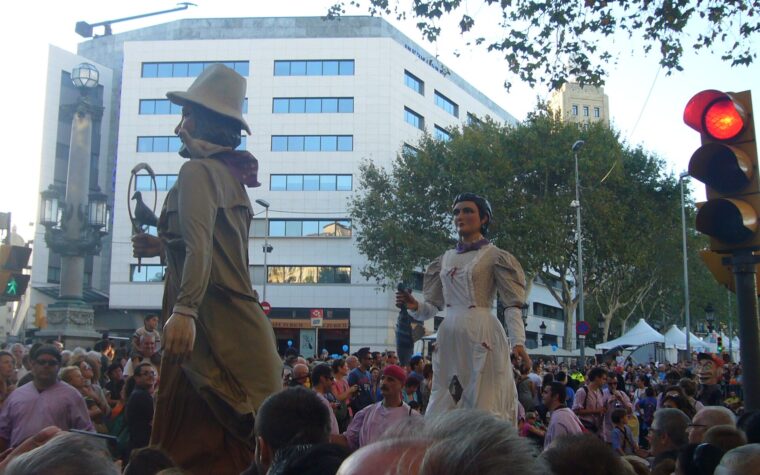
Beyond the streets, the festival fills Gràcia’s squares with stages, concerts, dances, giants, human towers built by the local castellers and, in the traditional way, a correfoc, a run of fire-spitting devils that you watch from a safe distance in long sleeves or not at all. Daytime is for families, with children’s activities and the slow walk from street to street. Night is for music, and the squares stay busy until the small hours, especially on weekends.
How to see it well
- Go in daylight for the decorations. Late morning on a weekday is the calmest time, and late afternoon gives you the decorations in good light before the evening crowd arrives. After about 21:00, and above all on a Friday or Saturday night, the busiest streets turn into a slow-moving crush, and at peak times the most popular ones can have queues and one-way systems.
- Come back at night for the atmosphere. Many decorations are lit after dark, and the squares are at their liveliest. Just accept that you will not see much of the streets themselves.
- Use the metro. Fontana (L3) and Joanic (L4) both put you on the edge of the festival area, and the FGC’s Gràcia station is at its western foot. Do not try to arrive by taxi.
- Carry little. Crowds this dense are where pickpockets do their best work. Keep your phone in a front pocket and leave the backpack at the hotel. Our safety guide has more.
- Remember people live here. These are residential streets, and the neighbours have been building these decorations since spring. Use the bins, do not climb on anything, and keep the noise down in the side streets late at night.
- Think twice before staying in Gràcia that week if you need to sleep early. The music goes on late. If you love it, though, there is no better base.
Our Gràcia neighbourhood guide covers the area the rest of the year, and our Barcelona festivals guide sets the Festa Major in the context of the whole year.
The Festa Major de Sants, and Sant Roc
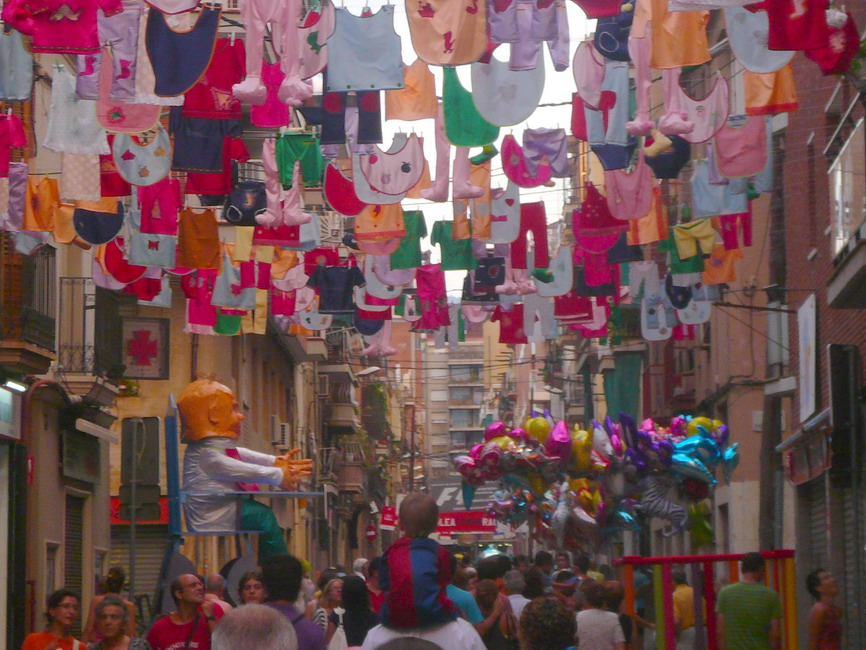
A week after Gràcia’s festival ends, Sants holds its own. The Festa Major de Sants is built around the feast of Sant Bartomeu on 24 August, follows the same formula of decorated streets, concerts, giants and fire-runs, and does it on a smaller, more local scale, with a fraction of the visitors. In 2026 it began on Saturday 22 August and ran towards the end of the month, with eleven decorated streets. Carrer de Valladolid won for the second year running, with “La ruta de la seda”, the Silk Road; Carrer de Sagunt came second, and Carrer de Guadiana third with a magical workshop full of giant sweets, pastries and croissants.
If you found Gràcia overwhelming, Sants is the antidote: you can walk its streets at a normal pace, talk to the people who built the decorations and get a drink without queueing. The decorated streets are spread either side of the Carrer de Sants, and metro L1 or L5 to Plaça de Sants puts you in the middle of them. It is also handy if you are leaving from Sants station at the end of a trip.
In the Gothic Quarter, meanwhile, the small Festa de Sant Roc fills the Plaça Nova in front of the cathedral around 16 August, with giants, traditional music and games for children. It claims to be the oldest festival in the city, and it feels nothing like the tourist streets around it. If you are near the cathedral that week, look in.
How to plan an August day
The single most useful thing to know about Barcelona in high summer is that the city runs on a different timetable, and fighting it is exhausting. Nobody who lives here walks across the Eixample at three in the afternoon in August. You do not have to either.
| Time | What to do |
|---|---|
| 08:00–12:00 | The outdoor sights: Park Güell, the Gothic Quarter, the first slots at the Sagrada Família, Montjuïc, the markets. Your best sightseeing hours by far |
| 12:00–14:00 | A swim, or an air-conditioned museum before lunch |
| 14:00–17:30 | The hottest hours. A long lunch in the shade, a siesta, the beach under an umbrella, or somewhere cool indoors. This is also when storms tend to break |
| 17:30–20:30 | Back out: the Gaudí houses, the decorated streets during the festivals, a walk along the seafront |
| 20:30–late | Sunset, the Magic Fountain, dinner at 21:30 or later, and the city at its liveliest |
Keeping cool
- Book the outdoor Gaudí sights for the morning. Park Güell’s famous terrace has almost no shade, and an afternoon slot in August is punishing. Our Park Güell guide explains the ticketed zone and the free parts of the park.
- Use the shade the old city gives you. The narrow lanes of the Gothic Quarter and El Born stay several degrees cooler than the broad, sunny avenues of the Eixample.
- Save the museums for the afternoon. CosmoCaixa is the best place in the city for families to sit out the heat (our CosmoCaixa guide has the details), the MNAC is free on Saturdays from 15:00, and the Picasso Museum stays open until 21:00 from Thursday to Saturday.
- Know about the climate shelters. The city opens a network of air-conditioned public buildings, many of them libraries, as places anyone can go to cool down.
- Do not plan a sunset at the Bunkers. The Bunkers del Carmel close at 19:30 in summer, an hour or more before the sun goes down. Our Bunkers del Carmel guide suggests where to go instead.
- When a storm comes in, get off the beach and out of the parks, wait it out over a coffee, and carry on afterwards. Our rainy day guide is useful for the odd washed-out afternoon.
The sea and the beaches in August
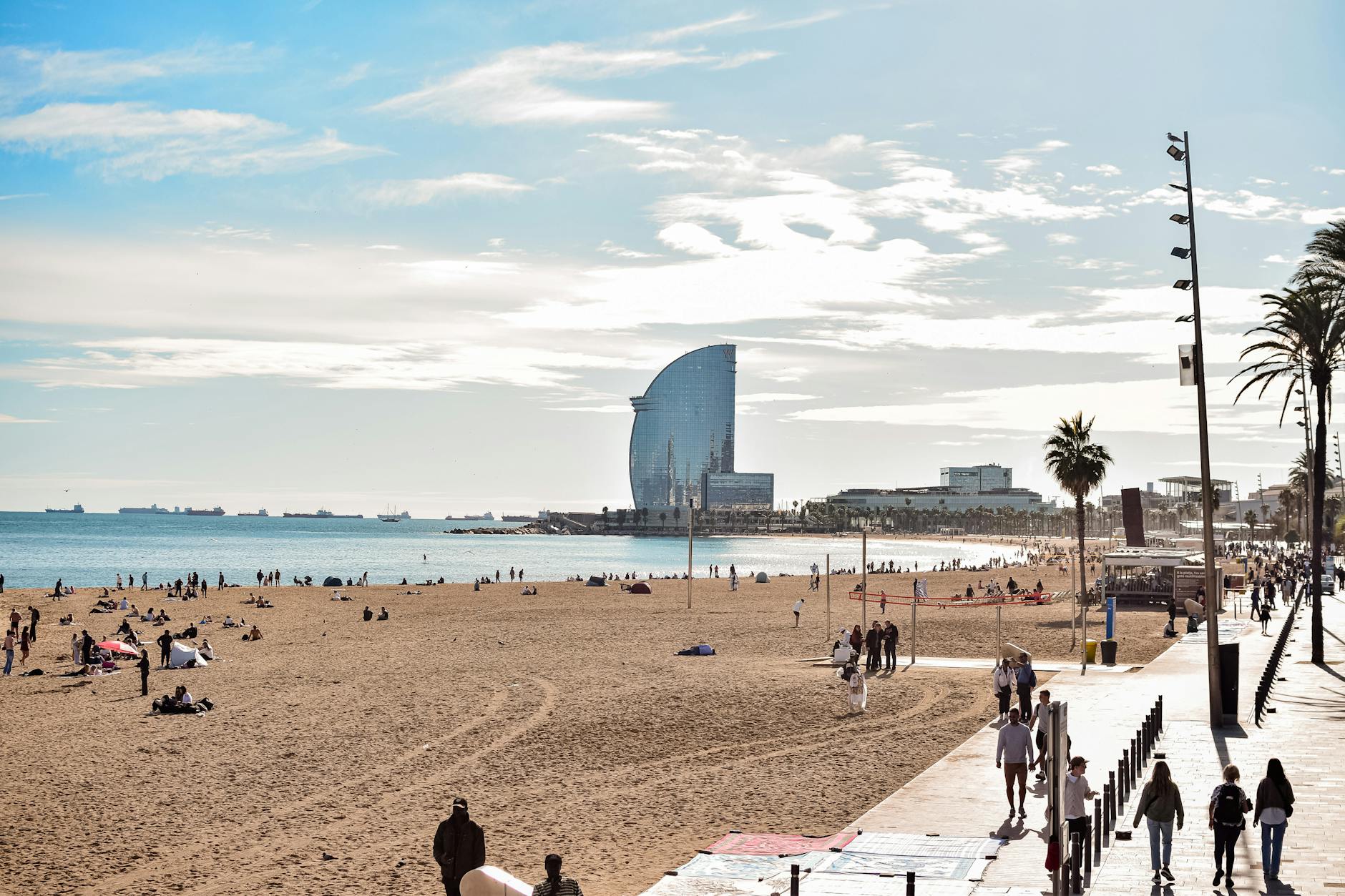
This is what August does better than any other month. The water is at its warmest, the evenings are long, and a swim at eight in the evening, with the sun low over Montjuïc and the sand finally cooling, is one of the great pleasures of a Barcelona summer.
The beaches are also at their busiest, and the city’s own residents are not the main reason. A few things make a real difference:
- Go early or late. Before 11:00 and after 18:30 there is room to spread out, the sun is kinder, and the sea is exactly as warm.
- Walk past Barceloneta. The beaches further north-east, Nova Icària, Bogatell, Mar Bella and Nova Mar Bella, have more space, fewer hawkers and a more local crowd. Our best beaches guide compares them one by one.
- Watch the flags, for sea conditions and for jellyfish, and take them seriously.
- Never leave your things alone. Theft from towels while their owners swim is the commonest crime on the city’s beaches, and August is its high season. Take turns, or bring nothing worth taking.
- Think about the coast outside the city. Sitges is 40 minutes south by train, and the Costa Brava’s coves are lovely, but be honest about August: half of Spain is on holiday, the coves are full by mid-morning and the roads are slow. Our beaches near Barcelona guide has the options.
Calm summer seas also make August good for paddleboarding, kayaking and sailing; our water sports guide covers where to hire and what it costs.
Escaping the heat
Every summer, visitors ask where they can go to get out of the heat for a day. The honest answer is that most of the classic day trips are no cooler than the city, so choose with care.
- Montserrat is a few degrees fresher than Barcelona at the monastery and on the trails above it, though hardly cold. Go early, when the light on the rock is best and before the coaches arrive; our Montserrat guide covers the trains and cable cars.
- Tibidabo, the highest point of the Collserola ridge above the city, catches whatever breeze there is, and its old-fashioned amusement park is at its busiest in high summer. Our Tibidabo guide has the details.
- Girona is a beautiful day trip, but not an escape: it sits inland and is often hotter than Barcelona in August. Go for the old town, not the climate.
- The Pyrenees are the only real escape, with genuinely cool air at altitude, but they are a long day out and better as an overnight trip.
Our day trips from Barcelona guide covers the rest. One seasonal note for wine lovers: the grape harvest starts in the Penedès in late August, and the cava houses south-west of the city are busy, and beautiful, at the end of the month.
Eating and drinking in August
The closures make eating out in August a little more work, but the food itself is at its summer best. Tomatoes taste of something, peaches and nectarines are piled high in the markets, and the first figs arrive towards the end of the month. What to look for:
- Cold dishes built for the heat. Gazpacho and the thicker salmorejo are on every menu; look also for esqueixada, the Catalan salad of shredded salt cod with tomato, onion and olives, and escalivada, roasted peppers and aubergine served cold with good olive oil.
- Rice by the sea. A seafood paella, a black arròs negre or a fideuà of short noodles at a beach restaurant, eaten at 14:30 and not hurried. Our paella guide explains how to spot the frozen tourist versions.
- Something icy in the afternoon. Orxata, the cold, sweet tiger-nut drink, and granissat, a crushed-ice slush of lemon or coffee, are the traditional cures for a hot afternoon.
- Vermouth before lunch, on a shaded terrace with a plate of olives and crisps, which is about as Barcelona as a summer Sunday gets.
With so many neighbourhood places shut, the restaurants that stay open fill up faster than usual. Book the ones you care about, eat late, and do not be afraid of the busier tourist streets for a quick lunch, as long as you avoid the picture-menu places on La Rambla. Our Catalan cuisine guide explains what to order.
August nights
The reward for an August afternoon is an August night. The city comes back to life as the heat breaks, around 20:00, and stays out late. The Magic Fountain plays five nights a week, the beach bars run until well after dark, the terraces in the squares of El Born and Gràcia are full until midnight, and during the festivals Gràcia and then Sants turn into one long open-air party. Our Magic Fountain guide explains where to stand, our rooftop bars guide has the best places for a sunset drink, and our nightlife guide covers the rest.
The CCCB, the contemporary culture centre in El Raval, has also traditionally run a season of free open-air films in its courtyard in August, with deckchairs; check the centre’s programme if that appeals.
What August is good for
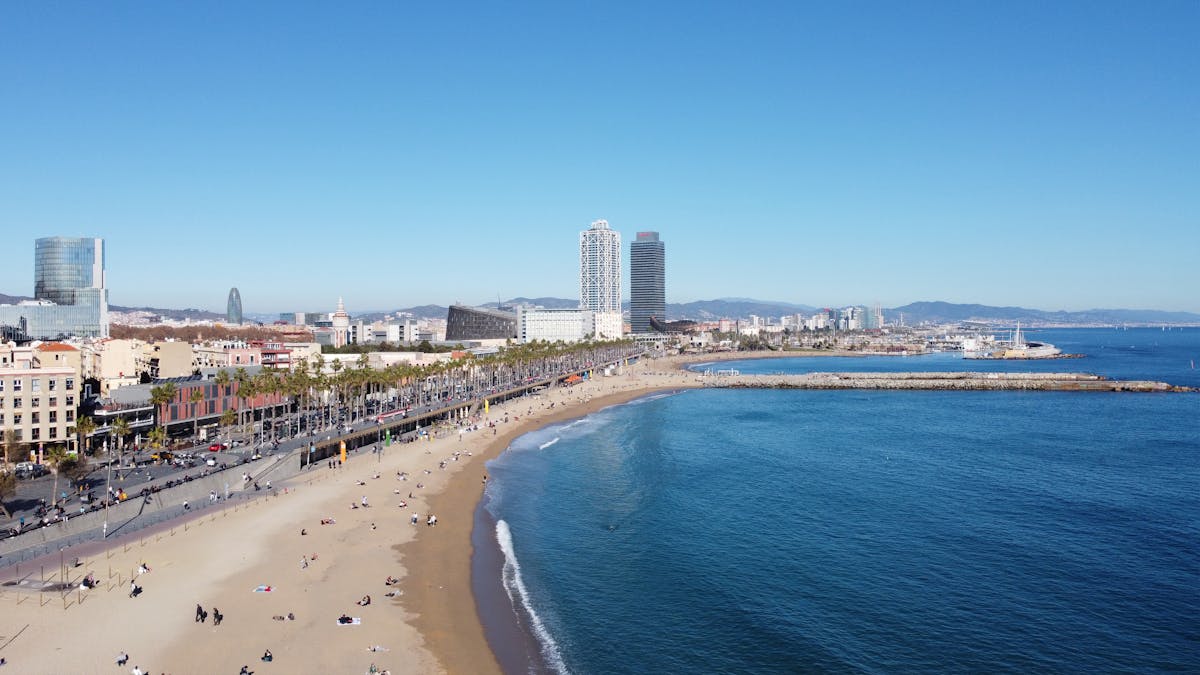
- Swimming. The sea is at its warmest, and the evenings are long enough to fit in a swim after a full day.
- Street festivals. The Festa Major de Gràcia is one of the best neighbourhood festivals in Europe, and Sants follows straight on.
- Nights out. Warm evenings, late dinners and a city that lives outdoors until the small hours.
- The sales. The end of the summer rebaixes, with Sunday opening in the central zone; our shopping guide explains the rules.
- Getting around. With residents away, the roads and the morning metro are quieter than at any other time of year.
What August is bad for
- Midday sightseeing. From about 13:00 to 17:30 the heat makes long walks miserable, and the humidity makes it worse.
- Sleep. Tropical nights, festival noise and early-morning deliveries. Choose an air-conditioned room at the back of the building.
- Neighbourhood food. If your trip is built around particular local restaurants, August is the month most likely to disappoint you.
- Crowds and queues. Every big sight sells out, the Gothic Quarter is packed and the beaches are full by late morning.
- Hiking. Collserola and the coastal paths are hot and dry; walk at dawn or save them for the autumn. Our hiking guide has the routes for a cooler month.
- Value. You pay peak prices for the least comfortable sightseeing weather of the year.
Crowds and prices
August is peak season for visitors, with European school holidays at their height, the cruise season in full swing and Spanish families on the move. The major sights sell out well ahead: book the Sagrada Família at least a month in advance if you want a morning slot (our Sagrada Família guide explains the tickets), and book Park Güell, Casa Batlló, La Pedrera and any restaurant you care about as early as you can. Our city passes guide covers whether any pass saves you money or time.
Accommodation is expensive. Barcelona’s hotels averaged about €195 a night across the first half of 2026, the highest of any Spanish city, and summer is not when that number goes down; hostel beds climb by 40–60% in July and August. Hotels aimed at business travellers, along the Diagonal and in the 22@ district, sometimes cut their rates in August when the conference trade disappears, so they are worth checking if you do not need to be in the old town. On top of the room rate comes the tourist tax, between €6 and €12 per person per night depending on the type of accommodation, plus VAT, for the first seven nights; under-17s are exempt. Our tourist tax guide has the bands, our hotels guide has the properties, and our where to stay guide helps you choose the area. Whatever you book, check it has air conditioning before you check anything else.
August or September?
| August | September | |
|---|---|---|
| Average high / low | 29 °C / 21 °C | 26 °C / 18 °C |
| Rain | About 65 mm, in short storms | About 85 mm, as the autumn rains begin |
| Sea | About 25 °C, the warmest of the year | About 23 °C, still excellent |
| City life | Many local businesses closed for the holidays | Fully open again, with schools back by the second week |
| Big events | The Festes de Gràcia and Sants | The Diada on 11 September and La Mercè, the city’s own festival, around 24 September |
| Crowds and prices | Peak | High, easing a little after the first fortnight |
Our view: August if you want the warmest sea and the street festivals and you can live with the heat; September if you want to swim and sightsee in the same trip. For most visitors who can choose, September is the better month. For anyone who has always wanted to see the Festa Major de Gràcia, there is no substitute for the middle of August. Our La Mercè guide covers September’s big festival.
Four days in August: a sample plan
- Day one: the old city before the heat. The Gothic Quarter and the cathedral from 08:30, El Born before midday, a long lunch in the shade, a siesta, and, on a Thursday, Friday or Saturday, the Picasso Museum in the evening, ideally on a free slot booked four days ahead. Our Picasso Museum guide explains how.
- Day two: Gaudí early, Gràcia late. The Sagrada Família on the first slot of the day and Park Güell straight after, then a rest through the afternoon. During the Festa Major, walk the decorated streets of Gràcia from about 18:00 and stay for the concerts.
- Day three: the sea. A morning swim at Bogatell or Mar Bella, a rice lunch at a beach restaurant, an afternoon indoors, and a second swim at sunset.
- Day four: Montjuïc or Montserrat. Either a morning trip to Montserrat, back in the city by mid-afternoon, or a slow day on Montjuïc: the MNAC, the Fundació Joan Miró, the gardens, sunset from the terrace of the Palau Nacional, and the Magic Fountain if it is Wednesday to Sunday.
Is August a good time to visit Barcelona?
For the sea and the street festivals, yes, emphatically. There is no warmer water all year, no better week for a neighbourhood party than the Festa Major de Gràcia, and few cities in Europe do warm summer nights as well. If that is what you are coming for, August delivers.
For everything else, it is a trade-off, and often a poor one. The heat and humidity make long days of sightseeing hard work, you pay peak prices, you share every big sight with peak crowds, and the neighbourhood restaurants that make the city special may well be shut. If your trip is mainly about Gaudí, museums and food, you will enjoy the same city more in May, June, late September or October.
If August is simply when you can travel, adopt the local rhythm: early mornings, long lunches, a siesta without guilt, and late nights, with a swim fitted in somewhere every day. Barcelona in August, approached that way, is a very good summer holiday. Fight it with a northern European sightseeing schedule and it will have beaten you by lunchtime.
For the month before, see Barcelona in July, and for the whole year at a glance, the month-by-month guide.
Frequently asked questions
How hot is Barcelona in August?
Hot and humid. The average high is about 29 °C and nights rarely fall much below 21 °C, and heatwaves pushing afternoons into the mid-30s have become common in recent summers. It feels hotter than the figures suggest because of the humidity.
Is August the hottest month in Barcelona?
Yes, by a small margin over July. August also has the warmest sea of the year, at about 25 °C.
Does it rain in Barcelona in August?
Not often, but heavily when it does. August gets about 65 mm of rain on around five days, mostly in short afternoon or evening thunderstorms that clear within an hour or two. Storms become more frequent towards the end of the month.
Is everything closed in Barcelona in August?
No. The sights, museums, department stores and restaurants in the tourist centre are all open. What closes are many independent restaurants, bars and shops in residential neighbourhoods, often for two to four weeks around the middle of the month. Check before you set out for a particular place.
When is the Festa Major de Gràcia in 2027?
It traditionally starts on 15 August and runs for a week, so expect 15 to 21 August 2027. The 2026 festival ran on exactly those dates, with 23 decorated streets. The programme is usually published in July.
Is 15 August a holiday in Barcelona?
Yes. The Assumption is a national public holiday in Spain. In 2027 it falls on a Sunday, so the effect on shops and offices is small, and the sights and museums open as normal.
Is the sea warm in Barcelona in August?
Yes, at about 25 °C it is the warmest of the year and comfortable for long swims. Watch for jellyfish warning flags, which go up when they are around.
Is Barcelona too crowded in August?
The tourist centre, the major sights and the central beaches are very busy, and the Festa Major de Gràcia is packed at night. At the same time, many residents are away, so traffic and the metro are quieter than usual. Book the big sights and your accommodation well ahead.
What should I wear in Barcelona in August?
The lightest clothes you have, a hat and sun cream, comfortable sandals, and one layer that covers shoulders and knees for churches. A small umbrella helps on storm days, and insect repellent is worth packing.
Is August or September better for Barcelona?
For most visitors, September: the sea is still warm, the heat is gentler and the city is fully open again. August wins if you want the warmest sea and the street festivals of Gràcia and Sants.
For the month after, see Barcelona in September: the neighbourhood restaurants reopen, the sea stays warm, the heat finally breaks, and the city celebrates the Diada and then La Mercè, its own festival. For most visitors who can choose, it is the best month of the year.
Related Barcelona Guides
- Barcelona month by month — the whole year at a glance.
- Barcelona in July — the month before, with the Grec and open-air cinema.
- Gràcia — the neighbourhood behind August’s best festival.
- Barcelona’s festivals — the year’s celebrations, month by month.
- Summer events in Barcelona — the season’s full calendar.
- Barcelona’s best beaches — where to swim, beach by beach.
- The best time to visit Barcelona — choosing between the seasons.
Photo Credits
Carrer de Jesús decorated for the Festa Major de Gràcia, 2026: Festa Major de Gràcia 2026 – Carrer de Jesús – Sant Pere Màrtir – 01 by KRLS, CC BY 4.0, via Wikimedia Commons.
Carrer de la Perla decorated for the Festa Major de Gràcia, 2023: 001 Festa Major de Gràcia 2023 (Barcelona), carrer de la Perla by KRLS, CC BY-SA 4.0, via Wikimedia Commons.
Carrer d’Alcolea de Baix decorated for the Festa Major de Sants: Carrer Alcolea de baix guarnit per la festa major de Sants 2008 by Pere López Brosa, CC BY-SA 3.0, via Wikimedia Commons.