We get commissions for bookings made through this post. Booking links, and any accommodation options shown on the page, are handled by a partner that adds commission tracking automatically. It never costs you more, and it never affects what we recommend. Affiliate disclosure
At half past eight on a Tuesday morning the fishmongers at the centre of the hall are still laying out their ice, a restaurant buyer is haggling amiably over the price of red prawns, and the counter bars are serving coffee and fried eggs to people who have been at work since six. By half past eleven the same aisles are a slow shuffle of visitors holding fruit cups and phones. Both of those places are La Boqueria, and which one you get depends almost entirely on when you walk in and how far past the front stalls you are prepared to go.
This guide covers the hours that matter, how the market is laid out, where the people who actually cook do their shopping, what is worth eating and what to walk past, and whether you should bother at all. If you want the city’s other markets, our Barcelona markets guide covers Santa Caterina, Sant Antoni and the rest. This page is only about the Boqueria. Details were checked in September 2026; stalls change hands more often than guidebooks admit, so treat named stalls as a starting point rather than a promise.
La Boqueria at a glance
| The short version | |
|---|---|
| Official name | Mercat de Sant Josep de la Boqueria |
| Address | La Rambla 91, halfway down La Rambla on the El Raval side |
| Metro | L3 (green) to Liceu, two minutes’ walk |
| Hours | Monday to Saturday, 08:00–20:30. Closed Sundays and public holidays |
| Entry | Free |
| Best time | Tuesday to Friday, 08:00–10:00 |
| Worst time | Late morning to mid-afternoon, especially on Saturdays and cruise-ship days |
| Fish stalls | Most are closed on Mondays |
| Tour groups | Groups of more than 15 are kept out on Friday and Saturday mornings |
| Time needed | 45 minutes to browse properly; an hour and a half with a counter breakfast or lunch |
| Worth it? | Yes, early and past the front stalls. No, at noon on a Saturday |

How the market is laid out
The Boqueria makes more sense once you realise it is really three markets under one iron roof, and they get more useful the further you walk from La Rambla.
The front: the market that faces the street
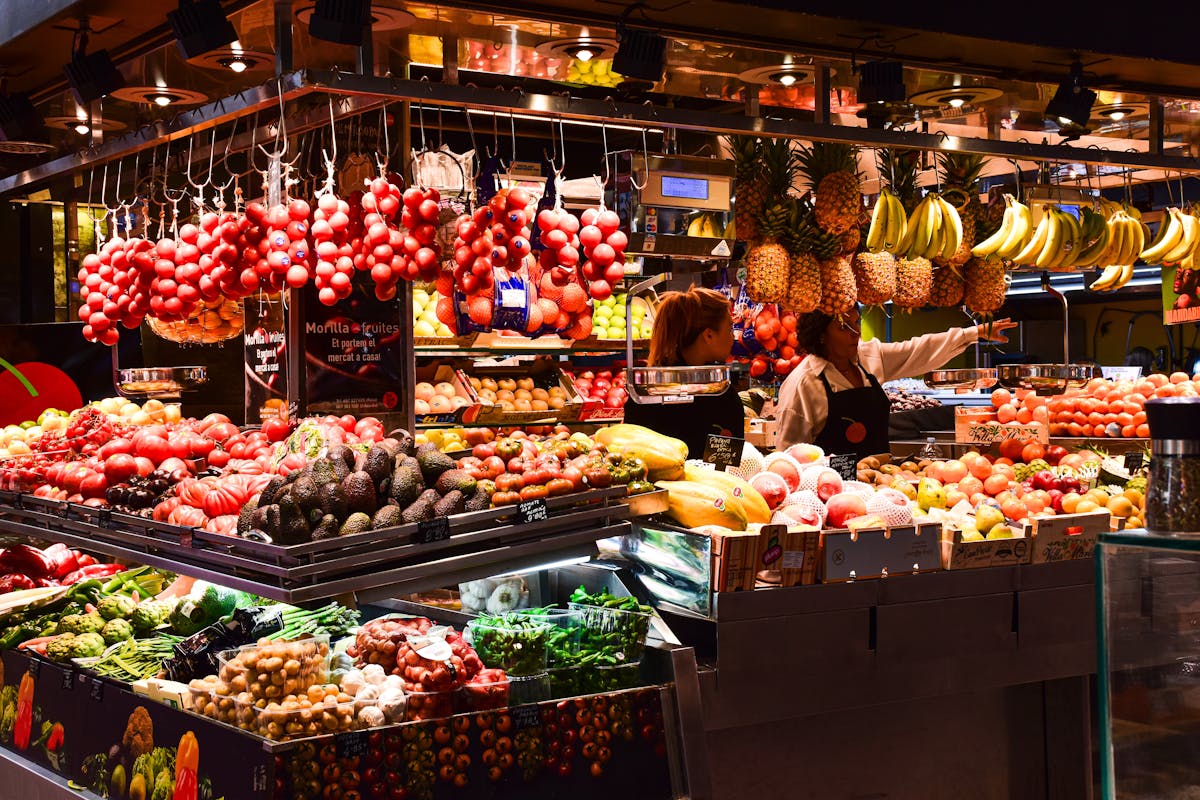
The first aisles inside the arch are where the market meets several million visitors a year, and the stalls there have adapted accordingly. This is the strip of pre-cut fruit in plastic cups, smoothies in every colour, paper cones of ham and cheese, chocolate-dipped strawberries and neat trays of sweets. None of it is a scam, exactly. It is simply food priced and packaged for people walking past, and it costs noticeably more than the same thing does a few aisles back or in any neighbourhood market in the city.
Look at it, photograph the famous displays if you like, and keep walking.
The middle: the fish
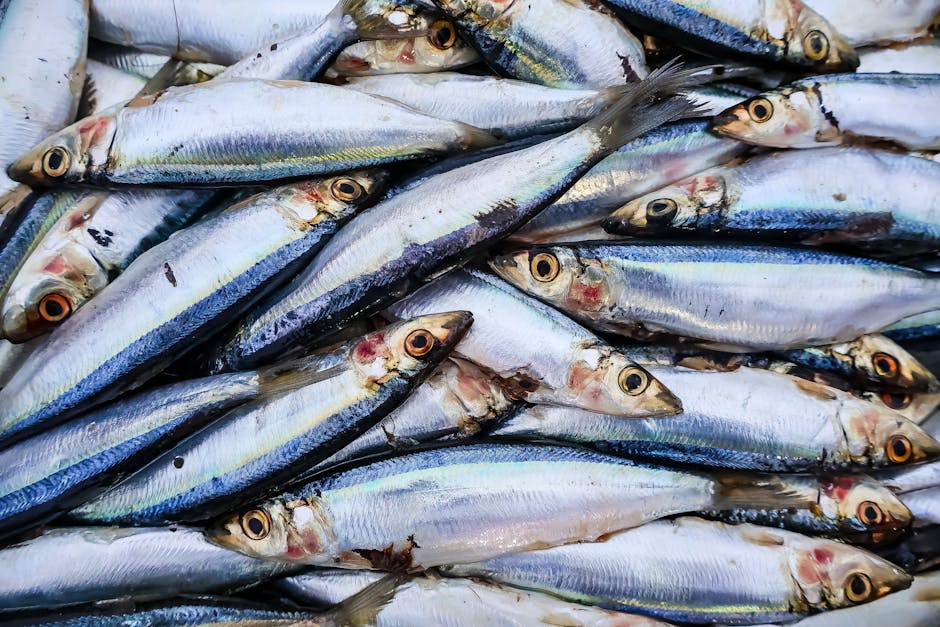
At the heart of the hall the fishmongers are arranged in a ring, and this is the part of the Boqueria that has changed least. The counters are banked with ice and whatever came in that morning: sardines and anchovies, hake and monkfish, cuttlefish and squid, clams, mussels and razor clams, and the deep-red prawns from Palamós on the Costa Brava that command a small fortune per kilo. Restaurant buyers do their rounds here early, and the handwritten price signs are one of the best guides to what is in season.
Most of these stalls are closed on Mondays, when there is little fresh catch after the weekend. If seafood is what you came to see, come between Tuesday and Saturday.
The back and sides: where people actually shop
Behind and around the fish ring is the market that locals still use: greengrocers, butchers, charcuterie counters, egg sellers, olive and pickle stalls, bakers, dried-fruit and nut stalls, and the casqueria counters selling tripe, trotters, sweetbreads and the other cuts that most northern European supermarkets gave up on decades ago. The rear of the market opens onto the Plaça de la Gardunya, and walking in from that side, rather than through the arch, is the single easiest way to see the Boqueria as a working market rather than a show.
Every stall has a number posted above it, which is useful if someone has recommended a particular one, because the names change more often than the numbers.
A 45-minute loop, done backwards
Most visitors enter under the arch, wade through the fruit cups, reach the fish, get tired and leave the way they came. Do it the other way round and you see a different market:
- Come in from the back, from the Plaça de la Gardunya. You arrive among the greengrocers and butchers, where the people with shopping trolleys are.
- Work through the back aisles slowly. Egg stalls with a dozen kinds of egg, mushroom baskets in autumn, the casqueria counters, the bakers. This is where the prices are per kilo and the customers are regulars.
- Walk the full circle of the fish ring. Look at what is expensive and what is cheap that day. It tells you what to order at dinner.
- Stop at a charcuterie counter for a hundred grams of ham sliced to order, or a wedge of Garrotxa.
- Sit down at a counter bar for coffee, or for eggs and a glass of something if the hour allows.
- Leave through the front, under the stained-glass arch and out onto La Rambla. You pass the tourist strip on the way out, already fed, which is the only sensible way to meet it.
When to go
Timing matters more at the Boqueria than at almost any other sight in Barcelona. The difference between 08:30 and 11:30 is the difference between a market and a queue.
- 08:00 to 10:00, Tuesday to Friday: the best of it. The stalls are full, the counter bars are feeding market workers, and you can stop and look without blocking anyone. Aim to arrive by 09:00 at the latest.
- Saturday morning: atmospheric but crowded. It is the big shopping day for Barcelona households, which makes it the most genuinely local morning of the week and also the busiest. Tour groups are kept out, which helps. Go early.
- Monday: thinner. The market is open, but most of the fish stalls are not, and the hall feels half-dressed.
- 11:00 to 15:00: the peak. Day visitors, walking tours and cruise passengers converge, the front aisles slow to a shuffle, and the counter bars have queues. This is when the Boqueria earns its reputation as a tourist trap.
- Late afternoon: winding down. The market is officially open until 20:30, but plenty of stalls start packing up after lunch, and by early evening a good share of the hall is shuttered. Fine for a quick look, poor for shopping.
- Sunday: closed. So are public holidays. Every week, people walk down La Rambla on a Sunday to find the gates shut.
Cruise-ship days
Barcelona is one of Europe’s busiest cruise ports, and the Boqueria sits at the top of almost every shore-excursion walk: shuttle bus into town, stroll up La Rambla, market, back to the ship. On a day with several large ships in port, late morning at the Boqueria becomes very crowded indeed. If you are staying in the city, you can dodge it simply by going early. If you are the one arriving off a ship, our cruise port to city centre guide explains how to get into town early enough to beat the rest of your ship.
What to eat, and what to walk past
Eat at a counter bar
The best thing to do in the Boqueria is sit at one of its counter bars, order what the person on the next stool is having, and watch the market go by. These are small, loud, cramped places with a dozen or so stools each, cooking market produce in front of you. There is no booking. You stand behind the stools, catch the eye of whoever is running the counter, and wait. When someone gets up, the seat is yours.
Two long-running names to look for:
- El Quim de la Boqueria, Quim Márquez’s counter, best known for fried eggs with baby squid (ous amb xipirons), which is exactly as good as it sounds at ten in the morning.
- Kiosko Universal, a no-nonsense counter for grilled fish and seafood straight from the stalls around it.
Expect a couple of plates and a glass of wine or a beer to run to roughly €25–40 a head, more if the red prawns get involved. That is more than a neighbourhood bar and less than a restaurant with the same seafood, which is about right. Get there before noon, and ideally well before.
A note on Bar Pinotxo
For decades the most famous counter in the market was Bar Pinotxo, just inside the entrance, where Juanito Bayén in his waistcoat served chickpeas, squid and cava to market workers, locals and a long line of visiting chefs. It is no longer here. After losing its place in the Boqueria, the bar reopened in the Mercat de Sant Antoni in October 2023, on the corner by Carrer del Comte d’Urgell and Carrer de Tamarit, run by the Asín family. Plenty of guides, apps and hotel concierges still send people looking for it in the Boqueria. If Pinotxo is what you are after, go to Sant Antoni instead. Our Sant Antoni neighbourhood guide covers the rest of the area.
Do the esmorzar de forquilla
Catalonia has a tradition called esmorzar de forquilla, the “fork breakfast”: a proper mid-morning meal, eaten with a knife and fork and often a glass of wine, for people who started work before dawn. The Boqueria’s counters are one of the last places in the city centre where it still happens in its natural habitat. Order eggs, a plate of botifarra sausage with beans, or chickpeas with black pudding, and you will be eating the way the market has always eaten.
What to buy and eat as you go
- Ham, sliced to order. Skip the pre-filled paper cones sitting under the lights at the front. Go to a charcuterie counter further in and ask for a hundred grams (cent grams) of whatever they are carving. It will be better and fresher, and you will know what you are paying per kilo.
- Catalan cheese. Look for Garrotxa, a nutty goat’s cheese from the volcanic Garrotxa district north-west of Girona, and mató, a fresh curd cheese that Catalans eat with honey as a dessert (mel i mató).
- Cured sausage. Fuet, thin, dry and snappable, is the classic. Llonganissa from Vic is its fatter, more serious cousin.
- Olives and pickles. The olive stalls sell them by weight in dozens of varieties, including the small, mild Arbequina from Catalonia itself.
- Seasonal fruit. Buy it whole from a greengrocer at the back, not cut into cups at the front. The difference in price is startling.
What to walk past
- Fruit cups and smoothies at the entrance. Photogenic and pricey. The same fruit costs a fraction as much, whole, twenty metres further in.
- Pre-made cones of ham and cheese. Assembled for speed, not quality, and priced accordingly.
- Anything sold by the “portion” with no price per kilo. Seafood and ham in particular. Ask the weight and the price before you say yes.
- Eating on the move in the aisles. It is not a picnic ground, the aisles are narrow, and stallholders have had enough of it. Eat at a counter or take it outside.
What is in season
The Boqueria is at its best when you let the calendar choose for you. A rough guide to what the stalls are proudest of through the year:
| Season | Look for |
|---|---|
| Autumn (October–November) | Wild mushrooms, above all rovellons (saffron milk caps) and ceps, piled in baskets; chestnuts and sweet potatoes for the All Saints’ feast of La Castanyada |
| Winter (December–March) | Calçots, the long sweet spring onions Catalans grill over fire and dip in romesco sauce; citrus; artichokes from late winter |
| Spring (April–June) | Strawberries, broad beans, peas, asparagus and the first cherries |
| Summer (July–September) | Tomatoes of every shape, including the tomàquet de penjar used for pa amb tomàquet; peaches, melons and figs |
Our guide to Catalan cuisine explains what to do with most of the above, and what to order when you see it on a menu.
Building a picnic from the Boqueria
The most enjoyable meal most people get from the Boqueria is not eaten in it. Put together a picnic and take it somewhere with a bench and some shade, and you will eat better and more cheaply than at most restaurants within a kilometre.
- Bread: a barra from one of the bakery stalls, or a round pa de pagès, the Catalan country loaf.
- Tomatoes: a couple of ripe ones to rub on the bread, the way Catalans make pa amb tomàquet. Ask for olive oil at an oil stall, or buy a small bottle.
- Ham and sausage: sliced to order, a hundred grams at a time.
- Cheese: a wedge of Garrotxa or a Manchego, cut in front of you.
- Olives in a tub, and fruit bought whole.
Then go and eat it. The courtyard garden of the Antic Hospital de la Santa Creu is two minutes from the back of the market and has benches under orange trees. The Parc de la Ciutadella is about twenty minutes’ walk east, and the beach at Barceloneta about twenty-five minutes south. Leave the wine for dinner, though: drinking alcohol in the street, in parks and on the beach can get you fined in Barcelona, and the police do issue the fines.
How to shop without annoying anyone
The Boqueria is somebody’s workplace, and the stallholders’ patience with visitors has been worn thin by a decade of people filming them without buying anything. A few habits make you welcome rather than tolerated:
- Do not touch the produce. Point, and let the stallholder pick. This is normal in every Spanish market, not a Boqueria quirk.
- Ask who is last. There is rarely a visible queue. Locals ask Qui és l’últim? (in Catalan) or ¿Quién es el último? (in Spanish), meaning “who’s last?”, then wait for that person to be served before stepping up. Do this and you will get a small nod of approval.
- Small amounts are fine. A hundred grams of ham, a single peach, a handful of olives. Nobody expects a tourist to buy a kilo of tripe.
- Buy something before you photograph a stall, or at least ask. Some stallholders put up signs about photography, and they mean them.
- Step out of the aisle to stop. The paths are narrow, and a group standing still in the middle of one blocks everyone behind it, including people with shopping trolleys and a job to do.
- Carry a little cash. Most stalls take cards now, but a few euros in coins makes small purchases easier for everyone.
- Watch your bag. The entrance from La Rambla is one of the busiest pickpocketing spots in the city. Wear bags in front and keep phones out of back pockets. Our Barcelona safety guide has more.
A few words that help at the stalls
Everyone in the Boqueria speaks Spanish, most stallholders speak Catalan first, and a surprising number manage English. A word or two of the local languages still goes a long way:
| Catalan | Spanish | English |
|---|---|---|
| Bon dia | Buenos días | Good morning |
| Qui és l’últim? | ¿Quién es el último? | Who’s last in the queue? |
| Cent grams, si us plau | Cien gramos, por favor | A hundred grams, please |
| Un quart de quilo | Un cuarto de kilo | A quarter of a kilo |
| Això | Esto | This one |
| Quant costa? | ¿Cuánto cuesta? | How much is it? |
| Me’l pot envasar al buit? | ¿Me lo puede envasar al vacío? | Could you vacuum-pack it? |
| Ja està, gràcies | Ya está, gracias | That’s everything, thanks |
Our Barcelona language guide covers the rest, including when to use Catalan and when Spanish is simply more practical.
The market’s quiet fight with its own fame
It is worth understanding why the Boqueria feels the way it does, because the tension is visible the moment you walk in.
For most of its history this was simply the city’s main food market, the one on the edge of the old town that the Raval and the Gothic Quarter did their shopping in. Then, over the 2000s and 2010s, it became one of the most visited places in Barcelona. Visitor numbers climbed into the millions, traditional stalls selling raw ingredients found they could make more by selling ready-to-eat food to people walking past, and local shoppers began to complain that they could no longer get down the aisles.
The city responded. In 2015 it barred organised groups of more than 15 people on Friday and Saturday mornings, when locals do their biggest shopping, and in busy seasons the restriction has at times been extended across those whole days. There have been repeated attempts to limit how many traditional stalls turn into takeaway counters, and the balance between stalls that sell to cooks and stalls that sell to visitors is argued over constantly. The departure of Bar Pinotxo in 2023, after decades as the market’s most famous counter, was the most public sign that the Boqueria is still working out what it wants to be.
For a visitor, all of this points to the same practical conclusion. The Boqueria’s front third belongs to tourism now. The rest is still a market, and it is still one of the best in Europe.
A short history
People have been selling food on this spot since the Middle Ages, when it lay just outside the city walls by one of the gates, and peasants from the surrounding countryside set up tables on the open ground. The name most likely comes from boc, the Catalan for a billy goat, after the meat once sold here, though nobody is entirely certain.
The market got a proper home in the nineteenth century. In 1835 the Carmelite convent of Sant Josep, which stood on the site, was burned in the wave of anti-clerical riots that swept Barcelona that summer, and on the cleared ground the city built a market square with stone porticoes, begun in 1840. That is why its official name is still the Mercat de Sant Josep. The iron roof went up in 1914, and so did the modernista entrance arch with its stained glass, which is now one of the most photographed doorways in the city.
La Boqueria or somewhere else?
If what you want is the experience of a Barcelona food market, rather than this one in particular, the city has more than thirty others, and several are better for it than the Boqueria at its busiest.
| Market | Where | Why go | Metro |
|---|---|---|---|
| Mercat de Sant Antoni | Sant Antoni, on the edge of the Eixample | An 1882 iron market restored and reopened in 2018; Bar Pinotxo’s new home; a Sunday book and coin market around the outside | L2 Sant Antoni |
| Mercat de Santa Caterina | El Born | The wave of a multicoloured roof; good counter lunches; five minutes from the Picasso Museum | L4 Jaume I |
| Mercat de la Llibertat | Gràcia | A small, handsome iron market in a neighbourhood with a strong local life of its own | FGC Gràcia |
| Mercat del Ninot | Esquerra de l’Eixample | A thoroughly local market that almost no visitor finds | L5 Hospital Clínic |
Our honest advice: if you are in Barcelona for three days or more, see the Boqueria once, early, and do your actual market eating somewhere else. Sant Antoni and Santa Caterina both have counter bars as good as the Boqueria’s, at a fraction of the crowd. Our cheap eats guide has more on the market counters that still feed locals for sensible money.
Is La Boqueria worth it?
Yes, if you do it properly. Go on a weekday before 10:00, walk straight past the fruit cups, spend your time in the fish ring and at the back, buy something from a stall that sells to cooks, and eat breakfast at a counter. Do that and the Boqueria is one of the great food markets of Europe, and a morning you will remember.
No, if you arrive at noon on a Saturday, stay within twenty metres of the entrance and leave with an overpriced smoothie and a sore elbow. That version of the Boqueria is exactly the tourist trap people warn you about, and it is the version most visitors get.
And if you only care about eating well, not about this specific market, go to Sant Antoni or Santa Caterina instead. Nobody will think less of you.
Building it into a morning
The Boqueria sits on the border of the Gothic Quarter and El Raval, which makes it an easy first stop on a walking morning. A sequence that works:
- 08:30: into the Boqueria from the back, via the Plaça de la Gardunya. Walk the fish ring and the back aisles while the stalls are fresh.
- 09:30: breakfast at a counter bar.
- 10:15: out through the back and two minutes west to the courtyard garden of the Antic Hospital de la Santa Creu, a medieval hospital that now houses the Biblioteca de Catalunya, with orange trees in its Gothic cloister and no entry fee to walk through.
- 11:00: Palau Güell, Gaudí’s early townhouse on Carrer Nou de la Rambla, five minutes south (€12). Our El Raval guide covers the neighbourhood around it.
- Midday: cross La Rambla into the Gothic Quarter, by which time the Boqueria behind you will be at its most crowded, and you will not be in it.
If you would rather have someone explain what you are looking at, most of the city’s food tours start at the Boqueria, and the better ones start early. Our food tours guide says which are worth the money.
Frequently asked questions
What are La Boqueria’s opening hours?
Monday to Saturday, 08:00 to 20:30. It is closed on Sundays and public holidays. Individual stalls keep their own hours within that, and many close well before 20:30, so the market is at its fullest in the morning.
Is La Boqueria open on Sundays?
No. The market is closed every Sunday. If Sunday is your only free day, the book and coin market around the Mercat de Sant Antoni runs on Sunday mornings, though the food market inside is closed too.
What is the best time to visit La Boqueria?
Between 08:00 and 10:00, Tuesday to Friday. The stalls are fully stocked, the counter bars are serving market workers, and the aisles are still passable. Avoid 11:00 to 15:00, and avoid Mondays if you want to see the fish.
Is La Boqueria a tourist trap?
The front of it is. The first aisles from La Rambla are dominated by fruit cups, smoothies and pre-made snacks priced for passers-by. The fish stalls at the centre and the greengrocers, butchers and charcuterie counters at the back are still a working market used by locals and restaurants.
What should I eat at La Boqueria?
Breakfast or lunch at a counter bar, such as fried eggs with baby squid at El Quim de la Boqueria or grilled seafood at Kiosko Universal. For snacks, buy ham sliced to order at a charcuterie counter, Catalan cheeses such as Garrotxa, fuet sausage, olives and whole seasonal fruit.
Is Bar Pinotxo still in La Boqueria?
No. Bar Pinotxo left the Boqueria and reopened in the Mercat de Sant Antoni in October 2023, on the corner by Carrer del Comte d’Urgell and Carrer de Tamarit. Many older guides still list it in the Boqueria.
Are the fish stalls at La Boqueria open on Mondays?
Most are not. The market itself is open, but the majority of fish counters close on Mondays, so visit between Tuesday and Saturday if seafood is the point.
Can tour groups visit La Boqueria?
Groups of more than 15 people are barred on Friday and Saturday mornings, the market’s busiest shopping hours for locals, and the restriction has at times been extended in busy seasons. Smaller groups and independent visitors can come at any time the market is open.
Does it cost anything to enter La Boqueria?
No, entry is free. You only pay for what you buy or eat.
How do I get to La Boqueria?
Take metro line L3 to Liceu, which comes up on La Rambla about two minutes’ walk from the entrance. Plaça de Catalunya is around ten minutes’ walk up La Rambla. The quieter rear entrance is on the Plaça de la Gardunya.
Can I pay by card at La Boqueria?
At most stalls and counter bars, yes. It is still worth carrying a few euros in cash for small purchases.
Can I take ham or cheese from La Boqueria home?
Many stalls will vacuum-pack ham, sausage and cheese for travel. Whether you can take it home is a question for your own country’s customs rules, which change. The United States and Australia restrict meat imports tightly, and the UK tightened its rules on meat and dairy from the EU in 2025, so check before you pack.
Related Barcelona Guides
- Barcelona markets — Santa Caterina, Sant Antoni, the flea markets and the rest.
- The Barcelona food guide — what to eat in the city, and where.
- Catalan cuisine — the dishes behind everything on the Boqueria’s counters.
- Cheap eats in Barcelona — including the market counters that still feed locals.
- Barcelona food tours — which ones start at the Boqueria, and which are worth it.
- Sant Antoni — Bar Pinotxo’s new neighbourhood.
- El Raval — the district directly behind the market.
- Barcelona attractions and tickets — the hub for everything worth queuing for, and everything that is not.
Photo Credits
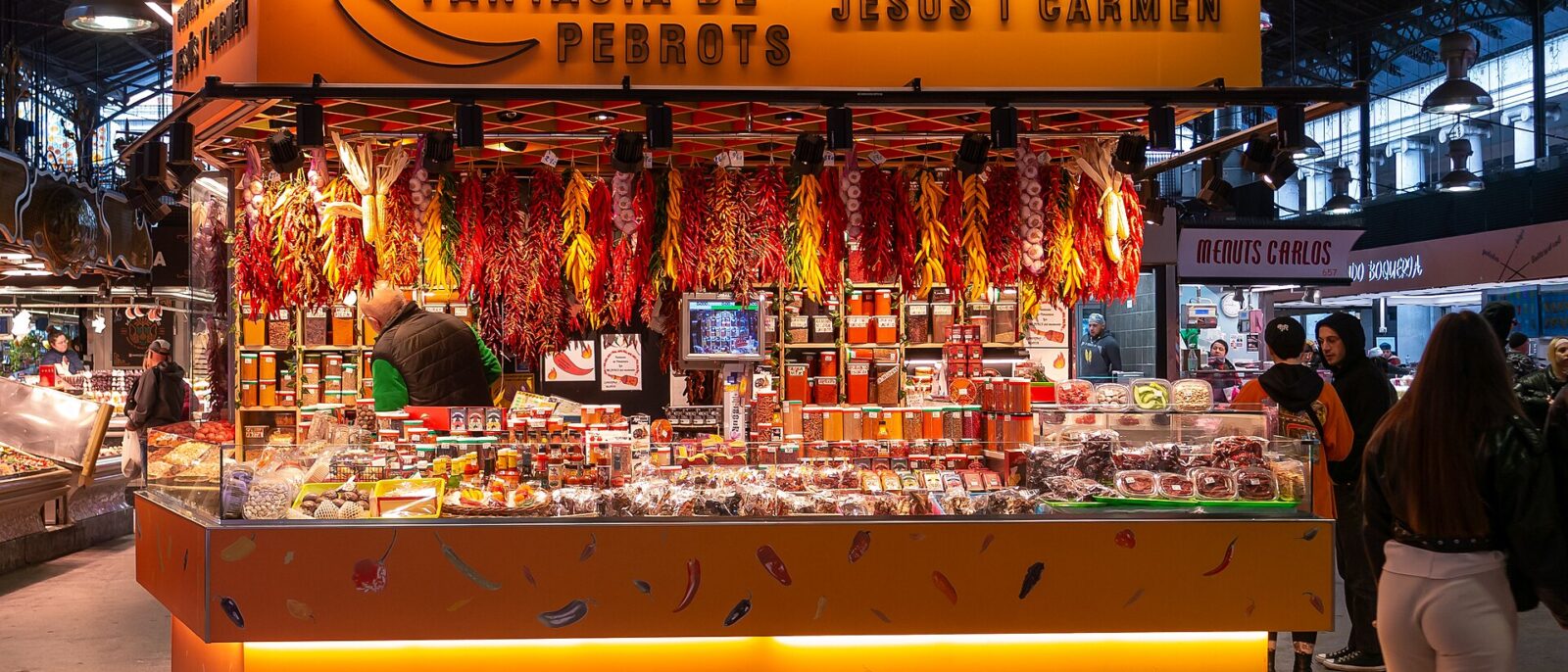
Chilli and spice stall at La Boqueria: Boqueria, Barcelona (P1170747) by Matti Blume, CC BY-SA 4.0, via Wikimedia Commons.
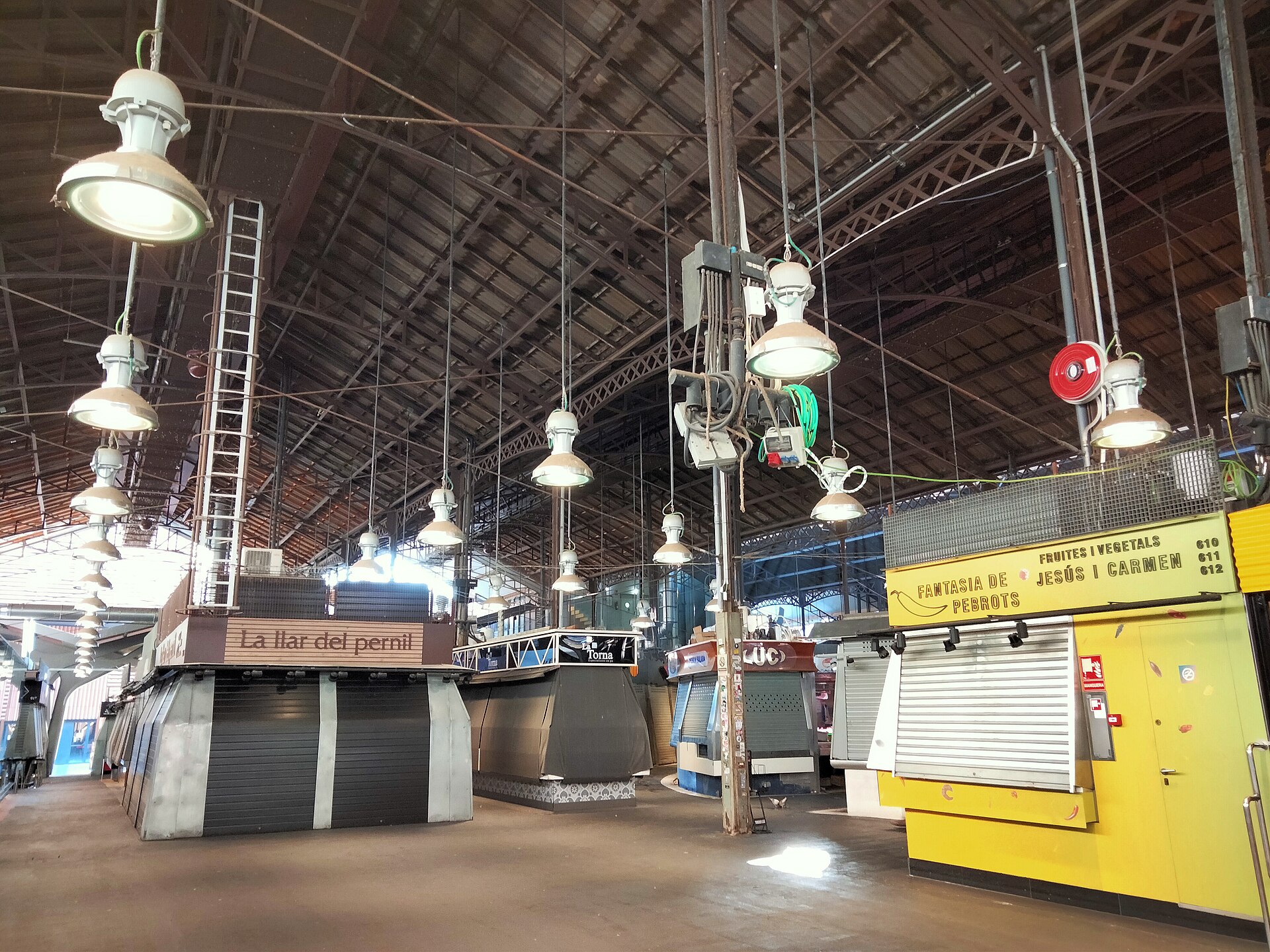
La Boqueria interior with stalls closed: 013 Mercat de la Boqueria, la Rambla 91 (Barcelona), interior by Enric, CC BY-SA 4.0, via Wikimedia Commons.
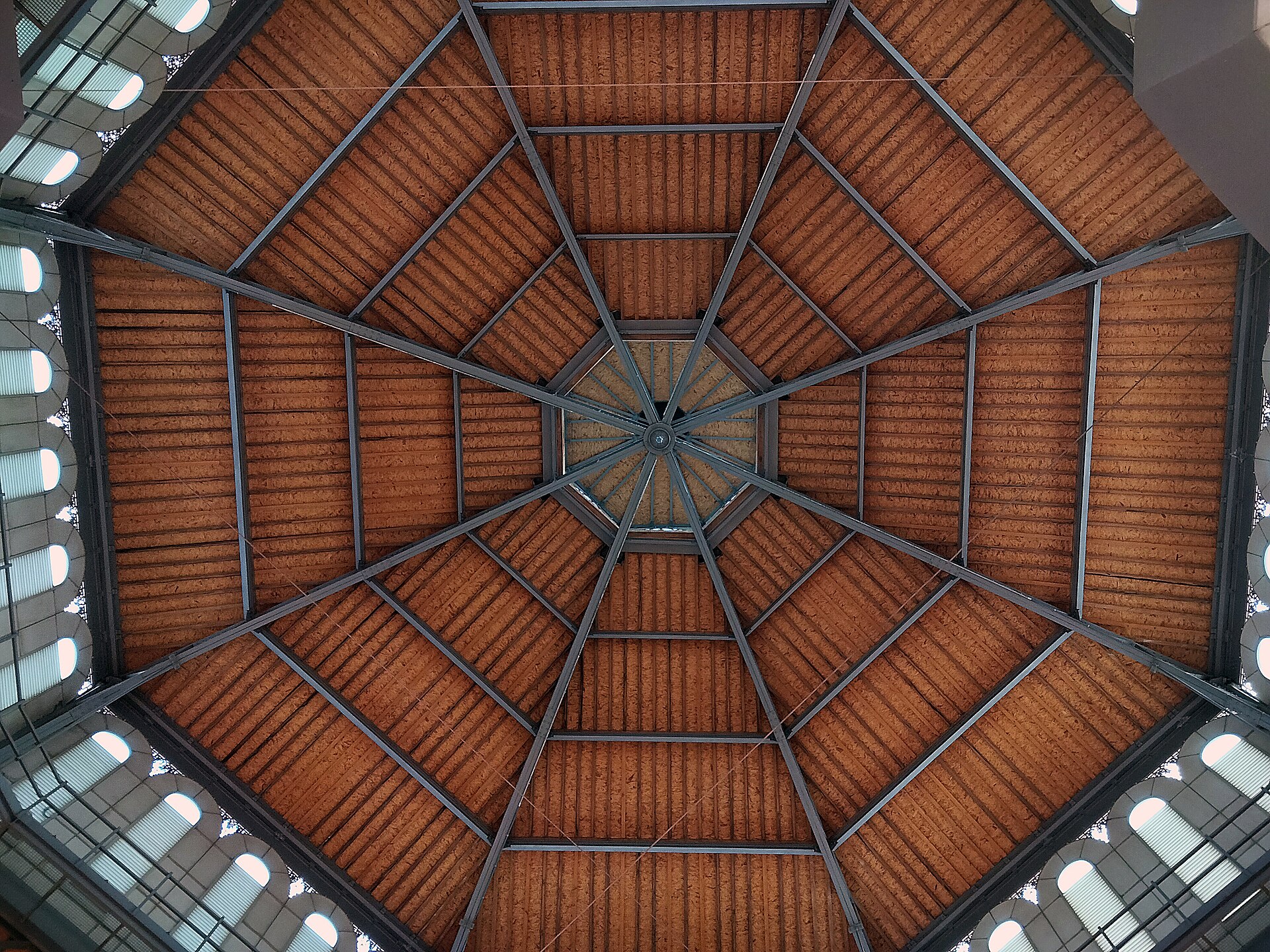
Dome of the Mercat de Sant Antoni: 134 Mercat de Sant Antoni (Barcelona), cúpula by Enric, CC BY-SA 4.0, via Wikimedia Commons.