We get commissions for bookings made through this post. Booking links, and any accommodation options shown on the page, are handled by a partner that adds commission tracking automatically. It never costs you more, and it never affects what we recommend. Affiliate disclosure
There is a specific moment, repeated a few thousand times every morning between April and October, when someone walks down a gangway at Moll Adossat, looks at the Columbus Monument a kilometre and a half away across the water, and says “we can walk that”. They cannot. Working out the barcelona cruise port to city centre journey before you are standing on the quay with six hours and a hat is the single most useful piece of preparation a cruise passenger can do, because the options differ by a factor of eight in price and by half an hour in time.
This page compares every transfer option in detail: the Cruise Bus, taxis, the ship’s own coach, ride-hailing, public transport and the hop-on hop-off buses, with 2026 fares, journey times and the situations each one suits. It is the companion to our Barcelona cruise port guide, which covers the terminals, the port restructuring and what to do once you are in the city. Fares were checked in September 2026 and are in euros; check the current fare before you travel.
Every option, compared
| Option | Cost | Time | Drops you | Best for |
|---|---|---|---|---|
| Cruise Bus (Portbus) | €3 single, €4.50 return | 10–15 min + queue | Columbus Monument | Solo travellers and couples |
| Taxi | €15–25 | 15–30 min | Your actual destination | Groups of 3–4, anyone with luggage |
| Ship’s shuttle | €12–20 pp return | Same as Cruise Bus | Columbus Monument area | Only if included in your fare |
| Ride-hailing | Variable, often above taxi | 15–30 min + wait | Your destination | Rarely the best choice here |
| Hop-on hop-off bus | ~€33/day | Slow by design | Everywhere, eventually | One-day sightseeing without planning |
| Walking | Free | Not viable from Adossat | — | Nobody |
| Public transport | ~€1.35 with T-casual | After you reach the city | Anywhere | Getting around once you are in town |
Two things fall out of that table. For one or two people, the Cruise Bus is the obvious answer. For three or four, a taxi costs about the same in total and takes you where you are actually going rather than to a monument you then have to walk from. That is the whole decision in a sentence.
The Cruise Bus in detail
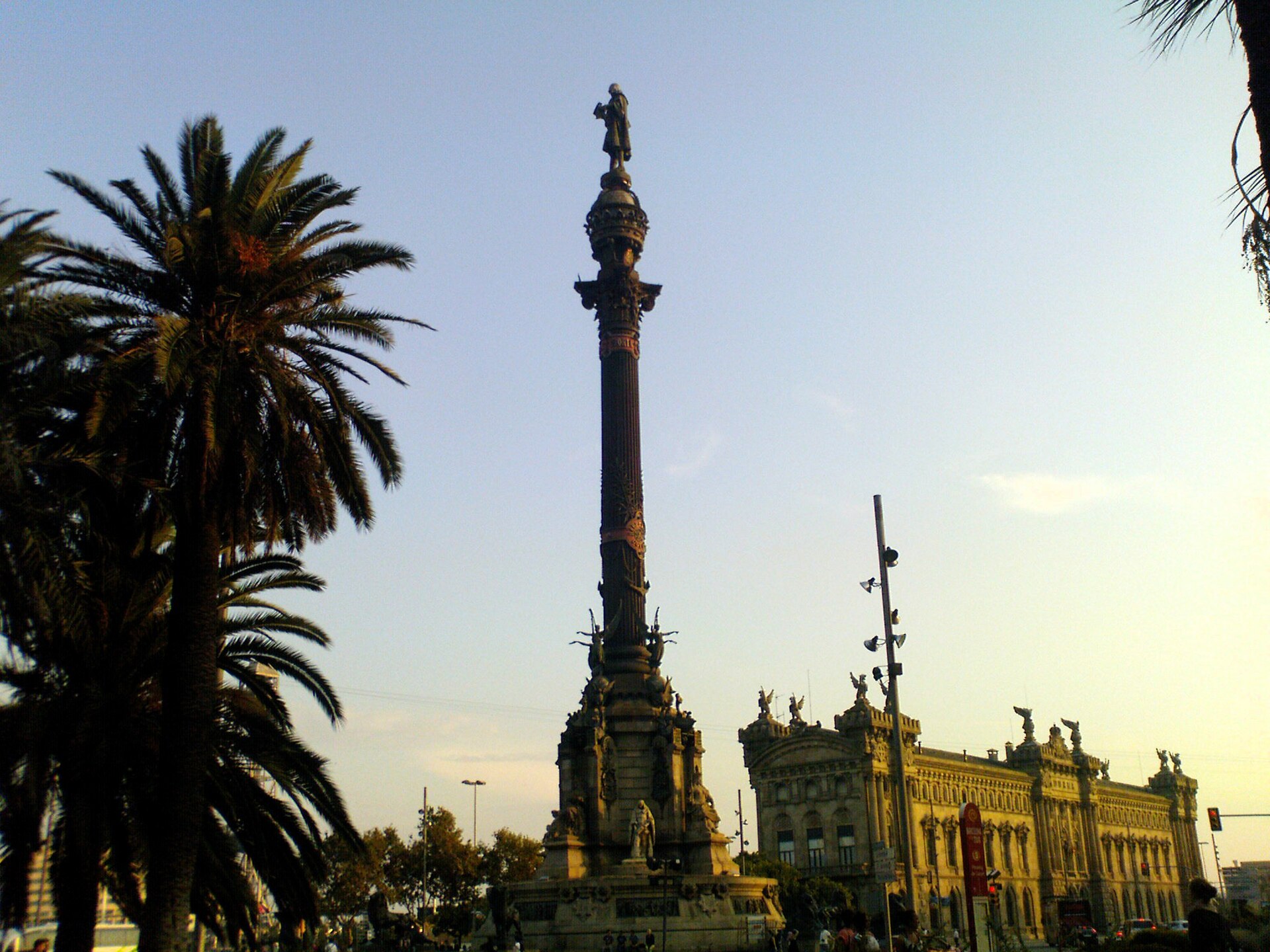
The blue Portbus shuttles between the Moll Adossat terminals and the Columbus Monument at the foot of Las Ramblas. It costs €3 one way and €4.50 return, which makes the return ticket the obvious buy — it is barely more than a single and it saves you queueing to pay at the other end.
Where to buy
At the kiosk inside each terminal, or from the driver. Cards are accepted at the kiosks; carry a few euros in coins as a backstop. Buy the return, keep the ticket somewhere you will not lose it in a pocket full of receipts.
Frequency and timing
Buses cycle continuously while ships are in port, typically every ten to twenty minutes depending on demand. The service is timed around ship movements rather than to a published clock, which means it is dense in the morning after disembarkation and again in the late afternoon before all-aboard.
The queue is the variable. Between about 08:30 and 10:00, when several ships have emptied at once, expect to wait — twenty minutes is common at the summer peak, occasionally more. The buses shift people quickly once they are running, but three thousand passengers hitting one bus stop at the same time has a predictable result.
The journey
Ten to fifteen minutes along the quay and around the port perimeter road, with a view of the ships you are leaving behind. It stops at each terminal on the way out, so if you are berthed at Terminal A or B — furthest along the breakwater — your journey is at the longer end.
Where it leaves you
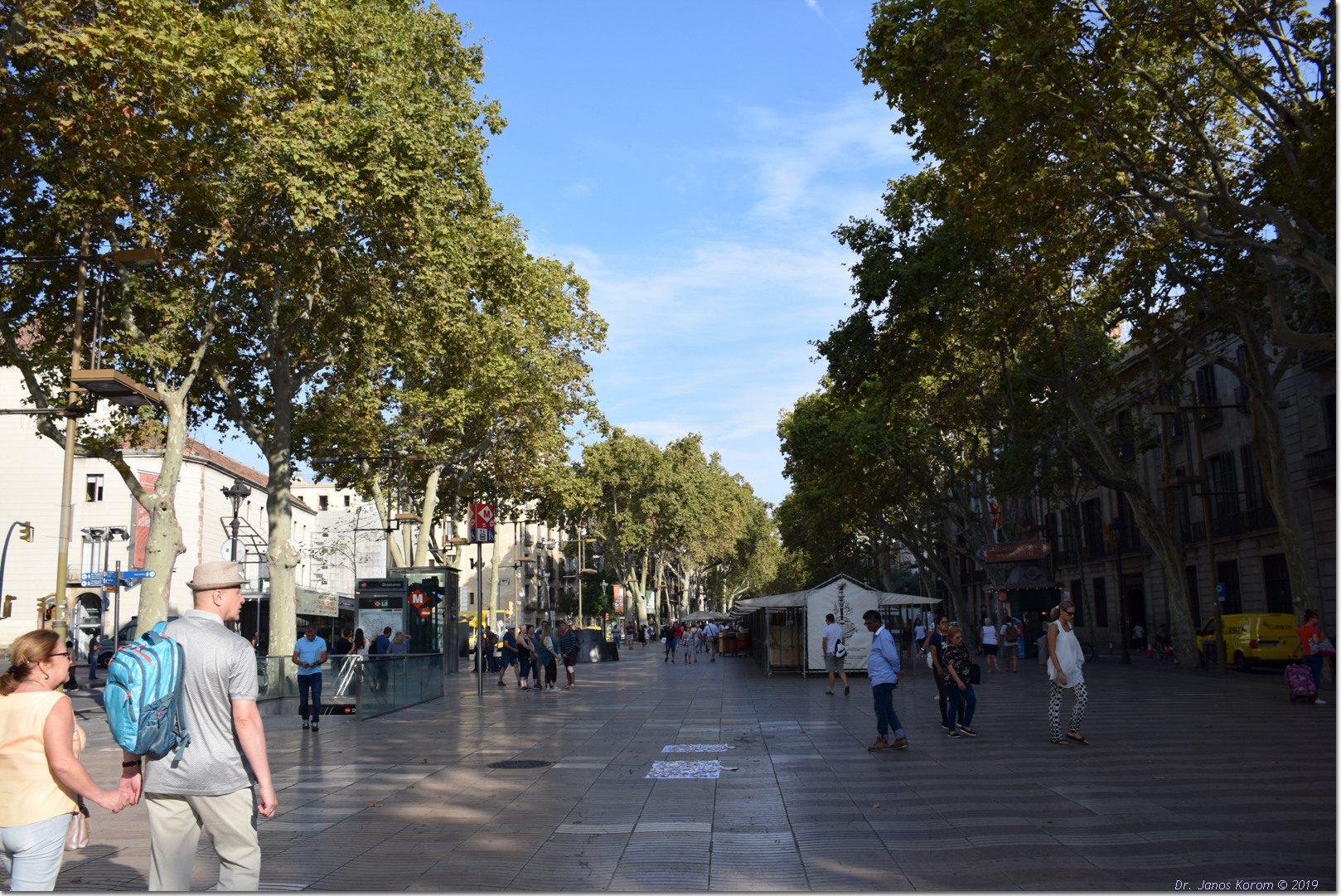
At the Columbus Monument, on the roundabout where Las Ramblas meets the waterfront. From there: five minutes into the Gothic Quarter, ten to the bottom of Las Ramblas proper, ten to the Maremagnum and the aquarium, fifteen to El Born, twenty to Barceloneta beach. Drassanes metro (L3) is a two-minute walk, which puts Passeig de Gràcia six minutes away and Sagrada Família territory about twenty.
Coming back
Same stop, and the same queue in reverse. Aim to be in the queue ninety minutes before your ship sails, which typically means an hour before all-aboard. That sounds excessive and it is the right amount of caution: Barcelona traffic at 16:00 is unsympathetic and the last thing you want is to watch the queue not moving.
Taxis
Barcelona’s taxis are black and yellow, metered, regulated and generally honest. Every cruise terminal has a rank, and at disembarkation there are usually more taxis than passengers wanting them.
What it costs
€15–25 to central Barcelona — the Gothic Quarter, El Born, the lower Eixample — with 15 to 30 minutes on the clock depending on traffic. Expect a port supplement and a small charge per large bag, both legitimate and both posted in the vehicle. For Passeig de Gràcia or the Sagrada Família, budget nearer the top of the range.
When it beats the shuttle
- Three or four people. Four Cruise Bus returns cost €18 and leave you at the Columbus Monument. A €20 taxi takes all four to the door of wherever you are going.
- Anyone with luggage. On a disembarkation morning with two suitcases, the taxi is not a luxury.
- Reduced mobility. Adapted taxis can be booked in advance and are more reliable than a crowded shuttle.
- A tight schedule. A taxi removes one queue and one walk from each end of the journey.
- Anywhere that is not central. Camp Nou, Park Güell, Montjuïc — none of these are near the Columbus Monument, and the shuttle only makes sense as a first leg.
Practical notes
Cards are accepted in almost all Barcelona taxis, though it is polite to say so at the start. There is no tipping culture beyond rounding up. Ignore anyone approaching you inside the terminal offering a ride; the official rank is outside and the meter is cheaper. Our Barcelona taxi guide covers the fare structure and the apps.
The ship’s own shuttle
Most lines sell a coach transfer at €12–20 per person for a return, dropping in broadly the same area as the Cruise Bus. It is the same journey at four to six times the price.
There are two reasons to buy it anyway: it is included in some fares, in which case take it; and it removes a decision on a morning when you have a lot of them. If neither applies, the Portbus does the same job for €4.50.
Ride-hailing
Barcelona’s private-hire market is heavily regulated and the apps are less dominant here than in most European cities. Fares at the port are frequently above the metered taxi rate, particularly at disembarkation peaks, and pick-up points at the terminals are not always well signposted. Given that a metered taxi is sitting on the rank, there is rarely a reason to open an app.
Hop-on hop-off buses
More defensible at a cruise port than for a normal city break, because they solve the transfer and the sightseeing in one purchase and remove any risk of getting lost. Around €33 for a day.
Against that: they are slow, they sit in the same traffic as everything else, and Barcelona’s metro is fast, cheap and easy. If you know what you want to see, the shuttle plus a T-casual costs a fraction and gets you there quicker. If you do not, and you want to sit down and be shown things, the bus is a reasonable purchase. See the metro guide for the alternative.
Why walking does not work
This is worth being explicit about, because it is the mistake that costs people the most time.
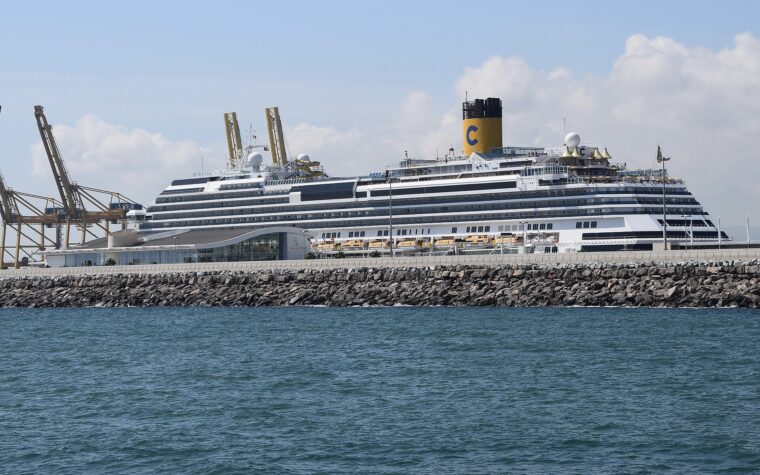
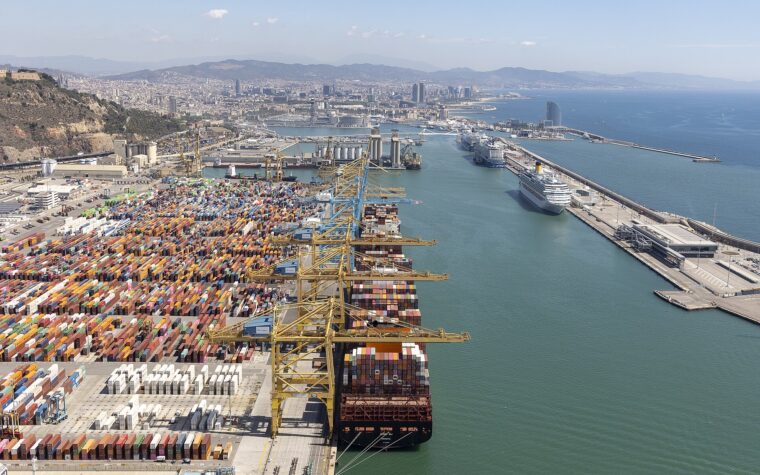
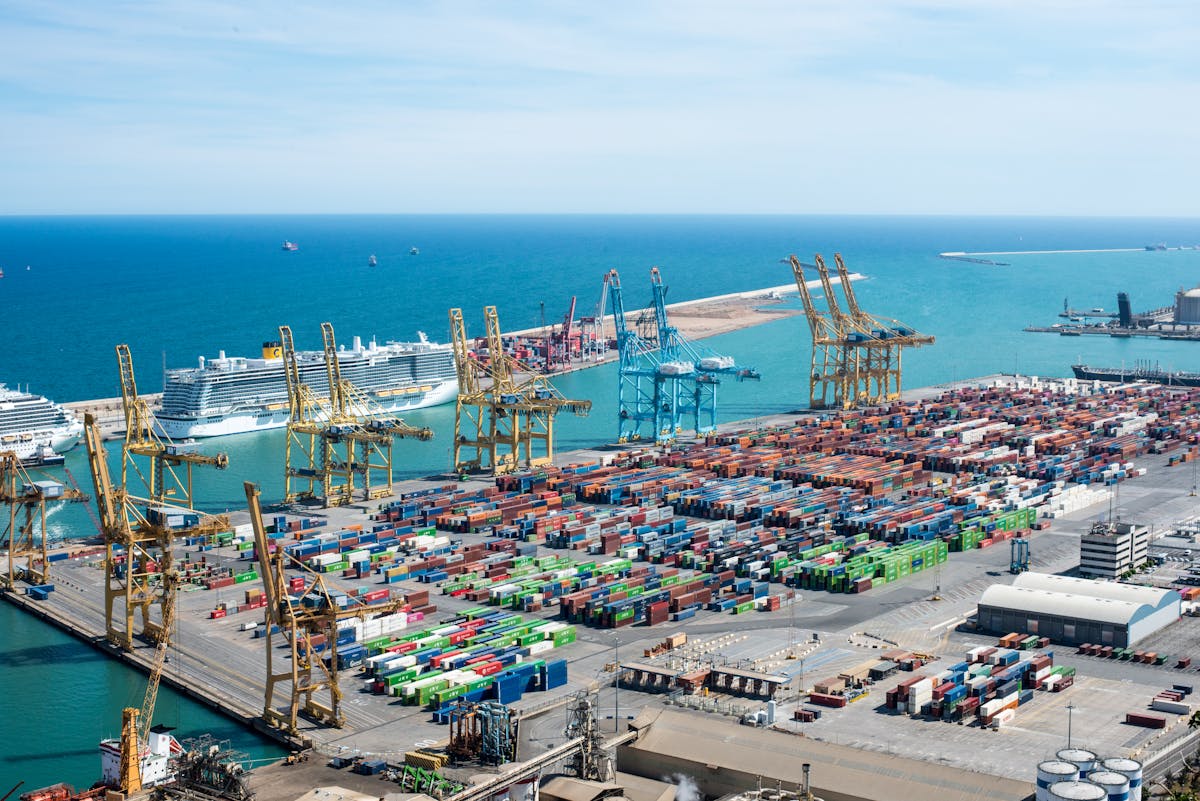
Moll Adossat is a working industrial quay roughly two kilometres long, running out from the base of Montjuïc into the harbour. It carries lorries, port vehicles and cranes; there is no pedestrian footpath along it; and pedestrians are not permitted to walk its length. Even if you could, you would arrive at the Columbus Monument having walked two kilometres with no shade, at which point the actual city begins.
The exception is the WTC terminals on Moll de Barcelona, from which Drassanes metro is a ten-minute walk. But WTC North has already closed and WTC South is closing at the end of 2026, moving all remaining calls out to Adossat. Plan for the shuttle.
Getting to specific places
Once you are at the Columbus Monument, here is what is actually within reach.
| Destination | From the shuttle stop |
|---|---|
| Gothic Quarter | 5 min walk |
| Las Ramblas (full length) | 15 min walk |
| La Boqueria market | 10 min walk |
| Picasso Museum / El Born | 15–20 min walk |
| Barceloneta beach | 20 min walk |
| Plaça de Catalunya | 20 min walk, or L3 from Drassanes |
| Passeig de Gràcia (Casa Batlló) | L3 from Drassanes, ~10 min |
| Sagrada Família | L3 to Passeig de Gràcia, change to L2, ~25 min |
| Park Güell | L3 to Lesseps, then 20 min uphill — allow an hour |
| Montjuïc / MNAC | L3 to Espanya, then escalators, ~25 min |
| Camp Nou | L3 to Les Corts, ~25 min |
Note the pattern: the L3 metro line from Drassanes does almost all the work. It runs from the waterfront up through Liceu, Plaça de Catalunya and Passeig de Gràcia to Lesseps and out to Les Corts, which covers most of what a cruise passenger wants. A T-casual gives ten journeys for around €13 and is shareable between people, which makes it the sensible buy for a group. See our T-mobilitat guide.
Which terminal you start from changes things

All the Adossat terminals are served by the same shuttle and the same taxi rank, but they are not equidistant, and the difference is worth knowing when you are working out how early to leave.
- Terminals A and B — furthest out along the breakwater. Add five to eight minutes to every journey in both directions, and expect the shuttle to be fuller by the time it reaches you on the way back in.
- Terminal C — mid-quay, and due for demolition at the end of 2026, so expect hoardings and diverted pedestrian routes around it.
- Terminal D — closer in, with a good taxi rank and a reasonable arrivals hall to wait in.
- Terminal E (Helix) and Terminal H (MSC) — the newest buildings, closest to the port entrance, and the quickest of the lot for both transfer options.
- WTC North and South — the city-centre pair on Moll de Barcelona, from which Drassanes metro is a ten-minute walk. WTC North is already closed and South goes at the end of 2026.
Your terminal is printed on the port document your cruise line issues shortly before departure, and it can change. It is worth checking on the morning of the call rather than relying on what you were sent weeks earlier.
Timing your day
Work backwards from all-aboard, which is typically thirty to sixty minutes before departure and is printed on your daily programme.
- Ship in at 07:00, out at 17:00. All-aboard around 16:30. Off the ship by 08:30, shuttle queue to 09:00, in the city 09:15. Leave the city at 15:00. That gives you roughly five and three-quarter usable hours.
- Ship in at 08:00, out at 18:00. Same shape, an hour later. Six hours ashore.
- Overnight call. Everything changes: do the ticketed sight in the afternoon and come back out for dinner at nine, which is when Barcelona actually starts. Check the last Cruise Bus before you leave the terminal.
Two rules that matter more than any of the above. Never plan to arrive back at the shuttle stop later than ninety minutes before sailing. And if you are going anywhere that involves a metro change, add fifteen minutes to whatever the map tells you — the interchanges at Passeig de Gràcia and Espanya involve long tunnels.
What each option costs a real group
- Solo traveller, into the Gothic Quarter: Cruise Bus return €4.50. Nothing beats it.
- Couple, into the Gothic Quarter: Cruise Bus €9 the pair, against €30–50 for two taxi journeys. Shuttle wins comfortably.
- Family of four, to Passeig de Gràcia: Cruise Bus €18 plus four metro journeys ~€5.40 = €23.40, and two walks. Taxi €25 each way = €50, door to door. Close, and the taxi wins on a hot day with children.
- Two people, disembarking with luggage: taxi, €20, every time.
- Six people travelling together: two taxis at €20 each = €40, against €27 of shuttle tickets plus the walking. Taxis, and it is not close on convenience.
The tourist tax is separate and unavoidable: cruise passengers pay around €9 per call of twelve hours or more, or €11 for a shorter one, usually billed through the cruise line. Our tourist tax guide has the detail.
Accessibility and travelling with children
The terminals themselves are modern and step-free, with lifts, accessible toilets and level access to the shuttle stop. The Cruise Bus takes wheelchairs but can be crowded at peak, and boarding a full bus with a chair at 09:00 is not a pleasant experience. Barcelona’s adapted taxi fleet can be booked in advance through the city’s central number and is by far the more reliable option — worth arranging before you sail.
Once you are in the city, the picture is mixed. Most of the L3 metro stations on the useful stretch are lift-equipped, but not all of Barcelona’s network is, and the Gothic Quarter’s medieval paving is genuinely hard going on wheels. The waterfront and Barceloneta are flat, wide and easy. Our accessible Barcelona guide maps which routes work.
With children, the calculation shifts towards the taxi faster than you would expect. The Cruise Bus queue in August with two under-tens is exactly as good as it sounds, and the twenty-minute walk from the Columbus Monument to anywhere interesting is the part that produces complaints. Prams fold and fit; car seats are not provided in taxis and are not legally required for short urban journeys here, though you may reasonably feel differently. See Barcelona with kids for what is worth heading to once you are moving.
Things that go wrong
- Missing the queue window. Arriving at the shuttle stop at 16:00 for a 16:30 all-aboard, with three ships loading. Leave earlier.
- Buying a single instead of a return. €3 twice is €6; the return is €4.50. Small, but the queue to buy the second one is not.
- Assuming the metro reaches the port. It does not. Drassanes is as close as the network gets, and that is a shuttle ride away.
- Booking a restaurant a long way out. Anything beyond the Eixample eats your return buffer. Eat near the water — see our restaurants guide for what is worth walking to.
- Carrying a bag on your back on the L3. Cruise passengers are a specific pickpocket target and Drassanes to Liceu is one of the busiest stretches. Front pockets, zipped bags. See the safety guide.
- Trusting a 2019 blog post. The WTC terminals are closing and the Adossat quay is being rebuilt. Check your line’s own port document for your berth.
If Barcelona is your embarkation or disembarkation port
The transfer problem changes shape entirely when you have luggage and a hotel or an airport at the other end.
Joining a ship
From a city-centre hotel, take a taxi — €15–25 and no queue, with a boot big enough for the cases. The Cruise Bus does run in this direction from the Columbus Monument, but wrestling two suitcases onto a shuttle you then have to wrestle them off at the right terminal is a false economy. From the airport, there is no public transport link to Moll Adossat at all, so a taxi at €35–45 is realistically the only option; see our airport transfer guide and the Barcelona airport guide for the wider picture.
Leaving a ship
Disembarkation puts you on a quay at eight in the morning with everything you own. Take the taxi. If your flight is not until the evening, the sensible plan is a taxi to Barcelona Sants, which has a proper left-luggage facility, then a full day in the city unencumbered, then the airport train or a taxi from there. Our train stations guide covers the Sants facilities.
Leave more time than you think
Disembarkation runs late more often than it runs early, and the taxi rank at 08:00 with three ships emptying is busier than at any other hour. Allow at least four hours between leaving the ship and your flight’s check-in closing, and more in August. If the gap is awkward, one more night in Barcelona is a better use of the time than an airport lounge — the where to stay guide has the neighbourhoods.
Frequently asked questions
How do you get from Barcelona cruise port to the city centre?
The Cruise Bus (Portbus) at €3 one way or €4.50 return runs between the Moll Adossat terminals and the Columbus Monument in 10–15 minutes. A taxi costs €15–25 and takes you to your actual destination in 15–30 minutes. There is no metro or train from the port itself.
How much is the Cruise Bus in Barcelona?
€3 for a single and €4.50 for a return, bought at the terminal kiosk or from the driver. Always take the return — it is barely more than a single and saves a second queue.
Can you walk from the Barcelona cruise terminal to Las Ramblas?
Not from Moll Adossat, where almost all ships dock. It is two kilometres of working quay with no pedestrian route. From the WTC terminals it is a ten-minute walk to Drassanes, but those terminals are closing.
How long does it take to get from the cruise port to Barcelona city centre?
Ten to fifteen minutes on the Cruise Bus once it is moving, or 15 to 30 by taxi. Add up to twenty minutes of queueing at the morning peak, so plan for 30 to 45 minutes door to door.
Is a taxi or the shuttle better from Barcelona cruise port?
The shuttle for one or two people going to the old city. A taxi for three or more, for anyone with luggage, or for any destination that is not within walking distance of the Columbus Monument.
Does the metro go to the Barcelona cruise port?
No. The nearest station is Drassanes on the L3, a two-minute walk from where the Cruise Bus drops you and a shuttle ride from the terminals.
What time should I head back to the ship?
Be in the shuttle queue ninety minutes before the ship sails, which usually means an hour before all-aboard. Barcelona traffic at 16:00 and a three-ship disembarkation queue are the two things that catch people out.
Do I need cash for the Cruise Bus?
Cards are accepted at the terminal kiosks, but carrying a few euros in coins is a sensible backstop. Barcelona generally is close to cashless.
Is the ship’s shuttle worth paying for?
Only if it is included in your fare or you have mobility needs. It goes to the same place as the €4.50 Cruise Bus for €12–20 per person.
Related Barcelona Guides
- Barcelona Cruise Port — terminals, embarkation and what to do ashore.
- Barcelona Taxi Guide — fares, supplements and how to hail one.
- Barcelona Metro Guide — the L3 does most of the work.
- One Day in Barcelona — the itinerary that fits a port call.
- Barcelona Waterfront — what is within walking distance of the drop-off.
- Gothic Quarter — five minutes from the shuttle stop.
- Barcelona Safety Guide — the pickpocket hotspots on this exact route.
Photo Credits
Columbus Monument: Columbus-monument-barcelona by Zuzanna K. Filutowska, CC BY-SA 3.0, via Wikimedia Commons.
Bottom of Las Ramblas at Drassanes: Barcelona 101DSC 0079 by János Korom Dr., CC BY-SA 2.0, via Wikimedia Commons.
Remaining photographs from the barcelonatourism.org library.