We get commissions for bookings made through this post. Booking links, and any accommodation options shown on the page, are handled by a partner that adds commission tracking automatically. It never costs you more, and it never affects what we recommend. Affiliate disclosure
The first decision at El Prat is one most people do not realise they are making. You come up the ramp from arrivals, you see a sign for the metro, you tap your contactless card at the barrier — and you have just paid €5.90 for a journey that costs about €1.35 everywhere else on the network, because the airport station carries a supplement that no ordinary ticket covers. Barcelona airport is an efficient, pleasant, unusually generous place to fly through, and it will still separate you from money in three or four small ways before you reach the city.
This guide covers all of it: which terminal you need and how to move between them, every route into Barcelona with current fares, the five lounges that all take Priority Pass, what to do with a long layover, whether you can sleep here, and the specific timings that decide whether you make your connection. Fares were checked in September 2026 and are in euros. Airlines move terminals occasionally, so confirm yours on the day.
The airport at a glance
| What | Detail |
|---|---|
| Code | BCN (Josep Tarradellas Barcelona–El Prat) |
| Terminals | T1 (2009) and T2 (T2A, T2B, T2C) |
| Distance apart | 4 km — free shuttle bus, every 5–10 min, 24/7, 10–15 min |
| Distance to central Barcelona | ~15 km |
| Metro (L9 Sud) | €5.90 single, €11.80 return, ~7 min frequency |
| Aerobús (A1/A2) | €7.45 single, €12.85 return (valid 90 days) |
| Renfe R2 Nord train | From T2 only, standard Rodalies fare |
| Taxi to the centre | ~€35–45, 20–30 minutes |
| Lounges | Five, all accepting Priority Pass; ~€48 to buy online |
| WiFi | Free and unlimited throughout |
T1 or T2: which one are you in?
This matters more at BCN than at most airports, because the two terminals are four kilometres apart with a road between them and there is no walking route.
Terminal 1
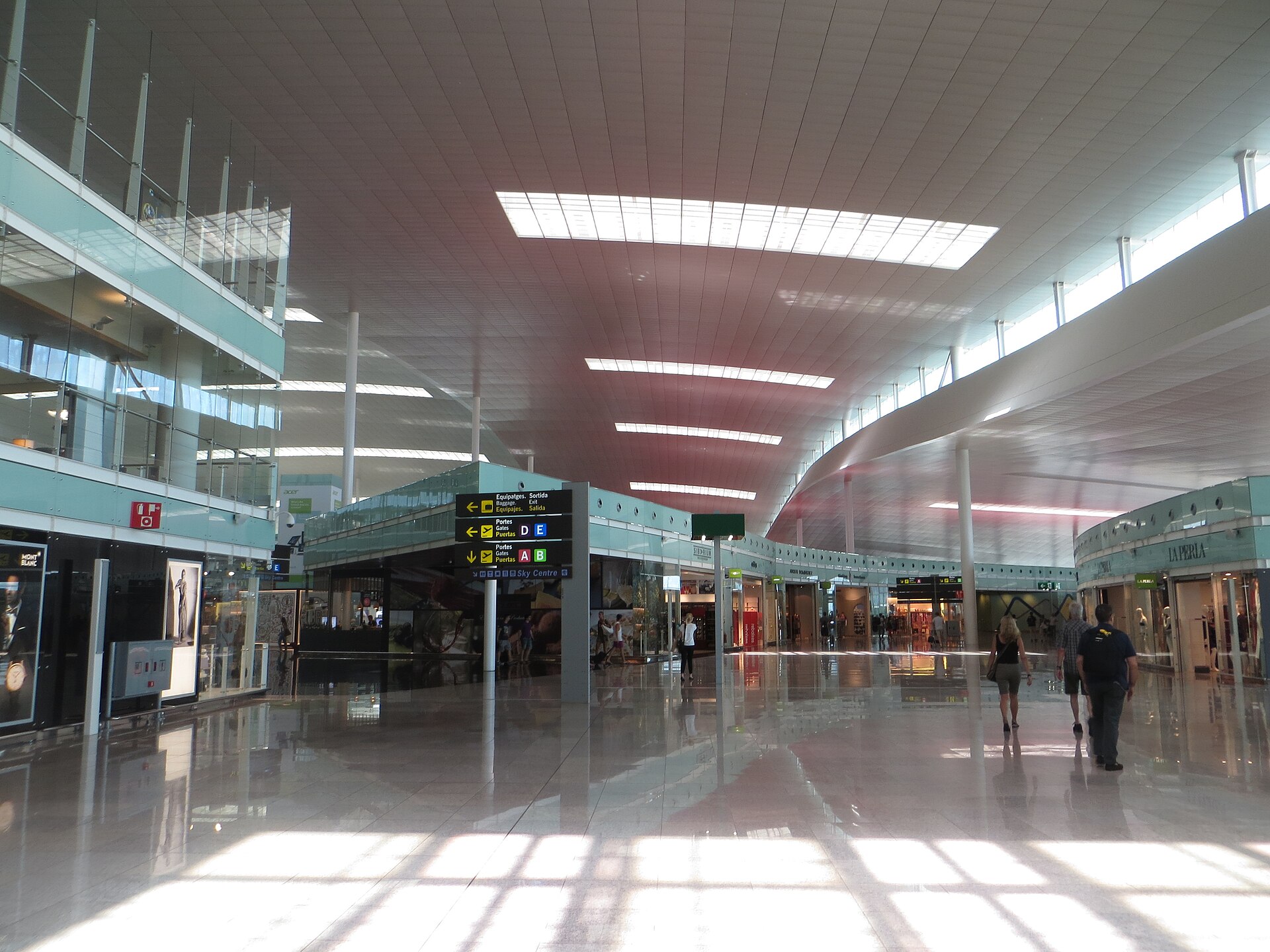
Opened in 2009, designed by Ricardo Bofill, and the terminal most passengers use. It handles Iberia, Vueling, most of the oneworld and SkyTeam carriers, the long-haul flights and a large share of everything else. Inside, it splits into a Schengen area (gates A and B) and a non-Schengen area (gates D and E), with C used flexibly. The building is enormous, bright, and much longer than it looks from the check-in hall — allow twenty minutes from security to a far gate, more if you are at the end of the E pier.
Terminal 2
The older complex, split into three linked buildings — T2A, T2B and T2C — connected by walkways. Mostly low-cost carriers, with Ryanair, easyJet and several charter operators here. It is smaller, plainer and considerably quicker to move through. T2B holds the main check-in and the Renfe station, which is the practical difference that matters: the R2 Nord train only serves T2. If you are flying from T1 and want the train, you take the shuttle first.
The free inter-terminal shuttle
A dedicated bus runs between T1 and T2 every five to ten minutes, twenty-four hours a day, and takes ten to fifteen minutes. It is free, it is signposted from both arrivals halls, and it is the only way across. Build twenty-five minutes into any plan that involves changing terminals, and thirty-five if you are doing it with checked bags.
Finding your way inside Terminal 1
Bofill’s building is beautiful and slightly disorienting, mostly because everything happens on different levels and the signage assumes you know which one you want. Departures are on level 3, arrivals on level 1, and the ground transport — metro, Aerobús, taxis — is reached from level 0 beneath arrivals. Check-in islands run in a long line across the departures hall; your airline’s letter is on your boarding pass and on the screens, and the walk from one end to the other is a good five minutes.
Past security, the concourse opens into the retail area that most photographs of BCN show, and then splits. Gates A and B are the Schengen pier — Spain, France, Germany, Italy, the Netherlands and the rest of the zone. Gates D and E are non-Schengen, reached through passport control, and cover the UK, Ireland, the United States and everywhere else. Gate C sits between them and is used flexibly, which is why the boarding pass sometimes says one thing and the screen another.
The single most common mistake here is underestimating the walk. The E pier is a long way from security, there are travelators but not everywhere, and the airport does not announce final calls loudly. Look at the walking time on the screens, not just the gate number.
Terminal 2 in practice
T2 is three buildings in a row — A, B and C — joined by walkways, with the main check-in and the Renfe station in T2B. It is dated, functional and considerably faster to move through than T1: from kerb to gate in twenty-five minutes is realistic outside peak.
What it lacks is comfort. Seating is limited, the food offering is thin, and at the summer peak the T2B departures hall becomes genuinely congested around the low-cost bag drops. If you are flying Ryanair or easyJet out of BCN in August, the queue for bag drop is the part of the journey to build time around — an hour before your airline’s cut-off is not excessive.
Getting into Barcelona
Metro L9 Sud
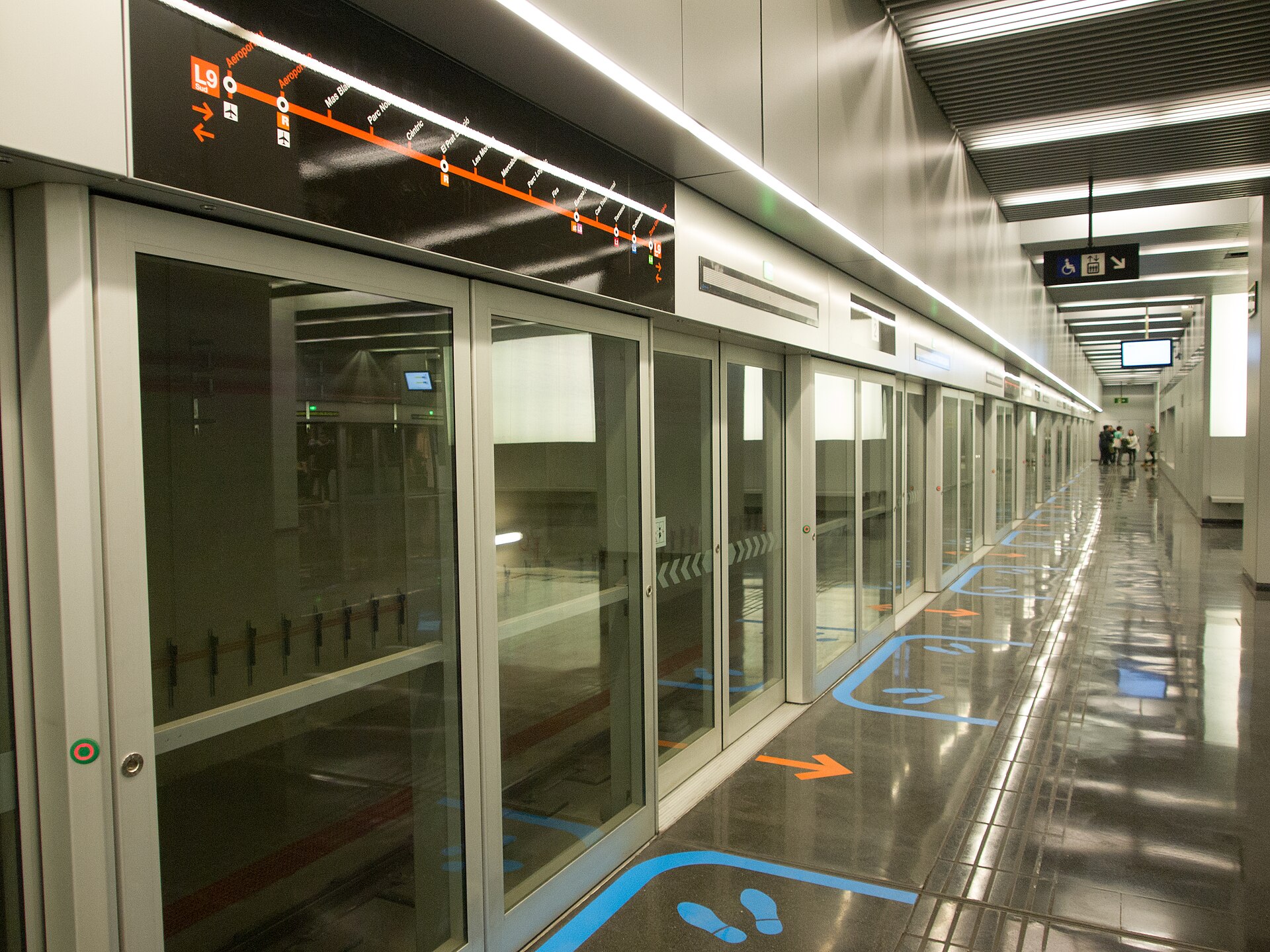
The orange line serves both Aeroport T1 and Aeroport T2 with modern, driverless trains every seven minutes or so. It is the cleanest and most predictable route, and it is also the one that catches people out on price: the airport stations carry a supplement, so a single costs €5.90 and a return €11.80. A T-casual multi-journey ticket does not cover it, and neither does a standard single.
The catch beyond the price is that L9 Sud does not go into the city centre. It runs to Zona Universitària, where you change onto L3 for Passeig de Gràcia, Las Ramblas and the Gothic Quarter, or onto L5 for the Sagrada Família side. That change adds fifteen to twenty minutes, which makes the metro slower than the bus to most central destinations even though it feels faster. Our metro guide covers the interchange properly.
The Hola Barcelona card
This is the single most useful piece of fare arithmetic at BCN. The Hola Barcelona travel card gives unlimited public transport for 48, 72, 96 or 120 continuous hours — €18.70, €27.30, €35.60 and €43.60 respectively — and, crucially, it includes the L9 Sud airport metro and the R2 Nord train. Since an airport return alone is €11.80, the card starts a long way ahead before you have made a single journey in the city. If you are staying two nights or more and intend to use the metro at all, it is the obvious buy. See the T-mobilitat and ticket guide for how it compares with the alternatives.
Aerobús
The dedicated airport coach: A1 from T1, A2 from T2, both running to Plaça de Catalunya via Plaça d’Espanya and Gran Via–Urgell. Since March 2026 it costs €7.45 single and €12.85 return, with the return leg valid for ninety days and under-fours free. It runs every five to ten minutes, takes about thirty-five minutes to Plaça de Catalunya, has proper luggage racks and USB sockets, and drops you in the middle of the city rather than at a suburban interchange.
For most visitors staying in the Eixample, the Gothic Quarter or El Born, this is the best value route despite costing more than the metro on paper, because it is one vehicle with your suitcase rather than two with a change.
The R2 Nord train
Renfe’s Rodalies commuter train runs from a station connected to T2 by a covered walkway, calling at Barcelona Sants, Passeig de Gràcia and Clot. It is the cheapest route — standard zone-one fare, and covered by a T-casual or the Hola Barcelona card — and the best one if you are heading straight for Sants to catch an onward train. Trains run roughly every thirty minutes, which is the drawback: miss one and you have lost half an hour.
From T1, factor in the shuttle bus first. From T2 it is genuinely convenient. See the train stations guide for the Sants connections.
Taxi
Ranks outside both terminals, metered, regulated, and roughly €35–45 into central Barcelona with the airport supplement and a small luggage charge. Twenty to thirty minutes outside rush hour. For three or four people it beats every other option on both cost and convenience; for a solo traveller with a backpack it does not. Our taxi guide explains the supplements, and the airport transfer guide compares every route with journey times.
What about the cruise port?
There is no public transport from the airport to Moll Adossat. A taxi is realistically the only option, at around €35–45. If you are joining a ship, see our Barcelona cruise port guide for the embarkation-day logistics.
The lounges — and why BCN is unusual
Barcelona has five lounges and every one of them accepts Priority Pass. That is rare in Europe, where the trend has run hard the other way, and it makes BCN one of the best airports on the continent to hold a lounge-access card at.
- Sala Pau Casals — T1, Schengen and domestic side. The largest, and the one most people end up in.
- Sala Joan Miró — T1, non-Schengen. Quieter, with better views over the apron.
- Sala Colomer — T1, serving the Madrid air shuttle area.
- Sala Canudas — T2. Smaller and plainer, but a genuine improvement on the T2 gate seating.
- Sala Miró VIP areas — the airline-operated spaces, availability depending on your carrier.
Walk-up or online purchase runs to roughly €48, which is a lot for a couple of hours unless your flight is delayed. With a Priority Pass, a lounge card or an eligible credit card, it is free and worth doing — the food is decent, the seating is real, and T1’s general concourse gets uncomfortably busy at peak.
Fast track and priority security
BCN sells a fast-track security product and several airlines and cards include it. It is genuinely useful between 06:00 and 09:00 and at the Sunday evening peak, and largely pointless at other times, when the main queues run under fifteen minutes. Judge it by the hour of your flight rather than buying it reflexively.
Layovers: what to do with the time
Under two hours
Stay airside and walk to your gate. T1’s piers are long and the walk to a distant E gate can take twenty minutes from security. If your connection involves a terminal change, two hours is genuinely tight — the shuttle alone eats twenty-five minutes and you will need to clear security again.
Two to five hours
Enough for a lounge, a proper meal and a book, not enough for the city. T1 has better food than most European airports, including a decent tapas counter or two and a reasonable selection past passport control. Free unlimited WiFi throughout, and plenty of power sockets in the newer seating areas.
Five to eight hours
Now the city is possible, and worth it. The Aerobús to Plaça de Catalunya takes thirty-five minutes each way, which leaves you three to five hours on the ground. Sensible plans: the Gothic Quarter and a long lunch; Passeig de Gràcia to look at Casa Batlló and La Pedrera from the street; or a walk along the beach from Barceloneta. Do not attempt the Sagrada Família on a layover unless you already hold a timed ticket — see the attractions and tickets guide for why.
Left luggage exists at Terminal 1, and Barcelona Sants has a larger facility if you are heading that way. Leave two hours and thirty minutes between arriving back at the terminal and your flight, more in August.
Eight hours or more
Go into the city properly. Our one day in Barcelona itinerary is built for exactly this amount of time, and the first-time tips page covers the practicalities of arriving cold in a city you do not know.
Travelling with children, and other special cases
BCN is an easy airport to be encumbered at. Both terminals have family rooms and changing facilities past security, pushchairs can be taken to the aircraft door and are returned there on arrival, and the play areas in T1 are better than the European average without being anything to plan around. The Aerobús has luggage racks that swallow a folded buggy; the metro’s step-free access is genuinely step-free, which matters when the alternative is a staircase with a pram in one hand.
Two practical notes for families. The T1 walk to a distant gate with small children is longer than you think — factor in twice the posted time. And the Spanish habit of eating late means the airport’s food outlets are busiest at times that will not match a child’s schedule, so buy something before you clear security if the timing is awkward. Our Barcelona with kids guide covers the city end.
Travelling with sports equipment — bikes, surfboards, ski bags for the Pyrenees — is routine here and both terminals have oversize baggage desks, though the low-cost carriers at T2 charge accordingly. If you are cycling in Catalonia, our bike rental guide covers the alternative of hiring locally, which is usually cheaper than flying a bike out.
Sleeping at the airport
BCN handles overnight passengers better than most. Terminal 1 has a Sleep&Fly facility inside the building with private cabins bookable by the hour, which is the civilised option for an early departure or a long night connection. Both terminals stay open twenty-four hours, the seating in T1’s quieter corners is tolerable, and the free WiFi does not time out.
The alternatives: there are hotels attached to or a short shuttle from the airport, which are worth it if you have more than about six hours; and the city is only thirty-five minutes away, which is worth it if you have more than about ten. Anything less and you will spend the saving on transfers. Our where to stay guide covers the airport-adjacent options and the neighbourhoods worth the extra journey.
Arriving: the first twenty minutes
- Passport control. Non-EU arrivals now use the EU’s biometric entry-exit system, which adds time at peak. Allow forty minutes from wheels-down to landside on a busy morning.
- Cash. You do not need any. Barcelona is close to cashless and the airport exchange booths have poor rates. Use an ATM in the city if you want notes — see the money guide.
- SIM cards. Buy in the city or use an eSIM bought before you fly; airport prices are higher. Our connectivity guide has the options.
- Tickets. If you have decided on the Hola Barcelona card, buy it at the machines in the arrivals hall rather than in the city — it is the same price and saves a queue later.
- Taxi touts. Ignore anyone offering you a taxi inside the terminal. The official rank is outside, it is metered, and it is cheaper.
Departing: how early to arrive
Two hours for a Schengen flight, two and a half to three for a non-Schengen or long-haul departure, and add thirty minutes in July and August or on a Sunday evening. If you are checking bags with a low-cost carrier at T2, add another thirty — the bag-drop queues there are the least predictable part of the airport.
Getting the transfer timing right matters more than the check-in advice. From the Gothic Quarter allow an hour door to gate-side by Aerobús, an hour and fifteen by metro with the change, and forty minutes by taxi outside rush hour. In practice the safest plan for an early flight is a pre-booked taxi; the Aerobús does run through the night but at reduced frequency, and the metro does not run all night on weekdays.
Car hire, and whether you want it
All the major hire companies operate from both terminals, with desks in the arrivals halls and cars in the adjacent multi-storey car parks. It is a straightforward operation and the pick-up is quick by European standards.
The question is whether you want a car at all. Inside Barcelona, emphatically not: parking is expensive and scarce, the low-emission zone covers the whole metropolitan area and requires registration for foreign-plated vehicles, and the public transport is excellent. A car sitting in a city car park for four days is a €100 mistake.
Outside the city it is a different calculation. The Costa Brava’s smaller coves, the Priorat wine country, the Pyrenean foothills and the villages around Besalú are all much easier with a car, and several are barely reachable without one. The sensible pattern is to do Barcelona on foot and by metro, then pick a car up on the day you leave the city. Our car rental guide covers the practicalities, and the day trips guide flags which destinations genuinely need one — Montserrat, Girona and Sitges emphatically do not.
When things go wrong
BCN is a reliable airport, but Spain has an active tradition of industrial action and August is unforgiving. Three things worth knowing.
- Strikes. Handling-agent and air traffic control strikes are announced days in advance and Spanish law requires minimum services, so flights usually operate with delays rather than cancellations. Check your airline’s alerts rather than the news.
- Your rights. EU261 applies to all departures from BCN and to arrivals on EU carriers. Delays over three hours on flights within the EU can attract compensation, and the airline owes you food and accommodation from two hours’ delay regardless of cause. Keep receipts. Our travel insurance guide covers what your policy adds on top.
- Summer weather. Late-afternoon thunderstorms in August and September occasionally close the airport for short periods, and the knock-on delays persist into the evening. If your itinerary has a tight onward connection, take the morning flight.
If you are stranded overnight, the city is thirty-five minutes away and has far better hotels than the airport perimeter. It is almost always the better answer.
Eating, shopping and killing time
Airport food is airport food, but BCN’s is better than the European average and the prices are less punitive than at, say, Heathrow or Charles de Gaulle. T1 has genuine tapas counters, a decent bakery or two and enough seating that you are not eating standing up. T2’s offering is thinner and more obviously functional.
The duty-free is standard, with the usual Catalan additions — turrón, cava, Iberian ham in vacuum packs — priced above what you would pay in a city market. If you want to bring food home, buy it at La Boqueria or Sant Antoni the day before and pack it properly. Cava travels fine in hold luggage with a bit of care.
The seven things that catch people out
- The airport metro supplement. €5.90, not the €1.35 you were expecting, and no ordinary multi-journey ticket covers it.
- L9 Sud does not reach the city centre. You change at Zona Universitària, and the change costs you fifteen to twenty minutes.
- The train only serves T2. From T1 you take the shuttle first, which adds twenty-five minutes.
- The T1 gate walk. Twenty minutes from security to the far end of the E pier, and the airport will not chase you.
- Terminal changes eat an hour. Shuttle, security again, and the walk at the other end. Two hours is not a comfortable connection across terminals.
- “Barcelona” airports that are not. Girona and Reus are ninety minutes and more away. Check the airport code, not the marketing.
- August bag drop at T2. The least predictable queue at the airport. Arrive an hour before your airline’s cut-off, not thirty minutes.
Accessibility
Both terminals are fully step-free, and Aena’s assistance service is booked through your airline at least forty-eight hours ahead. The inter-terminal shuttle is wheelchair-accessible. The L9 Sud metro stations are new and fully lift-equipped, which is not true of the entire Barcelona metro network — a point worth knowing if you are planning onward journeys. Our accessible Barcelona guide covers what works in the city itself.
Flying on from Barcelona
BCN is Spain’s second-largest airport and a genuinely good hub for the western Mediterranean: the Balearics are under an hour, Madrid is a fifty-minute shuttle, and the low-cost network reaches most of Europe directly. Where it is weaker is long-haul, which is thinner than Madrid’s, so a transatlantic itinerary often means connecting.
The important counter-argument is the train. Barcelona to Madrid by AVE takes about two and a half hours city centre to city centre from Barcelona Sants, with Renfe now competing against Ouigo and Iryo, which has pushed fares down considerably. Flying is an hour and a half in the air and loses the advantage entirely once you have added two airport transfers, security and a bag. For Madrid, Zaragoza, Valencia and much of southern France, take the train and skip the airport altogether. Our Barcelona versus Madrid comparison covers the route, and the train stations guide explains how Sants works.
Girona-Costa Brava and Reus airports also serve the region and are used by some low-cost carriers marketing themselves as “Barcelona”. They are not — Girona is about ninety minutes away by coach and Reus rather more. If a fare looks unusually cheap, check which airport it actually lands at before you book.
Frequently asked questions
How far is Barcelona airport from the city centre?
About 15 km, or 20 to 35 minutes depending on how you travel. The Aerobús takes roughly 35 minutes to Plaça de Catalunya, a taxi 20 to 30, and the metro around 45 to 50 once you have factored in the change at Zona Universitària.
How much is the metro from Barcelona airport?
€5.90 for a single and €11.80 for a return. The airport stations carry a supplement that a T-casual does not cover — but the Hola Barcelona travel card does, which is why it usually works out cheaper than buying separate airport tickets.
Is there a free shuttle between T1 and T2 at Barcelona airport?
Yes. It runs 24 hours a day, every five to ten minutes, and takes ten to fifteen minutes to cover the four kilometres between the terminals. It is the only way across — you cannot walk.
Which Barcelona airport lounges accept Priority Pass?
All five of them, which is unusual in Europe: Pau Casals, Joan Miró and Colomer in T1, Canudas in T2, plus the airline-operated spaces. Paid access costs around €48.
Can I sleep at Barcelona airport?
Yes. Both terminals are open 24 hours, and Terminal 1 has a Sleep&Fly facility with private cabins bookable by the hour. For more than about six hours, an airport hotel is more comfortable; for more than ten, go into the city.
How long is the layover I need to leave the airport?
Five hours minimum to make it worth going into Barcelona, and comfortable at six or more. Allow 35 minutes each way on the Aerobús and be back at the terminal two and a half hours before your flight.
Which terminal is Ryanair at in Barcelona?
Terminal 2, along with easyJet and most other low-cost carriers. Iberia, Vueling and the long-haul airlines use Terminal 1. Airlines do move occasionally, so check your boarding pass rather than relying on habit.
Does the train go to Barcelona airport?
Yes — the Renfe R2 Nord, but only to Terminal 2, via a covered walkway. From T1 you need the free shuttle first. It runs roughly every thirty minutes to Sants, Passeig de Gràcia and Clot, and is the cheapest route into the city.
How early should I get to Barcelona airport?
Two hours for Schengen flights, two and a half to three for non-Schengen or long-haul, plus thirty minutes in high summer or if you are dropping bags with a low-cost carrier at T2.
El Prat is not the only airport your ticket might call Barcelona. Girona–Costa Brava and Reus are both about 100 km out, both served almost entirely by low-cost carriers, and both need a coach ride of well over an hour to reach the city. Our guide to Girona and Reus airports sets out the transfers, the 2026 fares and how to check which airport you have actually booked.
Flying in to join a cruise? There is no direct public transport between El Prat and the cruise quay, so most passengers take a taxi or a booked transfer straight to the terminal door. Our Barcelona cruise terminals guide explains which terminal your cruise line is likely to use and what to expect on embarkation and disembarkation day.
Related Barcelona Guides
- Barcelona Airport Transfers — every route into the city compared.
- Getting Around Barcelona — the pillar for all city transport.
- Barcelona Metro Guide — lines, tickets and the interchanges that matter.
- T-mobilitat and Travel Cards — which ticket to buy.
- Barcelona Train Stations — Sants, França and the Rodalies network.
- One Day in Barcelona — the layover itinerary.
- First-Time Visitor Tips — arriving without doing anything expensive.
- Barcelona Packing List — what to bring and what not to.
Photo Credits
Terminal 1 concourse: BCN Terminal 1 interior, July 2015 by Sunnya343, CC BY-SA 4.0, via Wikimedia Commons.
L9 Sud airport metro platform: Barcelona metro Aeroport T1 L9 by Mariusmm, CC BY-SA 4.0, via Wikimedia Commons.
Remaining photographs from the barcelonatourism.org library.