We get commissions for bookings made through this post. Booking links, and any accommodation options shown on the page, are handled by a partner that adds commission tracking automatically. It never costs you more, and it never affects what we recommend. Affiliate disclosure
Barcelona gets about 2,510 hours of sunshine a year, which sounds like a promise until you arrive in the second week of October and it rains for four days straight. barcelona weather by month is not a single number: it is a set of trade-offs between heat, crowds, sea temperature, hotel prices and what is actually happening in the streets, and those trade-offs point in different directions depending on what you came for. This page is the reference — twelve months, each with the real climate figures, the festivals, the price picture and an honest verdict. If you want the short version, our best time to visit Barcelona guide makes the decision for you; this one gives you the data to disagree with it.
The climate figures below are long-term averages, checked in September 2026. Averages are averages: a 22 °C October day is typical and a 28 °C one is not unusual, and the wettest month here can still deliver a fortnight of sun. Festival dates that move — Easter, the music festivals — are flagged as such, and prices are indicative rather than quoted.
The whole year in one table
| Month | High °C | Low °C | Rain (mm) | Rain days | Sun hrs/day | Sea °C | Crowds | Hotel prices |
|---|---|---|---|---|---|---|---|---|
| January | 14 | 6 | 40 | 4 | 5 | 13 | Lowest | Lowest |
| February | 15 | 6 | 40 | 4 | 6 | 13 | Low (spikes for MWC) | Low, then extreme |
| March | 17 | 8 | 35 | 5 | 6.5 | 13 | Building | Moderate |
| April | 19 | 10 | 40 | 5 | 7.5 | 14 | Busy | High at Easter |
| May | 22 | 14 | 55 | 5 | 8 | 17 | Busy | High |
| June | 26 | 18 | 30 | 4 | 8.5 | 20 | Very busy | Very high |
| July | 28 | 21 | 20 | 2 | 10 | 23 | Peak | Peak |
| August | 29 | 21 | 65 | 5 | 9 | 25 | Peak | Peak |
| September | 26 | 18 | 85 | 5 | 7.5 | 23 | Busy | High |
| October | 22 | 14 | 100 | 7 | 6 | 20 | Moderate | Moderate |
| November | 18 | 9 | 65 | 5 | 5 | 17 | Low | Low |
| December | 15 | 6 | 40 | 5 | 4.5 | 15 | Low, then festive | Low, then high |
Three things jump out of that table and none of them are obvious. October is the wettest month by a distance, not November — the autumn rains here arrive early and hard. August is not the driest month, July is; August storms are short, violent and increasingly common. And the sea lags the air by two months, which is why late September swimming is better than early June swimming even though the air temperature says otherwise.
January
14 °C high, 6 °C low, 40 mm of rain over four days, five hours of sun.
The quietest month of the year and, for a certain kind of visitor, the best. The city belongs to the people who live in it, the Sagrada Família has short queues for the first time since September, restaurant tables appear without a reservation, and hotel rates drop 30–40% below summer.
It is genuinely cold by Mediterranean standards, in the specific way that southern European cold is worse than it sounds: the buildings are built to shed heat, not to hold it, and a 14 °C day feels colder indoors than out. Pack layers and something waterproof.
What is on: the Cavalcada dels Reis Mags on the evening of 5 January, when the Three Kings arrive by sea at Port Vell and process through the city throwing sweets — one of the great Barcelona spectacles and almost entirely a local affair. Epiphany on 6 January is a full public holiday and much of the city closes. The winter rebaixes — the regulated sales — start in early January and run for weeks.
Verdict: the best value month of the year, and a fine time to visit if you are here for architecture, museums and food. Not a beach month under any circumstances.
February
15 °C high, 6 °C low, 40 mm over four days, six hours of sun.
Statistically almost identical to January but with noticeably more light, and the almond blossom starts in the second half of the month. Still very quiet, still very cheap — with one enormous exception.
Mobile World Congress, usually in the last week of the month, brings roughly 100,000 delegates to the Fira and triples hotel rates across the entire city for four days. If your dates land on it by accident, you will pay €500 for a room that costs €140 the week before. Check the date before booking anything.
What is on: Santa Eulàlia around 12 February, the city’s winter festa major, with castellers, giants and a great deal of free family programming in the Gothic Quarter. Carnival falls in February or early March depending on the year, and while Barcelona’s own celebration is modest, Sitges down the coast throws one of Europe’s biggest — worth the forty-minute train.
Verdict: excellent value and pleasant walking weather, provided you dodge the congress.
March
17 °C high, 8 °C low, 35 mm over five days, six and a half hours of sun.
The driest of the winter months and the point at which the city visibly turns. Terraces reopen, the parks fill on Sundays, and by the end of the month you can eat outside at lunchtime in a jumper. Sea temperature is still 13 °C, which is to say: no.
Prices stay moderate until Easter looms. If Semana Santa falls in late March, the last ten days of the month behave like peak season — full hotels, higher fares, crowded attractions — and if it falls in April, March stays cheap throughout.
What is on: not much, and that is part of the appeal. This is the best month for the big attractions if you want short queues and decent light. The Barça calendar is in its most interesting stretch, and a match at Spotify Camp Nou is far easier to get into in March than in May.
Verdict: the most underrated month in Barcelona. Good weather, low crowds, full opening hours.
April
19 °C high, 10 °C low, 40 mm over five days, seven and a half hours of sun.
Spring proper. Warm enough for long days on foot, cool enough that walking up to Park Güell is not a penance, and the light is at its best. Also the month when the crowds return in earnest, so book ahead.
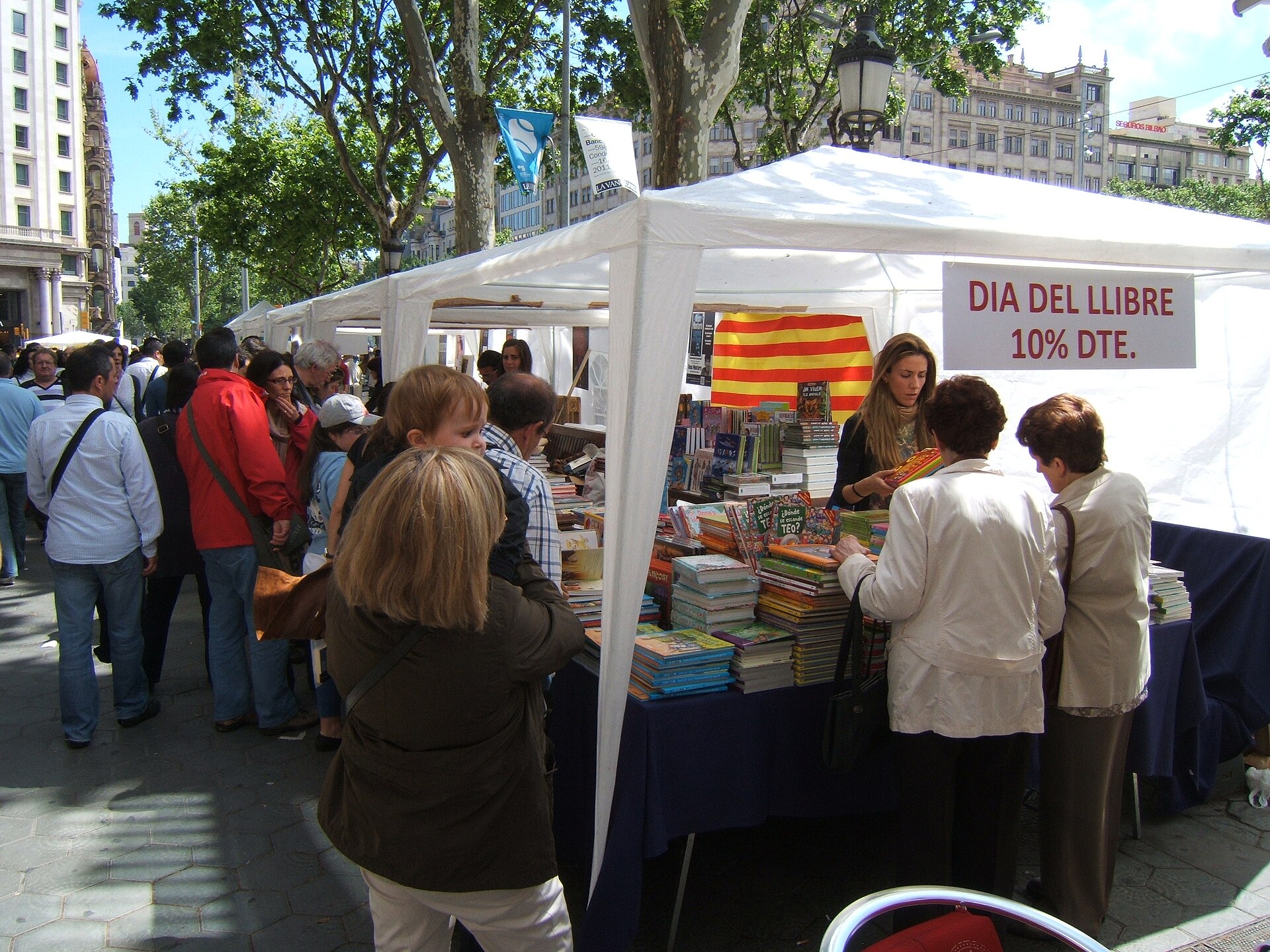
What is on: Sant Jordi on 23 April is the single loveliest day in the Barcelona calendar — the whole city turns out to exchange books and roses, Rambla de Catalunya becomes a mile of book stalls, and there is no admission charge to any of it. If you can time a visit to one day of the year, make it this one. Setmana Santa (Easter) brings processions, a public holiday on Good Friday and Easter Monday, and a national surge in domestic travel that pushes prices up sharply. The Feria de Abril de Catalunya, an Andalusian-style fair with flamenco and casetas, runs for a week towards the end of the month at the Parc del Fòrum.
Verdict: the best all-round month to visit, with the caveat that Easter week is expensive and busy. Aim for the days around Sant Jordi and avoid the Easter block if you can.
May
22 °C high, 14 °C low, 55 mm over five days, eight hours of sun.
Warm, long-evening weather with the sea still too cold for most people at 17 °C. May is the month the terraces genuinely take over, the rooftop bars reopen properly, and the city feels like the version of itself that appears in photographs.
It is also, quietly, one of the wetter spring months — the 55 mm arrives in short, dramatic thunderstorms rather than steady drizzle. Carry something light and waterproof and do not rearrange your day around a forecast.
What is on: Primavera Sound at the Parc del Fòrum, usually spanning the very end of May and the start of June (its 2027 edition has been announced for the first days of June), which fills the city with 60,000 people and pushes accommodation prices up for the whole week. Sant Ponç on 11 May turns Carrer de l’Hospital in El Raval into a herb and honey market. The Nit dels Museus, usually mid-May, opens dozens of museums free until the small hours.
Verdict: excellent, if you accept that it is no longer a bargain and that Primavera week is its own event.
June
26 °C high, 18 °C low, 30 mm over four days, eight and a half hours of sun.
Reliably hot without being oppressive, almost no rain, and the sea finally reaches a swimmable 20 °C in the second half. The longest days of the year, with light until nearly 22:00. It is a wonderful month and everybody knows it, which is reflected in the prices.
What is on: Sant Joan on the night of 23 June is Barcelona’s wildest night — bonfires on the beaches, fireworks in every square, and an entire city that does not sleep. It is chaotic, loud and genuinely dangerous around the amateur fireworks; go, but go with your eyes open. Sónar in mid-June brings the electronic music crowd. Pride Barcelona’s programme usually begins in late June, though in 2026 the march itself was held on 18 July, and the Grec festival of theatre and dance opens at the end of the month.
Verdict: the best month for beach-and-city combined, at the price you would expect.

July
28 °C high, 21 °C low, 20 mm over two days, ten hours of sun, sea 23 °C.
The driest and sunniest month of the year, and the one when the city is at maximum load. Every attraction has a queue, every beach has a wall of towels, and hotel rates are at their annual peak. It is also genuinely hot: 28 °C in the shade with high humidity from the sea, and the Eixample grid holds heat well into the night.
Practical adaptations that make July work: start at 08:30, retreat indoors or into a pool between 14:00 and 17:00, and do everything else after 19:00, when the city comes back to life. This is the Spanish rhythm and fighting it is exhausting.
What is on: the Grec festival runs all month, with performances in the Greek amphitheatre on Montjuïc and venues across the city. Cruïlla brings a large mixed-genre music festival. The Festa Major del Raval and a scattering of neighbourhood festes fill the weekends.
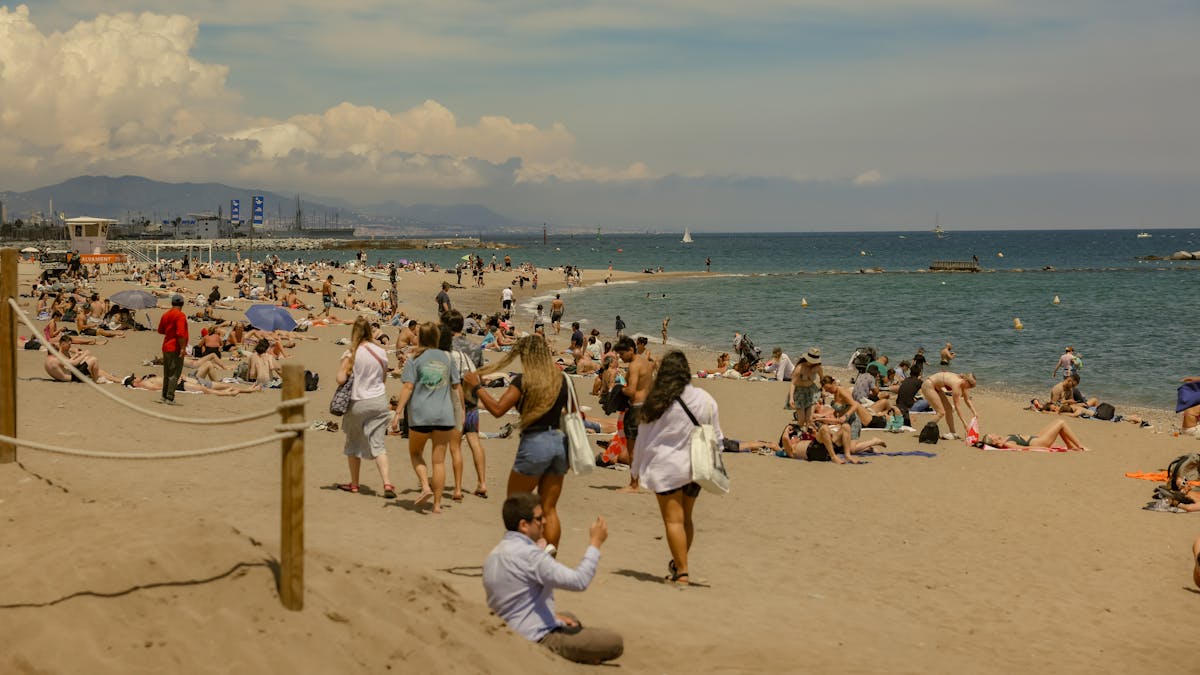
Verdict: the least pleasant month for sightseeing and the best for swimming. If you must come in July, plan around the heat rather than through it. Our Barcelona beaches guide covers which stretches of sand are worth the journey when the central ones are full.
August
29 °C high, 21 °C low, 65 mm over five days, nine hours of sun, sea 25 °C.
The hottest month and the strangest one. Barcelona’s own residents leave in large numbers, so a good proportion of the neighbourhood restaurants, bakeries and small shops close for two or three weeks — the ones with hand-written tancat per vacances signs are exactly the ones you wanted to eat in. The tourist-facing city stays wide open and completely full.
The 65 mm of rain is misleading. August storms here are short and dramatic: an hour of torrential rain and thunder in the late afternoon, then clear sky. They are increasingly frequent and worth being aware of if you have plans on a rooftop.
What is on: the Festa Major de Gràcia in mid-August, when the streets of Gràcia are decorated by their own residents in an annual competition that is genuinely spectacular and completely free. The Festa Major de Sants follows. Both are among the best things that happen in Barcelona all year, and both are overwhelmingly local.
Verdict: the warmest sea of the year and the Gràcia festival on one side; closures, heat and peak crowds on the other. Come for the beach, not for the restaurants.
September
26 °C high, 18 °C low, 85 mm over five days, seven and a half hours of sun, sea 23 °C.
The insider’s month. The heat breaks in the first week or two, the sea stays at 23 °C, the crowds thin out after the first weekend, and the city comes back to life as residents return. Rain increases sharply — 85 mm is more than double August — but it arrives in storms rather than in grey days.
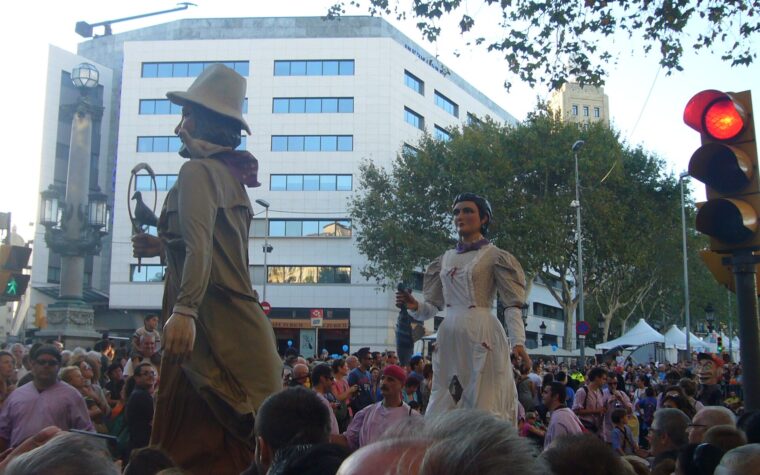
What is on: La Mercè around 24 September, Barcelona’s biggest festa major and the reason to be here this month. Five days of free concerts across the city, castells in Plaça Sant Jaume, the correfoc fire run, giants, and a closing pyro-musical on Montjuïc. La Diada, Catalonia’s national day, falls on 11 September and brings very large political demonstrations — peaceful, but they close streets and metro exits, so check before you plan that day.
Verdict: arguably the best month of the year: summer sea, autumn crowds, and the city’s finest festival.
October
22 °C high, 14 °C low, 100 mm over seven days, six hours of sun, sea 20 °C.
The wettest month in Barcelona by some margin, and the one most guides get wrong by describing it as a gentle autumn. It is warm — genuinely warm, and you can still swim early in the month — but a hundred millimetres over seven days means real rain, occasionally torrential, and the Mediterranean autumn storm is a serious weather event rather than a shower.
That said, the trade is good. Prices drop, attractions are manageable again, the light is beautiful, and a wet October week in Barcelona still contains more sun than most of northern Europe sees in a month.
What is on: the Sitges Film Festival, Europe’s leading fantasy and horror festival, in the first half of the month — a short train ride down the coast and a proper event. The 48h Open House architecture weekend opens buildings that are normally private. La Castanyada builds towards the end of the month, with roast chestnuts appearing on street corners.
Verdict: good value and pleasant, but pack a real coat and have indoor plans ready.
November
18 °C high, 9 °C low, 65 mm over five days, five hours of sun.
The quiet begins. Prices fall away after the first week, the queues shorten dramatically, and the weather is mild enough for full days on foot. The light gets low and golden by mid-afternoon, which flatters the architecture considerably.
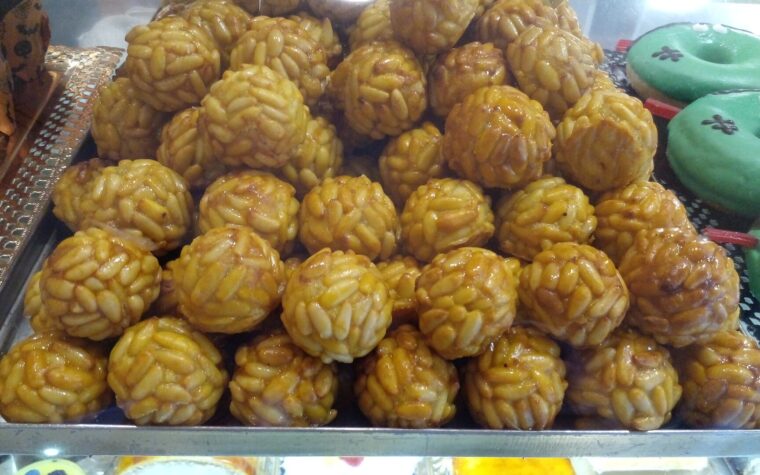
What is on: Tots Sants on 1 November, a public holiday, with families visiting cemeteries and panellets in every bakery window. Very little else, which is rather the point. The Christmas lights go up on Passeig de Gràcia in the last week of the month and the city begins to change gear.
Verdict: the best month for pure sightseeing value. Short queues, mild weather, real prices.
December
15 °C high, 6 °C low, 40 mm over five days, four and a half hours of sun.
Two different months in one. The first three weeks are cheap, quiet and atmospheric; the stretch from about 22 December to 2 January is fully booked, expensive and busy with visiting families and returning Catalans.
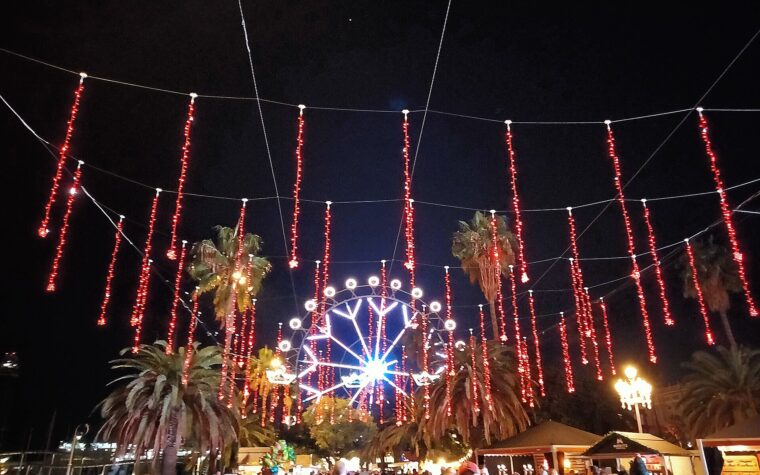
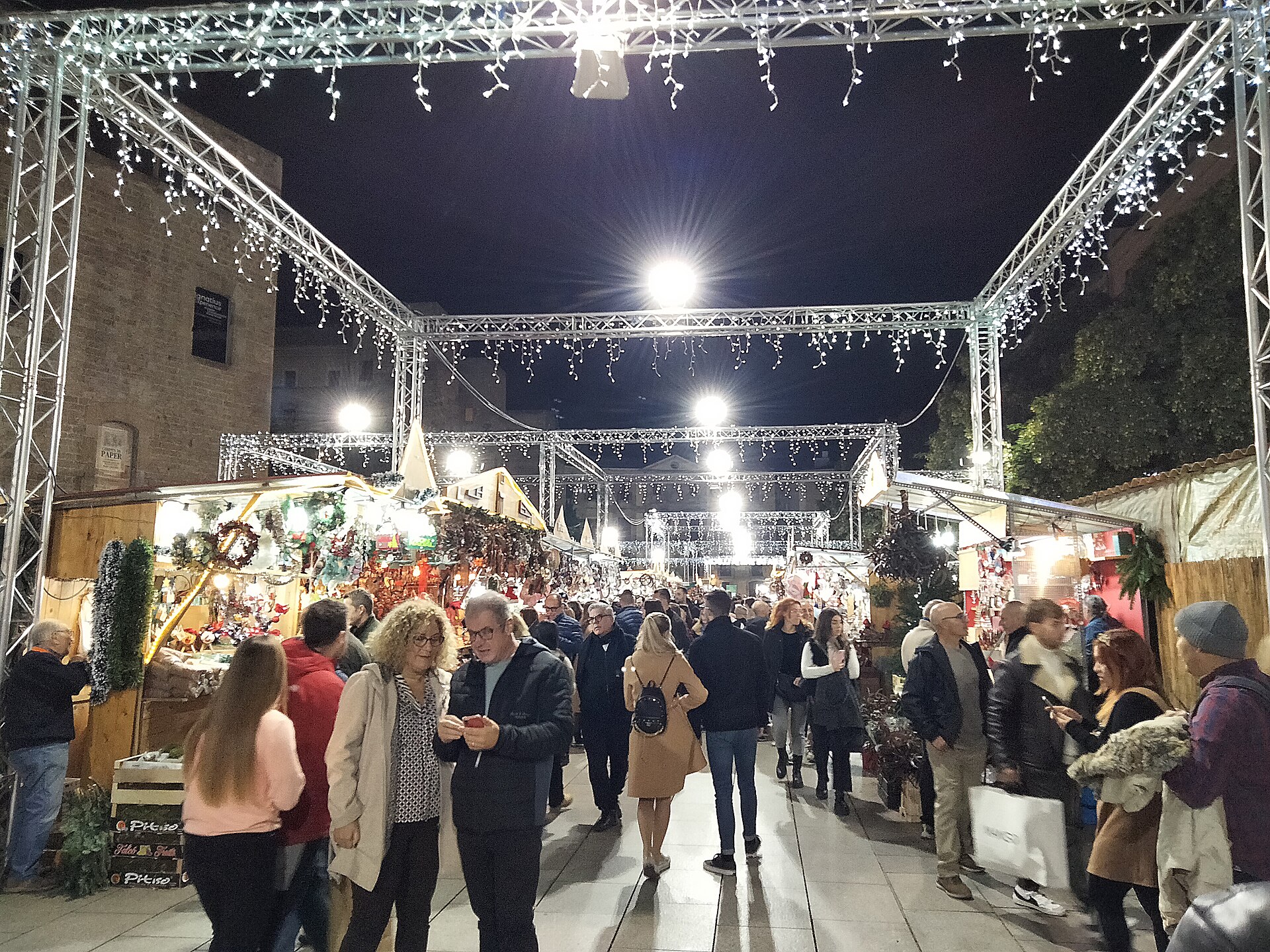
What is on: the Fira de Santa Llúcia in front of the cathedral, running from late November to 23 December — several hundred stalls selling nativity figures, greenery and, unavoidably, the caganer, the crouching defecating figure that Catalan nativity scenes have included for centuries. The tió de Nadal, a log children beat with sticks until it produces presents, is the other local custom that visitors find memorable. Christmas in Barcelona covers both in detail. Nadal on 25 December and Sant Esteve on 26 December are both public holidays and the city genuinely shuts. New Year’s Eve centres on the fountain show at Plaça d’Espanya and on twelve grapes at midnight.
Verdict: excellent in early December, expensive and crowded over the holidays, and be aware how comprehensively things close on 25 and 26 December.
Choosing your month by what you want
| If you want… | Go in… | Avoid… |
|---|---|---|
| Beach and swimming | July, August, September | November to May |
| Sightseeing without queues | November, January, February, March | June to September |
| The best weather overall | May, June, September | July, August, January |
| The lowest prices | January, February, early December | June to September, Easter, MWC week |
| The best festivals | April (Sant Jordi), June (Sant Joan), September (La Mercè) | March, October, November |
| Long evenings outdoors | May to September | November to February |
| Reliable dry weather | June and July | October, September |
Things about the Barcelona year that catch people out
- The trade-fair calendar matters more than the season. Mobile World Congress in February, the Integrated Systems Europe show, the big medical congresses — any of these can put a February Tuesday above an August Saturday for hotel rates. Check the Fira Barcelona calendar before you fix dates, then read our Barcelona hotels guide for how to book around them.
- August closures are real. Neighbourhood restaurants, bakeries and small shops close for two or three weeks. If you have a specific place in mind, check it is open.
- Public holidays close things properly. 1 January, 6 January, Good Friday, Easter Monday, 1 May, 24 June, 15 August, 11 September, 24 September, 12 October, 1 November, 6 and 8 December, 25 and 26 December. Museums and most shops shut; restaurants are patchy.
- The sea is not warm in May. 17 °C is swimmable for the hardy and unpleasant for everyone else. Wait for late June.
- Rooftop bars and hotel pools are seasonal. Many close from October to April, including some that do not say so on the booking page.
- Sunset moves a long way. Late June gives you light until nearly 22:00; late December it is dark by 17:30. That changes how much you can fit into a day more than the temperature does.
- Shoulder season is now three months long. April, May, September and October all behave like high season in terms of crowds even when they do not in terms of price. The genuinely quiet months are November through March.
Daylight, and why it matters more than temperature
Barcelona sits at roughly 41 degrees north, further south than Rome and considerably further south than any northern European capital, so the difference between its longest and shortest days is smaller than visitors from Britain or Scandinavia expect. It is still enough to reshape a trip.
| Period | Sunrise (approx.) | Sunset (approx.) | Usable daylight |
|---|---|---|---|
| Late December | 08:15 | 17:30 | About nine hours |
| Late March (after the clocks change) | 07:30 | 20:15 | Nearly thirteen hours |
| Late June | 06:20 | 21:30 | Over fifteen hours |
| Late September | 07:45 | 20:00 | About twelve hours |
Spain runs on Central European Time despite sitting geographically in the same band as the UK, which is why sunset here is so late in summer and why the Spanish day is shifted so far back — lunch at 14:30, dinner at 21:30, and a city that is still busy at midnight. In December that shift works against you: it is dark by 17:30 but nothing opens for dinner until 20:30, leaving a long dead stretch in the early evening. Plan an indoor stop into your winter afternoons.
The clocks change on the last Sunday of March and the last Sunday of October, in step with the rest of the EU.
What to pack, season by season
Winter — December to February
A proper coat, not a jacket. Barcelona’s 14 °C is damp, wind comes off the sea, and interiors are frequently colder than the street because Spanish buildings are designed to shed heat rather than retain it. Layers, a scarf, closed shoes, and something waterproof. You will not need gloves. Sunglasses, still — the winter sun sits low and directly in your eyes on an east–west street.
Spring — March to May
The hardest season to pack for, because a 19 °C April day and a 12 °C April evening are the same day. Layers, a light waterproof, and one warm thing for after dark. Comfortable shoes matter more here than in any other season, because this is when you will walk the most.
Summer — June to August
Light, loose, natural fabrics; a hat; high-factor sun cream; a refillable water bottle, because Barcelona’s public fountains are drinkable and everywhere. One long-sleeved layer for over-air-conditioned interiors and for evenings by the sea. Swimwear, obviously, and a second set, because the first will not dry. Note the dress codes: churches including the Sagrada Família require covered shoulders and knees, and beach attire is not acceptable away from the seafront — the city fines people for walking through the Gothic Quarter in swimwear.
Autumn — September to November
September needs a summer wardrobe. October is the month that needs a genuine rain layer — an umbrella is close to useless in a Mediterranean downpour with wind, so bring a hooded waterproof. November wants a mid-weight coat and closed shoes. Our full Barcelona packing list goes further, including the things people consistently forget.
What things cost across the year
Indicative figures to show the shape of the year rather than to quote a price. The room rate is a mid-range four-star double; flights vary far more by origin than by month.
| Period | Four-star double | Attraction queues | Restaurant availability |
|---|---|---|---|
| January–February (non-congress) | €110–160 | Walk-up possible almost everywhere | Excellent |
| March | €130–190 | Short | Very good |
| April–May | €180–260 | Book ahead for the big three | Book two or three days out |
| June–August | €220–340 | Timed entry only, booked weeks ahead | Book a week out for anything good |
| September | €180–250 | Easing after the first weekend | Good, except La Mercè week |
| October–November | €120–180 | Short | Excellent |
| Christmas and New Year | €200–320 | Moderate, but reduced holiday hours | Book ahead; much is closed on 25–26 December |
| Mobile World Congress week | €400–600 | Normal | Business restaurants fully booked |
The heat is changing the calendar
It is worth saying plainly that the Barcelona summer is not what it was twenty years ago. Heatwaves that used to be exceptional now arrive most years, and a stretch of 35 °C days in July or August is no longer remarkable. The practical effect for visitors is that the mid-afternoon has become genuinely unusable in high summer — not merely uncomfortable — and that the local rhythm of early mornings and late evenings has become the only sensible way to spend those months.
Catalonia has also been through serious drought in recent years, with regional restrictions on water use that at various points affected pools, garden watering and the foot showers on the beaches. Restrictions come and go with reservoir levels, so check the current position if you are travelling in summer and a hotel pool matters to you.
The wider consequence is that the shoulder seasons keep getting better and longer. October now regularly delivers swimmable sea and 24 °C afternoons; April is warmer than it used to be. If you are choosing between July and either May or October, the case for the shoulder months gets stronger every year.
Picking a month by who you are
- First-time visitor, no fixed constraints: late September, or the second half of May. Warm, long days, the city functioning normally, and prices below the summer peak.
- Travelling with school-age children: you are tied to the holidays, so aim for the last week of August rather than the first — prices soften and the city starts reopening — or the October half-term, accepting the rain risk.
- Here for the architecture: November through March. The museums are empty, the Gaudí buildings can be visited without a slot booked weeks ahead, and the low winter light is far better for photographs than the flat summer glare.
- Here for the beach: July to mid-September, and nothing else will do. See the beaches guide for which stretches are worth the journey.
- Here for the food: avoid August, when the best neighbourhood places close. Anything from September to July works, and the winter months are best for getting a reservation.
- On a tight budget: mid-January to mid-March, dodging the congress week. The saving on accommodation alone will fund several very good dinners.
- Coming for one specific event: book accommodation before you book anything else. La Mercè, Primavera Sound, Sant Joan and Mobile World Congress all move the entire city’s prices, not just those of the venue’s neighbourhood.
Frequently asked questions
What is the best month to visit Barcelona?
September, for most people: the sea is still 23 °C, the summer crowds have gone, and La Mercè is the city’s best festival. May and late April are the strongest alternatives if you do not need to swim. November is the best value.
What is the wettest month in Barcelona?
October, with around 100 mm over seven days — more than double August. September is second at 85 mm. Contrary to the usual assumption, the autumn is wetter here than the winter.
When is the sea warm enough to swim in Barcelona?
July through September, peaking at 25 °C in August. June reaches 20 °C, which most people find acceptable by the second half of the month. May is 17 °C and October is 20 °C, so early October swimming is more comfortable than late May swimming.
How hot does Barcelona get in summer?
An average high of 28 °C in July and 29 °C in August, with humidity from the sea that makes it feel warmer, and nights that stay around 21 °C. Heatwaves push this considerably higher, and the Eixample grid holds heat well into the small hours.
Is Barcelona worth visiting in winter?
Yes, if you are here for architecture, museums and food rather than beaches. January and February bring 14–15 °C days, the lowest prices of the year, short queues at the major sights, and a city that feels like it belongs to its residents again.
What is the cheapest month to visit Barcelona?
January, closely followed by February and the first three weeks of December. Expect hotel rates 30–40% below the summer peak. The one exception is Mobile World Congress week in late February, when rates across the whole city triple.
Which month has the fewest tourists in Barcelona?
January. November, February and March are close behind. The genuinely quiet stretch runs from mid-November to the end of March, excluding the Christmas and New Year fortnight.
When is Sant Jordi, and is it worth planning around?
23 April, every year. It is free, it is city-wide, and it is the day Barcelona is most itself — book stalls the length of Rambla de Catalunya, roses everywhere, and a genuinely celebratory mood. If you can align one day of a trip with one date in the calendar, this is the one.
What is the weather like in Barcelona in October?
Warm and wet: an average high of 22 °C, a sea temperature of 20 °C, six hours of sun a day, and around 100 mm of rain spread over seven days. It is the wettest month of the year but still perfectly good for sightseeing, provided you have a coat and a wet-weather plan.
Does anything close in Barcelona in August?
A great deal, but not the tourist infrastructure. Neighbourhood restaurants, bakeries, butchers and small independent shops routinely close for two to three weeks while their owners take holidays. Museums, major attractions, hotels and beach businesses stay open throughout.
When are the Barcelona sales?
The regulated rebaixes run from early January for several weeks, and again from the start of July. Both are genuine, with substantial discounts in the first fortnight and picked-over stock after that.
The first of this guide’s individual month pages are now live, each with the weather in detail, dated events for the coming year, crowds, prices and an honest verdict: Barcelona in January, the quiet, cheap month of the Three Kings and the sales; Barcelona in April, with Sant Jordi and, in 2027, no Easter holidays; Barcelona in May, with Sant Ponç, the Nit dels Museus and l’Ou com balla; Barcelona in June, the month of Primavera Sound, Sónar and Sant Joan; Barcelona in July, peak heat and peak crowds, with the Grec, Cruïlla and open-air cinema on Montjuïc; Barcelona in August, the warmest sea of the year and the decorated streets of the Festa Major de Gràcia, in a city half-closed for the holidays; Barcelona in September, the best all-round month, with a warm sea, the Diada and La Mercè; Barcelona in October, the wettest month, but also the month of 48h Open House, the Sitges Film Festival and the first wild mushrooms; and Barcelona in December, crisp sunny days, the Christmas fairs and some of the year’s lowest prices, until New Year sends them soaring. More months are on the way.
Related Barcelona Guides
- The best time to visit Barcelona — the decision page that pairs with this reference.
- Barcelona’s festivals — the full calendar, with what each one actually involves.
- What to pack for Barcelona — season by season, including the things people forget.
- Barcelona’s beaches — which stretches of sand are worth it, and when.
- Barcelona hotels and accommodation — how seasonality and the congress calendar move room rates.
- Barcelona on a rainy day — essential reading if you are coming in October.
- The complete Barcelona travel guide — the hub for everything else on this site.
Photo Credits
Sant Jordi book stalls: Diada de Sant Jordi (5646758837) by Francis Lenn, CC BY 2.0, via Wikimedia Commons.
Fira de Santa Llúcia: 053 Fira de Santa Llúcia, av. de la Catedral (Barcelona) by Enric, CC BY 4.0, via Wikimedia Commons.