We get commissions for bookings made through this post. Booking links, and any accommodation options shown on the page, are handled by a partner that adds commission tracking automatically. It never costs you more, and it never affects what we recommend. Affiliate disclosure
The departure boards at Barcelona Sants list Madrid roughly every twenty minutes through the middle of the day, on three different liveries, at prices that can differ by a factor of ten for seats in the same carriage class. That is the whole problem with barcelona to madrid in one sentence: the route is not hard, it is simply over-supplied, and the difference between a good decision and a bad one is worth about €80 and two hours of your life. This page is the logistics — which operator, which fare, which station, and how the plane and the bus actually compare once you stop measuring in flight time. If you are still deciding whether Madrid deserves the trip at all, our Barcelona vs Madrid comparison is the page for that: it weighs the two cities against each other, while this one assumes you have already picked and just want to get there without overpaying.
Everything below was checked in September 2026 and covers all four realistic options — high-speed rail with Renfe, Ouigo and iryo; Iberia’s Puente Aéreo air shuttle; the long-distance coach; and driving. Prices are the ones on sale at the time of writing and they move constantly on this route, so treat them as the right order of magnitude rather than a quote, and always check the operator’s own site before you commit.
Barcelona to Madrid at a glance
Four options, honestly costed. The “door to door” column assumes a central Barcelona hotel and a central Madrid hotel, which is how most visitors actually travel — not terminal to terminal.
| Option | Journey time | Door to door | Typical cost | Best for |
|---|---|---|---|---|
| High-speed train (AVE / iryo / Ouigo) | 2h30–3h10 | 3h30–4h | €9–90 one way | Almost everybody |
| Flight (BCN–MAD) | 1h15 in the air | 4h30–5h30 | €40–150 one way | Connecting to a long-haul flight |
| Coach (ALSA and others) | 7h20–11h55 | 8h–12h30 | €15–55 one way | Very tight budgets, overnight departures |
| Driving | ~6h non-stop | 6h30–7h30 | €120–200 all-in | Trips that continue beyond Madrid |
If you only read one line: take the train, book it eight to twelve weeks out, and let a comparison site decide which of the three operators is cheapest on your date rather than picking a brand out of loyalty. The rest of this guide is why.
The train is the right answer, and here is the arithmetic
Spain built the Madrid–Barcelona high-speed line to take passengers off the plane, and it worked. The fastest non-stop services cover the 620 km in 2 hours 30 minutes, city centre to city centre. Services that call at Zaragoza, Lleida, Camp de Tarragona or Guadalajara take between 2h50 and 3h10 — worth knowing, because the cheapest fares are disproportionately on the stopping trains, and an extra half hour on a comfortable train is a fair trade for €25.
Across all operators there are roughly forty departures a day. On a weekday morning you can turn up at Sants without a plan and be in Madrid before lunch, though you will pay handsomely for the privilege. The route is dense enough that a missed train is an inconvenience rather than a disaster, which is not true of the coach and is emphatically not true of a non-flexible flight.
Rail liberalisation is the reason this journey is now cheap. Until 2019 Renfe had the line to itself and fares behaved accordingly. Today three operators run the same tracks at the same speeds, and the price war between them is the single best thing to have happened to Spanish domestic travel in a decade.
Renfe AVE — the incumbent
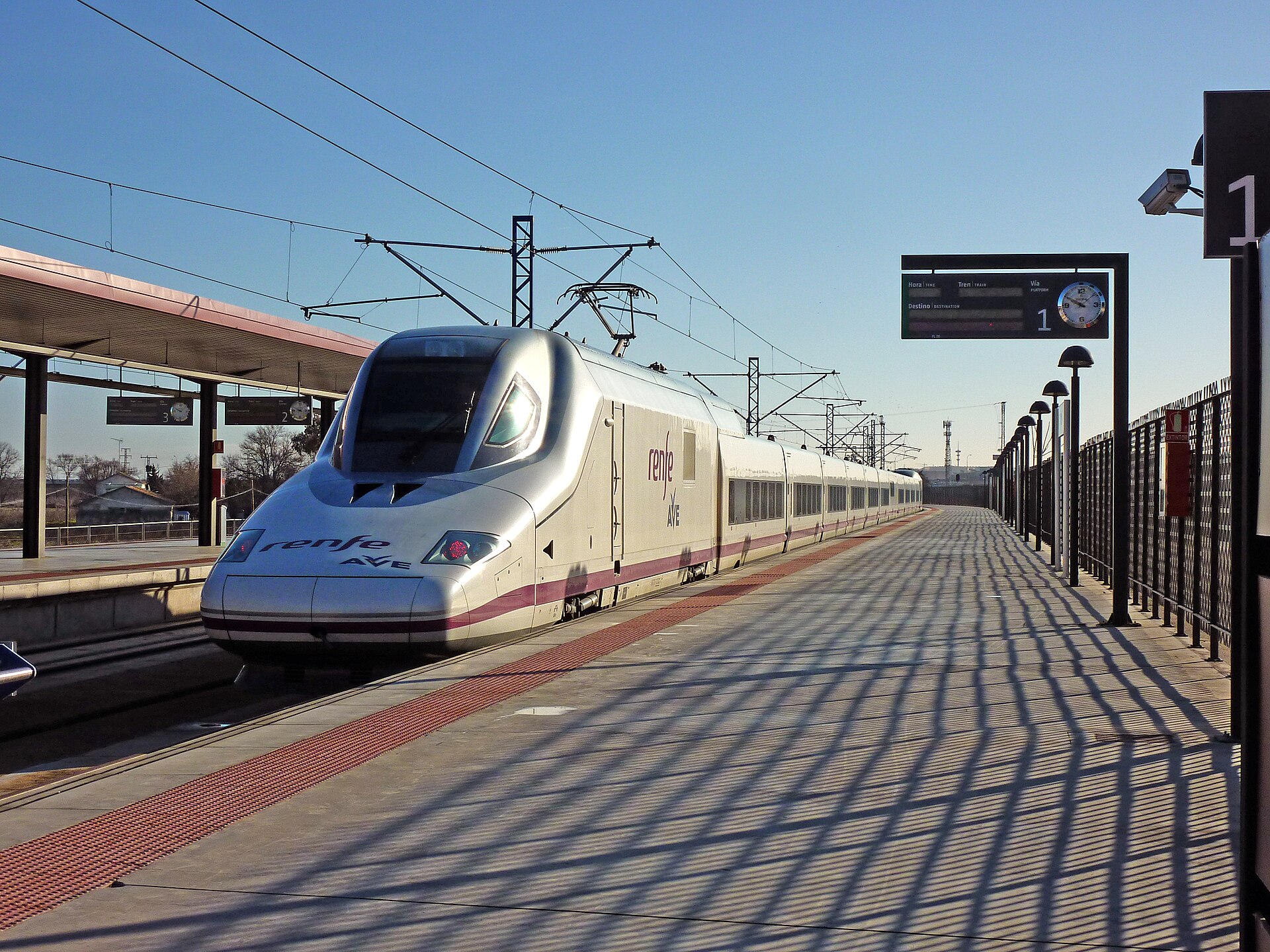
AVE is the flagship: white-and-purple Renfe sets, two classes in the normal configuration (Estándar and Confort, with Premium on some services), at-seat catering on the higher fares, and the most departures of any operator. Advance fares start around €17 and walk-up fares run to €90 and beyond.
What the extra money buys over the budget operators is legroom, a slightly quieter carriage, generous luggage racks, and — the underrated one — Renfe’s own network for onward connections, so a delay that makes you miss a connecting train in Madrid becomes Renfe’s problem rather than yours. Confort class adds a wider seat, a meal on longer services and lounge access at Sants and Atocha. On a two-and-a-half-hour run, Estándar is perfectly comfortable and Confort is a luxury, not a fix for something broken.
Ouigo — the cheapest, with conditions
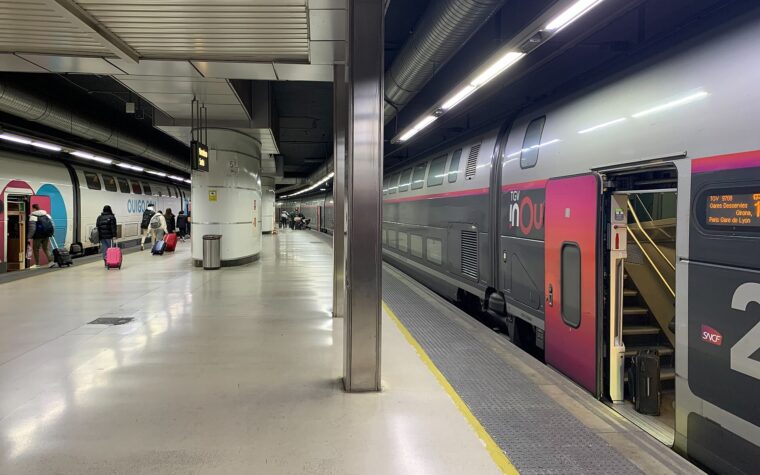
Ouigo Spain is SNCF’s low-cost operation, running double-deck TGV sets in an unmissable shade of blue. Promo fares start at €9 and they genuinely exist — this is not a headline price that evaporates when you click. In exchange you get a no-frills product: one class as standard, a paid upgrade to Ouigo Plus, a charge for a second large bag, and a strict approach to changes.
Two practical warnings. First, check your ticket for the exact Madrid station and platform area, and allow extra time if you are connecting — Ouigo does not always use the same part of Atocha as Renfe, and the walk is not short. Second, the double-deck sets are wonderful for the view and awkward for luggage. If you are travelling with two big suitcases and a pushchair, the racks fill early, so board at the start of the boarding window rather than the end.
iryo — the surprise
iryo runs Frecciarossa 1000 trains, the same Italian stock used on the Rome–Milan corridor, in a distinctive dark red. Fares start around €15 and the product sits between Renfe and Ouigo: four fare classes, decent catering, comfortable seats and — subjectively, but widely agreed — the nicest interior of the three. If iryo comes out cheapest on your date, take it without hesitation.
Avlo — Renfe’s own budget brand
Avlo is Renfe’s answer to Ouigo: the same AVE trains in a high-density configuration, sold cheap, with paid extras for bags and seat selection. It is a perfectly good way to reach Madrid and the fares are competitive. The only thing to watch is that Avlo services skew towards unsociable hours and towards more intermediate stops, which is precisely how the fare gets to be low.
When to book, and where
The sweet spot is 60 to 90 days ahead. That is when all three operators release their cheapest inventory, and it is where the €9–19 promo fares live. Book four weeks out and you will typically pay €35–55. Book on the day and you are looking at €80–120, at which point the plane starts to look reasonable and the coach starts to look sensible.
- Book direct where you can. renfe.com, ouigo.com and iryo.eu all sell in English and take foreign cards without much drama. Third-party resellers add a booking fee and, more annoyingly, sit between you and the operator when something goes wrong.
- Compare across operators before you buy. A single search site is the fastest way to see all three at once. Use it to compare, then buy direct if the price matches.
- Renfe’s site occasionally rejects non-Spanish cards. If it does, try the app, try a different browser, or fall back to a reseller. This is a known irritation, not a sign that your booking failed.
- Price the two legs separately. There is rarely a discount for booking a return as one transaction. Two singles, on whichever operator is cheapest in each direction, is normal practice here.
- Rail passes are poor value on this route. Interrail and Eurail holders still pay a compulsory seat reservation on Spanish high-speed trains, and that reservation fee often exceeds the promo fare you could have bought outright.
- Children travel cheaply. Under-fours go free without a seat on all three operators, and 4–13s get a substantial discount. Families should always check the operator’s own site, because comparison engines handle child fares badly.
Barcelona Sants: what to expect
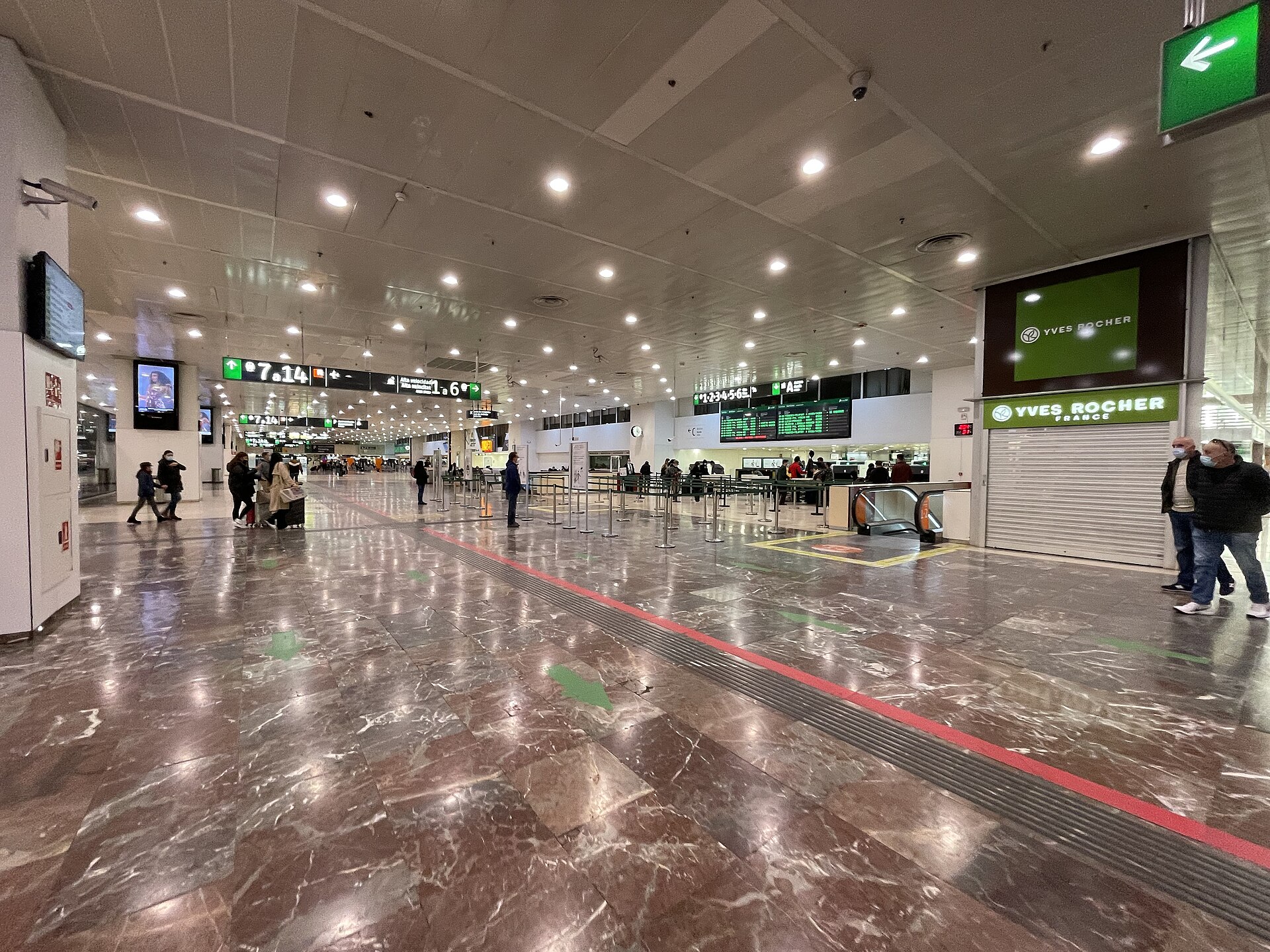
Sants is not a beautiful station. It is a low, wide, largely subterranean box beneath a plaza in the Sants district, and it does its job briskly rather than gracefully. The practical points:
- Getting there: metro L3 (green) and L5 (blue) both serve Sants Estació directly, and Rodalies suburban trains stop here too. From Plaça de Catalunya it is about ten minutes on L3. Our Barcelona metro guide covers ticketing if you have not sorted a travel card yet.
- Security: Spanish high-speed trains put your bags through an X-ray scanner before you reach the platform. It is quick — nothing like an airport — but it is a real queue at peak times. Arrive 25–30 minutes before departure and you will never have a problem.
- Gates close early. Boarding typically shuts a couple of minutes before departure, and the platform is not announced until roughly twenty minutes beforehand. Do not go for a coffee in the far corner of the concourse at T-minus fifteen.
- Left luggage exists at Sants and is genuinely useful if you are checking out at 11:00 and travelling at 18:00. Expect roughly €6–10 a day depending on locker size.
- Pickpockets work the concourse and the metro interchange beneath it. This is the one part of the journey where the usual Barcelona advice applies with force — our Barcelona safety guide has the specifics.
Madrid Atocha: what to expect on arrival
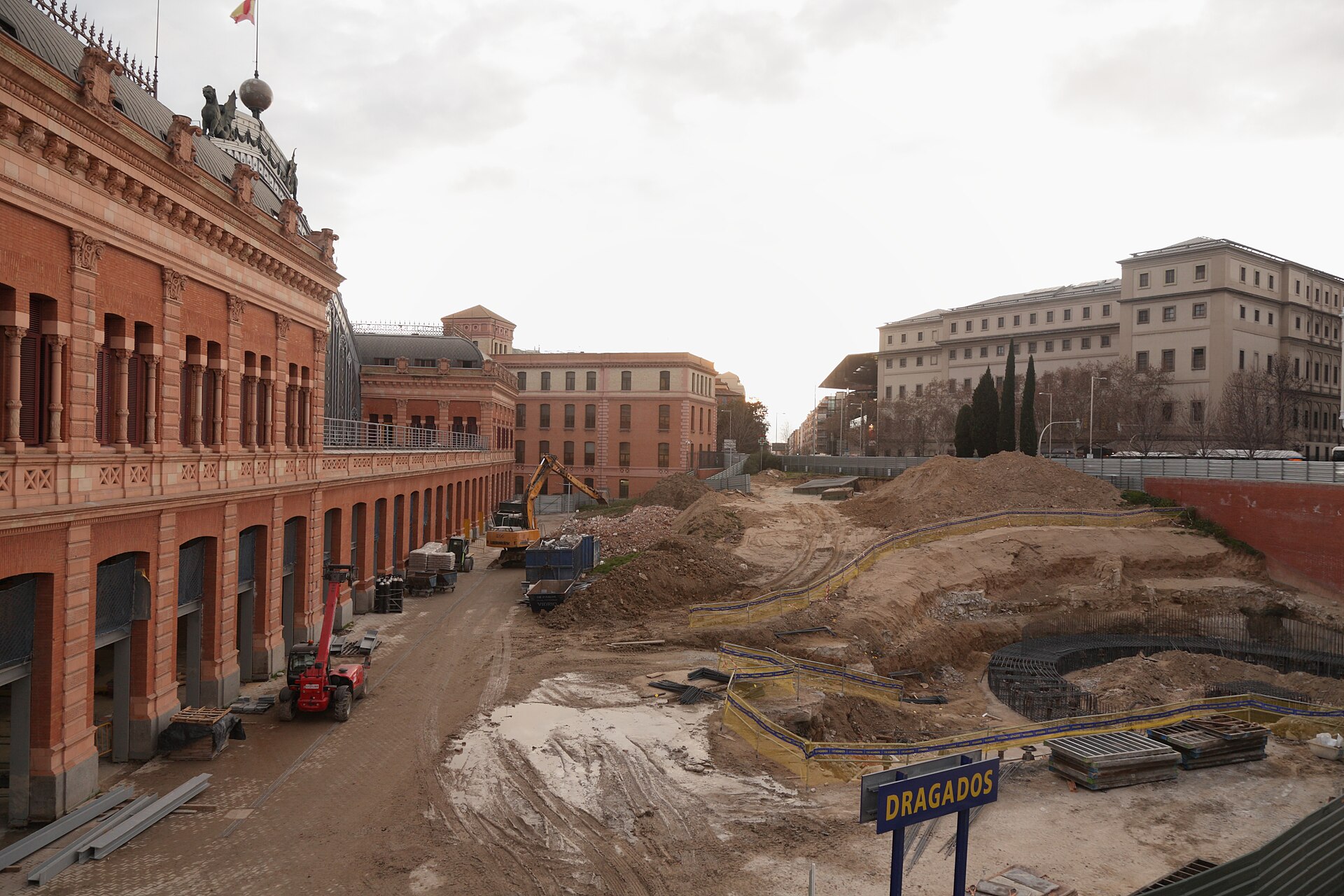
You will arrive at Madrid Puerta de Atocha–Almudena Grandes, the southern terminus and one of the more pleasant big-city stations in Europe once you find the old iron hall with the tropical garden inside it. Atocha has been under heavy expansion for several years, so expect hoardings, diverted walkways and signage that occasionally contradicts itself. Give yourself an extra ten minutes to find the exit you want.
From Atocha, metro line 1 reaches Sol in about eight minutes, and the Cercanías suburban trains — frequent and cheap — get to Sol and Nuevos Ministerios faster still. A taxi to the centre is roughly €10–15 and takes a quarter of an hour in normal traffic. Walking to the Prado, the Reina Sofía or Lavapiés is entirely realistic; walking to Gran Vía with luggage is not.
Flying: an hour and a quarter that takes five hours
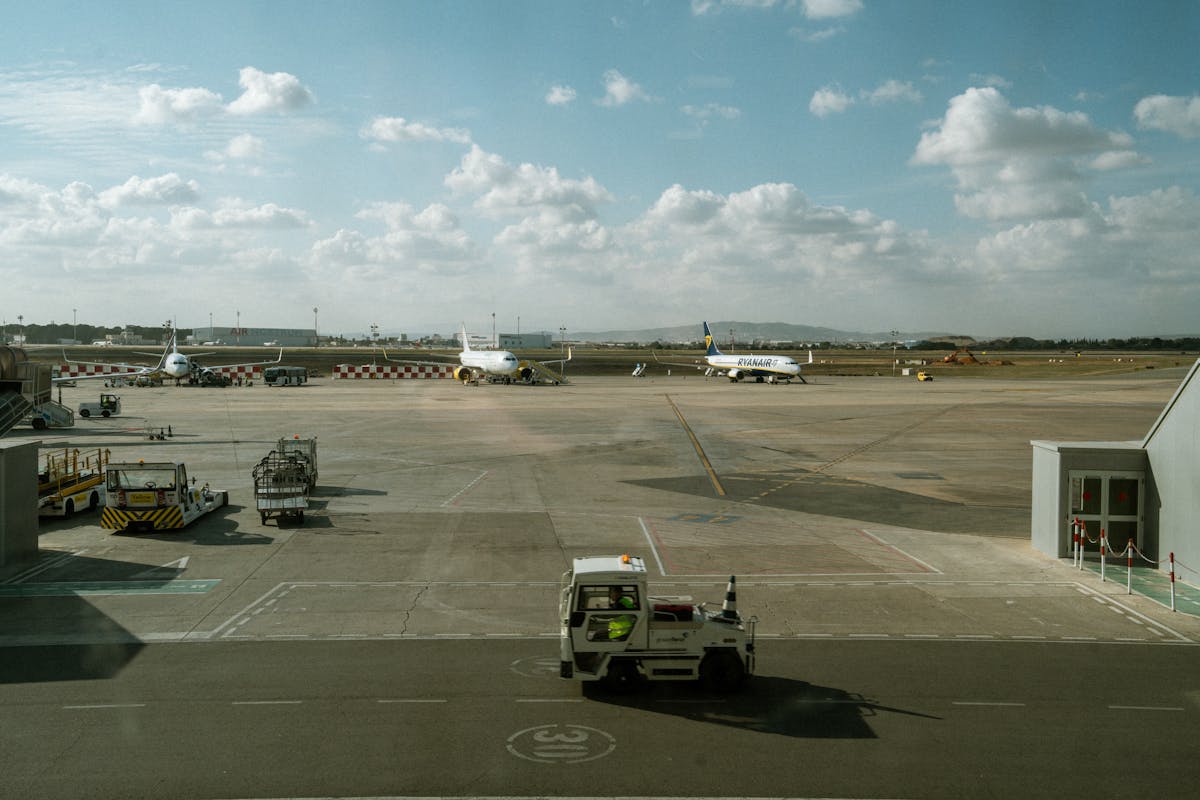
Iberia’s Puente Aéreo — the air bridge — is a genuine piece of aviation history. Launched in 1974, it once ran on the principle that you turned up, joined a queue and boarded the next aircraft with no booking at all. A version of that survives: on the shuttle fares you can still board up to twenty minutes before departure, there are up to fourteen flights each way on weekdays and around nine at weekends, and departures come every half hour at peak.
The flight itself is about 1 hour 15 minutes in the air. That number is why people still book it, and it is also the number that misleads them. Here is the honest door-to-door accounting, from a hotel in the Eixample to a hotel near Sol.
| Step | Train | Plane |
|---|---|---|
| Hotel to departure point | 15 min (metro to Sants) | 35–45 min (L9 Sud or Aerobús to El Prat) |
| Recommended arrival before departure | 25 min | 90–120 min |
| Journey | 2h30 | 1h15 |
| Disembarking and clearing the terminal | 5 min | 25–40 min with a checked bag |
| Arrival point to hotel | 15 min | 40–50 min from Barajas |
| Realistic total | about 3h30 | 4h30–5h30 |
So the plane loses on time, and it usually loses on cost too, once you add the €5.90 airport metro supplement at the Barcelona end (or €7.45 for the Aerobús) and whatever the transfer costs at the Madrid end. Our BCN airport guide and the airport transfer comparison have those fares in full.
The two cases where flying genuinely wins
There are exactly two, and it is worth naming them rather than pretending the train is always right.
- You are connecting onward from Madrid–Barajas. If your long-haul flight leaves from Barajas, flying BCN–MAD on a single ticket protects the connection: if the first leg runs late, the airline owes you a rebooking. Arriving at Atocha on a separate train ticket and missing an intercontinental flight is entirely your problem.
- The train fare has gone silly. Booking on the day of travel can put a rail fare at €120 against a €55 flight. It is still slower, but it may genuinely be cheaper, and there is no virtue in pretending otherwise.
Outside those two situations, flying between Barcelona and Madrid is worse in every dimension that matters — time, cost, comfort, carbon, and the sheer amount of standing in queues.
The coach: slow, cheap, and better than its reputation
ALSA and a handful of competitors run roughly forty coaches a day between Barcelona’s Estació del Nord and Madrid’s Estación Sur (Méndez Álvaro). The fastest direct service takes 7 hours 20 minutes; the ones that call at every provincial capital along the way stretch to nearly twelve. Fares run from about €15 booked well ahead to €55 close in.
Modern Spanish long-distance coaches are considerably better than the word “coach” suggests: reclining seats, USB sockets, wifi that works about two-thirds of the time, and a toilet on board. ALSA’s Supra and Premium tiers add proper airline-style seats with a lot of pitch, and on a seven-hour run that upgrade is money well spent.
The case for the coach is narrower than it used to be, and honesty requires saying so. When a Ouigo fare is €19 and a coach fare is €15, four euros does not buy back five hours. The coach earns its place in three specific situations:
- Overnight departures. A late-evening coach arriving in Madrid early the next morning saves you a hotel night, which is a real saving now that Barcelona’s tourist tax has roughly doubled.
- Genuinely last-minute travel. Coach fares rise far less steeply than rail fares as departure approaches. Two days out, the coach is often less than a quarter of the train price.
- You are stopping somewhere en route. Zaragoza in particular is a fine and much-overlooked overnight stop, and the coach serves it well.
What the coach is not is a scenic option. The A-2 corridor is flat, wide and monotonous, and seven hours of it in daylight is a long day for no reward. If you are taking the coach, take the night one.
Driving: only if Madrid is not really the destination
The AP-2 and A-2 get you from Barcelona to Madrid in about six hours of driving, plus stops, over roughly 620 km. Reckon on €60–90 of fuel in a small petrol car, tolls on parts of the route, and — the killer — Madrid Central, the low-emission zone that restricts non-resident vehicle access to the central districts and is enforced by camera rather than by anyone you can argue with.
Add hire car costs and central Madrid parking at €25–35 a day and driving becomes the most expensive option on this page for a straight A-to-B journey. It only earns its keep if the car is doing other work: a loop through Zaragoza and Soria, a detour to Cuenca, or a trip that continues into Andalusia afterwards. For everything else, our getting around Barcelona guide makes the same point about the city itself — a car in either of these two cities is a liability, not an asset.
Can you do Madrid as a day trip from Barcelona?
You can. You should not, and this is where a lot of guides go soft.
The mathematics work. An early train puts you in Madrid before 09:00, and a 21:00 return gets you back to Sants before midnight. That is a bit under twelve hours in the city — enough for the Prado, a walk through Sol and La Latina, a long lunch, and one more thing. But it consumes two of the most expensive fare slots of the day, because peak-hour departures in both directions are precisely where the €90 fares live. You are likely spending €120–160 on transport to spend a tired day in a city that deserves three.
Compare that with what the same day and the same money buy you closer to home. Montserrat is an hour away and genuinely extraordinary. Girona is thirty-eight minutes by AVE and has a medieval core that Madrid cannot match. Tarragona has Roman ruins above a beach. Our day trips from Barcelona guide has the full list, and almost every entry on it is a better use of a spare day than a round trip to Madrid.
The honest verdict: if you want to see Madrid, give it two nights and treat the train as a one-way leg in a multi-city trip. If you have one spare day, spend it in Catalonia.
Practicalities nobody mentions until you are on the platform
Luggage
Spanish high-speed trains have generous but finite luggage space. Renfe’s stated allowance is three pieces up to 25 kg in total, which nobody weighs; Ouigo allows one cabin bag plus one large bag and charges for a second; iryo sits between the two. In practice the constraint is physical rather than contractual — the end-of-carriage racks fill up, and if you board last with a very large case you may be walking it to the next carriage. Board in the first half of the boarding window and this never comes up.
Seats, and which side to sit on
The line runs through the flat, wide agricultural country of Aragón and Castilla-La Mancha, and it is more interesting scenery than people expect: vast, empty, and utterly unlike the coast you have just left. Neither side has a decisive advantage, but on an afternoon westbound run the right-hand side takes less direct sun. On the double-deck Ouigo sets, ask for the upper deck.
Wifi, power and phone signal
All three operators offer onboard wifi. It ranges from usable to decorative, and it collapses in the long tunnels approaching Guadalajara. Power sockets are standard in all classes on AVE and iryo, and at most seats on Ouigo. Mobile coverage along the corridor is good, so a phone hotspot is more reliable than the train’s own wifi — worth knowing if you were planning to work. Our Barcelona money and payments guide covers eSIM and card options if you are arriving from outside the EU.
Food
The café car exists on AVE and iryo, and it is priced like a café car. Ouigo sells snacks from a trolley. For a two-and-a-half-hour journey the sane move is to buy something at Sants — there is a decent bakery and a supermarket on the concourse level — or, better, to pick something up at one of the city’s markets on your way. Alcohol brought aboard is tolerated in moderation; a full picnic with a bottle of wine will get a polite word from the crew.
Delays, and what you are owed
Renfe’s punctuality guarantee on AVE is unusually generous by European standards: a delay beyond a set threshold triggers a partial or full refund, and it is paid without much argument. Ouigo and iryo run similar but less generous schemes. Keep your booking reference — claims are made online after the fact, not at the station, and the window for filing them is limited.
Accessibility
Renfe’s Acerca service provides free assistance at Sants and Atocha for passengers with reduced mobility, but it must be booked in advance — typically at least half a day, and further ahead at busy periods. Ouigo and iryo have equivalents. All three operators’ trains have wheelchair spaces and accessible toilets; the stations are step-free throughout.
Building Madrid into a longer Spanish trip
The most sensible way to use this route is not as a return trip at all. Fly into Barcelona, spend three or four days, take the train to Madrid, spend three more, and fly home from Barajas — an open-jaw booking that usually costs no more than a return and saves a wasted day of backtracking.
From Madrid the same high-speed network reaches Seville in about two and a half hours, Córdoba in one and three-quarters, Valencia in one and two-thirds and Málaga in two and a half, so Madrid works far better as a hub than as a terminus. If you would rather stay in Catalonia, our Barcelona and beyond guide sets out the regional options, and the three days in Barcelona itinerary is a good template for the first half of a split trip. If you have not booked accommodation yet, where to stay in Barcelona will help you pick a base that is close to Sants without being stranded in Sants.
Frequently asked questions
How long does the train from Barcelona to Madrid take?
Two hours thirty minutes on a non-stop high-speed service, and 2h50–3h10 on services that call at Zaragoza, Lleida, Camp de Tarragona or Guadalajara. All departures leave from Barcelona Sants and arrive at Madrid Puerta de Atocha–Almudena Grandes.
What is the cheapest way to get from Barcelona to Madrid?
A Ouigo promo fare booked 60–90 days ahead, from about €9. Failing that, an advance coach ticket from about €15. Booked on the day of travel, the coach is almost always cheapest — but it costs you seven hours.
Is it better to fly or take the train from Barcelona to Madrid?
Take the train, unless you are connecting to a long-haul flight from Madrid–Barajas on the same ticket. The plane is 1h15 in the air but 4h30–5h30 door to door once you add airport transfers, security and baggage reclaim, against about 3h30 for the train.
Do I need to book Barcelona to Madrid trains in advance?
You do not need to, and there are almost always seats. But walk-up fares reach €90 and beyond, against €9–19 for the same seat booked two months out. Advance booking on this route is about price, not availability.
Which train operator is best — Renfe, Ouigo or iryo?
iryo has the nicest interiors, Renfe has the most departures and the best onward connections, and Ouigo is the cheapest. On a two-and-a-half-hour journey the differences are small enough that price should decide it. Compare all three for your date rather than picking a brand.
How much luggage can I take on the AVE?
Renfe allows three pieces up to a combined 25 kg, which is not weighed in practice. Ouigo includes one cabin bag and one large bag and charges for extras. The genuine constraint is rack space, so board early if you are carrying a large case.
Is there a night train from Barcelona to Madrid?
No. Spain withdrew its domestic sleeper services on this corridor years ago. The overnight option is a coach, typically leaving late in the evening and arriving in Madrid early the next morning.
Can I use a Eurail or Interrail pass on this route?
Technically yes, but it is poor value. Spanish high-speed trains require a compulsory paid seat reservation for pass holders, and that reservation frequently costs more than an advance fare bought outright.
Is Barcelona to Madrid worth doing as a day trip?
No. Twelve hours in Madrid costs you two peak-priced fares, typically €120–160, and delivers a rushed day in a city that needs at least two nights. A day trip to Montserrat, Girona or Tarragona is a far better use of the same day.
Which Madrid station do trains from Barcelona arrive at?
Madrid Puerta de Atocha–Almudena Grandes for the overwhelming majority of services, with metro line 1 and Cercanías connections into the centre. Check your ticket carefully if you are travelling with Ouigo, as its services do not always use the same part of the station.
Are there direct trains from Barcelona airport to Madrid?
No. You must reach Barcelona Sants first — either by the R2 Nord Rodalies train from the airport, which stops at Sants directly, or by metro L9 Sud and a change. Allow a full hour between landing and your train, and considerably more if you have checked bags.
If you are building a longer route around Spain, Valencia makes a natural third point of the triangle with Barcelona and Madrid. Our Barcelona to Valencia guide compares the trains, the coaches and the drive down the coast, and explains which Valencia station each service uses.
Related Barcelona Guides
- Barcelona vs Madrid — which of the two cities to choose if you only have time for one.
- Barcelona train stations — Sants, França and Passeig de Gràcia, and which one your train actually leaves from.
- Barcelona El Prat airport guide — terminals, lounges and the shuttle between T1 and T2.
- Barcelona airport transfers compared — metro, Aerobús, taxi and private transfer, with 2026 fares.
- Day trips from Barcelona — the Catalan alternatives that beat a rushed day in Madrid.
- Barcelona and beyond — building a multi-city Spanish trip around the high-speed network.
- The complete Barcelona travel guide — the hub for everything else on this site.
Photo Credits
Barcelona Sants concourse: 202201 Concourse of Barcelona-Sants by MNXANL, CC BY-SA 4.0, via Wikimedia Commons.
Renfe AVE high-speed train: AVE class 112 Toledo by Adbar, CC BY-SA 3.0, via Wikimedia Commons.
Madrid Atocha station and expansion works: Atocha railway station – Improvement works 2024 – Madrid 01 by Javier Perez Montes, CC BY-SA 4.0, via Wikimedia Commons.