We get commissions for bookings made through this post. Booking links, and any accommodation options shown on the page, are handled by a partner that adds commission tracking automatically. It never costs you more, and it never affects what we recommend. Affiliate disclosure
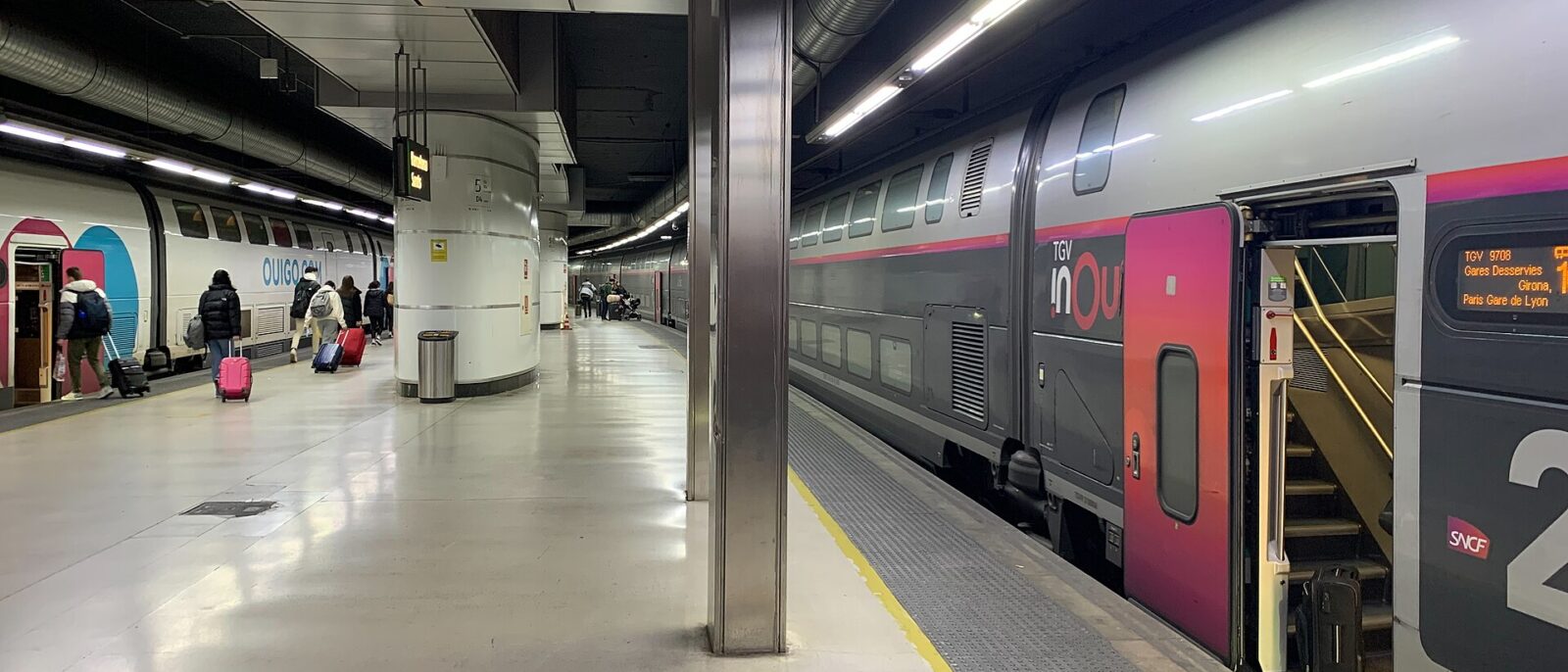
Down on the lower level of Barcelona Sants, a little before half past nine on most mornings, a double-deck French train sits at the platform with “Paris Gare de Lyon” glowing on the screen by the door. It does not look like anything special. But it will cross the Pyrenees through a tunnel, run up through Languedoc past lagoons full of flamingos, and deliver you to the middle of Paris in time for an early dinner, without a check-in desk, a boarding gate or a security queue in sight. The direct Barcelona to Paris train is one of the great rail journeys of Europe, and it is also, more often than people expect, the sensible way to make the trip.
This guide covers the direct high-speed service, what it costs and how to book it cheaply, the split-ticket trick at Perpignan that can halve the fare, the other routes when the direct trains are full, and an honest comparison with flying. For every other route out of Barcelona, see our onward travel guide. Fares and timetables were checked in October 2026; both change with the seasons, so check before you book.
Barcelona to Paris at a glance
| Option | Time | Price | Verdict |
|---|---|---|---|
| Direct TGV inOui | About 6h30–6h50, Sants to Gare de Lyon | From about €39 second class, €59 first, booked ahead | The best way for most people |
| Split ticket via Perpignan | About 7–8 hours with a connection | From about €29 plus €19, booked well ahead | Worth it when the direct train is expensive |
| Via Lyon | About 7–8 hours with a change | From about €39 to Lyon, plus Lyon to Paris | A good fallback when the direct trains are full |
| Slow trains via Portbou | Most of a day | Cheap regional fares, then a high-speed leg | For rail lovers with time to spare |
| Night train via the Pyrenees | Overnight | Varies | Check first: the Spanish connection has been closed for works |
| Flight | About 1h50 in the air; 4–5 hours door to door | Varies widely | Faster on paper, rarely by much in practice |
The direct TGV
The direct trains between Barcelona and Paris are French high-speed TGV inOui services, the double-deck TGV Duplex, running between Barcelona Sants and Paris Gare de Lyon, a distance of a little over a thousand kilometres. The journey takes about six and a half to seven hours, depending on the service.
- Frequency: two trains a day in each direction on most days, with a third at weekends from May to late June. From Barcelona, one leaves in the morning, at around 09:30, and one in the afternoon, at around 16:20; the exact times shift with the seasons.
- Stops: Girona, Figueres Vilafant and Perpignan, then a handful of stations in the south of France, including Narbonne, before the long, fast run north to Paris.
- Classes: second and first. First class has wider seats in a 1+2 layout and more space; second is perfectly comfortable for the journey.
- On board: a bistro car, Wi-Fi, power sockets at every seat and plenty of luggage space at the ends of the carriages.
The journey
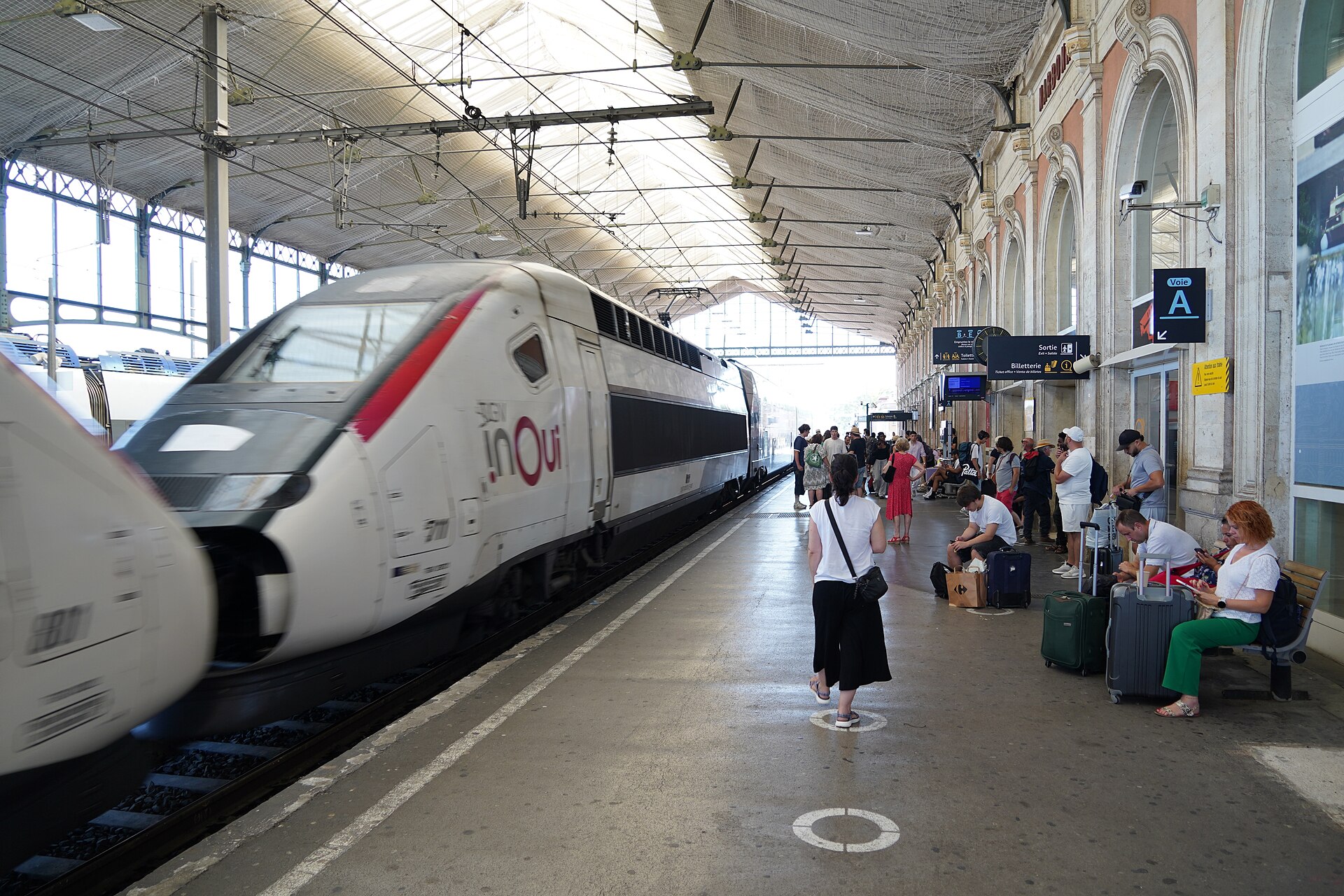
The first part is the most dramatic. Out of Barcelona, the train runs north on the high-speed line through the Vallès and past Girona, then crosses the Pyrenees not over them but under them, through the Perthus tunnel, and emerges in France just south of Perpignan. From there it runs up the Mediterranean coast of Languedoc, past vineyards and the salt lagoons, the étangs, where flamingos stand in the shallows; for the best of the lagoon views going north, sit on the right. Beyond, the train swings inland towards the Rhône and settles into the long, fast final stretch to Paris.
Sit upstairs if you can: the upper deck of the TGV Duplex has the better views, and it is quieter than the lower deck, where the luggage and the doors are.
Fares and booking
- From about €39 in second class and €59 in first, for advance tickets on the cheapest fare. Fully flexible tickets cost far more, from around €169 in second class.
- Book early. Tickets go on sale months ahead, the cheapest fares go first, and the summer, Easter and Christmas trains fill up. Two trains a day is not many.
- Book on SNCF’s own site or app, or through a reputable booking platform that shows the fare conditions clearly. Compare the cheapest fare with the next one up; a little extra for the right to change your ticket is often worth it on a journey this long.
- Rail passes: Interrail and Eurail holders need a seat reservation, and the allocation for pass holders is limited, so book it as soon as you can.
- At Sants, long-distance trains have a luggage security check, so arrive with time to spare. Our train stations guide explains the station.
Spain and France are both in the Schengen area, so there is normally no passport control on the train, but you must carry a passport or national ID card and may be asked to show it.
Morning or afternoon train?
With only two direct trains a day, the choice of departure shapes your whole day.
- The morning train gets you into Gare de Lyon in the late afternoon, in time to check in, have a walk and sit down to dinner in Paris. It is the better choice for almost everyone, and it fills first.
- The afternoon train arrives late in the evening, around eleven at night. That leaves you a morning in Barcelona, which is a real bonus on the last day of a trip, but it means arriving in Paris tired, late and hungry. Book a hotel near Gare de Lyon, the Marais or Bastille so that the last leg is short, and eat on the train.
Food and drink on board
The bistro car sells sandwiches, salads, hot dishes, snacks, coffee, beer and wine, and it is perfectly decent for a journey of this length, if not cheap. Many regulars bring a picnic instead: a bocadillo and some fruit from a Barcelona market, a bottle of water, perhaps a little cheese and a bottle of cava for the second half of the journey, once you are rolling through the vineyards of Languedoc. Our markets guide has the best places to stock up before you go.
Step by step: Sants to Gare de Lyon
- Arrive at Sants 30 to 45 minutes early. The long-distance trains leave from the lower level, and the luggage security check can have a queue.
- Find your train on the departures board under “París” or “Paris”, go through the check and down to the platform when boarding opens.
- Find your carriage and seat using the numbers on the doors, stow big bags in the racks at the end of the carriage and climb upstairs if your seat is on the upper deck.
- Settle in. Girona comes after about forty minutes, Figueres soon after, and then the long tunnel under the Pyrenees into France.
- After Perpignan, watch for the lagoons and flamingos on the right, have lunch, read, sleep or work.
- Arrive at Gare de Lyon in the heart of Paris, walk off the platform and straight onto the metro or into a taxi.
The split-ticket trick at Perpignan
When the direct train is expensive, which it often is close to the date or at busy times, there is a well-known way to save money: buy two tickets instead of one, and change at Perpignan.
- Barcelona to Perpignan is about an hour and a half on the high-speed line, with fares from around €29. As well as the Paris TGVs, the Spanish AVE trains to Lyon and Marseille stop at Perpignan, so there are more departures than on the direct route to Paris.
- Perpignan to Paris is served by both TGV inOui trains and Ouigo, SNCF’s low-cost high-speed brand, which runs a direct train a day between Perpignan and Paris in about five hours, via Narbonne, Sète and Nîmes. Ouigo fares start at €19 for adults, booked far ahead; more realistically, expect €20–80.
Booked well in advance, the two legs together can cost well under the price of a last-minute direct ticket, and sometimes less than half.
The catch
Two separate tickets are two separate contracts. If your first train is late and you miss the second, the second company owes you nothing, and on a route with only one Ouigo a day that can be expensive. So:
- Leave a generous gap, at least an hour, and more on a busy day.
- Consider a night in Perpignan, or in Collioure on the coast nearby, and turn the connection into a stop.
- Read Ouigo’s rules. Its cheapest fares come with strict limits on luggage, and extra bags cost extra; price them in before you compare.
- Check which Paris station the Ouigo uses, as it is not always the same as the TGV inOui’s.
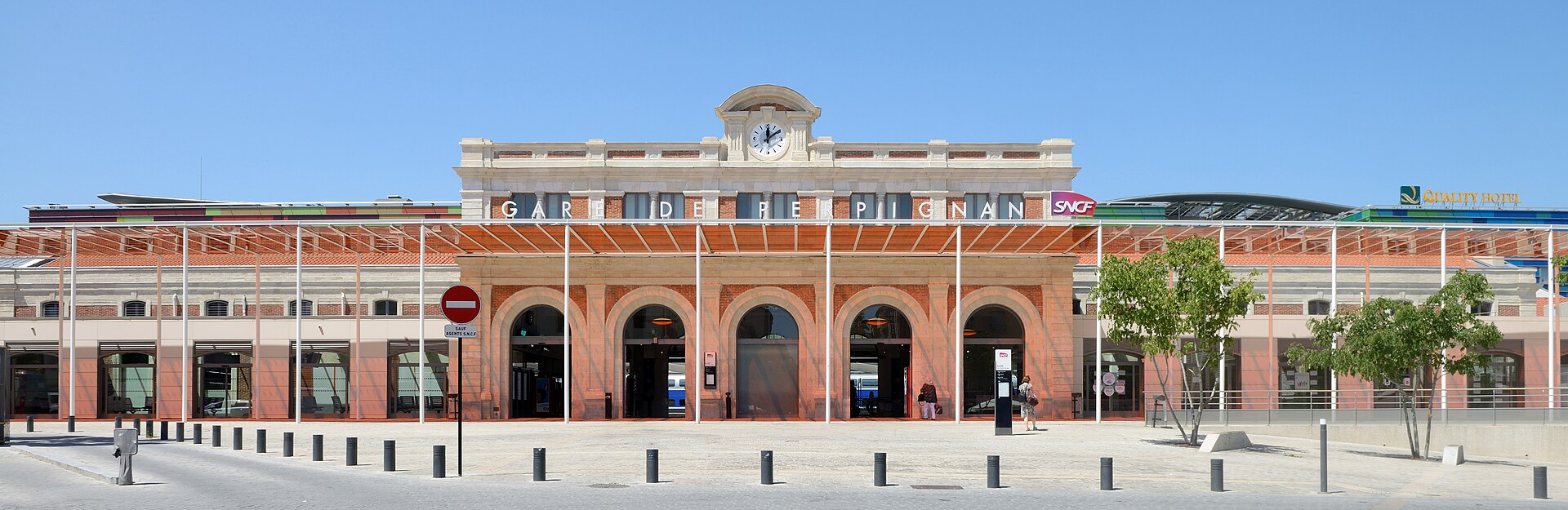
Salvador Dalí, who spent a great deal of time at Perpignan station on his way to and from Paris, called it “the centre of the universe”. You may feel differently after an hour on the platform, but the old town, with its Catalan character and its Palace of the Kings of Majorca, is a short walk away if you have time to look.
Other ways by train
Via Lyon
Renfe runs direct high-speed AVE trains from Barcelona to Lyon, taking about five hours, with fares from around €39. From Lyon there are frequent TGVs to Paris, taking about two hours. It is a good fallback when the direct trains are full or expensive, and Lyon is one of France’s great food cities, which makes it a tempting place for a night.
The slow way, via Portbou and Cerbère
Before the high-speed line, everyone crossed the border on the coast. You can still do it: a Rodalies regional train north through Girona and Figueres to Portbou, on the coast at the border, a change to a French regional TER train at Cerbère on the other side, then on to Perpignan or Narbonne for a high-speed train to Paris. It takes most of a day and the connections need care, but the regional legs are cheap and the line along the Côte Vermeille, through Collioure and Banyuls, is lovely. It is a journey for people who love trains rather than people in a hurry.
The night train, via the Pyrenees
One of France’s surviving night trains, the Intercités de Nuit, runs from Paris Austerlitz to Latour-de-Carol in the Pyrenees, on the Spanish border. From there, Rodalies line R3 runs down through the mountains to Barcelona, a beautiful three-hour journey. The catch in 2026 is that the R3 has been closed for long-running engineering works, reported to last until January 2027, so check the state of the Spanish connection before you plan around it. Plans for a direct night train between Paris and Barcelona have been announced and shelved more than once; for now there is no such train.
Flying instead
Barcelona to Paris is one of the busiest air routes in Europe, with many flights a day to Charles de Gaulle and Orly, and about an hour and fifty minutes in the air. On paper that looks like a knockout. In practice, once you add the trip out to El Prat, check-in and security, the flight, the wait for bags and the journey from the Paris airport into the city, a flight takes four to five hours door to door, against six and a half to seven on the train from city centre to city centre.
| Direct train | Flight | |
|---|---|---|
| City centre to city centre | About 6h30–6h50 | About 4–5 hours |
| Usable time | Almost all of it: work, read, eat, watch the view | Fragmented by queues and transfers |
| Luggage | Generous, carried on board | Often extra on low-cost fares |
| Frequency | Two or three a day | Many a day |
| Price | From about €39, booked ahead | Can be cheaper or much dearer |
| Carbon | A fraction of the flight’s | Much higher |
Our view: take the train unless you are very short of time or the flight is dramatically cheaper. The extra couple of hours buy you a comfortable seat, a view of the Pyrenees and the Languedoc coast, and arrival in the centre of Paris rather than on its outskirts. Our Barcelona airport guide covers El Prat if you do fly.
When to travel
The direct trains run all year, but demand, and so the price, follows the holidays. Summer, Easter, the Christmas and New Year fortnight and the French school holidays are the busiest times, and the cheapest seats on the two daily trains can be gone weeks ahead. Midweek trains outside the holidays are the easiest to book cheaply.
One honest warning: French rail unions strike from time to time, and a national strike can thin out or cancel high-speed services, including international ones. Strikes are normally announced in advance, SNCF publishes the reduced timetable a day or so before, and passengers on cancelled trains are usually offered an exchange or a refund. If a strike is in the news when you are due to travel, check your train the evening before and keep the Lyon or Perpignan routes, or a flight, in mind as a fallback.
Travelling with children, luggage or a bike
- Children do well on the TGV: there is room to move, the bistro car is an outing in itself, and the time passes faster than in an airport. Book seats together, and bring entertainment for the long stretch through France.
- Luggage goes in the racks at the ends of each carriage and above the seats; the allowance is generous by airline standards, but you must be able to carry your own bags, and they should carry a label with your name.
- Bicycles generally need to be folded or bagged on high-speed trains, or booked into one of the limited bike spaces where the train has them. Check the rules for your specific train when you book.
Combining Barcelona and Paris in one trip
If you are travelling from further afield, the direct train makes it easy to see both cities on one trip without doubling back. Book an open-jaw flight, into one city and home from the other, which usually costs little or nothing more than a return to either, and take the train in between. Five days in Barcelona, a morning TGV and five days in Paris is one of the classic European trips, and it replaces a short-haul flight with a day that is part of the holiday rather than a gap in it. If you have more time, add a night in Girona, Perpignan or Lyon on the way.
Is the train worth it? Our honest verdict
Take the direct train if you can book a few weeks ahead, travel on the morning departure and enjoy a long journey for its own sake. You will pay about the same as a flight, often less once bags are counted, arrive in the centre of Paris and see two countries out of the window on the way.
Take the split ticket via Perpignan if the direct train has become expensive, you are booking well ahead, and you are happy to leave a generous connection or stay a night on the way.
Fly if you are very short of time, the trains are sold out, or a flight is dramatically cheaper on your date. There is no shame in it; Barcelona to Paris is a long way, and two trains a day is not many.
By coach or car
Long-distance coaches run between the two cities, mostly overnight, and take most of a day or night. They are cheap, and that is about all that can be said for them on a route this long. Driving is a little over a thousand kilometres, about ten hours without stops, with French motorway tolls on top; it only makes sense if you are touring on the way.
Stopovers worth making
A train route of seven hours passes some very good places, and it is easy to break the journey on separate tickets:
- Girona, forty minutes from Barcelona, with its medieval Jewish quarter and the coloured houses along the Onyar. Our Girona guide covers it.
- Figueres, for the Dalí Theatre-Museum, the artist’s own extraordinary monument to himself. Our Figueres and Dalí guide explains how to visit; the high-speed station is outside the town, so allow time to get in.
- Perpignan and Collioure, the Catalan corner of France, with a fine old town and one of the prettiest harbours on the coast.
- Montpellier, Nîmes or Avignon, for Roman remains, medieval streets and the Provençal south.
- Lyon, via the Renfe AVE, for France’s great food city.

Arriving in Paris
The direct trains arrive at Gare de Lyon, one of the great Paris stations, on the right bank of the Seine near the Bastille. It is a hub for the metro (lines 1 and 14) and the RER (lines A and D), so it is easy to get anywhere in the city from there. If you have time, look up at the clock tower outside and into Le Train Bleu, the gilded Belle Époque restaurant in the station building, which is worth a coffee even if you cannot run to lunch.
Paris to Barcelona
The journey in the other direction works the same way. The direct TGVs leave Gare de Lyon twice a day, morning and afternoon, and arrive at Barcelona Sants about six and a half to seven hours later. The split-ticket trick works in reverse too: Paris to Perpignan on Ouigo or TGV inOui, then Perpignan to Barcelona on any of the high-speed trains heading south. Our train stations guide covers arriving at Sants, our metro guide covers getting across the city from there, and our where to stay guide helps you choose a base.
Frequently asked questions
Is there a direct train from Barcelona to Paris?
Yes. TGV inOui high-speed trains run direct from Barcelona Sants to Paris Gare de Lyon, twice a day in each direction on most days, with a third train at weekends in late spring.
How long is the train from Barcelona to Paris?
About six and a half to seven hours, depending on the service, from Barcelona Sants to Paris Gare de Lyon.
How much is the train from Barcelona to Paris?
Advance fares start from about €39 in second class and €59 in first. Prices rise as the train fills, and fully flexible tickets cost much more.
Is it cheaper to change at Perpignan?
Often, if you book both legs well ahead: Barcelona to Perpignan from about €29 and Ouigo from Perpignan to Paris from €19. But separate tickets are not protected against missed connections, so leave a generous gap.
Is the train or the plane better from Barcelona to Paris?
The flight is quicker door to door by an hour or two, but the train goes city centre to city centre, has generous luggage allowances and is far more comfortable and much lower in carbon. For most people with the time, the train is the better trip.
Is there a night train from Barcelona to Paris?
Not a direct one. The French night train from Paris runs to Latour-de-Carol in the Pyrenees, connecting with the Rodalies R3 to Barcelona, but the R3 has been closed for engineering works in 2026, reportedly until January 2027. Check before relying on it.
Do I need a passport for the train from Barcelona to Paris?
Spain and France are both in the Schengen area, so there are normally no border checks, but you must carry a passport or national ID card and may be asked to show it.
Which station does the Barcelona train arrive at in Paris?
Paris Gare de Lyon, in the east of central Paris, served by metro lines 1 and 14 and RER lines A and D.
Related Barcelona Guides
- Onward travel from Barcelona — every route out of the city.
- Barcelona’s train stations — Sants and the rest.
- Barcelona to Madrid — the other great high-speed route.
- Barcelona to Valencia — the route south.
- Girona — the first stop on the way north.
- Figueres and the Dalí Theatre-Museum — the second.
Photo Credits
A TGV inOui to Paris Gare de Lyon at Barcelona Sants, beside a Ouigo train: Ouigo – TGV inOui at Barcelona Sants by Robot8A, CC BY-SA 4.0, via Wikimedia Commons.
The Barcelona–Paris TGV at Narbonne: Départ du TGV InOui Paris – Perpignan-Barcelona Sants de la voie A de la gare de Narbonne by Remontees, CC BY-SA 4.0, via Wikimedia Commons.
Perpignan station: Perpignan gare by Cayambe, CC BY-SA 3.0, via Wikimedia Commons.