We get commissions for bookings made through this post. Booking links, and any accommodation options shown on the page, are handled by a partner that adds commission tracking automatically. It never costs you more, and it never affects what we recommend. Affiliate disclosure
Stand outside number 43 Passeig de Gràcia for ten minutes and you will watch the same conversation happen four or five times. A couple reaches the door, looks at the board, and starts working out the difference between Blue, Silver, Gold and Be The First while a queue forms behind them. Buying casa batllo tickets is genuinely more complicated than buying tickets for almost anything else in Barcelona, and the tier you choose changes the visit substantially — as does, more quietly, the day on which you buy.
This page explains what each tier actually contains, which one is worth the money for which kind of visitor, how the dynamic pricing works and how much it can cost you, and what to look at once you are inside. Prices were checked in September 2026 and are in euros. Casa Batlló prices by demand, so the figures here are a floor rather than a fare — treat them as the right order of magnitude and check the operator’s own site for your date.
The tiers, in plain language
| Ticket | Price from | What it adds | Worth it? |
|---|---|---|---|
| Blue / basic | ~€29 | The house with the smart-guide tablet | Yes, for most people |
| Silver / General | From €29 | The standard visit, immersive rooms included | The default choice |
| Gold | Higher tier | AR tablet, Gaudí Dôme, Concierge Room, private Batlló residence | Yes if you care about the house |
| Be The First | €45 | Entry before general opening, empty rooms | Yes for photographers |
| Magic Nights | Seasonal, higher | Rooftop concert on summer evenings | An evening out, not a house visit |
| Box office | €4–15 above online | Nothing | No |
Two structural points before the detail. First, everything is timed entry — you book a slot, not a day. Second, the box office charges meaningfully more than the website and there is effectively no walk-up booth worth queueing at, so the only sensible way to buy is online, in advance.
What each tier actually gets you
The standard visit
From about €29, and the tier that most visitors should buy. You get the whole route: the entrance hall and its mushroom-shaped fireplace nook, the main staircase with its handrail shaped like a spine, the Noble Floor with the great blue-glass window onto Passeig de Gràcia, the light well tiled in a gradient from deep blue at the top to almost white at the bottom, the attic with its parabolic arches, and the roof terrace with the dragon’s-back ridge and the mosaic chimneys.
It also includes the smart guide — a tablet with augmented reality that shows you what each room looked like when the Batlló family lived in it. This sounds like a gimmick and is, in fact, the best interpretive device in any Barcelona attraction: point it at an empty room and the furniture, the fabrics and the fittings assemble around you. Nobody who has used it thinks it is a gimmick afterwards.
Gold
The upgrade adds four things: the augmented-reality tablet in its fuller version, the Gaudí Dôme — a conical immersive room lined with screens that plays a piece by Refik Anadol — the Concierge Room, and access to the private Batlló residence, the family’s own apartment, which is not on the standard route.
Whether that is worth the difference depends on what you came for. If you are interested in Gaudí as an architect and want to see how the family actually lived, the residence is a genuine addition and Gold is the right ticket. If you are here because Casa Batlló looked extraordinary in a photograph, the standard visit already delivers the extraordinary bit and the immersive room is the least Gaudí thing in the building.
Be The First
Forty-five euros, and the only tier that changes the nature of the visit rather than its length. You enter before general opening, and for the first stretch the house is genuinely empty. Casa Batlló at 08:30 with nobody in it is a different building from Casa Batlló at 13:00 with four hundred people in it, and the rooms were designed for a family rather than a crowd.
If you take photographs, this is the one to buy and it is not close. If you do not, it is €16 for a quieter hour, which some people will consider excellent value and others will not.
Magic Nights
Seasonal summer evenings with live music on the roof terrace and a drink included. It is a pleasant evening and a poor way to see the house, because you are on the roof rather than in the building and the light has gone. Treat it as a concert with an exceptional venue rather than as a substitute for a daytime visit.
The dynamic pricing, and how much it costs you
Casa Batlló prices by demand, in the same way an airline does. The pattern is consistent enough to plan around:
- Three to four weeks out — the advertised “from” price, or close to it.
- One week out — noticeably higher, particularly for mid-morning and early-afternoon slots.
- The day before — commonly 30–40% above the floor, and the best slots have gone.
- At the box office — €4–15 above the online price on the same day, for the same ticket.
The practical implication is simple: if your dates are fixed, book early. Booking three weeks ahead rather than three days ahead is worth more than choosing a cheaper tier, and it is the single largest saving available on this attraction.
The slots themselves also price differently. The first hour of the day and the last two hours of the afternoon are consistently cheaper than the middle, and they are also less crowded — which makes the early slot the best value in the building by some distance, quite apart from the price.
Casa Batlló or La Pedrera?
The question everybody asks, because the two Gaudí houses are eight minutes apart on the same street and both cost roughly the same. The honest answer is that they are different buildings doing different things, and that doing one properly beats doing both quickly.
| Casa Batlló | La Pedrera (Casa Milà) | |
|---|---|---|
| Price from | ~€29 | €25–29 |
| Built | 1904–06 remodelling of an 1877 block | 1906–12, from scratch |
| The draw | Colour, glass, the interiors | The stone façade and the roof |
| Roof | Dragon’s back, mosaic chimneys | Chimney warriors, the famous one |
| Interpretation | AR smart guide, immersive rooms | Period apartment, Espai Gaudí attic |
| Crowd feel | Busier, more theatrical | Calmer, more museum-like |
| Evening option | Magic Nights (summer) | Night Experience, €39, year-round |
Choose Casa Batlló if you want to be inside something strange and beautiful, and if you like being surprised by a building. Choose La Pedrera if the roof terrace is what drew you and you would rather have a calmer, more explanatory visit. We break the comparison down further in the dedicated Casa Batlló versus Casa Milà guide.
What to look at, in order
The route is one-way and takes most people between an hour and ninety minutes. Here is what to slow down for.
The façade
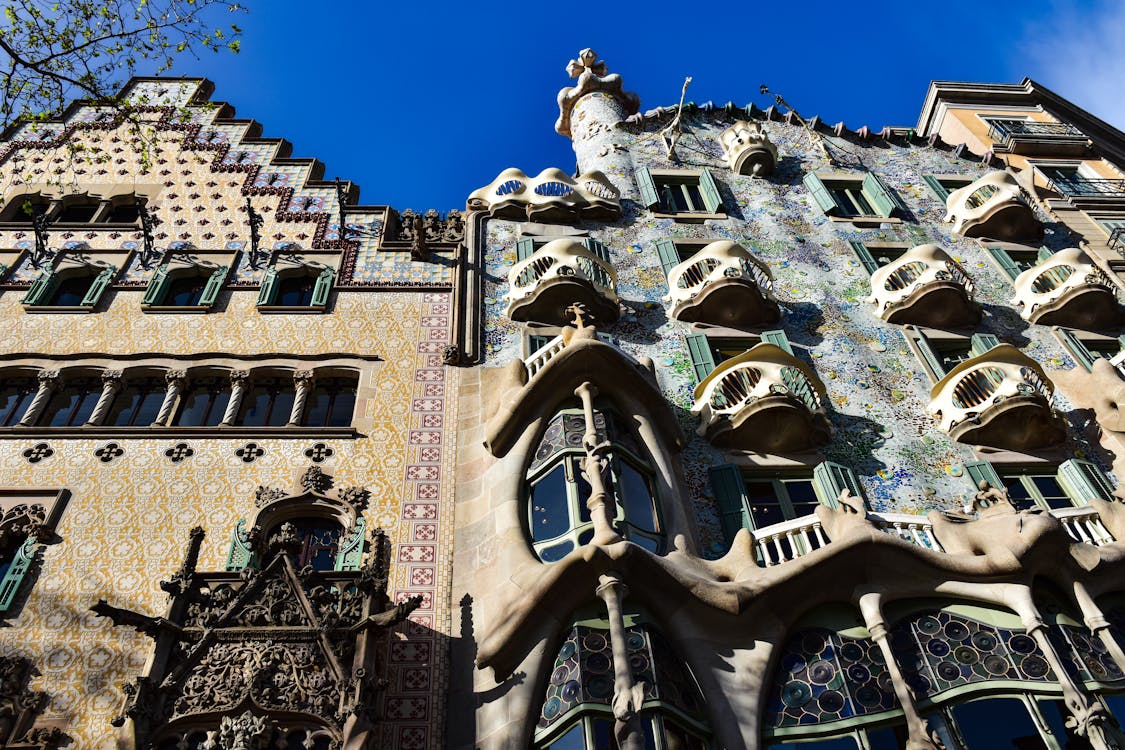
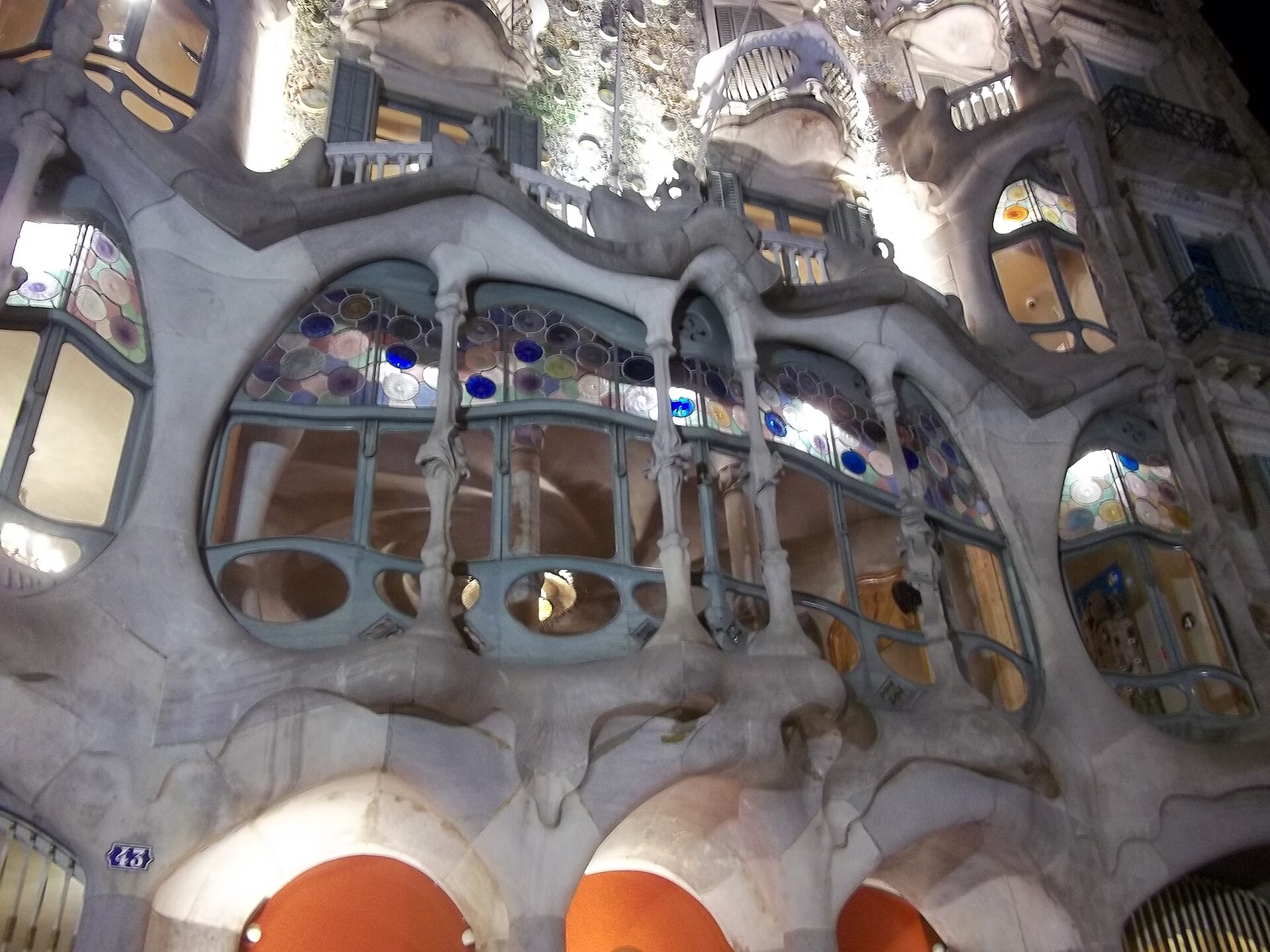
Free, from the pavement, and worth five minutes before you go in. The commonest reading is Sant Jordi and the dragon: the roof is the dragon’s scaled back, the cross-topped turret is the saint’s lance, and the balconies are skulls with the columns below as bones — hence the building’s local nickname, casa dels ossos, the house of bones. Gaudí never confirmed any of it. The trencadís of broken glass and ceramic changes colour completely between morning and late afternoon.
The entrance hall and staircase
Everything curves. There is no straight line and almost no right angle in the lower house, and the oak handrail is shaped to a hand rather than to a drawing. Look at the ceiling of the small waiting nook, which whirlpools.
The Noble Floor
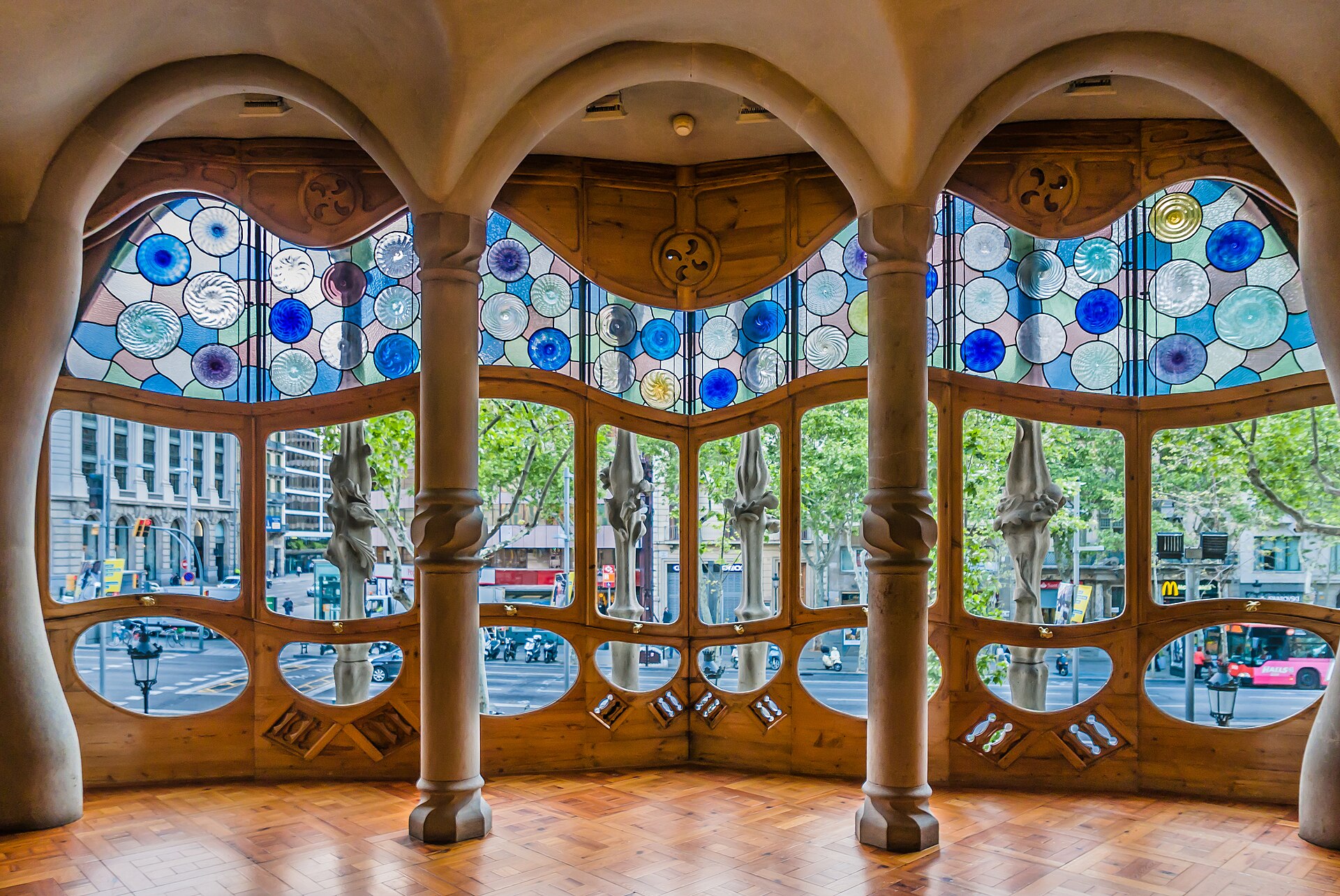
The best room in the building and the one that justifies the ticket on its own. The window wall onto Passeig de Gràcia is a single curved sheet of joinery and coloured glass discs, the ceiling swirls out from a central light fitting, and the doors between rooms fold away so the whole floor becomes one space. Stand at the window and look back into the room rather than out at the street.
The light well
Gaudí tiled the central shaft in a gradient — deep cobalt at the top, pale blue at the bottom — so that light arriving from above appears evenly distributed on every floor. He also made the windows larger at the bottom and smaller at the top for the same reason. It is a piece of engineering disguised as decoration and it is the cleverest thing in the house.
The attic
Sixty parabolic arches, whitewashed, originally the laundry and storage floor. It looks like the inside of an animal and it is the purest structural statement in the building.
The roof terrace
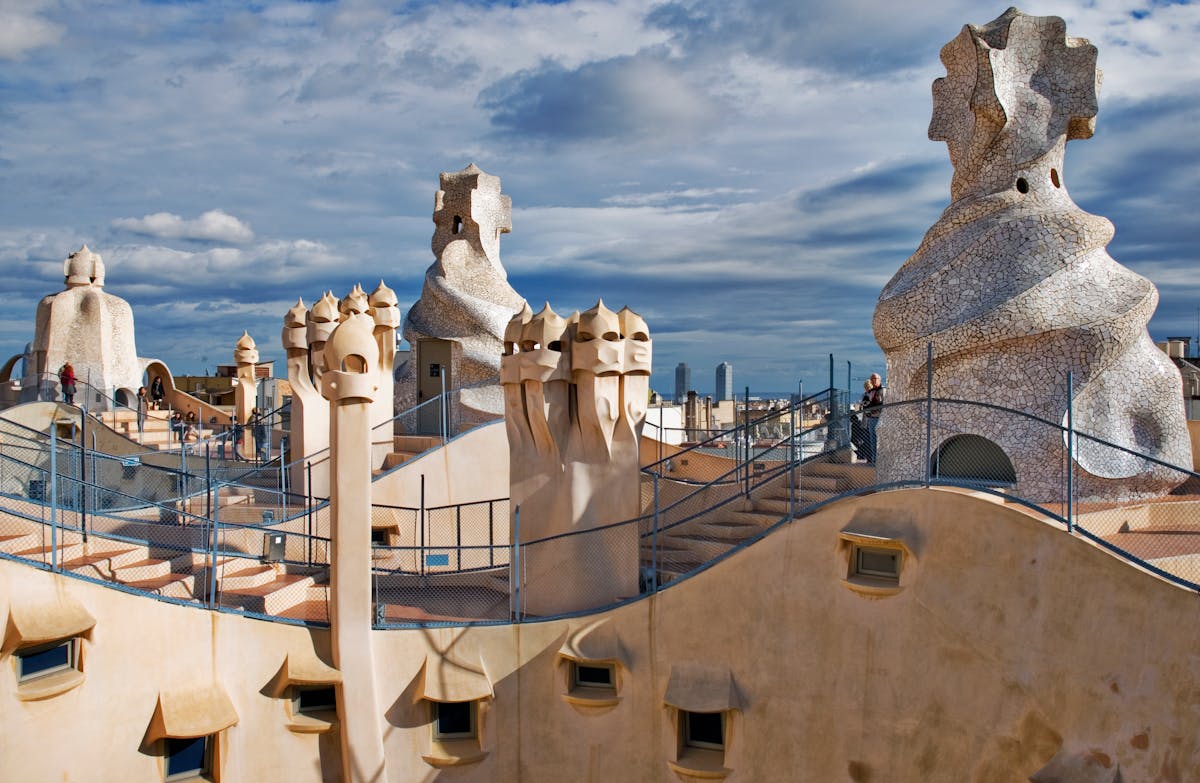
The dragon’s spine in iridescent tile, the chimney stacks in trencadís, and a view along Passeig de Gràcia. It is smaller than people expect and it gets crowded, which is another argument for an early slot.
How a dull block became this
The building at number 43 was put up in 1877 by Emilio Sala Cortés, one of Gaudí’s own architecture teachers, and it was entirely unremarkable: a conventional Eixample apartment block on a street that was rapidly becoming the address in Barcelona. Josep Batlló i Casanovas, a textile industrialist, bought it in 1903 and initially intended to demolish it and start again.
Gaudí talked him out of it. What followed between 1904 and 1906 was not a decoration job but a structural remodelling: the façade was rebuilt, two floors were added, the central light well was widened and re-tiled, the party walls were reworked and the interior partitions were replaced with something closer to open-plan living than anything else in Barcelona at the time. The city’s architectural authorities objected to several elements as exceeding permitted dimensions. They were overruled.
Batlló lived on the Noble Floor with his family; the upper floors were let as apartments, which is why the building has the ordinary bones of a rental block underneath the extraordinary surface. The family kept it until the 1950s. It passed through several owners, served for a time as offices, and was bought by the Bernat family — of Chupa Chups — in the 1990s, who restored it and opened it to the public in 2002. UNESCO listed it in 2005 as part of the Works of Antoni Gaudí.
The restoration is worth knowing about because it explains the presentation. Very little original furniture survived, which is precisely why the augmented-reality guide exists: the house is shown to you as an empty shell with its contents reconstructed digitally, rather than furnished with approximations. It is an honest solution to a real problem, and it works better than the period-room approach used at La Pedrera. For the wider story of how Gaudí arrived at this point, see our short biography.
Practicalities
Getting there
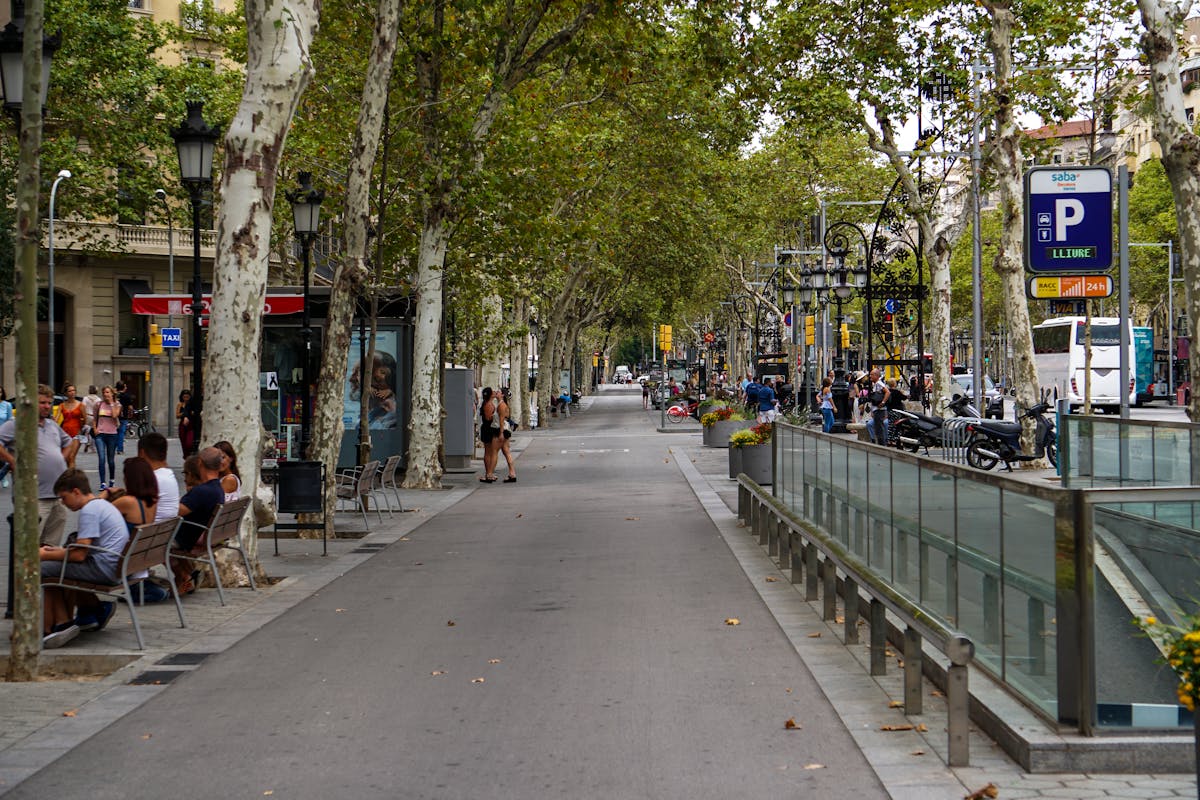
Passeig de Gràcia 43, in the Eixample. Metro to Passeig de Gràcia (L2, L3, L4) and it is a two-minute walk. The Rodalies R2 also stops at Passeig de Gràcia, which makes it easy from the airport via T2. See the metro guide.
How long to allow
An hour to ninety minutes for the standard route, longer with Gold or if you use the smart guide properly. Add fifteen minutes for the queue to enter even with a timed slot in high season.
Accessibility
The house is a 1900s residential building and there are limits to what can be done, but it is better than most: a lift serves the main floors and staff are practised at assisting. The roof terrace and parts of the attic route involve steps. Contact the operator in advance if you need specifics, and see our accessible Barcelona guide.
Photography
Allowed throughout, without flash and without tripods. The Noble Floor window in the late afternoon and the light well from the top are the two shots worth waiting for. Be The First exists largely because of this.
Children
Under-12s go free and the augmented-reality tablet holds their attention far better than a conventional audio guide does. It is one of the more child-friendly attractions in the city, though the roof terrace needs supervision. See Barcelona with kids.
Do the passes cover it?
Go City Barcelona includes Casa Batlló. The Barcelona Card does not — it offers a discount rather than entry, which is a much smaller benefit than most buyers assume. Articket is art museums only and does not apply. Our city passes comparison does the arithmetic properly.
When to go, by season
Casa Batlló is indoors, which makes it weather-proof, but the season changes both the price and the experience considerably.
- July and August. The busiest and most expensive period, with the middle of the day close to unbearable in the narrower rooms. The air conditioning is adequate rather than generous. Book the first slot or do not bother.
- May, June, September and October. The sweet spot: warm light, manageable crowds, and prices below the summer peak. October in particular is quiet and the low afternoon sun does remarkable things to the Noble Floor glass.
- November to March. Cheapest and emptiest. You can book two or three days ahead without a penalty, and on a weekday morning in February the house is close to how Be The First feels in August. The trade-off is shorter daylight, so take a slot before 15:00.
- Around Christmas and Easter. Barcelona fills up and so does this building. Treat these as summer for booking purposes.
One seasonal note that catches people out: Casa Batlló decorates for Sant Jordi on 23 April, covering the façade in roses, which is spectacular and also means the pavement outside is impassable. See our Sant Jordi guide for what else happens that day, and when to visit Barcelona for the broader calendar.
What else is on the block
Casa Batlló sits in the Illa de la Discòrdia — the block of discord — where three rival architects built next to each other within five years, and it is worth ten minutes of your time to look at the neighbours.
- Casa Amatller, immediately next door, by Josep Puig i Cadafalch: a stepped Dutch gable and an interior that is largely intact rather than restored. The short guided visit ends with hot chocolate made to the family recipe.
- Casa Lleó Morera, on the corner at number 35, by Lluís Domènech i Montaner. Currently limited in terms of public access, but the exterior sculpture repays a look.
- Casa Mulleras and Casa Bonet, quieter neighbours that complete the row.
Walk eight minutes further up the street and you reach La Pedrera at number 92. The whole stretch is the densest concentration of modernista domestic architecture anywhere, and most of it costs nothing to look at. Our modernisme guide walks the block, and the complete Gaudí buildings list covers what is visitable across the city.
Building a day around it
Casa Batlló takes ninety minutes and sits in the middle of the most walkable stretch of the Eixample, which makes it easy to build a good day around. Three that work:
The architecture morning
Casa Batlló at the first slot, then the Illa de la Discòrdia from the pavement, then a coffee, then La Pedrera at midday or a walk up to Casa Vicens in Gràcia. Lunch in Gràcia, which is better and cheaper than anything on Passeig de Gràcia itself. This is the standard Gaudí day and it works.
The contrast day
Casa Batlló in the morning, then metro to the Sagrada Família and Sant Pau in the afternoon — early Gaudí, late Gaudí, and Domènech i Montaner in between. Sant Pau at €18 is the best-value ticket in the city and ten minutes on foot from the basilica. Our attractions guide has both.
The late-afternoon version
Take the last slot of the day, when the Noble Floor window is at its best and the price is lower, then walk down Passeig de Gràcia into the Gothic Quarter for a vermut and dinner. Casa Batlló is lit after dark and worth a second look on the way past. See the Gothic Quarter guide and the restaurants guide.
What does not work is stacking Casa Batlló, La Pedrera and the Sagrada Família into one day. All three are timed, all three are ninety minutes minimum, and you will spend the day watching a clock. Two big sights is a full Barcelona day — see the itineraries hub for plans built around that pace.
Buying without getting caught out
- Go to casabatllo.es directly. The sponsored search results above it are resellers with a margin on top.
- Book three to four weeks ahead if your dates are fixed. This is worth more than any tier decision.
- Pick the first slot or the last two hours. Cheaper, quieter, better light.
- Decide about Gold before you look at the price, not after. If you want the private residence, buy it; if you were only upgrading because it was on the screen, do not.
- Add children to the booking even though under-12s are free — they still need a ticket issued.
- Check the cancellation terms. Direct bookings are typically less flexible than the resellers’ 24-hour cancellation, which is the one genuine argument for using a platform.
- Ignore anyone selling tickets on the pavement. The price is above official and the slot may not exist.
Is it worth it?
Yes, with two caveats.
The first is that Casa Batlló is expensive by the standards of what else Barcelona charges. Twenty-nine euros and up puts it above the Picasso Museum, MNAC, Sant Pau, the Palau de la Música and Palau Güell — several of which are, by any conventional measure, more important buildings or better collections. If your budget forces a choice between Casa Batlló and two of those, take the two.
The second is that it is busy, and the presentation has moved a long way towards the immersive-experience end of the museum spectrum. Some visitors find the projection rooms enhance the house; others find they distract from a building that did not need help. If you are in the second camp, book the earliest slot, use the smart guide sparingly and spend your time on the Noble Floor and the attic.
Set against that: there is nothing else like it. Gaudí took a dull rented apartment block and turned it into something that does not resemble architecture at all, and the interiors do things with light and colour that photographs cannot carry. Most people come out of it grinning. That is worth €29.
Frequently asked questions
How much are Casa Batlló tickets?
From around €29 online for the standard visit, rising through the Gold tier to €45 for Be The First. Prices move with demand, so the figure you see depends on how far ahead you book and which slot you choose. The box office charges €4–15 more.
Which Casa Batlló ticket is best?
The standard or Silver visit for most people — it includes the whole house and the augmented-reality smart guide. Gold if you want the private Batlló residence and the Gaudí Dôme. Be The First if you take photographs and want the rooms empty.
Do I need to book Casa Batlló in advance?
Yes. Entry is timed, the box office costs more, and in high season the good slots go a week or two ahead. Booking three to four weeks out also gets you the lowest price, because the house uses dynamic pricing.
How long does a Casa Batlló visit take?
An hour to ninety minutes for the standard route. Longer with the Gold additions or if you work through the smart guide carefully.
Is Casa Batlló better than La Pedrera?
Different rather than better. Casa Batlló is more theatrical and more colourful inside; La Pedrera has the more famous roof and a calmer, more explanatory visit. Do one properly rather than both in a hurry.
Is Casa Batlló included in the Barcelona Card?
No — the Barcelona Card offers a discount, not entry. Go City Barcelona does include it. See our city passes comparison for whether either pass repays itself on your trip.
What is the best time of day to visit Casa Batlló?
The first slot of the morning, which is quieter and usually cheaper, or the last two hours of the afternoon, when the light through the Noble Floor window is at its best. The middle of the day is both the busiest and the most expensive.
Can you see Casa Batlló for free?
The façade, yes, and it is genuinely worth standing in front of — particularly after dark, when the building is lit. The interior needs a ticket, and there is no free-entry day.
Are children free at Casa Batlló?
Under-12s enter free. They still need a ticket issued, so include them when you book.
Four blocks north on the same avenue, Gaudí’s other Passeig de Gràcia apartment block asks the same question with different answers: no load-bearing walls, an attic of 270 brick arches, and a roof of sculpted chimneys. Our Casa Milà and La Pedrera ticket guide covers its eight ticket tiers, the night visit and the rooftop — and the case for doing one by day and the other after dark.
Related Barcelona Guides
- Barcelona Attractions and Tickets — every major sight with its 2026 price.
- Casa Batlló vs Casa Milà — the head-to-head, in detail.
- Gaudí in Barcelona — the full architectural trail.
- Modernista Architecture — Gaudí’s rivals, and why they matter.
- The Eixample — the district Casa Batlló sits in.
- Barcelona City Passes Compared — which pass covers what.
- Gaudí: A Short Biography — how he got to this building.
Photo Credits
Casa Batlló façade at night: Casa Batlló, Barcelona 58 by Simon Burchell, CC BY-SA 4.0, via Wikimedia Commons.
Noble Floor stained glass: CasaBatlló NobleFloor saloon stainedglass by Sara Terrones, CC BY-SA 4.0, via Wikimedia Commons.
Remaining photographs from the barcelonatourism.org library.