We get commissions for bookings made through this post. Booking links, and any accommodation options shown on the page, are handled by a partner that adds commission tracking automatically. It never costs you more, and it never affects what we recommend. Affiliate disclosure
Casa Batllo vs Casa Mila: Two Gaudi Masterpieces, a Short Walk Apart
Antoni Gaudi designed Casa Mila and remodelled Casa Batllo, two iconic apartment buildings a short walk apart on Passeig de Gracia. Casa Batllo (1904-1906) is a riot of colour, fantasy, and dreamlike forms; Casa Mila, also known as la pedrera barcelona (1906-1912), is a monumental wave of stone with a rooftop populated by surreal warrior-helmet chimneys. Together they represent the peak of Gaudi’s mature creativity. The question every architecture-curious visitor asks is: casa batllo or casa mila? Which one should you visit if you only have time for one?
This guide compares them across every dimension: architecture, interior experience, rooftop, ticket prices, opening hours, accessibility, photo opportunities, and ideal time of day. We also offer a clean recommendation for each visitor type at the end. Whether you visit one, both, or neither, by the end you will know exactly what each building offers and which is right for your trip.
Casa Batllo: Quick Facts
- Years built: 1904 to 1906.
- Address: Passeig de Gracia 43.
- Architect: Antoni Gaudi (renovation of an existing 1877 building).
- Style: Late Modernisme; organic, dreamlike, colourful.
- Symbolism: The legend of Saint George (Sant Jordi); the dragon, the bones, and the cross.
- UNESCO status: World Heritage 2005 (Works of Antoni Gaudi).
- Hours: 9:00 AM to 10:30 PM daily, year-round.
- 2026 ticket prices: General Visit from 29 EUR online; other ticket types and dates are priced differently.
- Visit duration: 60 to 90 minutes inside.
- Best feature: The technologically advanced museum experience with augmented reality and Gaudi Cube LED chamber.
Casa Mila: Quick Facts
- Years built: 1906 to 1912.
- Address: Passeig de Gracia 92.
- Architect: Antoni Gaudi (his last residential building).
- Style: Late Modernisme; monumental, wave-like, sculptural.
- Symbolism: The Virgin Mary; the building’s height was originally meant for a giant statue (later abandoned).
- UNESCO status: World Heritage 1984 (inscribed together with Park Guell and Palau Guell).
- Hours: 9:00 AM to 6:30 PM (winter), 9:00 AM to 8:30 PM (summer).
- 2026 ticket prices: Essential from 29 EUR; Sunset from 25 EUR, Night Experience from 39.50 EUR and Premium from 120 EUR.
- Visit duration: 60 to 90 minutes including rooftop.
- Best feature: The rooftop with surreal warrior-helmet chimneys, one of the most photographed architectural spaces in Barcelona.
Side-by-Side Comparison
Facade
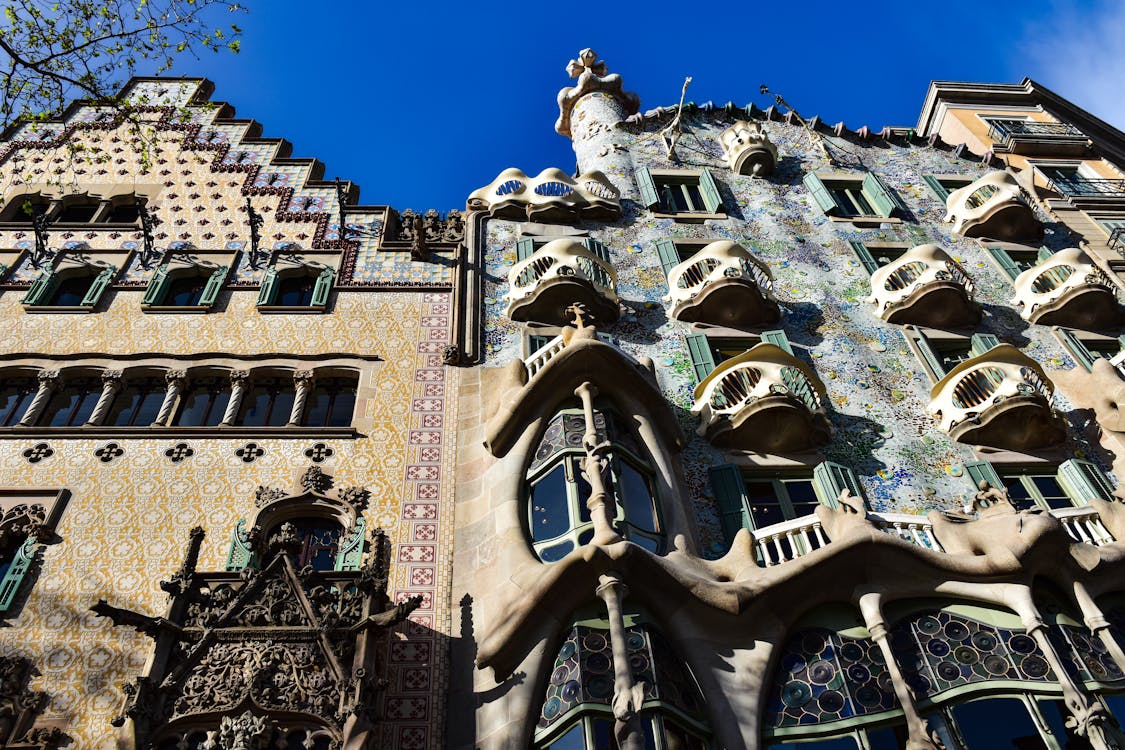
Casa Batllo has a vivid, colourful trencadis (broken-tile mosaic) facade in shades of blue, green, and purple. The balconies are shaped like skulls or carnival masks; the columns at the lower windows resemble bones. The roof is undulating and tiled like dragon scales, with a turret topped by a small cross representing Saint George’s lance.
Casa Mila is a vast undulating wall of light limestone, with no straight lines anywhere. The wrought-iron balconies twist like sea creatures or tangled vines. The whole building looks like a wave, an iceberg, or a quarry; locals nicknamed it “La Pedrera” (the stone quarry) when it was built, intending it as an insult.
Interior Experience
Casa Batllo features the most technologically advanced museum experience of all Gaudi’s Barcelona buildings. Its SmartGuide audio tour, introduced in 2013, adds augmented-reality overlays that show how rooms looked when the Batllo family lived there. The “Gaudi Cube” is an immersive multimedia room on Gaudi’s design philosophy. The interior is bright, organic, and full of stained-glass colour effects.
Casa Mila offers a quieter, more historical experience. The interior includes the period-furnished Pedrera Apartment (showing how a wealthy 1910s Barcelona family lived), the Espai Gaudi attic exhibition (which uses Gaudi’s signature catenary arches and contains his original models), and the patio courtyards. The audio guide is included with all tickets and is excellent.
Rooftop
Casa Batllo’s roof terrace sits beside the famous dragon-scale tiling and the cross-topped turret.
Casa Mila’s rooftop is one of the most extraordinary architectural spaces in Europe. The undulating surface is dotted with 29 chimneys and two ventilation towers shaped like medieval warriors in helmets, alongside six stairwell exits. Some chimneys are decorated with broken-glass champagne bottles. The 360-degree view takes in the city, with the Sagrada Familia framed in the distance. This single space is the strongest argument for visiting Casa Mila.
Time and Price Comparison
| Casa Batllo | Casa Mila | |
|---|---|---|
| Basic ticket | From 29 EUR | From 29 EUR |
| Out-of-hours visit | 45 EUR (Be the First) | From 39.50 EUR (Night Experience) |
| VIP / private | Check casabatllo.es | From 120 EUR (Premium) |
| Visit duration | 60-90 min | 60-90 min |
| Hours | 9 AM – 10:30 PM | 9 AM – 8:30 PM (summer) |
| Wow factor | Interior + Gaudi Cube | Rooftop + chimneys |
| Photogenic | Facade + interior | Rooftop + facade |
Best for Photography
Casa Batllo is best photographed at the front facade in late afternoon golden light. The exterior is the most photogenic angle. Inside, the colour gradient through the patios is also iconic.
Casa Mila‘s rooftop is one of the great photo spots in Barcelona, especially at sunset. The chimneys silhouetted against the Sagrada Familia in the distance is the iconic shot.
Crowd Levels
Casa Batllo tends to be more crowded due to the augmented reality experience attracting families. Book the first slot of the day (9:00 AM) or the late evening slots (after 6:30 PM) for fewer crowds.
Casa Mila is slightly less crowded. The Night Experience, an evening visit to the rooftop, is one of the most peaceful experiences and a personal favourite.
Accessibility
Both buildings are wheelchair accessible. Lifts reach the main floors and rooftops. Casa Mila’s rooftop has some uneven surfaces but is mostly accessible. Casa Batllo’s interior is fully accessible.

Which One Should You Visit?
Visit Casa Batllo if you…
- Want the most dramatic, immersive, technology-enhanced experience.
- Are travelling with children who enjoy interactive exhibits.
- Love bright colours and dreamlike imagery.
- Want late-evening visiting hours.
- Are visiting in winter when daylight ends early.
Visit Casa Mila if you…
- Care most about the rooftop and panoramic views.
- Prefer a quieter, more historical visit.
- Enjoy seeing how period-era apartments looked.
- Want to experience a Gaudi sunset or evening visit.
- Are an architecture purist who values structural innovation over visual spectacle.
Visit Both if you…
- Are a Gaudi enthusiast.
- Spend more than 2 days in Barcelona.
- Want the complete picture of Gaudi’s mature work.
- Have time for a focused architecture day.
Both buildings are on Passeig de Gracia, a short walk apart, so doing both in a single day is easy. Leave time for the two visits, the walk between them and lunch.
Combined Visits: Buying Tickets for Both
Several third-party tour operators sell combined Casa Batllo + Casa Mila tickets, but the savings are usually minimal (5 to 10 EUR off the standard prices) and the time slots may be inflexible. We recommend booking each building’s official tickets separately for full flexibility.
Detailed Walkthrough: Casa Batllo
The Facade
The facade of Casa Batllo is one of the most photographed in Barcelona. The trencadis mosaic, the bone-shaped columns, the skull-balconies, and the dragon roof tell a coherent visual story: the legend of Saint George defeating the dragon, with the small cross-tipped turret representing the saint’s victory lance. Spend at least 10 minutes outside before going in.
The Noble Floor
The first stop inside is the noble floor (Planta Noble), the original Batllo family home. The doors, ceilings, fireplace, and stained-glass windows are all original Gaudi designs. The shape of the rooms mimics underwater grottos, with curved walls and ceiling effects designed to flow with movement.
The Patios
The patio interiors are coloured in a graduated tile scheme: deep blue at the top transitioning to white at the bottom. The result is a uniform light effect that compensates for the natural light fall-off in the central courtyard. The blue grows lighter as you descend, mimicking how water deepens.
The Loft and Roof
The loft features Gaudi’s signature catenary arches in white plaster, and the rooftop features the dragon-scale tiles and the cross-topped turret. A small viewing platform offers limited but charming views.
The Gaudi Cube
An immersive room that takes you through Gaudi’s design philosophy. The multimedia experience is included with most ticket levels.
Detailed Walkthrough: Casa Mila
The Facade
The undulating limestone wall has no straight lines and is made of more than 6,000 stone blocks. The wrought-iron balcony railings were twisted from scrap iron, bars and chains into shapes that resemble seaweed or vines; Gaudi supervised the first one in the Badia brothers’ workshop. Look up at the building from across Passeig de Gracia for the wave effect.
The Pedrera Apartment
A period-furnished apartment showing how a wealthy 1910s Barcelona family lived. Original furniture, kitchen, bedrooms, bathrooms, and reading rooms. The doorways and walls are organic curves; no straight angles anywhere.
The Espai Gaudi (Loft)
The attic is built around 270 catenary arches in brick, creating an undulating space. The exhibition includes original Gaudi models, photographs, and design tools. Allow 30 minutes here; serious architecture fans spend an hour.
The Patios
Two patio courtyards in pale stone and tile with curved staircase access to the upper floors.
The Rooftop
The headline experience. Climb the final stairs to find an undulating surface with six stairwell exits, two ventilation towers and 29 chimneys, the chimneys shaped like warriors in helmets. Some are decorated with broken champagne bottles (Gaudi’s trencadis aesthetic in 3D). The views run right round the city, and the Sagrada Familia appears framed in the distance.
Special Experiences
Casa Batllo “Magic Nights”
Summer evening rooftop concerts with cocktails and live music. Book online; about 49 EUR.
Casa Mila “Night Experience”
The after-dark visit to Casa Mila and its rooftop, from 39.50 EUR; one of the most magical evening experiences in Barcelona.
Private Tours
Both buildings offer private guided tours for small groups. Around 75 to 110 EUR per person depending on group size.
Architecture Lover Combined Tours
Several Barcelona-based companies offer guided full-day Gaudi tours that include both buildings plus the Sagrada Familia. About 110 to 170 EUR per person.
Other Gaudi Sites Worth Combining
If you have time, you can extend your Gaudi day to include:
- Sagrada Familia: The masterpiece of Gaudi’s career; book separately.
- Park Guell: Outdoor playground of mosaic and dragon; book separately.
- Casa Vicens: Gaudi’s first major commission, in upper Gracia.
- Palau Guell: Earlier Gaudi work in the Raval, with a stunning rooftop.
- Colonia Guell Crypt: Gaudi’s experimental basilica outside the city.
For a complete Gaudi tour, see our Gaudi Barcelona pillar, the Sagrada Familia guide, and the Park Guell guide.
Practical Tips
- Book online in advance. Do it as early as you can for peak-season dates.
- Visit early or late. First slot of the day or last 90 minutes have fewer crowds.
- Combine with breakfast or dinner. Both are on Passeig de Gracia, with cafes nearby.
- Allow 60 to 90 minutes per building. Don’t rush.
- Use the audioguide. Both buildings include excellent multilingual audio.
- Photograph the facade from across the street. Wider angle, better light.
- Casa Mila rooftop best at sunset. The warrior chimneys glow in golden light.
- Casa Batllo Gaudi Cube can be intense. Skip if you have epilepsy or are sensitive to flashing lights.
- Carry water. No fountains inside.
- Watch for pickpockets. The queue area on Passeig de Gracia is a known hotspot.
How to Plan a Casa Batllo + Casa Mila Day
- 9:00 AM: Coffee at Petit NOMAD (Carrer de Bergara 10).
- 9:30 AM: Casa Batllo with audioguide.
- 11:00 AM: Walk down Passeig de Gracia to Casa Mila.
- 11:30 AM: Casa Mila with rooftop and Espai Gaudi.
- 1:30 PM: Lunch at Tapas 24 or Cervezeria Catalana.
- 3:00 PM: Walk back through the Block of Discord to view the other architects’ buildings.
- 4:00 PM: Coffee or vermouth on a terrace.
- Evening: Return to Casa Mila for the Night Experience (book ahead; summer sessions run 8:40 to 10:20 PM, winter sessions 7 to 11 PM).
Frequently Asked Questions
Should I visit Casa Batllo or Casa Mila if I have time for only one?
For families and visitors wanting the most dramatic experience: Casa Batllo. For architecture lovers and those wanting a rooftop view: Casa Mila.
How much do tickets cost?
Casa Batllo: General Visit from 29 EUR online, with other tickets and dates priced differently. Casa Mila: from 25 EUR (Sunset) to 120 EUR (Premium), with Essential from 29 EUR.
Can I see both in one day?
Yes, easily. Both are on Passeig de Gracia, so the walk between them is short. Allow 60 to 90 minutes for each.
Are tickets refundable?
It depends on the ticket. La Pedrera normally accepts no changes or refunds, though its flexibility insurance allows one change in advance. At Casa Batllo, Platinum tickets can be rescheduled and some ticket types allow cancellation.
Which has the better rooftop?
Casa Mila by a wide margin. The warrior chimneys and 360-degree views are unmatched.
Which has the better interior?
Casa Batllo for the immersive experience. Casa Mila for the historical period interiors.
Are children welcome?
Both welcome children. Casa Batllo’s interactive elements are particularly engaging for kids 6 and up. Under-3s skip the Gaudi Cube but enjoy the colour effects.
Is the audioguide worth it?
Yes for both. They explain the symbolism, the construction techniques, and the family histories.
Can I take photos inside?
Yes, in both buildings. No flash, no tripods.
Is Casa Mila open at night?
Daytime visits end at 8:30 PM in summer. After that comes the Night Experience, with summer sessions between 8:40 and 10:20 PM; in winter the sessions run from 7 to 11 PM.
Is Casa Batllo open at night?
Open until 10:30 PM daily, year-round.
Which one is better for sunset?
Casa Mila rooftop, hands down.
Are wheelchairs and strollers accommodated?
Yes at both buildings. Lifts reach the main floors and rooftops.
Final Thoughts: A Tale of Two Masterpieces
The casa batllo vs casa mila comparison comes down to what you most want from a Gaudi visit. Casa Batllo dazzles with colour, technology, and dreamlike interiors; Casa Mila monumentalises with stone, structure, and a rooftop that feels like another planet. Visit one and you have seen genuine Gaudi mastery; visit both and you have seen the full range of his late-career imagination. Either way, you will leave with a deeper appreciation for the architect who reshaped Barcelona.
For more, see our Gaudi Barcelona pillar, the Sagrada Familia guide, the Park Guell guide, and our Eixample neighbourhood guide for the broader architectural context.
If you have already settled on Casa Batlló, the next decision is which ticket, and it is not a trivial one: Blue, Silver, Gold and Be The First differ by more than price, and the house uses dynamic pricing that can put the day-before rate 30–40% above the advertised floor. Our Casa Batlló tickets guide sets out exactly what each tier includes — the private Batlló residence, the Gaudí Dôme, the pre-opening slot — and when to book to pay the least for the best light.
If Casa Milà is the one you settle on, the next question is which ticket to buy — seven standalone visits run from €25 to €120, plus three combined offers with other attractions, and they open noticeably different visits. Our La Pedrera ticket guide sorts them out, including why the Sunset slot is the value pick and whether the Night Experience earns its premium.