We get commissions for bookings made through this post. Booking links, and any accommodation options shown on the page, are handled by a partner that adds commission tracking automatically. It never costs you more, and it never affects what we recommend. Affiliate disclosure
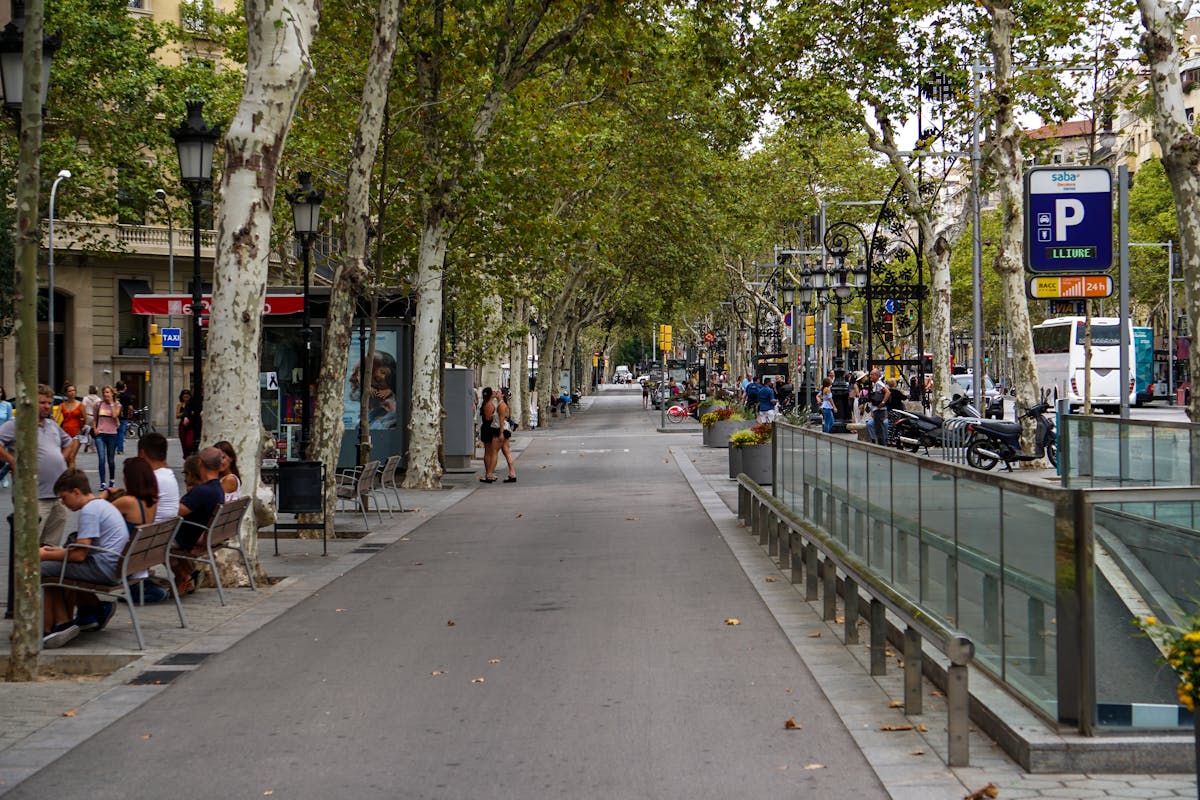
Nobody in Barcelona calls it Las Ramblas. It is La Rambla, singular, and it is the street locals will tell you they avoid, usually while admitting they walked down it last week. Type Las Ramblas Barcelona into a search engine and you will be told it is the city’s most famous street, which is true, and its most beautiful, which has not been true for a long time. It is 1.2 kilometres of plane trees, pickpockets, overpriced sangria, genuinely great buildings and a crowd that rarely thins. It is also, in 2026, a construction site.
This guide is the honest version: what is still worth stopping for from top to bottom, what to skip, how the common scams work, what the rebuild means for your visit, and where to find the better ramblas that locals actually use. The market halfway down gets a guide of its own, our La Boqueria guide, because it needs one. Details were checked in September 2026.
Las Ramblas at a glance
| The short version | |
|---|---|
| Length | About 1.2 km, from Plaça de Catalunya down to the Columbus Monument by the port |
| Time | 25 minutes to walk straight down; two to three hours with the stops worth making |
| Metro | L3 Catalunya at the top, Liceu in the middle, Drassanes at the bottom |
| Cost | Free to walk. Everything sold on it is expensive |
| Best time | Before 09:00, any day |
| Worst time | 11:00 to 20:00 in summer, and any day with several cruise ships in port |
| Eat here? | No. Walk two minutes into the side streets |
| Building works | A full rebuild, due to finish in February 2027 |
| Verdict | Walk it once, early. Spend your time in the streets either side |
The rebuild: what you will find in 2026
La Rambla is in the middle of the most thorough reconstruction in its modern history, and any guide that does not mention it is out of date. The city is rebuilding the whole length of the street at once, from Plaça de Catalunya to the Portal de Santa Madrona end by the sea, at a cost now put at around €55.6 million, some €11 million over the original budget.
- Phase one, the roadway and pavement on the Gothic Quarter side, finished in June 2025.
- Phase two, the same work on the El Raval side, ran through spring 2026.
- Phase three, the central promenade itself, began in stages from November 2025 and is being done in halves, one side at a time, so that there is always a walkway down the middle.
- Completion is scheduled for February 2027, subject to the usual caveats about Barcelona building projects.
What that means if you visit before then: hoardings along parts of the central walkway, narrower passages in places, and fewer of the café terraces that used to line the promenade. Most were removed for the works and are coming back gradually. Traffic runs one way only, uphill towards Plaça de Catalunya. Liceu metro station is unaffected.
The works have turned up more history than anyone planned for. Archaeologists found sections of the medieval city wall, remains of the towers of one of its old gates, the Portal de la Ferrissa, and pillars from the city’s former cannon foundry. That is partly why the schedule slipped.
The flower stalls are the change regular visitors notice most. The eight floristes of La Rambla moved in March 2026 to temporary stalls on Plaça de Catalunya, on the stretch between Carrer de Bergara and Ronda de la Universitat. It is the first time they have left the street since 1888, when Flors Carolina, the oldest of them, opened. They are due back when the works finish.
The finished Rambla is meant to give pedestrians about a third more space, with a single, unified design for the terraces and fewer tables, and a deliberate push to make the street a cultural axis rather than a tourist conveyor belt. Whether that works is another matter, but the street you walk down in 2027 will look noticeably different from the one in older photographs.
What is worth stopping for, from top to bottom
La Rambla is really five streets in a row, each with its own name, running downhill from the Eixample to the sea: the Rambla de Canaletes, dels Estudis, de Sant Josep, dels Caputxins and de Santa Mònica. Walk it downhill. It is easier on the legs and it ends at the water.
Font de Canaletes
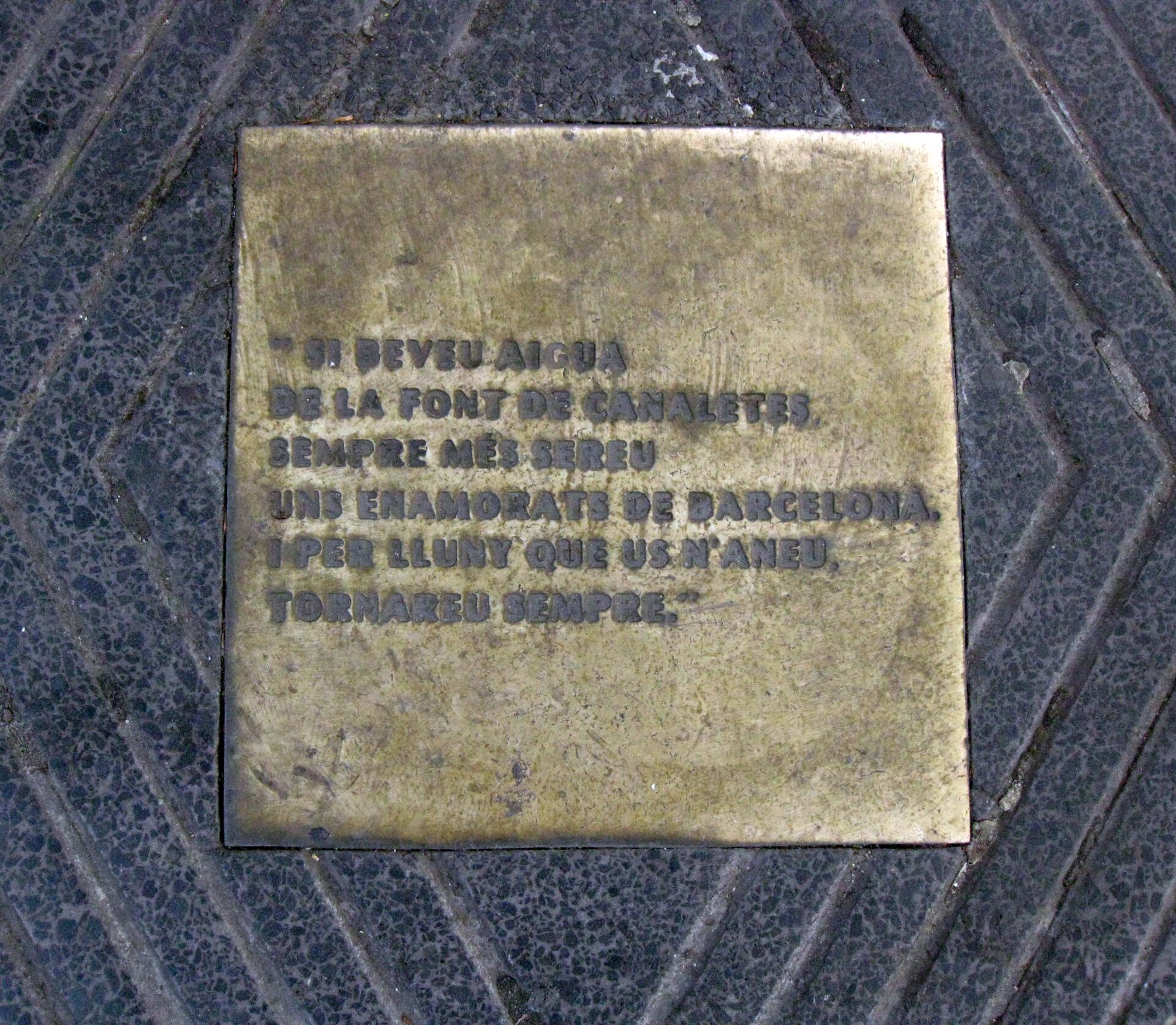
Just below Plaça de Catalunya stands a cast-iron drinking fountain with four spouts and a lamp on top. The legend, set into the pavement on a brass plaque, is that anyone who drinks from it will fall in love with Barcelona and always come back, however far they go. It is also where FC Barcelona supporters gather to celebrate titles, a tradition that dates back to when the sports newspapers posted results on boards nearby. On a big night the whole top of the Rambla fills with people in blue and claret. If you are in town for one, our guide to seeing FC Barcelona play covers the rest of the evening.
The Rambla dels Estudis
Named after the city’s old university, the Estudi General, which stood here until Philip V shut it down after the siege of 1714. Look for the Església de Betlem on the right as you walk down, a baroque church with a heavily decorated side door facing the Rambla. Its interior was gutted by fire in 1936, and what you see inside is largely a rebuild. Almost opposite stands the Palau Moja, an eighteenth-century mansion with painted interiors that is occasionally open.
Palau de la Virreina
A little further down on the right is a grand 1770s palace built by a viceroy of Peru who came home rich; he died soon after it was finished, and his young widow, the virreina, lived on in it, which is where the name comes from. Today it is La Virreina Centre de la Imatge, the city’s photography and image centre, and its exhibitions are usually free. It is one of the most consistently worthwhile ten minutes on the whole street, and almost nobody goes in.
La Boqueria
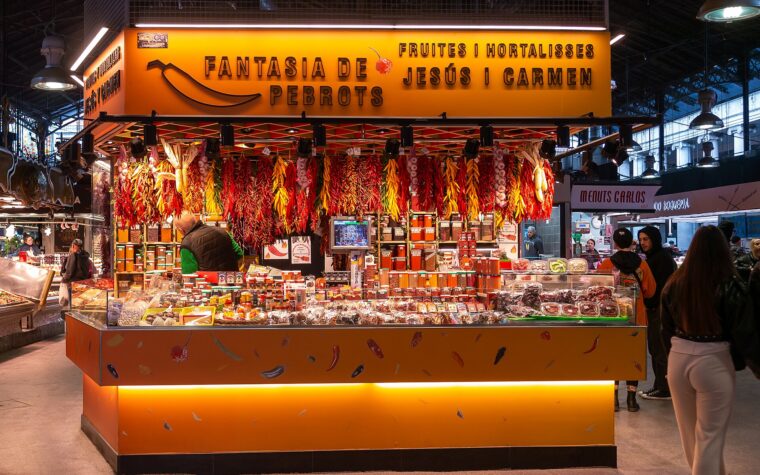
The market’s stained-glass arch is a few doors below the Virreina. Go before 10:00 on a weekday, walk past the fruit cups at the front, and it is one of the great food markets of Europe. Go at noon on a Saturday and it is a queue. Our La Boqueria guide covers how to do it properly.
The Pla de la Boqueria: Miró and a dragon
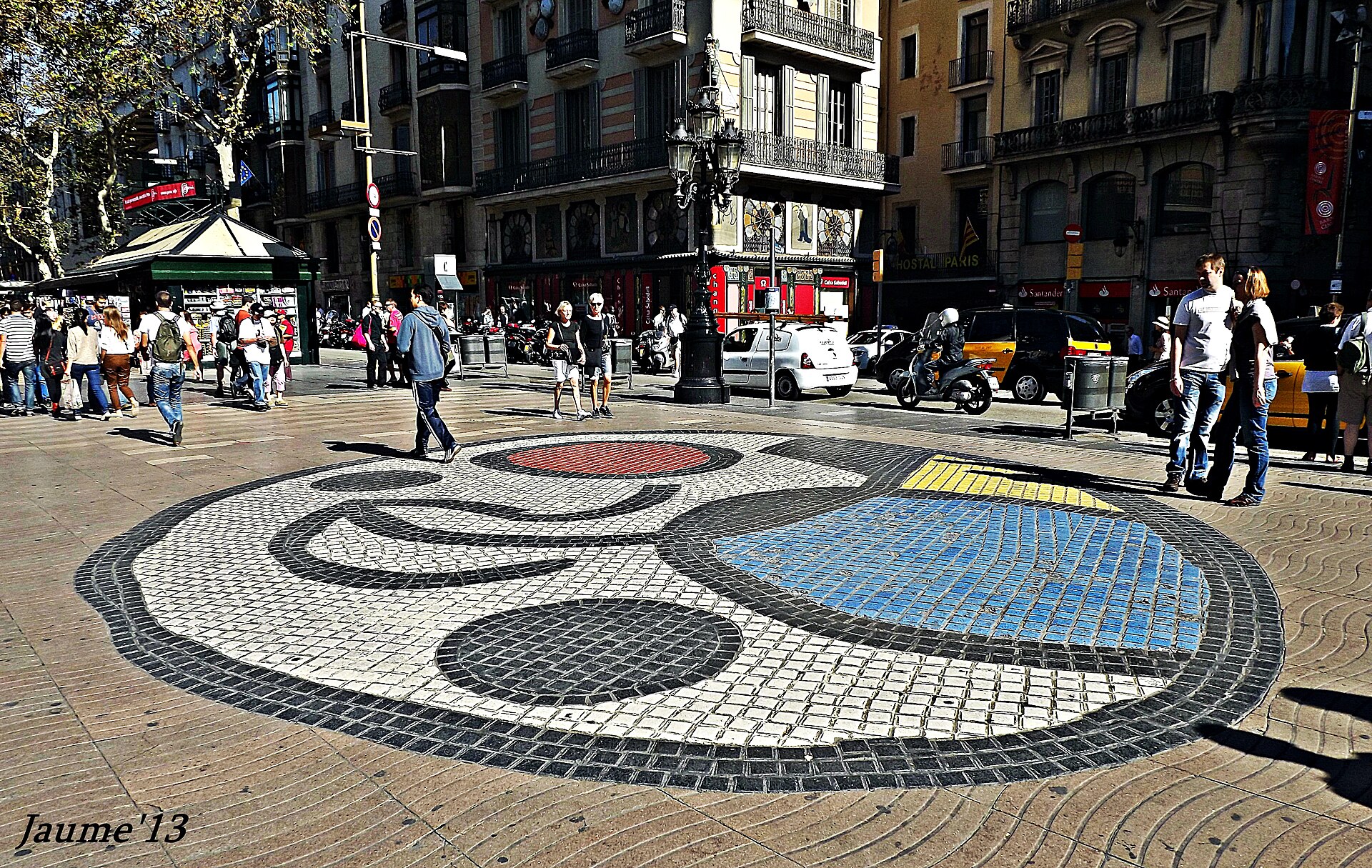
Just below the market the Rambla widens into a small square, and in the middle of the pavement is a circular mosaic in red, blue, yellow and black by Joan Miró, laid in 1976. Millions of people walk across it every year without looking down. It was Miró’s way of welcoming visitors arriving from the port, and it is the best free modern art in the city.
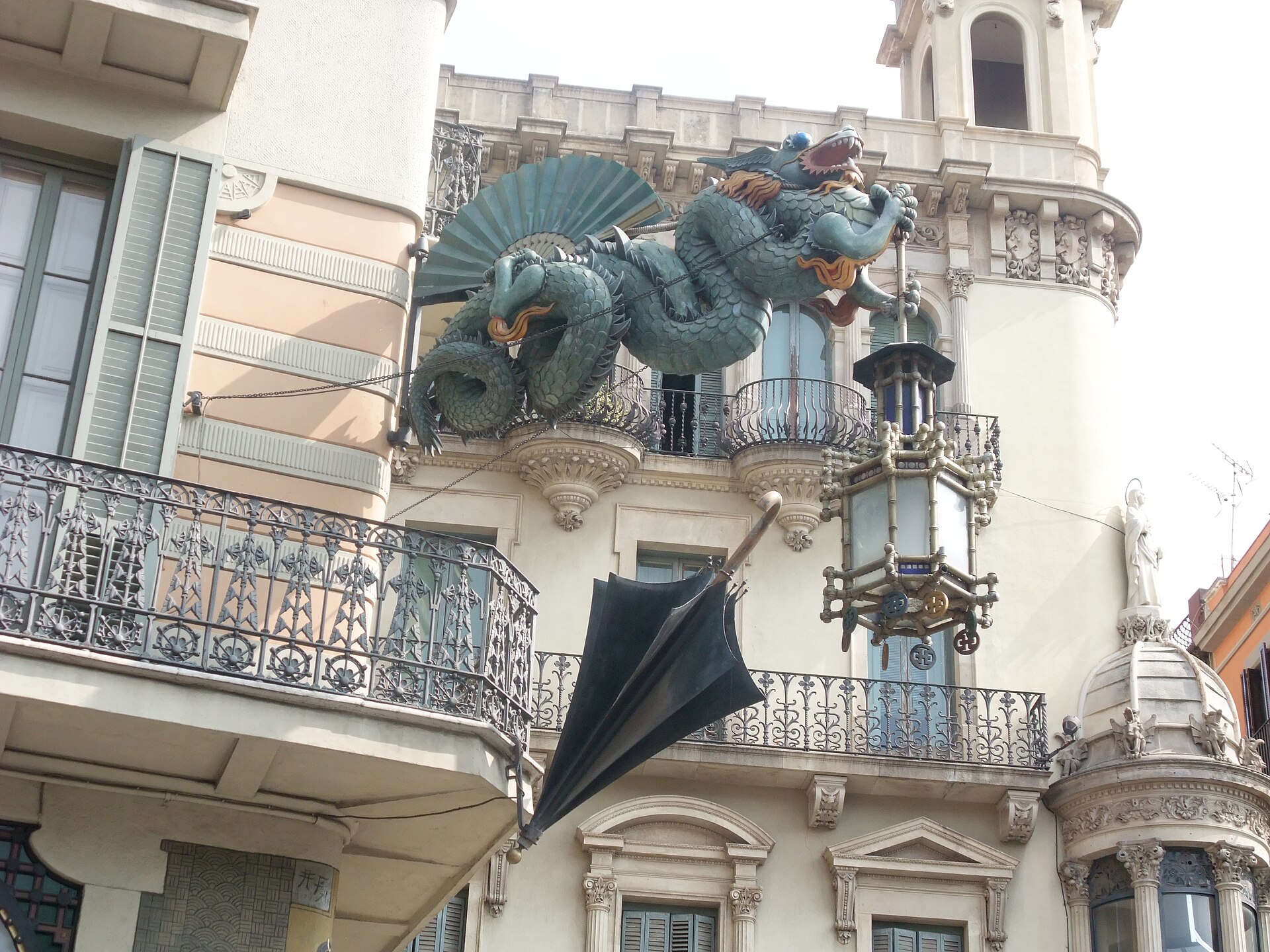
On the corner above it is Casa Bruno Cuadros, a former umbrella shop that its architect, Josep Vilaseca, redecorated in the 1880s in a fit of enthusiasm for all things Japanese and Egyptian. A green Chinese dragon clutches a lantern over the corner, parasols and fans climb the walls, and it is completely mad in the best way.
Gran Teatre del Liceu
Barcelona’s opera house has stood on the Rambla since 1847 and has had a dramatic life. It burned in 1861, was bombed by an anarchist during a performance in 1893, burned again in 1994 and reopened in 1999, restored in full red-and-gold splendour. From the street it is almost modest. Inside it is one of the grandest auditoriums in Europe. You can see it on a guided tour, or, better, by buying a ticket for a performance; cheap seats high up exist, and our theatre and opera guide explains how to find them.
Plaça Reial
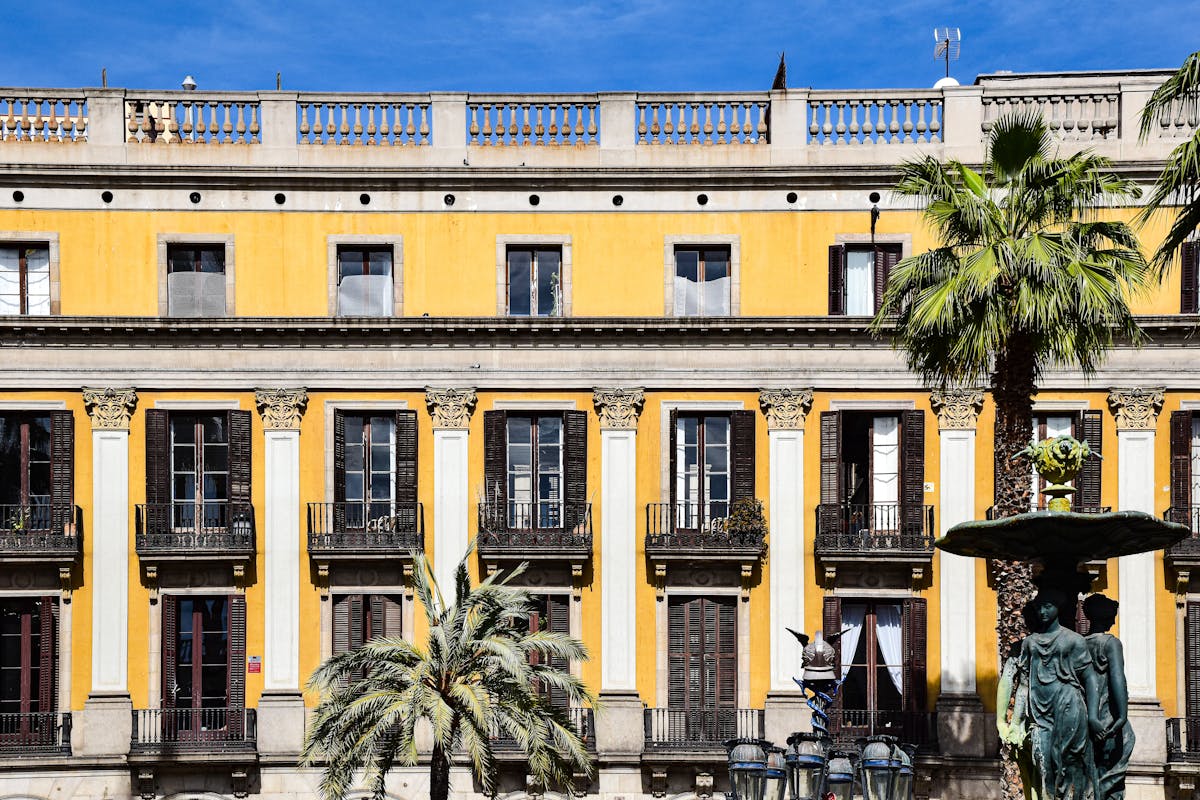
A few steps to the left, through an archway, is the Rambla’s best-looking neighbour: an arcaded square of the 1850s with tall palms, a fountain and, on either side of it, a pair of ornate lampposts that were among Gaudí’s first commissions, designed for the city in 1879 while he was barely out of architecture school. Look at the square, admire the lamps, and do not eat under the arcades. The restaurants there are aimed squarely at visitors and priced accordingly. After dark the square becomes a nightlife hub; Jamboree, the long-running jazz club, is in its basement.
Palau Güell
Opposite, a few metres down Carrer Nou de la Rambla, is Palau Güell, the townhouse Gaudí built for his patron Eusebi Güell between 1886 and 1890. It is the most underrated of his buildings, a dark, theatrical mansion with a rooftop forest of tiled chimneys, and at €12 it is also one of the cheapest. If you only go inside one building on the whole Rambla, make it this one. Our Gaudí guide puts it in context.
The Rambla de Santa Mònica
The last stretch is the quietest, and it is where the street starts to smell of the sea. The Centre d’Art Santa Mònica, in a converted convent on the right, shows contemporary art and is usually free. The old Teatre Principal, the site of the city’s oldest theatre, is being restored and is expected to reopen in 2028.
The Columbus Monument and the Drassanes
At the bottom, where the Rambla meets the port, Christopher Columbus stands on top of a 60-metre column built for the Universal Exhibition of 1888. He is pointing out to sea, and famously not towards the Americas but roughly towards the Balearics and North Africa. A small, elderly lift inside the column takes a few people at a time to a cramped viewing gallery below his feet; tickets have been around €6, but check before you go. The view is good, the experience claustrophobic, and on a busy day the queue is not worth it. The best views guide has better options.
On the right as you face the sea are the Drassanes Reials, the medieval royal shipyards, a vast Gothic hall where the galleys of the Crown of Aragon were built. They house the Museu Marítim, and the building alone is worth the visit. Beyond the monument, the wooden Rambla de Mar walkway carries on over the water to the Port Vell. Our waterfront and port guide picks up from there.
What to skip
The Rambla’s problem is not that it has nothing good on it. It is that the good things sit among a lot of things designed to separate visitors from their money as efficiently as possible. Skip these:
- Eating or drinking on the Rambla itself. The picture menus, the paella that took four minutes to arrive, the jugs of sangria at prices that would buy a good dinner two streets away. Every so often a receipt from a Rambla terrace goes viral, and nobody in Barcelona is surprised. Walk two minutes into El Raval or the Gothic Quarter and the prices halve and the food improves. Our best tapas guide and cheap eats guide both have places within ten minutes’ walk.
- Souvenir shopping. The same magnets, flamenco dolls and football shirts of uncertain origin as everywhere else, at a Rambla mark-up.
- The front of the Boqueria at midday. Covered above. Come back early.
- Any game involving three cups and a ball. See below.
- A hotel room facing the Rambla, unless you sleep through anything. The street is loud until very late and the delivery lorries start early. Our where to stay guide suggests quieter bases a few minutes away.
The human statues are a different case. They are part of the street’s character and some are genuinely skilful; the city limits how many can perform and where. If you photograph one, drop a coin in the box. That is the deal, and it is a fair one.
Scams and pickpockets: how they actually work
La Rambla has long been one of the worst places in Europe for pickpocketing, and it is still the part of Barcelona where you are most likely to lose a phone or a wallet. Violent crime against visitors is rare. Distraction theft is not. Almost every trick on the street works the same way: something takes your attention for three seconds while someone else takes your property.
The pickpocket hotspots
- Liceu metro station, on the escalators and on crowded platforms.
- The entrance to the Boqueria, where everyone slows down and looks up.
- Anywhere a crowd is watching something: a performer, a street argument, a human statue.
- Café terraces, where a phone left on the table is the easiest target of all.
The tricks
- The shell game. Three cups, a ball and a crowd of apparently delighted winners. The winners are working with the man running the game, the game is rigged, and the crowd around you is where the pickpockets stand. The police have spent years moving these games on. They keep coming back because they keep working.
- The spill. Someone points out that a bird has messed on your jacket, or “accidentally” spills something on you, and helpfully starts to clean it off. While you are distracted, a partner goes through your bag. If a stranger starts wiping you down, step away and hold onto your bag.
- The clipboard. A petition, often for a deaf or disabled charity, is pushed at you. The clipboard goes flat over your phone on the café table, and when it is lifted away, so is the phone.
- The football fan. An overfriendly young man asks where you are from, talks about Barça, and mimes a bit of footwork, which involves getting very close to your legs and pockets. The conversation is the distraction.
- Fake police. Plain-clothes “officers” flash a badge and ask to check your wallet for counterfeit notes. Real police do not do this. Offer to walk with them to the nearest police station and watch them lose interest.
- The rosemary or flower gift. A sprig is pressed into your hand “for luck”, and then money is demanded. Do not take it.
At night
After dark, and particularly in the small hours, the lower Rambla changes. Can sellers walk up and down with six-packs, which you should ignore: drinking in the street can get you fined, and the beer is warm. You may be offered drugs or approached by sex workers, whose approaches have a well-documented habit of ending with a missing wallet. None of this is dangerous if you keep walking, but this is not the place to be lost, drunk and holding a phone at three in the morning.
If something is stolen
Report it to the Mossos d’Esquadra, Catalonia’s police force. There is a police station on Carrer Nou de la Rambla, just off the street, and you will need the report for any insurance claim. Our Barcelona safety guide covers the process and the rest of the city’s hotspots.
Five habits that stop almost all of it
- Wear your bag in front, zipped, and your backpack on your front in crowds.
- Phones never go in back pockets or on café tables.
- Carry one card and some cash, and leave the rest in the hotel safe.
- When a stranger gets close for no obvious reason, step back and put a hand on your bag.
- Do not stop to watch anything with a crowd around it. That is where the work happens.
When to walk it
Early morning is the Rambla at its best. Between 07:00 and 09:00 the delivery vans are finishing, the street cleaners are hosing down the paving, the Boqueria is opening, and you can see the buildings rather than the backs of other people’s heads. If you only walk it once, walk it then.
Winter evenings are pleasant enough: busy but not crushed, with the Liceu audience arriving and the street lit up. Summer from late morning to evening is the worst of it, especially when several cruise ships are in port and their passengers all take the same walk from the Columbus Monument to the Boqueria and back.
And one day a year, go no matter what. On 23 April, Sant Jordi, Catalonia’s day of books and roses, the Rambla has traditionally been lined end to end with bookstalls and rose sellers, authors sign copies in the open air, and the whole city comes out. In 2026 the works kept the stalls off the Rambla, and the celebration’s heart moved to a traffic-free “literary superblock” on Passeig de Gràcia and Rambla de Catalunya. With the rebuild due to finish in February 2027, the Rambla should be back in the celebration the following April, and on that day it is crowded beyond belief, utterly joyful, and more completely Barcelona’s than on any other day of the year. Our Sant Jordi guide explains what to do.
Better ramblas the locals actually use
The word rambla means a promenade built over an old stream bed, and Barcelona has several. Three of them are nicer than the famous one:
| Street | Where | Why go |
|---|---|---|
| Rambla de Catalunya | The Eixample, running north from Plaça de Catalunya, parallel to Passeig de Gràcia | A leafy central walkway with café terraces that locals use, handsome modernista buildings and none of La Rambla’s hustle. The natural continuation of your walk, uphill |
| Rambla del Raval | El Raval, a few minutes west of La Rambla | A broad palm-lined boulevard carved through the old Raval in 2000, with Fernando Botero’s enormous bronze cat at one end and a multicultural street life all its own |
| Rambla del Poblenou | Poblenou, near the beaches | A neighbourhood rambla in the old industrial district, with bars, terraces and El Tío Che, which has been making orxata since 1912 |
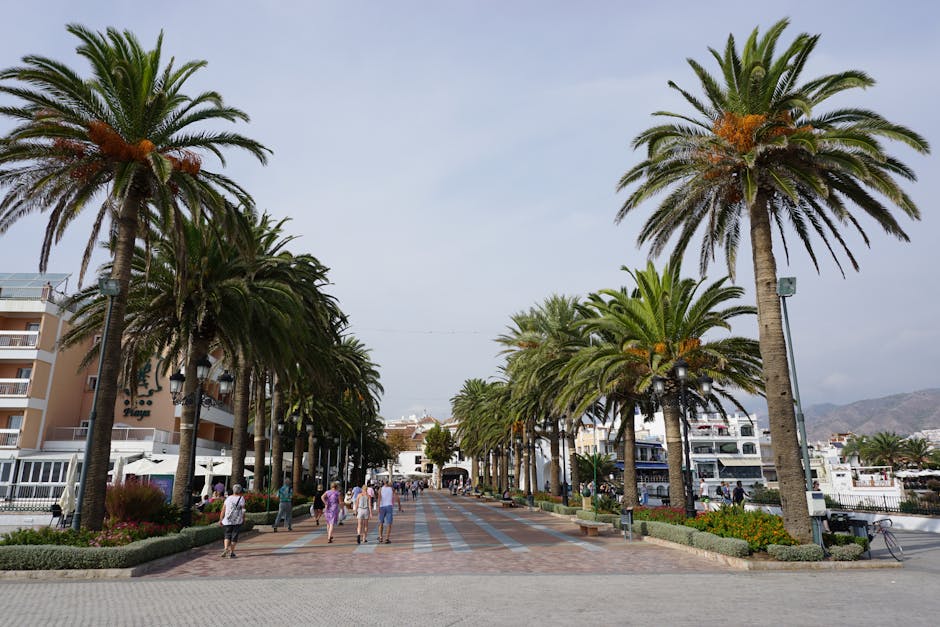
Our Eixample guide covers Rambla de Catalunya and the streets around it, and the El Raval guide covers the Rambla del Raval.
A walk that uses La Rambla properly
The best way to treat La Rambla is as a spine rather than a destination: walk down it, but keep stepping off it. A morning route that works, about three hours with stops:
- 08:00 — start at Plaça de Catalunya. Take a sip at the Font de Canaletes, if you want to be sure of coming back.
- 08:15 — walk down past the Església de Betlem and the Virreina to the Boqueria while it is still a market. Breakfast at a counter bar.
- 09:30 — the Miró mosaic and the dragon on the Pla de la Boqueria, then the Liceu’s façade.
- 09:45 — step left into Plaça Reial for Gaudí’s lampposts, then cross to Carrer Nou de la Rambla for Palau Güell when it opens.
- 11:30 — down to the Columbus Monument, a look at the Drassanes, and out along the Rambla de Mar over the harbour.
- 12:15 — turn back into the Gothic Quarter rather than walking back up the Rambla. By now the street behind you is at its most crowded, and you will not be on it.
Our Barcelona walking guide strings this into longer routes across the old city.
A short history of the Rambla
The Rambla began as a seasonal stream running down to the sea outside Barcelona’s thirteenth-century walls. The word comes from the Arabic ramla, a sandy riverbed. When the city expanded, the stream was built over, the walls came down, and the space became a promenade lined with convents, several of whose sites are now occupied by the Boqueria, the Liceu and the Centre d’Art Santa Mònica.
Through the nineteenth century it became the city’s great public stage, with its flower sellers from 1888 and the bird sellers who stayed until well into this century. George Orwell spent part of the street fighting of May 1937 on the roof of the Poliorama theatre on the Rambla, keeping watch, and wrote about it in Homage to Catalonia. The street’s reputation as the heart of the city lasted until mass tourism took it over from the 1990s onwards, and by the 2010s most Barcelonans had quietly stopped using it.
In August 2017 a van was driven down the central promenade in a terrorist attack that killed more than a dozen people and injured many more. The next day the city filled Plaça de Catalunya for a minute’s silence that turned into a chant of No tinc por, “I am not afraid”, and the security bollards that now line the street are, in part, a legacy of it.
The current rebuild is the city’s attempt to win the street back: more room for people, fewer tables, more culture. Barcelona has been trying to do that for twenty years. This time it has dug up the whole street to prove it means it.
Is Las Ramblas worth it?
Yes, once, early in the morning, and as a way of getting somewhere. The Miró mosaic, the dragon on Casa Bruno Cuadros, the Virreina, the Liceu, Plaça Reial, Palau Güell and the Drassanes are all genuinely worth your time, and they happen to be strung along the same street.
No, as a place to spend an afternoon, eat a meal or have a drink. That version of the Rambla, the one in the holiday photos with a sangria jug the size of a vase, is exactly what locals mean when they say they avoid it.
If you are short of time, the most useful thing to know is that nearly everything good about the Rambla is within two minutes of it, not on it. Walk it, step off it often, and leave it by mid-morning. Our first-time visitor tips have more of the same kind of advice for the rest of the city.
Frequently asked questions
Is it La Rambla or Las Ramblas?
Both, and neither is wrong. The street is made up of five named sections, which is why it is often called Las Ramblas (Les Rambles in Catalan). Locals almost always say La Rambla, singular.
Is Las Ramblas worth visiting?
Yes, for an early-morning walk and for the buildings along it: the Boqueria, the Liceu, Plaça Reial, Palau Güell, the Miró mosaic and the Columbus Monument. It is not worth eating, drinking or shopping on, and at peak times it is too crowded to enjoy.
Is Las Ramblas safe?
It is safe in the sense that violent crime against visitors is rare, but it is one of the worst places in Europe for pickpocketing and distraction theft. Keep bags in front and zipped, keep phones off café tables, and be wary of anyone who gets close for no reason.
What are the most common scams on Las Ramblas?
The three-cup shell game, the “spill” or “bird droppings” distraction, petition clipboards laid over phones, overfriendly football fans, fake plain-clothes police asking to see your wallet, and people pressing sprigs of rosemary or flowers on you before demanding money.
Is La Rambla under construction?
Yes. The whole street is being rebuilt, with the central promenade worked on in halves so that it stays walkable. Completion is scheduled for February 2027. Expect hoardings, fewer café terraces and one-way traffic until then.
Where have the flower stalls on La Rambla gone?
The eight flower stalls moved to temporary sites on Plaça de Catalunya, between Carrer de Bergara and Ronda de la Universitat, in March 2026, for the duration of the works. They are due to return to the Rambla when the rebuild is finished.
How long does it take to walk Las Ramblas?
About 25 minutes to walk the 1.2 kilometres from Plaça de Catalunya to the Columbus Monument without stopping. Allow two to three hours if you visit the Boqueria and Palau Güell and look properly at the buildings along the way.
Should I eat on Las Ramblas?
No. The restaurants and terraces on the street itself charge well above the city’s normal prices for food that is usually worse. Walk two minutes into El Raval or the Gothic Quarter and you will eat better for less.
What is the best time to visit Las Ramblas?
Early morning, between about 07:00 and 09:00, when the street is quiet and the Boqueria is opening. Avoid late morning to evening in summer, and days when several cruise ships are in port. On 23 April, Sant Jordi, go regardless.
Which metro station is on Las Ramblas?
Line L3 stops at Catalunya at the top, Liceu in the middle and Drassanes at the bottom. Liceu is the closest to the Boqueria and the opera house.
Can you go up the Columbus Monument?
Yes. A small lift inside the column takes visitors up to a viewing gallery just below the statue, 60 metres above the port. Tickets have been around €6 for adults; check the current price and hours before you go.
Related Barcelona Guides
- La Boqueria — how to visit the market halfway down without the tourist trap.
- The Gothic Quarter — the old city on the left as you walk down.
- El Raval — the neighbourhood on the right, and the Rambla del Raval.
- Barcelona safety — pickpockets, scams and what to do if something goes wrong.
- Gaudí in Barcelona — including Palau Güell and the Plaça Reial lampposts.
- The waterfront and Port Vell — where the Rambla ends.
- Sant Jordi — the one day the Rambla is unmissable.
- Barcelona attractions and tickets — what to book, what to skip and what to pay.
Photo Credits
Font de Canaletes plaque: 72 Font de Canaletes, a la Rambla by Enfo, CC BY-SA 3.0 ES, via Wikimedia Commons.
Miró mosaic on the Pla de la Boqueria: Paviment Miró a la Rambla by Jaume Meneses, CC BY-SA 2.0, via Wikimedia Commons.
Dragon on Casa Bruno Cuadros: Barcelona-Rambla de San José-Casa Bruno Cuadros o casa del dragón by Francisco Javier Guerra, CC BY-SA 4.0, via Wikimedia Commons.