We get commissions for bookings made through this post. Booking links, and any accommodation options shown on the page, are handled by a partner that adds commission tracking automatically. It never costs you more, and it never affects what we recommend. Affiliate disclosure
The Life and Legacy of Antoni Gaudi
Antoni Gaudi i Cornet (1852-1926) was the most original architect of his generation and one of the most influential of any era. He spent more than 50 years designing buildings, almost all of them in or around Barcelona, almost all of them controversial in their time, and almost all of them now UNESCO World Heritage Sites. He died on a Barcelona street in 1926 at age 73, struck by a tram while walking to his daily prayers. His funeral procession drew hundreds of thousands. This gaudi biography covers everything you need to understand the architect: his early life, his major commissions, his radical design philosophy, and the legacy that continues to shape Barcelona today.
Whether you are visiting his buildings for the first time or returning for a deeper understanding, this antoni gaudi history guide gives you the complete picture of his gaudi life story, the circumstances of his gaudi death, and the ongoing gaudi legacy in 2026.

Early Life (1852-1878)
Antoni Gaudi was born on 25 June 1852 in Reus, a town 100 km southwest of Barcelona, into a family of metalworkers and coppersmiths. His father, grandfather, and uncle all worked with metal; the boy spent hours watching them shape sheet metal into three-dimensional forms. Years later he would credit this early observation as the foundation of his understanding of structure: “Without a doubt, I have this quality of feeling, seeing space, because I am the son and grandson and great-grandson of metalworkers.”
Gaudi was a sickly child with rheumatism, which kept him from playing physical games and turned him toward observation. He studied nature obsessively, watching how trees branched, how shells curved, and how mountains formed. He carried the lessons into his architectural designs decades later.
He moved to Barcelona at 17 to study architecture at the Llotja School of Architecture. He completed his studies in 1878 with mediocre grades; the dean famously remarked: “We have either given a degree to a madman or a genius. Time will tell.”
The Modernisme Movement (1878-1900)
Gaudi graduated as the Catalan Modernisme movement was beginning. The Renaixenca (Catalan cultural renaissance) had revived interest in Catalan identity, language, and arts. The wealthy Catalan industrial class wanted buildings that expressed this cultural pride. Modernisme combined Art Nouveau aesthetics with Catalan medievalism, naturalistic ornament, and rich craftsmanship.
Gaudi’s early commissions included the lampposts in Plaça Reial (1879, his first public work), Casa Vicens (1883-1885, his first major residence), and the Sagrada Familia (begun 1882, taken over by Gaudi in 1883). His patron Eusebi Guell, a wealthy industrialist, became his most important supporter, commissioning Palau Guell (1886-1888), the Pavilions of Finca Guell (1884-1887), the Crypt of Colonia Guell (1898-1914), and Park Guell (1900-1914).
The Mature Period (1900-1914)
The years between 1900 and 1914 were Gaudi’s most prolific. He designed Park Guell, Casa Batllo (1904-1906), Casa Mila/La Pedrera (1906-1912), Bellesguard (1900-1909), and continued the Sagrada Familia. He developed his signature techniques during this period:
- Catenary arches: The chain-shaped curves that distribute weight perfectly. He derived these from hanging weighted strings upside down and studying the curves.
- Trencadis: The broken-tile mosaic technique he pioneered. Used at Park Guell, Casa Batllo, Casa Mila, and the Sagrada Familia roof.
- Ruled surfaces: 3D mathematical surfaces (hyperboloids, paraboloids) that look curved but can be drawn with a straight edge.
- Naturalistic ornament: Carved leaves, flowers, animals, and human figures.
- Catholic symbolism: Crosses, religious iconography, and theological references throughout.
Devotion to the Sagrada Familia (1914-1926)
From 1914 onward, Gaudi essentially abandoned other commissions and devoted himself to the Sagrada Familia. He moved into a small apartment in the basilica’s complex and lived a monastic life: simple meals, daily prayer, and architectural work.
He famously said: “My client is in no hurry,” referring to God, his ultimate patron for the basilica. He left detailed plans for the basilica’s completion: 18 towers (12 apostles, 4 evangelists, the Virgin Mary, and Jesus Christ), three facades (Nativity, Passion, Glory), and exact mathematical surfaces for every column and ceiling.
Death and Funeral (1926)
On 7 June 1926, Gaudi was walking from his Sagrada Familia workshop to the church of Sant Felip Neri for evening prayers. He was 73 years old, dressed in his customary worn clothes (his appearance had become so disheveled in his later years that he was sometimes mistaken for a beggar). At a tram crossing on the Gran Via, he was struck by a tram.
The tram driver assumed he was a vagrant and refused to help. Bystanders eventually carried him to the Hospital de la Santa Creu in El Raval, where he was placed in the public ward. By the time someone identified him as the famous architect, his condition had deteriorated beyond saving.
He died on 10 June 1926, three days after the accident. His funeral procession drew hundreds of thousands of mourners and stretched from the hospital to the Sagrada Familia, where he was buried in the crypt. He remains buried there today; visitors can see his tomb through a small window.
Major Works
1. Sagrada Familia (1882-2026)
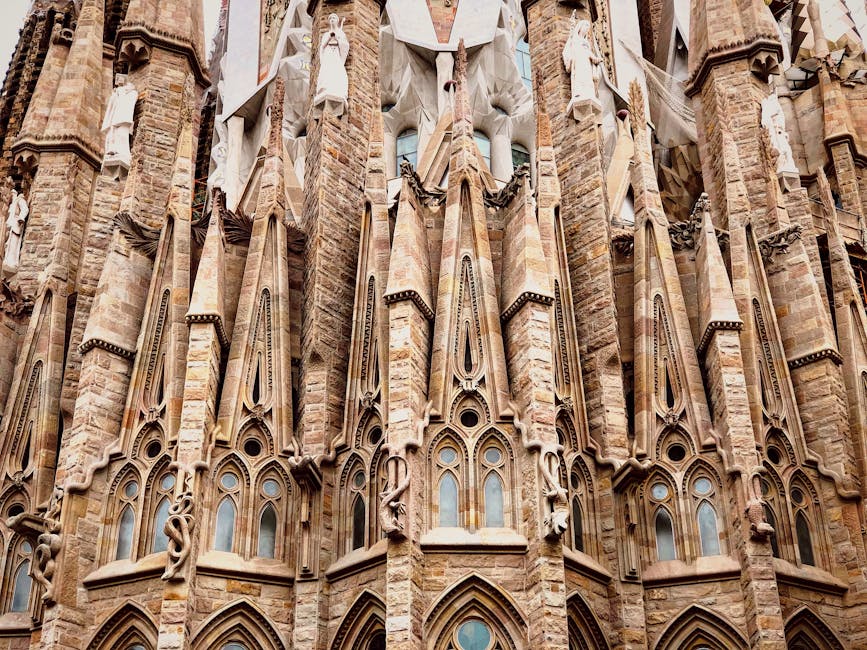
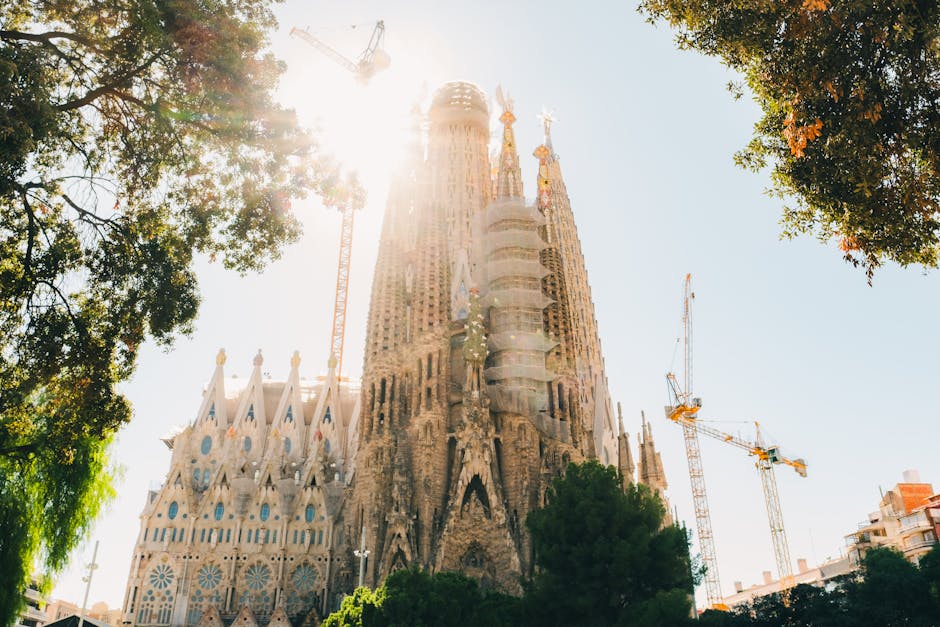
Begun in 1882 and approaching completion in 2026 with the Tower of Jesus Christ. The masterpiece of his career and the most extraordinary basilica on earth.
2. Park Guell (1900-1914)
The hilltop wonderland with the famous mosaic dragon, serpentine bench, and gingerbread gatehouses. Originally a planned residential community.
3. Casa Batllo (1904-1906)
The dreamlike facade on Passeig de Gracia. Symbolises the legend of Saint George and the dragon.
4. Casa Mila / La Pedrera (1906-1912)
Gaudi’s last residential building. Iconic for its undulating limestone facade and the surreal warrior-helmet chimneys on the rooftop.
5. Casa Vicens (1883-1885)
His first major commission. Moorish-Mudejar-influenced facade. Open to the public since 2017.
6. Palau Guell (1886-1888)
Eusebi Guell’s town residence in El Raval. Innovative parabolic arches and trencadis chimney sculptures on the roof.
7. Crypt of Colonia Guell (1898-1914)
The experimental basilica that prefigured the Sagrada Familia. Only the crypt was completed.
8. Bellesguard / Casa Figueras (1900-1909)
A neo-Gothic-influenced manor on a 14th-century royal residence site.
For the complete list, see our complete Gaudi buildings list.
Gaudi’s Design Philosophy
Nature as Blueprint
Gaudi famously said: “The straight line belongs to men, the curved one to God.” He believed natural forms (trees, shells, bones, organic growth patterns) held the answer to all architectural problems. His structures mimic natural shapes for both aesthetic and structural reasons.
Mathematics as Language
Despite his organic appearance, Gaudi’s work is mathematically precise. He pioneered the use of catenary arches, hyperboloids, and paraboloids in architecture. His most famous design tool was a hanging-string model: he tied weights to strings and studied the curves they formed when hung upside down. The catenary curves were structurally optimal for arches.
Total Art
Gaudi did not just design buildings. He designed the furniture, the doorhandles, the stained glass, the floor tiles, the wrought-iron balconies, and even the chimneys. Every element of every building was his design.
Catalan Identity
Gaudi was a passionate Catalan nationalist. He spoke Catalan exclusively (refusing Spanish even with the king of Spain). His buildings featured Catalan flags, Saint George dragons, and Catalan-language inscriptions. The Sagrada Familia was conceived as a Catholic but emphatically Catalan basilica.
Religious Devotion
Gaudi was devoutly Catholic. His later years were spent in increasingly austere religious devotion. The Vatican has begun the process of his canonisation; he is currently a “Servant of God” and may eventually be declared a saint.

Gaudi’s Personal Life
Gaudi never married. He had one documented romantic interest: a young woman named Pepeta Moreu in his late 20s. She rejected him and married another man. After this, Gaudi appears to have remained celibate by choice.
His daily routine in later life was monastic: simple meals (often just bread, vegetables, and water), daily prayer, and constant work. He lived in his small apartment at the Sagrada Familia, with few possessions.
He was politically conservative and a Catalan nationalist. He refused to speak Spanish in public. He was once arrested for refusing to speak Spanish to a police officer at a Catalan demonstration.
The Spanish Civil War and Gaudi’s Models
In 1936, anarchist forces during the Spanish Civil War sacked Gaudi’s Sagrada Familia workshop, destroying many of his original plaster models and architectural drawings. Subsequent architects had to reconstruct his vision from photographs, surviving fragments, and the geometric rules embedded in his designs.
This reconstruction continues today. Modern architects use 3D modeling and CNC stone-cutting to complete the basilica according to Gaudi’s surviving plans.
The 2026 Centenary
2026 marks the 100th anniversary of Gaudi’s death. Barcelona is celebrating with:
- Special evening illuminations of major buildings.
- The Sagrada Familia Tower of Jesus Christ completion (the building’s centrepiece).
- Special exhibitions at the Casa Vicens and Casa Batllo.
- A dedicated Gaudi walking route through the Eixample.
- Academic conferences and publications.
Gaudi’s Legacy
Architectural Influence
Gaudi influenced 20th-century architects including Frank Lloyd Wright (organic architecture), Le Corbusier (structural innovation), and Frank Gehry (sculptural form). His use of catenary arches and ruled surfaces remained marginal until 21st-century computer-aided design made them accessible.
UNESCO Status
Seven Gaudi works are inscribed as UNESCO World Heritage Sites under “Works of Antoni Gaudi”. The first inscription was Park Guell, Palau Guell, and Casa Mila in 1984. The 2005 expansion added Casa Vicens, Casa Batllo, the Sagrada Familia Nativity Facade and Crypt, and the Crypt of Colonia Guell.
Catholicism and Beatification
The Vatican opened Gaudi’s beatification process in 2003. He is currently a “Servant of God”; the next steps are “Venerable”, “Blessed”, and finally “Saint”. The process is ongoing.
Cultural Impact in Catalonia
Gaudi is a national hero in Catalonia. His birthday (25 June) is sometimes informally celebrated. His face appears on Catalan postcards, t-shirts, and souvenirs. Catalan schools teach his life and work.
How to Experience Gaudi’s Legacy in 2026
- Visit the Sagrada Familia (book 4-8 weeks ahead).
- Walk Avinguda Gaudi to Hospital de Sant Pau.
- Visit Casa Batllo and Casa Mila.
- Climb to Park Guell.
- Visit Casa Vicens (his first major work).
- Visit Palau Guell in El Raval.
- See the Cascada fountain in Parc de la Ciutadella (his student work).
- View the Plaça Reial lampposts (his first public work).
- Take a day trip to Colonia Guell.
- Visit the Casa Museu Gaudi at Park Guell (his actual home).
For practical visiting plans, see our complete Gaudi buildings list.
Frequently Asked Questions
When was Gaudi born?
25 June 1852 in Reus, Catalonia.
How did Gaudi die?
Struck by a tram on 7 June 1926; died three days later from his injuries on 10 June.
Where is Gaudi buried?
In the crypt of the Sagrada Familia. The tomb is visible through a small window during normal visiting hours.
Why was Gaudi mistaken for a beggar?
His later years were spent in austere religious devotion; his clothes were simple and worn.
Is Gaudi a saint?
Currently a “Servant of God”; the Vatican beatification process is ongoing.
Did Gaudi marry?
No. He never married. One documented romantic interest (Pepeta Moreu) rejected him in his late 20s.
Who was Eusebi Guell?
Wealthy Catalan industrialist and Gaudi’s most important patron. Commissioned Palau Guell, Park Guell, Pavilions of Finca Guell, and the Crypt of Colonia Guell.
What is the Sagrada Familia completion date?
The Tower of Jesus Christ is approaching completion in 2026, marking the 100th anniversary of Gaudi’s death. Some decorative work continues beyond.
What is trencadis?
The broken-tile mosaic technique Gaudi pioneered. Used on Park Guell’s bench, Sagrada Familia roof, and many other works.
What was Gaudi’s most famous quote?
“The straight line belongs to men, the curved one to God.”
Was Gaudi religious?
Deeply. His later years were monastically devoted to the Sagrada Familia.
What language did Gaudi speak?
Catalan exclusively. He refused to speak Spanish in public.
How many UNESCO Gaudi sites are there?
Seven, inscribed in 1984 and expanded in 2005.
What is the Sagrada Familia Tower of Jesus Christ?
The tallest tower of the basilica, planned at 172.5 metres. Topped with a radiant cross. Approaching completion in 2026.
Why is Gaudi important?
He is one of the most original and influential architects in history. His work shaped Barcelona’s identity and influenced 20th-century architecture worldwide.
Final Thoughts: A Life Lived for Architecture
Antoni Gaudi’s gaudi biography is the story of an architect who refused easy paths, who believed deeply in his vision, and who turned the natural world and Catholic faith into stone. His buildings continue to draw millions of visitors each year, and his legacy continues to shape Barcelona’s identity. The 2026 centenary is the perfect moment to deepen your understanding of the man behind the masterpieces.
For more, see our Gaudi Barcelona pillar, the Sagrada Familia guide, the Park Guell guide, the Casa Batllo vs Casa Mila comparison, and the complete Gaudi buildings list.