We get commissions for bookings made through this post. Booking links, and any accommodation options shown on the page, are handled by a partner that adds commission tracking automatically. It never costs you more, and it never affects what we recommend. Affiliate disclosure
Most of what you will read about visiting Barcelona’s stadium is out of date, and it is out of date in a way that matters: the classic pitch-side walk down the tunnel, past the dressing rooms and out to the touchline, is not currently running. The camp nou tour people book today is the Barça Immersive Tour — the museum, a 360-degree cinema and a viewpoint over an enormous building site — and whether that is worth €28 depends entirely on what you were expecting.
This page explains what the tour actually contains in 2026, what the rebuild has changed, what it costs, how long it takes, how to get there, and whether to wait for the finished stadium instead. Details were checked in September 2026; the stadium is a live construction project and what is open shifts, so confirm on the club’s own site in the week before you go.
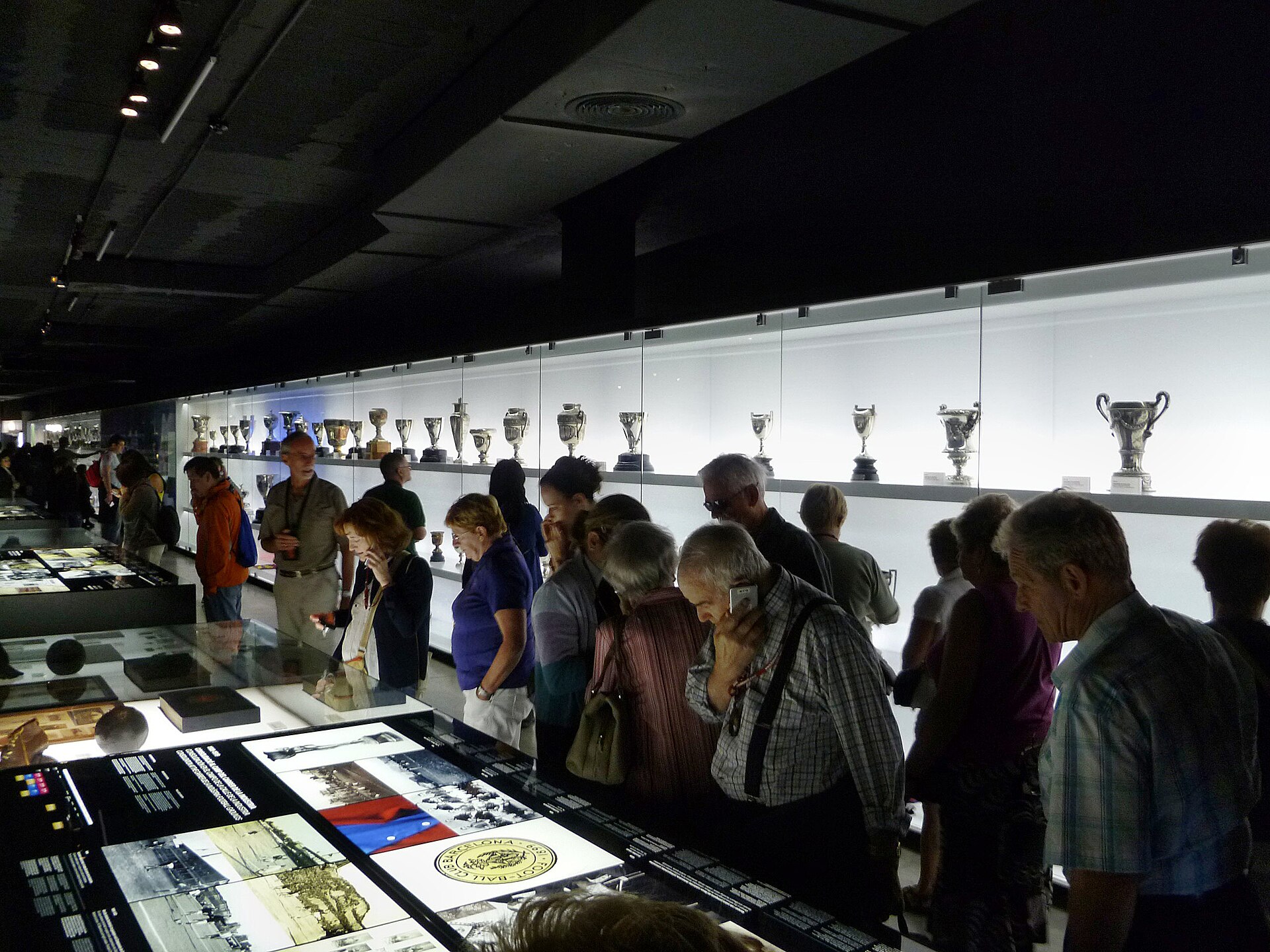
What you get in 2026
| Element | Included now? |
|---|---|
| FC Barcelona Museum — 10 immersive rooms, 1899 to today | Yes |
| Trophy gallery | Yes |
| 360° “Spotify Camp Nou Live” immersive cinema | Yes |
| Construction viewpoint over the rebuild | Yes |
| Audio guide in 12 languages | Yes |
| Pitch-side access | No |
| Dressing rooms | No |
| Players’ tunnel | No |
| Press room and directors’ box | No |
| Barça Store | Yes, at the exit, inevitably |
That is the honest picture. The Barça Immersive Tour is a very good football museum with a screen room attached and a hard hat’s view of a construction site. It is not a stadium tour in the sense that Anfield, the Bernabéu or the San Siro offer one, and the marketing does not always make that as clear as it might.
Prices and practicalities
- Adults — from €28–31, depending on date and demand.
- Children aged 6–13 and over-65s — around €21.
- Students — around €20.
- Guided tour — from roughly €64 per person, and about 90 minutes.
- Duration — 90 minutes guided; allow an hour and a half to two hours self-guided if you read the displays properly.
- Entrance — between the Barça Café and the Barça Store, C/ d’Arístides Maillol 12, in Les Corts.
- Hours — late March to mid-October, daily 09:30–19:00. Mid-October to late March, Monday to Saturday 10:00–18:00 and Sunday 10:00–15:00. Closed 25 December and 1 January.
- Match days — museum only, and reduced hours. Check before travelling.
Book online through fcbarcelona.com. The club’s own site is the cheapest and the only place where a change to the route will be reflected accurately. Go City Barcelona includes the tour; the Barcelona Card does not — see our city passes comparison.
Getting there
Metro L3 to Les Corts or Palau Reial, then ten to fifteen minutes on foot — Les Corts is marginally closer to the museum entrance. L5 to Collblanc and L9 Sud to Collblanc also work and are useful if you are coming from the airport side. Several bus routes stop on Travessera de les Corts.
The site is large and confusing while the works are ongoing, with hoardings redirecting pedestrians and signage that has not always caught up. Aim for the Barça Store rather than the stadium itself; the entrance is beside it. Allow ten minutes more than the map suggests. See the metro guide for the lines.
What is actually happening to the stadium
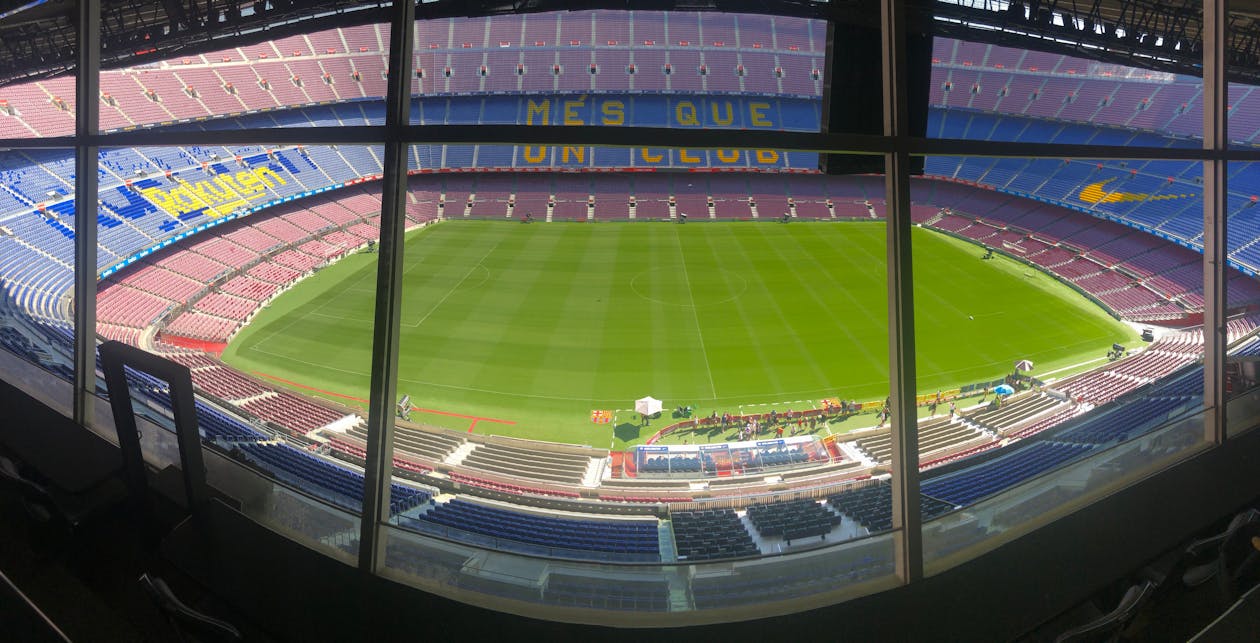
The Espai Barça project is turning Camp Nou into a 105,000-seat stadium with a new roof, a third tier and a substantially reworked surrounding campus. It is the largest stadium project in Europe and it has run behind schedule, which is unsurprising given that the club has been rebuilding the ground while continuing to play in it.
The sequence so far: the club moved out to the Estadi Olímpic on Montjuïc for the demolition and rebuild of the lower bowl, returned to Camp Nou on 22 November 2025 for a match against Athletic Club, and has been playing in a partially reopened stadium since. As of March 2026 the capacity stood at around 62,652, with the third tier and the roof still under construction. Full completion is expected in late 2026 or 2027, and the 2026/27 La Liga home season began at Spotify Camp Nou on 16 August 2026.
What that means for visitors is that the tour is being rebuilt alongside the stadium. The full route — tunnel, dressing rooms, pitch-side — is expected to return once the works finish. Nobody at the club is putting a firm date on it, and given the project’s history, treating any date as provisional is sensible.
A short history of the ground
Barcelona outgrew its previous ground, Les Corts, in the 1950s — largely because of Ladislao Kubala, the Hungarian forward who drew crowds the old stadium could not hold. Camp Nou opened in 1957 with a capacity of around 93,000 and was expanded for the 1982 World Cup, at which point it became the largest stadium in Europe, a title it held for decades.
The name is worth a paragraph of its own. Officially it was the Estadi del FC Barcelona for its first four decades; everybody called it Camp Nou — Catalan for “new ground” — and in 2000 the members voted to make the nickname official. In 2022 the club sold naming rights to Spotify, producing Spotify Camp Nou, which locals use approximately never.
What happened inside it is the reason the museum works. The 1974 arrival of Johan Cruyff, and the 5–0 at the Bernabéu that season. The 1992 European Cup won at Wembley by the Dream Team he built. Ronaldinho, and the night the Bernabéu applauded him. Six trophies in 2009. Messi, for seventeen years. And, through the Franco years, the club’s role as one of the few places where Catalan identity could be expressed publicly at all — which is what més que un club actually refers to, and which the museum handles with more seriousness than most club museums manage.
The Espai Barça project
The rebuild is not only a stadium. Espai Barça covers the whole campus: the new Camp Nou at 105,000 seats with a three-tier bowl and a roof carrying solar panels; a rebuilt Palau Blaugrana for basketball and handball; the Estadi Johan Cruyff, already complete, for the women’s team and the youth sides; new public space, a campus square and an underground car park replacing surface parking.
The headline numbers are large — a budget above €1.5 billion, financed largely by debt against future stadium revenues — and the project has been controversial among members for exactly that reason. It has also slipped repeatedly, which is why the tour has been in limbo for so long and why any completion date should be treated with caution.
For a visitor, the practical upshot is this: the stadium you can see now is a hybrid, with a modern lower and middle tier, an unfinished top and no roof. In two or three years it will be one of the most impressive sporting venues in the world. Right now it is a fascinating half-finished object, and the construction viewpoint is the only place you can properly look at it.
Barcelona’s other football
Two things worth knowing if the Camp Nou tour disappoints you.
The Estadi Johan Cruyff, on the same campus, is where the women’s team plays — and Barça Femení have been the dominant force in European women’s football for years. Tickets are cheap, the ground is small and modern, and the atmosphere is genuinely good. If your dates coincide with a home fixture, it is the best-value football in the city by a wide margin.
RCD Espanyol, Barcelona’s other first-division club, play at the RCDE Stadium out in Cornellà, twenty minutes on the metro or Rodalies. The club is the city’s counterweight to Barça — historically the Spanish-identified side to Barça’s Catalanist one, though the modern reality is far more mixed — and a Saturday there is cheap, easy to get tickets for, and a completely different experience from the tourism machine at Les Corts. The derby, when it happens, is one of the fiercest in Spain.
Both are covered in our match-day guide, alongside how the ticketing works.
Is it worth it?
This depends on which of three people you are.
If you are a Barça supporter
Yes. The museum is excellent — genuinely one of the best club museums anywhere — and it covers the whole arc from the 1899 founding through the Cruyff years, the Dream Team, the Guardiola side and Messi. The trophy gallery is absurd in the best way. The construction viewpoint has its own appeal if you have followed the rebuild, and there is something to be said for seeing the stadium in this state, which it will never be in again.
If you are a general football fan
Probably, with reservations. Thirty euros for a museum and a screen room is at the top end of what that is worth, and the absence of the pitch removes the thing that makes stadium tours emotionally different from museums. If you have done Anfield or the Bernabéu and are expecting the same, you will feel short-changed.
If you are not especially interested in football
No. The same money buys the Recinte Modernista de Sant Pau at €18 and a very good lunch, or two Picasso Museum tickets, and Camp Nou is a twenty-minute metro ride out of the centre. Our attractions and tickets guide ranks the alternatives honestly.
Getting the most out of the visit
If you are going, a few things make the difference between a good ninety minutes and a shuffle past display cases.
- Use the audio guide. It is included and it is the difference between reading captions and understanding what you are looking at. Twelve languages, and the Catalan and Spanish versions are noticeably richer than the English one if you have either.
- Start slowly. The first rooms — the founding, the early decades, the Civil War and its aftermath — are the ones most visitors rush past to reach the trophies, and they are the most interesting part of the museum. The story of club president Josep Sunyol, executed in 1936, is the one that reframes everything after it.
- Give the 360° room a full cycle. It runs on a loop and people tend to walk in halfway through. Wait for the start.
- Spend real time at the construction viewpoint. It is the only genuinely unrepeatable thing in the visit — in three years it will not exist.
- Skip the photo package. The green-screen souvenir photo at the entrance is the usual arrangement and the usual price.
- Budget for the shop or avoid it deliberately. The route exits through it and the pricing is what you would expect from a club servicing a billion-euro rebuild.
Common misconceptions
- “The tour includes the pitch.” Not at the moment. This is the single biggest source of disappointed reviews, and it is not the club hiding anything so much as a lot of third-party listings not having been updated.
- “You can just turn up.” You can, usually, but slots are timed and summer mornings sell out. Book online.
- “The Barcelona Card covers it.” It does not. Only Go City includes the tour outright.
- “Camp Nou is in the city centre.” It is out in Les Corts, twenty minutes from Plaça de Catalunya on the L3 plus a walk. Factor in an hour round trip on top of the visit.
- “It is closed because of the rebuild.” Also wrong — the museum has been operating throughout. It is the stadium access that is suspended.
- “The team plays at Montjuïc.” They did, from 2023 to 2025. They are back at Camp Nou.
Should you wait?
If you are likely to be back in Barcelona within a couple of years and you care about the full stadium experience, waiting is the better plan. The finished Camp Nou will be one of the great sporting venues in the world and the tour will presumably be rebuilt to match it.
If this is a one-off trip, go now or do not go. The museum is not going to get worse, and seeing a 105,000-seat stadium half-built is a genuinely unusual thing that will not be available for much longer.
Going to a match instead
The strongest argument against the tour is that the alternative is available. Barça are playing at Camp Nou again, and a live match in a stadium of 62,000 is a completely different proposition from a museum visit — better, louder, and often not much more expensive for a mid-table league fixture.
Tickets go on sale a few weeks before each match through the club’s official channels, with prices varying enormously by opponent: a midweek Copa del Rey tie or a league game against a lower-half side can be found for a reasonable figure, while a Clásico or a Champions League knockout is another matter entirely. Buy from the club, not from the men outside the metro station.
Our FC Barcelona match-day guide covers the booking process, which end to sit in, the pre-match ritual and how to get out afterwards. If your dates allow a match, take the match.
What to look for in the museum
The route runs roughly chronologically through ten rooms. These are the parts worth slowing down for.
- The founding, 1899. Joan Gamper’s newspaper advertisement looking for players, and the club’s earliest kit. The més que un club idea starts here and the museum is careful about explaining what it actually means — the club’s role during the dictatorship, when Catalan could not be spoken publicly but could be shouted in a football ground.
- The Cruyff room. Both as a player in the 1970s and as the manager who invented the modern club. Everything Barcelona has been since 1988 traces to him.
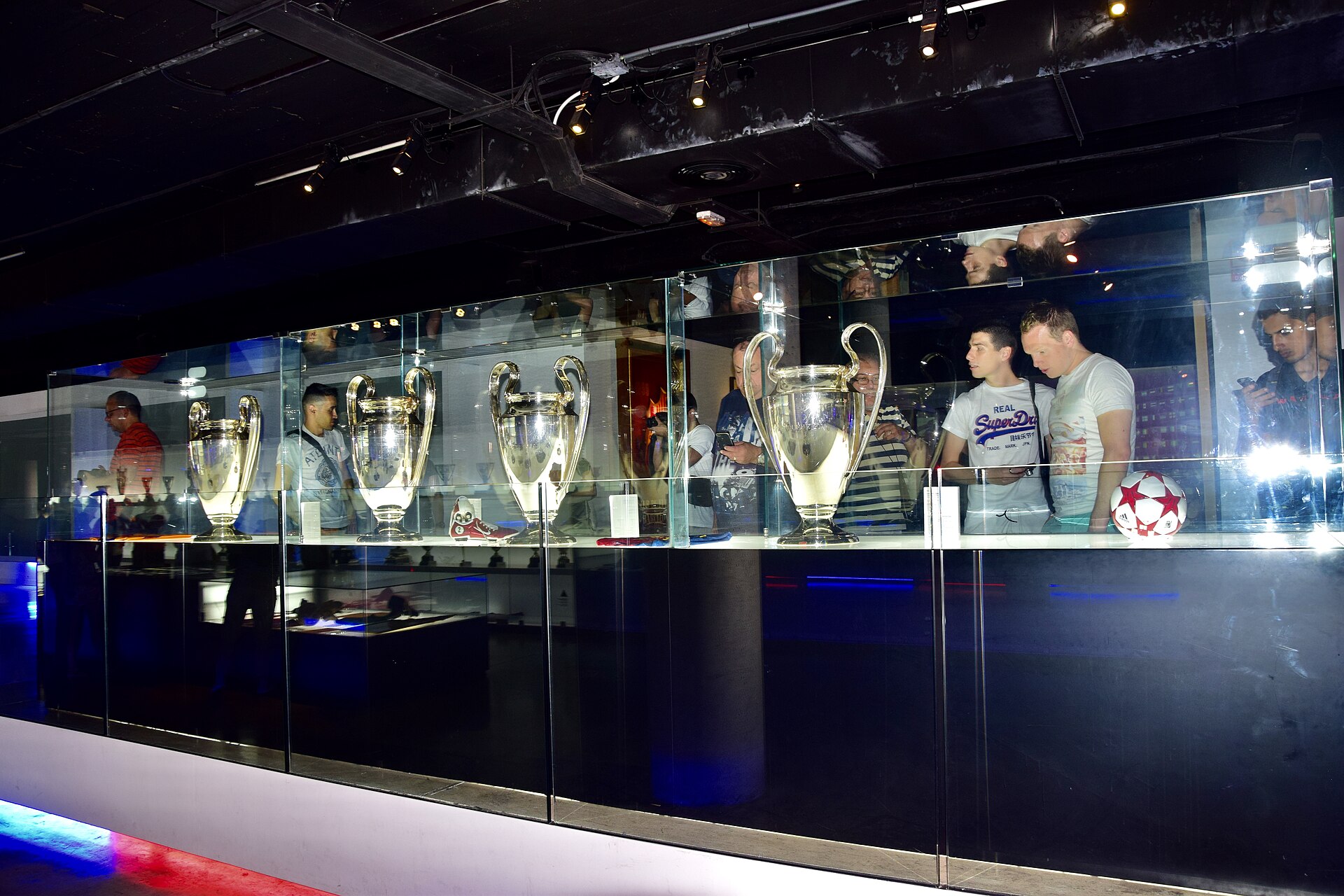
- The trophy gallery. Five European Cups, the European Cup Winners’ Cups, the Copas del Rey and a wall of league titles. The 1982 Cup Winners’ Cup, won at Camp Nou itself, is the one with the local significance.
- The Messi cabinet. The Ballons d’Or, and a boot collection that is more moving than it has any right to be.
- The 360° cinema. Spotify Camp Nou Live puts you in the middle of a matchday atmosphere. It is well done and it is also, plainly, a substitute for the pitch you cannot walk onto.
- The construction viewpoint. Better than it sounds. Seeing the scale of the bowl from above, with the third tier going up around it, gives you a sense of the project that photographs do not.
How it compares with other stadium tours
Context helps, because €28–31 for a museum with no pitch access sounds worse in isolation than it is in comparison.
| Tour | Typical price | Pitch access | What you get |
|---|---|---|---|
| Barça Immersive Tour | €28–31 | No, during works | Excellent museum, 360° room, construction viewpoint |
| Santiago Bernabéu, Madrid | ~€35 | Yes | Rebuilt stadium, pitch, trophy room |
| Anfield, Liverpool | ~£25–30 | Yes | Tunnel, dugout, museum |
| San Siro, Milan | ~€30 | Yes | Two clubs’ museums, stands |
| Wembley, London | ~£27 | Yes | Dressing rooms, tunnel, royal box |
Barcelona’s museum is the best of the group; the access is currently the worst. Whether that trade suits you is the whole question. If you have never been inside a top-level stadium, one of the others will give you the experience you are imagining. If you are here for the club rather than the building, the museum delivers.
Practicalities and tips
When to go
Mornings are quieter than afternoons and weekdays quieter than weekends. Avoid the two hours before a home match entirely, when the whole area fills. Winter afternoons are the quietest slots of the year.
With children
Good, if they care about football and less so if they do not. Under-sixes go free, six to thirteen pay around €21, and the immersive rooms hold attention better than the display cases. There is no play area and the visit is essentially a walk through a museum. See Barcelona with kids for alternatives if the interest is thin.
Accessibility
The museum route is step-free and lift-served, and the club’s assistance is well organised. The construction viewpoint may have restrictions depending on the state of the works — contact the club in advance if this matters. Our accessible Barcelona guide covers the metro end of the journey.
Eating nearby
Les Corts is a residential district with ordinary neighbourhood restaurants and not much else, which is actually a point in its favour: the menú del dia within a few streets of the ground is honest and cheap, and considerably better value than the Barça Café. Our restaurants guide covers the city’s districts, and the cheap eats guide explains how the lunch menu works.
Combining it with something else
Camp Nou sits in the western part of the city, close to Palau Reial and Pedralbes. The Monastery of Pedralbes, the Palau Reial gardens and the CosmoCaixa science museum up the hill are all in the same quadrant and none of them is busy. That makes a decent half-day out of an area most visitors never see — see the CosmoCaixa guide and the hidden gems page.
Where the club fits in the city
One thing the museum explains well and most visitors arrive without: why this football club occupies the place it does in Barcelona. It is not simply that the team was good.
FC Barcelona was founded in 1899 by a Swiss accountant, Joan Gamper, through a newspaper advertisement. It grew alongside a city that was industrialising fast and asserting a Catalan identity that Madrid periodically tried to suppress. Under Primo de Rivera in the 1920s the ground was closed and Gamper forced into exile. Under Franco, the Catalan language was banned in public life, the club was made to Castilianise its name to Club de Fútbol Barcelona, and its crest was altered. The stadium became one of the few places where tens of thousands of people could shout in Catalan without consequence.
That is the substance behind més que un club — more than a club — and it is why an ordinary league fixture here carries a charge that a comparable game elsewhere does not. It also explains the club’s ownership model: Barça is owned by its members, roughly 145,000 of them, who elect the president. That has produced both the club’s identity and, arguably, the financial pressure behind a €1.5 billion stadium.
If any of that interests you, the museum is worth the ticket on its own, and the broader story sits alongside the city’s own in our Barcelona travel guide and the Catalan language guide, which explains why the distinction between Catalan and Spanish matters here in a way it does not in Madrid.
Frequently asked questions
Can you tour Camp Nou in 2026?
Partly. The Barça Immersive Tour runs — museum, 360° cinema, trophy gallery, construction viewpoint and audio guide — but the classic pitch-side stadium tour is suspended during the rebuild. There is no pitch, tunnel or dressing-room access.
How much does the Camp Nou tour cost?
From €28–31 for adults, around €21 for children aged six to thirteen and over-65s, and about €20 for students. Guided visits start at roughly €64. Book on fcbarcelona.com.
How long does the Camp Nou tour take?
About 90 minutes for the guided version. Allow an hour and a half to two hours self-guided if you read the displays.
Can you go on the pitch at Camp Nou?
Not currently. Pitch access, the players’ tunnel and the dressing rooms are all closed while the stadium is rebuilt, and are expected to return when the works finish in late 2026 or 2027.
Which metro goes to Camp Nou?
L3 to Les Corts or Palau Reial, then ten to fifteen minutes on foot. L5 and L9 Sud to Collblanc also work. Aim for the Barça Store, beside which the entrance sits.
Is the Camp Nou tour included in the Barcelona Card?
No. Go City Barcelona includes it; the Barcelona Card offers a discount rather than entry.
When will the new Camp Nou be finished?
Late 2026 or 2027, for a final capacity of 105,000. The club returned to the ground in November 2025 and capacity has been rising in stages as sections reopen — around 62,652 as of March 2026, with the third tier and roof still to come.
Is it better to go to a match than take the tour?
If your dates allow it, yes, comfortably. A league game against a mid-table side is often not much more expensive than the tour and is an entirely different experience. Buy through the club’s official channels only.
Is the Camp Nou tour worth it right now?
For Barça supporters, yes — the museum is outstanding and the half-built stadium is a sight in itself. For casual visitors, it is an expensive museum a long way from the centre, and Barcelona has better ways to spend €30.
Related Barcelona Guides
- FC Barcelona Match Day — how to get tickets and what to expect.
- Barcelona Attractions and Tickets — the alternatives, with prices.
- Barcelona City Passes Compared — which pass covers the tour.
- Barcelona Metro Guide — getting to Les Corts.
- Things to Do in Barcelona — the wider list.
- Barcelona with Kids — whether the family will thank you.
- Barcelona Hidden Gems — the quiet western districts.
Photo Credits
FC Barcelona Museum gallery: Barcelona 277 by Georges Jansoone (JoJan), CC BY 3.0, via Wikimedia Commons.
Trophy cabinet: Camp Nou Experience ( Ank Kumar, INFOSYS Limited ) 18 by Ank Kumar, CC BY-SA 4.0, via Wikimedia Commons.
Remaining photographs from the barcelonatourism.org library.