Step Back in Time: Exploring Barcelona’s Ancient Medieval Core
Narrow alleyways twist beneath stone archways older than most European nations. Roman columns hide behind apartment walls, and candlelit tapas bars spill out onto squares where medieval kings once held court. The Gothic Quarter Barcelona is not a museum frozen in amber — it is a living, breathing neighbourhood where two thousand years of history collide with 21st-century creativity every single day.
Known locally as the Barri Gotic Barcelona, this labyrinthine district sits at the geographic and symbolic centre of the Catalan capital. Whether you have a single afternoon or an entire week, this guide covers everything you need to plan your visit: the history behind the stones, the landmarks you should never skip, the best places to eat and drink, and the practical tips that will keep your wallet safe while you wander.
A Brief History: From Roman Barcino to Medieval Capital
Understanding the Gothic Quarter Barcelona begins with the Romans. Around 15 BC, Emperor Augustus founded the colony of Barcino on a small hilltop between two streams — roughly where Placa Sant Jaume stands today. The settlement was modest, home to perhaps a thousand residents, but it was surrounded by sturdy defensive walls, fragments of which are still visible near the cathedral and along Carrer del Sotstinent Navarro.
After the fall of Rome, Visigoths and then Moors briefly controlled the city before the Frankish counts of Barcelona established their power base here in the ninth century. Over the following four hundred years, the district transformed from a compact Roman town into the glittering capital of an expanding Mediterranean empire. The Catalan-Aragonese confederation controlled trade routes stretching from Valencia to Athens, and the wealth that flowed back funded an explosion of Gothic architecture: churches, palaces, guild halls, and the soaring cathedral that still dominates the skyline of Barcelona old town.
By the 15th century, Barcelona’s political influence had waned, but the medieval street plan survived virtually intact. When the 19th-century Eixample expansion pushed the city’s boundaries outward, the old quarter was largely left alone. What you walk through today is essentially the same network of lanes that a 14th-century merchant would have navigated — overlaid with Renaissance facades, Baroque chapels, and the occasional modernist surprise.
Must-See Landmarks in the Gothic Quarter
There is no shortage of gothic quarter things to do, but a handful of landmarks deserve a place at the top of every itinerary. Below are the sites that capture the district’s character most powerfully.
Barcelona Cathedral (La Seu)
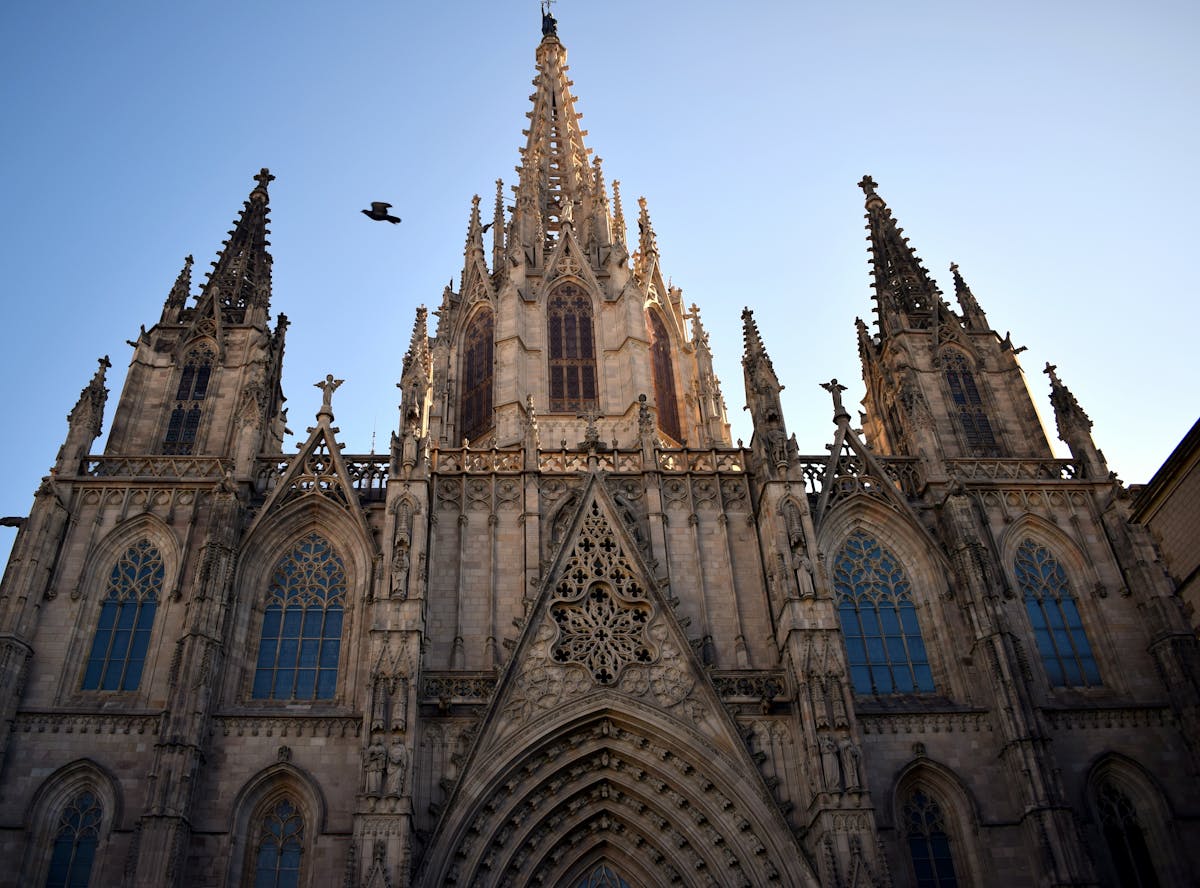
Officially the Cathedral of the Holy Cross and Saint Eulalia, this magnificent church was built between 1298 and 1448 on the site of an earlier Romanesque basilica and, before that, a Visigothic church and a Roman temple. The neo-Gothic facade you see from Placa de la Seu was actually added in 1890, but step inside and the soaring nave is pure Catalan Gothic — elegant, wide, and flooded with coloured light.
The cloister is the cathedral’s hidden gem. A lush garden of magnolias, palm trees, and a moss-edged fountain is patrolled by 13 white geese — one for each year of Saint Eulalia’s life when she was martyred during the Roman persecution. The geese have lived here for centuries and have become one of the most photographed residents of the gothic quarter Barcelona. Admission to the cathedral is free during morning hours (typically before 12:45 pm), though a small donation is requested for afternoon visits and rooftop access.
Placa del Rei
Tucked behind the cathedral, this austere medieval square is arguably the most atmospheric spot in all of Barcelona old town. The Sala del Tinell, a vast 14th-century banqueting hall with soaring stone arches, lines one side. Legend says Ferdinand and Isabella received Columbus here after his first voyage to the Americas in 1493. Overhead rises the five-storey watchtower of King Martin, and below the square lies an extensive archaeological site — more on that shortly.
Placa Reial
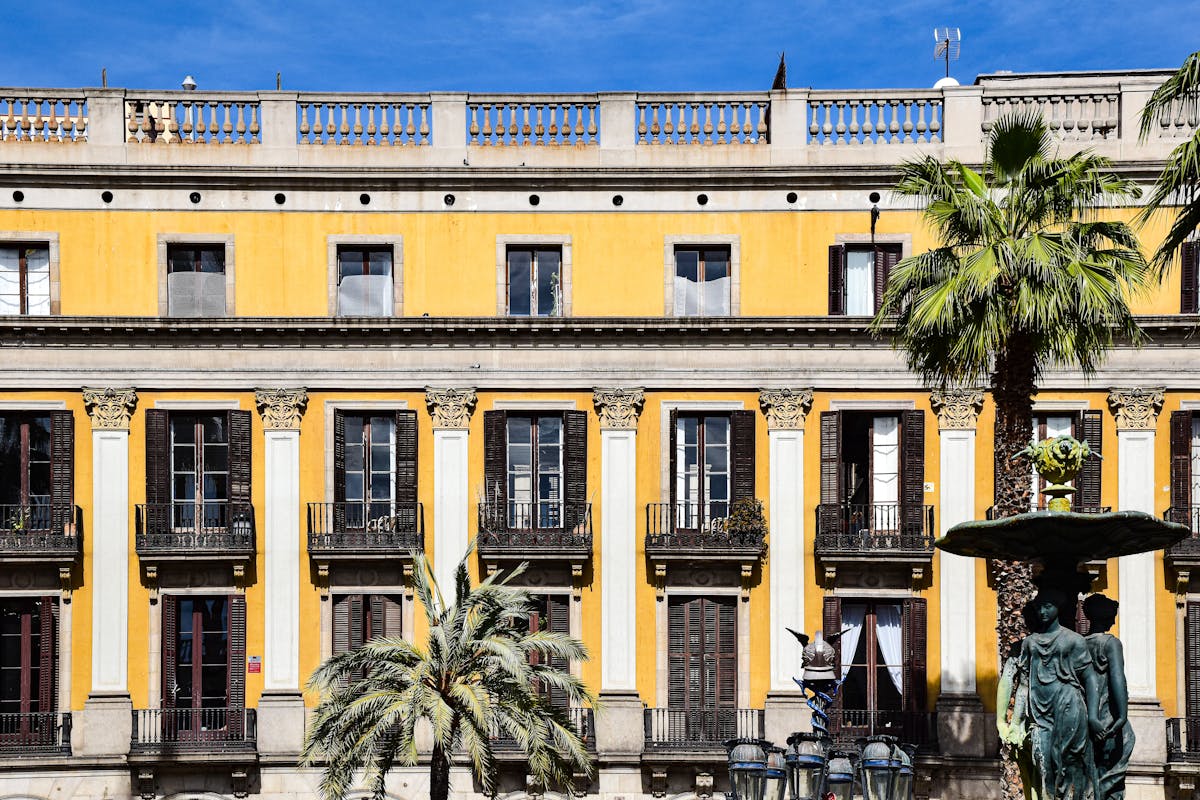
Step through the archway off La Rambla and you emerge into one of the most elegant squares in southern Europe. Placa Reial is framed by ochre-walled neoclassical buildings, shaded by towering palms, and anchored by the Fountain of the Three Graces at its centre. Look closely at the ornate lampposts flanking the fountain — they were designed by a young Antoni Gaudi in 1879, one of his very first public commissions. For more on how Gaudi’s genius shaped the city, explore our guide to Gothic and Gaudi architecture. The square is also a major nightlife hub, ringed with jazz clubs and cocktail bars that keep the energy high well past midnight.
The Bishop’s Bridge (Pont del Bisbe)
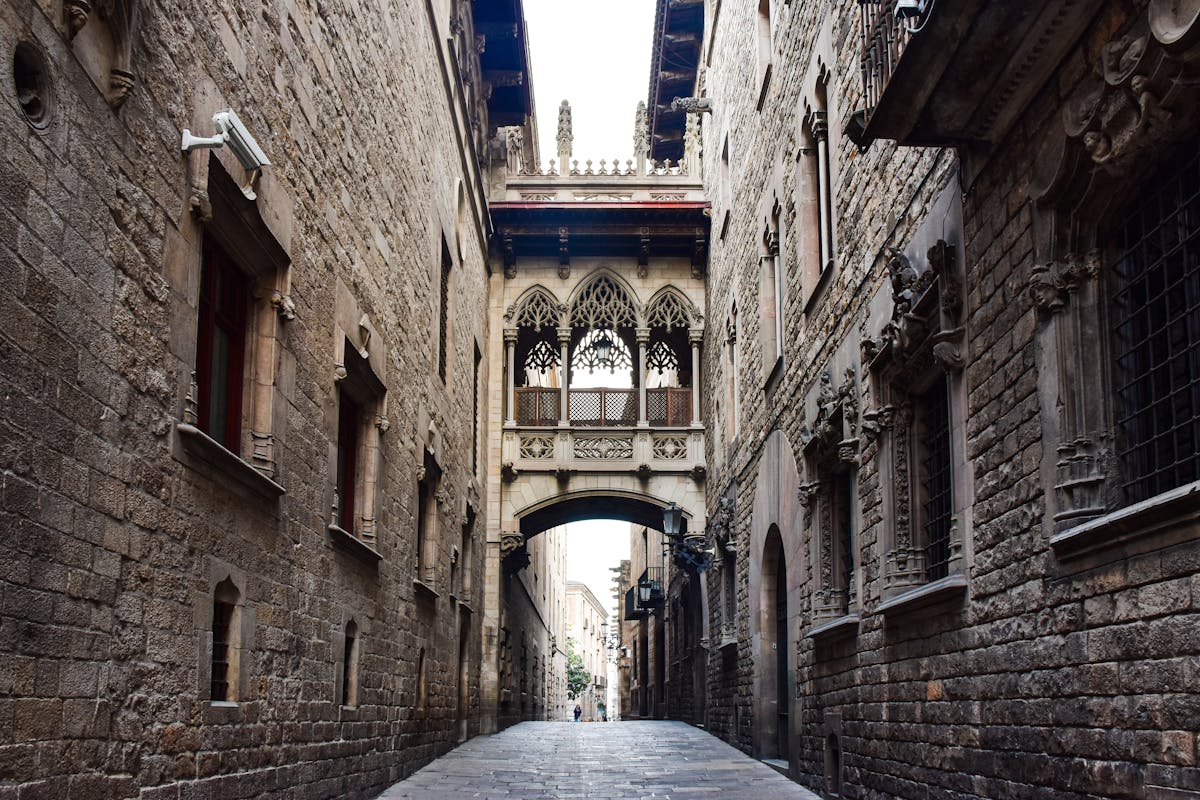
This ornate, neo-Gothic bridge connecting the Palau de la Generalitat to the Casa dels Canonges is one of the most photographed spots in the gothic quarter Barcelona. Built in 1928 by architect Joan Rubio i Bellver, it looks convincingly medieval — which is part of its charm and its controversy. Purists note that it is a 20th-century addition, but visitors adore it regardless. Look for the skull-and-crossbones carving on the underside, which local legend says conceals a curse on anyone who walks beneath it backwards.
Temple of Augustus
Hidden inside a medieval courtyard at Carrer del Paradis 10, four Corinthian columns soar nine metres into the air — the remains of the Temple of Augustus, built in the first century BC when Barcino was founded. It is astonishing to stand at the highest point of the original Roman settlement and gaze up at columns that have witnessed every chapter of the city’s story. Entry is free, and the site is managed by the MUHBA city history museum network.
Santa Maria del Pi
This 14th-century church, fronting the lively Placa del Pi, features one of the largest rose windows in the world — ten metres in diameter. The austere single-nave interior is a masterclass in Catalan Gothic restraint, and the bell tower offers panoramic views across the rooftops of the barri gotic Barcelona. Weekend art markets in the adjacent square make this an especially rewarding stop on Saturday or Sunday mornings.
El Call: The Historic Jewish Quarter
Within the already ancient Gothic Quarter Barcelona lies an even older layer of history. El Call (from the Hebrew qahal, meaning community) was one of the most important Jewish neighbourhoods in medieval Europe. Centred on the tiny Placa Manuel Riba and the winding Carrer del Call, the quarter was home to scholars, physicians, and cartographers whose influence stretched far beyond Catalonia.
The community thrived from the 11th to the late 14th century, when anti-Jewish pogroms in 1391 devastated the neighbourhood. Today, you can visit the Sinagoga Major de Barcelona at Carrer Marlet 5, one of the oldest synagogue structures in Europe, with foundations dating to the third or fourth century. A small museum inside tells the story of Jewish life in medieval Barcelona. Nearby, an inscribed Hebrew stone embedded in a wall on Carrer Marlet is a haunting reminder of the community that once flourished here.
MUHBA: The Underground Roman Ruins
Beneath Placa del Rei, the Museu d’Historia de Barcelona (MUHBA) preserves one of the most extraordinary archaeological sites on the continent. A glass elevator descends below the medieval square to reveal an entire subterranean Roman and Visigothic city — streets, houses, a laundry, a fish-sauce factory, wine-making facilities, and early Christian churches spread across nearly 4,000 square metres.
Walking the raised metal walkways above the excavated ruins is a genuinely moving experience. You are literally standing above the daily life of people who lived in this exact spot two millennia ago. Allow at least 90 minutes, and consider visiting on a weekday morning to avoid crowds. The combined MUHBA ticket also grants access to several other historical sites across the city. For anyone serious about understanding the history beneath the gothic quarter Barcelona, this museum is unmissable.
A Self-Guided Walking Route Through the Gothic Quarter
The beauty of the barri gotic Barcelona is that getting lost is half the point. That said, a loose route helps ensure you hit the highlights without doubling back too often. Here is a suggested walk that takes roughly two to three hours at a comfortable pace, including brief stops at each landmark.
- Start at Metro Jaume I — exit onto Via Laietana and cross into the Gothic Quarter via Carrer de la Princesa or Carrer de Jaume I.
- Placa Sant Jaume — the political heart of Catalonia, flanked by the Generalitat palace and the City Hall.
- Temple of Augustus — duck into Carrer del Paradis to see the Roman columns.
- Barcelona Cathedral — explore the interior and visit the geese in the cloister.
- Pont del Bisbe — snap photos of the iconic bridge, then continue to Placa del Rei.
- MUHBA underground ruins — descend into Roman Barcino.
- El Call — weave south through the Jewish Quarter and visit the ancient synagogue.
- Placa del Pi and Santa Maria del Pi — admire the rose window and browse the art market.
- Placa Reial — end with a coffee or a cold beer beneath the Gaudi lampposts.
If you only have a single day in the city, this route slots perfectly into our one-day Barcelona itinerary. For a broader overview of where the Gothic Quarter fits within the city’s patchwork of districts, see our Barcelona neighbourhoods guide.
Where to Eat and Drink in the Gothic Quarter
Despite its tourist-magnet status, the gothic quarter Barcelona still harbours genuinely excellent places to eat — you just need to know where to look. Our Barcelona food guide covers the wider city, but here are standout picks within the medieval streets.
Els Quatre Gats
Opened in 1897 inside the Casa Marti, a stunning modernista building on Carrer de Montsio, Els Quatre Gats was the bohemian haunt of Picasso, Ramon Casas, and the avant-garde circle that defined turn-of-the-century Barcelona. The restaurant still serves Catalan classics — think braised beef cheeks, bomba croquettes, and crema catalana — in an interior that looks much as it did when Picasso designed the menu cover in 1900. It is not the cheapest meal in the neighbourhood, but the historical atmosphere justifies every cent.
Caelum
This enchanting cafe on Carrer de la Palla specialises in sweets and pastries made by monasteries and convents across Spain. Upstairs is a bright shop selling marzipan, honey, biscuits, and herbal liqueurs. Downstairs, a candlelit medieval cellar — built atop old Jewish baths — serves coffee, hot chocolate, and tasting plates of monastic treats. It is the sort of place that makes the barri gotic Barcelona feel genuinely magical.
More Recommendations
For pintxos and vermouth, try Bar Celta Pulperia on Carrer de la Merce, a no-frills Galician spot beloved by locals. Milk Bar and Bistro on Carrer d’en Gignas serves excellent brunch and creative cocktails in a cosy, low-lit setting. And if you want traditional Catalan tapas in a setting free of tourist crowds, Bodega La Palma on Carrer de la Palma de Sant Just is a neighbourhood gem.
Shopping in the Gothic Quarter
Retail therapy in Barcelona old town ranges from high-street chains to one-of-a-kind artisan workshops. Portal de l’Angel, the wide pedestrian boulevard running north from Placa de Catalunya, is one of the most-trafficked shopping streets in Spain, lined with international brands and department stores.
For something more distinctive, venture deeper into the side streets. Carrer dels Banys Nous and Carrer de la Palla are dotted with antique shops selling everything from Art Deco jewellery to 18th-century maps. Carrer d’Avino and the lanes around Placa del Pi host independent boutiques offering locally designed clothing, leather goods, and ceramics. On Thursdays, a charming honey and cheese market sets up in Placa del Pi — a perfect place to pick up edible souvenirs.
Nightlife in the Gothic Quarter
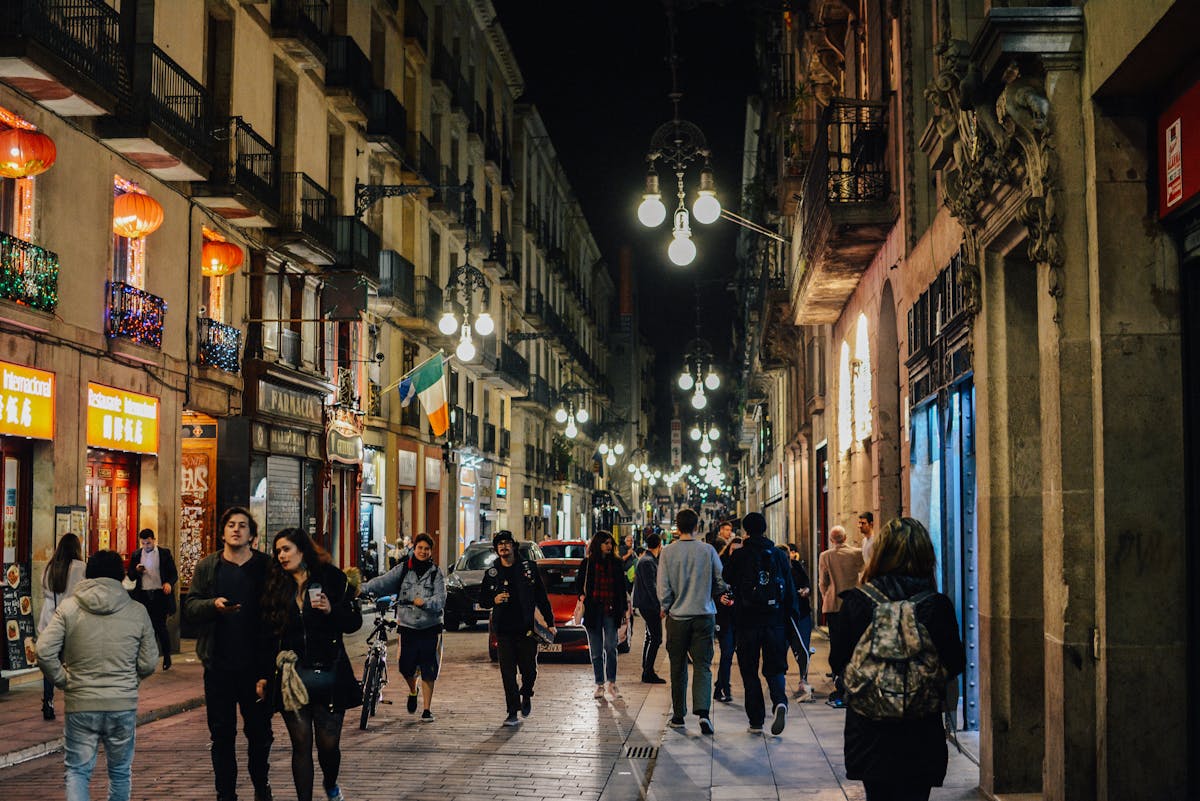
When the sun sets, the gothic quarter Barcelona transforms. Placa Reial becomes the epicentre of the action, with live-music venues like Jamboree Jazz Club hosting nightly sets in a vaulted underground space. Since 1960, Jamboree has welcomed legends of jazz, blues, and soul, and its Monday-night jam sessions remain one of the best free-form musical experiences in the city. Sidecar Factory Club, also on the square, programmes rock, indie, and electronic acts across two floors — arrive before midnight for the live band, then stay for the DJ set that follows.
Beyond the square, the lanes around Carrer d’Escudellers hide some of the most atmospheric cocktail bars in Barcelona old town. L’Ascensor, named for the antique elevator door that serves as its entrance, mixes classic cocktails in a dimly lit space filled with vintage furniture. For wine lovers, La Vinateria del Call pairs natural and biodynamic wines with cheese and charcuterie boards in a candlelit cellar deep within El Call. And if you prefer craft beer, BlackLab Brewhouse on the edge of the quarter near the marina serves house-brewed IPAs and stouts alongside hearty pub food. Our Barcelona nightlife guide covers the best venues across the city, but the Gothic Quarter alone could keep you entertained for a full week of evenings.
Hidden Details and Street Art
Part of the joy of wandering the gothic quarter Barcelona is discovering details that no guidebook mentions. On Carrer dels Comtes, just behind the cathedral apse, look for the carved letterboxes embedded in the medieval stone — remnants of a postal system that predates the modern mail service by centuries. Around the corner on Carrer de la Tapineria, sections of the original Roman aqueduct are visible between more recent brickwork, a casual reminder that you are walking atop an ancient city.
Street art also has a quiet but growing presence in the quarter. While the large-scale murals are more common in El Raval next door, the Gothic Quarter hosts smaller, more subtle pieces — stencilled figures on doorways, paste-up illustrations tucked into alcoves, and ceramic tile interventions on walls along Carrer d’Avignon and Carrer del Bisbe. These works change frequently, which means every visit to the barri gotic Barcelona offers something new to spot. Keep your camera ready and your eyes pointed above street level — some of the best pieces are placed high on walls where most visitors never think to look.
Practical Tips for Visiting the Gothic Quarter Barcelona
A little preparation goes a long way in making your visit smooth and stress-free. Keep these pointers in mind before you set out.
Getting There
The most convenient metro station is Jaume I (Line 4, yellow). It drops you right on the eastern edge of the district. Liceu (Line 3, green) is the best stop if you are approaching from La Rambla. From either station, you are moments away from the heart of the quarter. For broader transport advice and arrival logistics, check our Barcelona travel guide.
Best Time to Visit
The gothic quarter Barcelona is at its most atmospheric in the early morning, between 8 and 10 am, when shopkeepers are hosing down the cobblestones, light slants through the narrow gaps between buildings, and you can photograph the Bishop’s Bridge without a crowd. Late evening — after 9 pm in summer — is another golden window, when the day-trippers have gone and the neighbourhood takes on a moody, cinematic quality.
Seasonally, spring (April and May) and autumn (October and November) offer the most comfortable temperatures and thinner crowds. July and August bring intense heat that the shaded lanes mitigate somewhat, but popular sites like the cathedral can be packed.
Pickpocket Awareness
The Gothic Quarter Barcelona, like most historic tourist districts in major European cities, sees its share of petty theft. This is not a reason to avoid the area — it is a reason to be sensible. Keep your phone in a front pocket or a zipped bag. Wear crossbody bags facing inward. Be especially alert on La Rambla, in Placa Reial, and on crowded metro platforms. Avoid placing bags on the backs of chairs at restaurants. With basic awareness, the vast majority of visitors have no trouble at all.
Accessibility and Terrain
The quarter’s medieval layout means uneven cobblestones, narrow pavements, and occasional steps with no ramp alternative. While some main routes are reasonably flat, the district is not fully wheelchair-accessible. Visitors with mobility concerns may want to plan routes along the wider streets like Carrer de Ferran and Via Laietana, which are smoother underfoot. Comfortable walking shoes with good grip are strongly recommended for everyone — sandals and heels struggle on the polished stone, especially after rain when the cobbles become slick.
Budget Tips
Many of the best experiences in the gothic quarter Barcelona are completely free. The Temple of Augustus, the cathedral during morning hours, wandering El Call, browsing the weekend art markets, and simply absorbing the architecture cost nothing at all. If you plan to visit MUHBA and other paid museums, the Articket BCN pass bundles several major attractions at a significant discount. Lunchtime menu del dia deals — a fixed-price two-course meal with a drink — are offered by many restaurants in the area, typically ranging from ten to fifteen euros and providing excellent value even in this tourist-heavy neighbourhood.
Why the Gothic Quarter Deserves More Than a Quick Walk-Through
It is tempting to treat the barri gotic Barcelona as a box to tick — snap the bridge, peek at the cathedral, and move on to the long list of things to do in Barcelona. Resist that urge. The district reveals its best secrets slowly: the tiny courtyard cafe you stumble on at the end of a dead-end alley, the sound of a flamenco guitar drifting from an upper window, the way the evening light turns the sandstone walls the colour of burnt honey.
Allocate at least half a day, and ideally return for a second visit at a different time of day. Morning and night feel like two entirely different neighbourhoods. The gothic quarter Barcelona rewards patience, curiosity, and a willingness to put the map away and simply follow the next interesting lane.
For visitors planning a wider exploration of the Catalan capital, the official Barcelona tourism board offers up-to-date event calendars and museum passes that include MUHBA and other Gothic Quarter attractions. Combined with the walking route above and the restaurant picks in this guide, you have everything you need to make the most of Barcelona’s extraordinary medieval heart.